By Shane Snider | Senior News Writer, Data Center Knowledge
August 17, 2026
Executive Overview
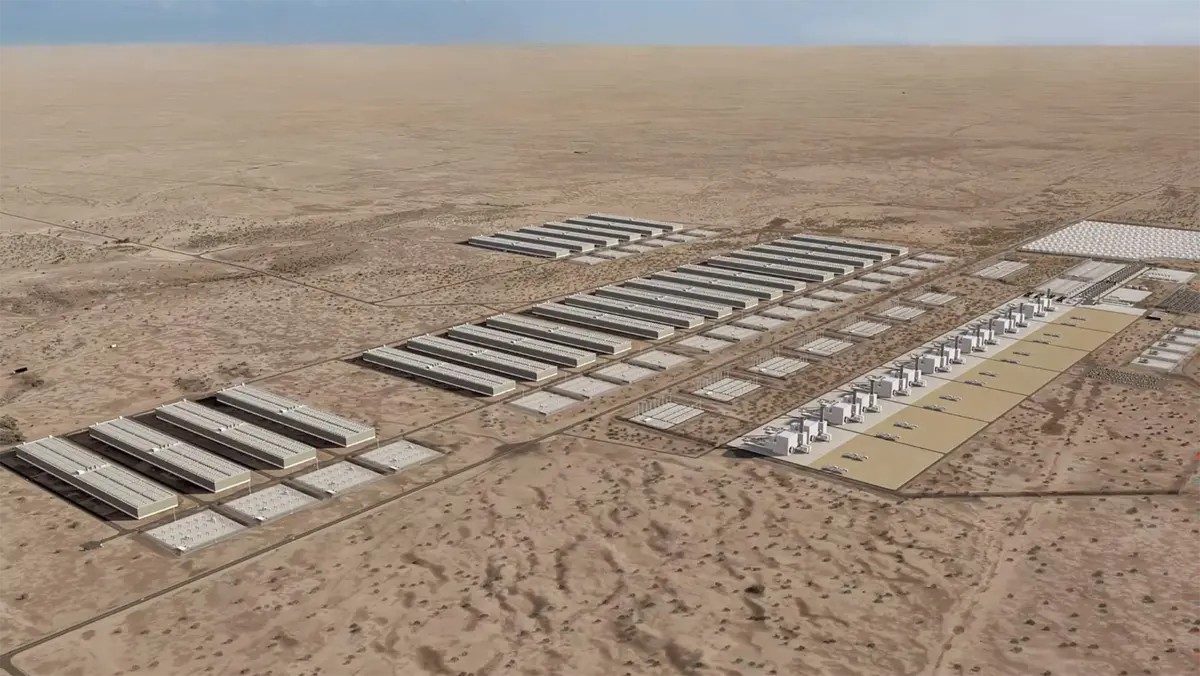
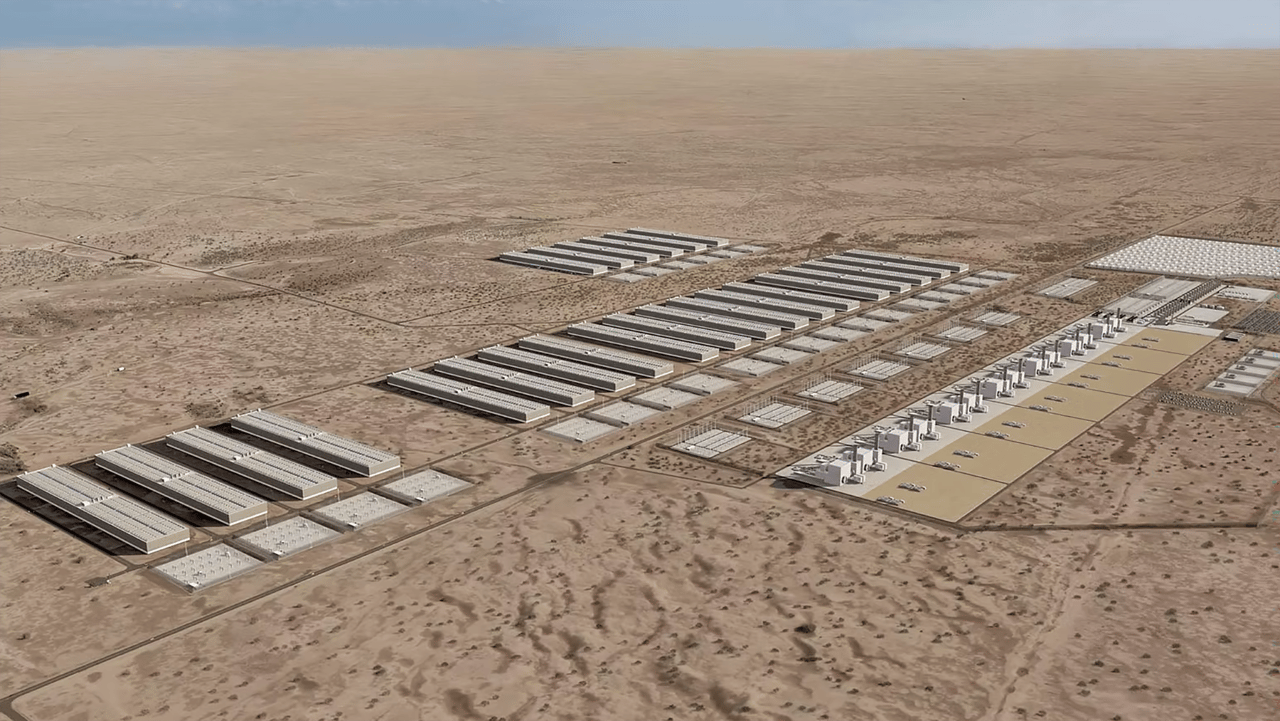
Amazon is advancing plans for a sprawling, 8,000-acre artificial intelligence campus in West Texas known as GW Ranch. To feed the voracious power demands of its future compute clusters, the tech giant is initially bypassing traditional utility networks by building its own dedicated, behind-the-meter power system through a partnership with Pacifico Energy.
However, in a significant shift of posture, Amazon has revealed to Data Center Knowledge that it is actively exploring transitioning the site’s energy infrastructure to a front-of-the-meter grid service. This potential pivot could eventually allow the campus to supply surplus energy back to the public grid, benefiting surrounding customers in the Electric Reliability Council of Texas (ERCOT) market.
The project—slated for Pecos County, roughly 17 miles north of Fort Stockton—has captured national attention due to its unprecedented scale, heavy reliance on natural gas-fired generation, and profound environmental questions. While environmental filings with the Texas Commission on Environmental Quality (TCEQ) estimate massive maximum annual emissions thresholds under full-capacity operations, Amazon maintains that the campus will incorporate solar, battery storage, and advanced water conservation techniques.
As hyperscale cloud providers increasingly collide with grid capacity constraints, the GW Ranch development has become a high-stakes test case for how Big Tech navigates energy independence, regulatory compliance, and eventual integration into regional power markets.
Detailed Chronology: How the GW Ranch Project Unfolded
The path from a quiet greenfield land acquisition to one of the most closely scrutinized infrastructure projects in the American technology sector highlights the breakneck speed at which AI infrastructure is reshaping energy markets.
- Early 2026 / Pre-Filings: Pacifico Energy quietly lays the groundwork for a massive generation and data center hub in Pecos County, Texas, securing early site permissions and drafting environmental permit applications.
- August 7, 2026: Cleanview publishes a foundational report connecting public construction filings and land documents to reveal that retail and cloud computing giant Amazon is the primary force behind the GW Ranch initiative.
- Mid-August 2026: Amazon formally confirms its acquisition of the site, outlining its intent to procure massive amounts of power from Pacifico Energy to fuel an advanced AI data center campus.
- TCEQ Regulatory Filings: Preliminary determinations from the Texas Commission on Environmental Quality reveal detailed technical proposals for a natural gas-fired plant featuring 35 simple-cycle turbines and a nominal output of 5,000 megawatts (MW). Environmental groups and major media outlets immediately latch onto the permit’s worst-case emissions modeling.
- August 17, 2026: In exclusive statements to Data Center Knowledge, Amazon announces it is actively evaluating future front-of-the-meter grid integration, signaling a potential bridge between private off-grid setups and public utility participation.
Supporting Context, Metrics, and Technical Architecture
The sheer magnitude of the GW Ranch project places it in a league of its own, far exceeding the typical footprint of even modern hyperscale data center developments.
Power Generation and Infrastructure Scale
According to Pacifico Energy’s project disclosures and state regulatory filings, the campus infrastructure is slated to include:
- Natural Gas Generation: Up to 7.65 gigawatts (GW) of total gas generation capacity authorized under permits, anchored by a preliminary TCEQ proposal detailing 5,000 MW of nominal output driven by 35 simple-cycle natural gas turbines.
- Renewable Energy & Storage: Integrations planned for up to 1.8 GW of battery energy storage systems (BESS) and up to 750 MW of dedicated solar photovoltaic generation.
- Phased Rollout: Project timelines target initial power generation in the first quarter of 2027, scaling to 1 GW online by 2028, and expanding beyond 5 GW by 2031.
Environmental Footprint and Emissions Modeling
Much of the national media coverage—spurred by reports from outlets like The New York Times, The Verge, and Futurism—has focused on TCEQ documents calculating allowable annual emissions of roughly 33 million tons of carbon dioxide equivalent ($textCO_2texte$).
However, energy analysts note that this figure represents a theoretical maximum operating assumption rather than an actual emissions forecast. The state regulator calculates these maximum annual emissions based on rigorous, continuous normal operations assuming 8,760 operating hours per turbine annually—a scenario that rarely reflects real-world dispatch profiles, particularly when paired with variable solar generation and battery storage.
Water Conservation Strategy
Given its location in arid West Texas, water sourcing is a critical constraint for large-scale industrial projects. Amazon has outlined a phased water management strategy:
- Phase 1: Initial operations require zero water for power-generation cooling, relying on dry-cooling technology.
- Later Phases: Designed to utilize brackish groundwater—an unpotable underground resource that does not compete with municipal community drinking-water supplies.
- Alternative Sources: The company is also investigating the viability of "produced water" (water captured as a byproduct of oil and gas extraction) as an additional non-potable cooling source.
Official Statements and Industry Analysis
The Bottleneck Moves Upstream
The strategy of employing behind-the-meter (BTM) generation—where a facility produces its own electricity directly on-site without drawing from local utility distribution lines—is designed to bypass notoriously lengthy and congested grid interconnection queues. However, industry experts caution that this approach introduces entirely new hurdles.
"Many have talked about doing behind-the-meter generation, but didn’t proceed when they realized how hard it is," noted Joshua Rhodes, a researcher at the University of Texas who studies electricity markets and infrastructure.
Rhodes points out that building a private power plant does not completely isolate a developer from global supply chain shortages. Gas turbines and heavy electrical equipment remain intensely scarce commodities worldwide.
"It will still compete with the electric grid in that turbines are scarce right now," Rhodes explained. "If 5 GW of turbines go to this behind-the-meter data center, they won’t be available for other uses."
Furthermore, Rhodes believes that hyperscale technology companies are unlikely to view utility and power plant operations as a permanent core business model. "I don’t think that hyperscalers want to be in the power business, the margins are too low," he said. "I think this is just a necessity for some right now."
Amazon’s Evolving Strategy: Bridging Private and Public Grids
Amazon’s willingness to explore front-of-the-meter transitions signals a pragmatic evolution in its energy strategy. While building out an isolated private microgrid allows the company to secure power for time-sensitive AI infrastructure deployment, transitioning to a grid-connected framework could eventually help alleviate broader regional capacity pressures.
An Amazon spokesperson confirmed to Data Center Knowledge that the company views its energy investments through a dual lens: ensuring rapid compute deployment while identifying opportunities for energy infrastructure to eventually "add supply to benefit other customers."
However, significant regulatory unknowns remain. ERCOT (the Electric Reliability Council of Texas) operates under strict protocols regarding co-located generation and large-load interconnections. Frameworks such as ERCOT’s "Batch Zero"—a systemwide study process for qualifying large-load requests of 75 MW or greater—are designed to manage reliability assessments and transmission upgrades. Additionally, ERCOT oversees "Withdrawal-Limited Private Use Networks" (WLPUNs), often called bring-your-own-generation models.
How GW Ranch’s massive generation assets will be classified if Amazon transitions from an isolated private system to an active grid participant remains an open question. Rhodes notes that the mechanics of such a transition are still fluid and will depend heavily on how ERCOT’s ongoing large-load review processes mature.
Future Outlook
The GW Ranch project stands at the bleeding edge of the intersection between artificial intelligence infrastructure and energy market design. As hyperscalers race to secure gigawatt-scale power pockets to train next-generation foundational models, traditional utility planning models are being rewritten in real time.
For Amazon, the immediate priority is clear: deliver reliable, scalable power to support billions of dollars in AI hardware without waiting years for conventional transmission lines to be approved and built. Yet, by keeping the door open to future front-of-the-meter integration, Amazon is hedging its bets.
If successful, GW Ranch could serve as a blueprint for how private tech infrastructure can evolve from an isolated energy consumer into an active, stabilizing contributor to regional power grids. Conversely, if regulatory roadblocks, equipment scarcity, or environmental pressures stall execution, the project will underscore the immense limits of corporate energy self-sufficiency. As construction targets approach their 2027 milestones, policymakers, utilities, and industry observers will be watching Pecos County closely.