








Executive Overview
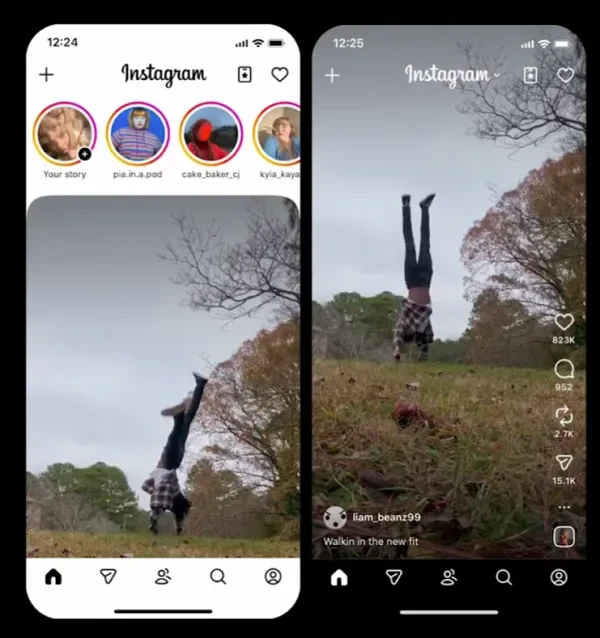
In a strategic maneuver that signals a monumental shift in how billions of people consume digital media, Instagram is once again testing a radical redesign of its core user interface. According to early-stage discoveries shared by prominent app researcher Radu Oncescu, the Meta-owned platform is exploring a new user-choice setting that would allow individuals to launch the app directly into a full-screen Reels feed rather than the traditional, photo-centric home feed.
This development is not entirely unprecedented; Instagram previously experimented with a similar format in select regional markets, such as India, last year. However, the current iteration places a renewed emphasis on user autonomy by framing the transition as a customizable option rather than an aggressive, platform-wide mandate. Under this newly spotted test configuration, users who opt into the Reels-first layout will still see the familiar horizontal carousel of Stories anchored at the top of the screen. Meanwhile, transitioning back to the chronological post feed remains a swipe or a tap away, offering a bridge between legacy usage and short-form video immersion.
The motivations driving this iterative testing are rooted deeply in shifting digital consumption habits. Short-form video has systematically cannibalized traditional media formats across virtually every major social platform, and Instagram is no exception. With internal data indicating that more than half of all user time on the app is now dedicated to Reels consumption—and with nearly all recent engagement growth directly attributable to the video format—Meta is under immense economic pressure to optimize its real estate.
Yet, this pivot is fraught with strategic tension. Instagram was built on the foundation of square photographs, curated static feeds, and intimate grid layouts. Forcing a sudden, unprompted shift to a TikTok-style video discovery engine has historically sparked fierce user backlash, as evidenced by previous redesign controversies in 2022. By introducing the feature as an opt-in toggle, Instagram is threading the needle: it aims to accelerate its algorithmic video dominance while mitigating the risk of alienating its legacy user base. This deep dive will explore the architectural mechanics of the new test, trace the history of Instagram’s video evolution, analyze the hard metrics justifying the pivot, and evaluate what this means for the future of digital content creation.
Detailed Chronology: The Evolution of Instagram’s Feed
To understand the weight of Instagram’s current interface experiment, one must look backward at how the platform has systematically dismantled and rebuilt its own navigation over the past decade.
The Golden Era of the Chronological Grid
For the first several years of its existence, Instagram’s value proposition was brilliantly simple: a chronological grid of square photographs shared by friends, family, and followed creators. There was no algorithmic sorting, no algorithmic video pushes, and certainly no algorithmic encroachment into full-screen immersive entertainment. Users opened the app, scrolled through static images in the exact order they were posted, and closed the app.
The Algorithmic Disruption (2016)
The first major fracture in this traditional experience occurred in 2016, when Instagram abandoned pure chronology in favor of an algorithmic feed. The company argued that users were missing roughly 70% of all posts in their networks due to the sheer volume of content being uploaded. While the algorithmic feed successfully increased time-spent metrics, it sparked the first wave of user resentment, setting a precedent that platform utility would henceforth supersede user control.

The Stories Phenomenon (2016)
Later that same year, Instagram introduced Stories—a direct clone of the ephemeral broadcasting format pioneered by Snapchat. Placed at the very top of the home screen, Stories successfully captured high-intent, casual sharing without fundamentally disrupting the main post feed below it. It became a cultural touchstone and a dominant advertising vehicle, proving that Instagram could successfully expand its ecosystem without breaking its core DNA.
The Rise of TikTok and the Birth of Reels (2020)
By 2020, the existential threat of TikTok could no longer be ignored. Short-form, algorithmically served video was capturing the cultural zeitgeist, particularly among younger demographics. In response, Instagram launched Reels, carving out a dedicated tab in the bottom navigation bar and slowly injecting video modules into the primary feed.
The 2022 Full-Screen Backlash
Instagram’s most aggressive attempt to overhaul its UI occurred in the summer of 2022. Head of Instagram Adam Mosseri announced a widespread test of a full-screen, TikTok-style main feed where both photos and videos were shoehorned into an immersive vertical player. The backlash was swift, severe, and public. High-profile creators and everyday users alike revolted, spearheaded by viral petitions and public critiques from cultural figures like Kylie Jenner and Kim Kardashian. The message to Meta was unambiguous: "Make Instagram Instagram again." Chastened by the uproar, Instagram rolled back the test, vowing to rethink its strategy.
The Current Test: Offering Choice Over Force
Having learned valuable lessons from the 2022 debacle, Instagram’s latest initiative represents a more sophisticated approach. Instead of forcing a universal paradigm shift, the company is testing an architectural choice. By allowing users to consciously select whether their app opens to the traditional post feed or the Reels feed, Meta is attempting to sidestep the wrath of purists while aggressively capturing the high-engagement behavior of video-first consumers.
Supporting Context & Metrics: Why Reels is King
Meta’s relentless prioritization of short-form video is not an arbitrary design whim; it is a clinical response to hard user data and fierce market competition. To grasp why Instagram is willing to risk user alienation by tinkering with its opening screen, one must examine the metrics that dictate modern social media economics.
The 50% Milestone and Engagement Drivers
Public disclosures and industry insights reveal a staggering operational reality: more than 50% of all user time on Instagram is now spent consuming Reels. When users open the application, they are increasingly bypassing static image grids in favor of the infinite, algorithmic scroll of short-form video.
Furthermore, financial and product analytics highlight a critical trend: virtually all of Instagram’s recent net engagement gains are directly attributable to Reels. While static image sharing and text-based updates (via Threads integration) maintain stable, loyal communities, they are not acting as growth engines. Reels, powered by Meta’s state-of-the-art recommendation engine (largely driven by AI advancements), is the primary engine keeping younger demographics engaged and driving ad-impression volume.

The Advertising Imperative
From a monetization perspective, video content represents a vastly superior product for platforms like Meta. Vertical video ad units seamlessly integrate into the Reels flow, commanding higher engagement rates and longer dwell times compared to standard in-feed banner or carousel ads. By making Reels the default entry point for even a subset of its user base, Instagram can dramatically increase its video ad inventory without fundamentally altering the ad formats themselves.
Consumer Behavioural Shifts
The broader digital media landscape has undergone a permanent generational shift. Gen Z and Millennial cohorts increasingly treat social media not merely as a communication tool for keeping up with friends, but as a primary search engine, entertainment hub, and discovery mechanism. For this audience, static photography feels archival, whereas video feels dynamic, educational, and socially relevant.
By testing an option to open directly to Reels, Instagram is acknowledging that its user base is bifurcated. There are legacy users who want to see what their high school acquaintances ate for breakfast, and there are modern consumers who want to be entertained by algorithmically curated creators. Catering to both without fracturing the app entirely is the ultimate UX balancing act.
Official Statements and Industry Insights
Meta executives have been remarkably candid about the platform’s strategic evolution, even as they navigate the treacherous waters of user sentiment.
Adam Mosseri, Head of Instagram, has repeatedly addressed the tension between static media and video in public video updates and Threads posts. During the height of the 2022 backlash, Mosseri famously stated that while the platform needed to evolve because the world was changing rapidly, the team had pushed too far, too fast.
"We need to evolve because the world is changing rapidly, and we have to stay ahead of that," Mosseri explained during a weekly Ask Me Anything session. "But we also need to take a step back… If you’re not failing every once in a while, you’re not thinking big enough or bold enough. But we need to acknowledge that we made a lot of mistakes on that test."
In the wake of those lessons, Meta’s approach to the current Reels-first UI test has been notably more measured. Rather than rolling out a sudden global update that catches users unawares, the platform is utilizing app researchers—such as Radu Oncescu—to surface early developments, testing the waters of public opinion while keeping the implementation flexible.
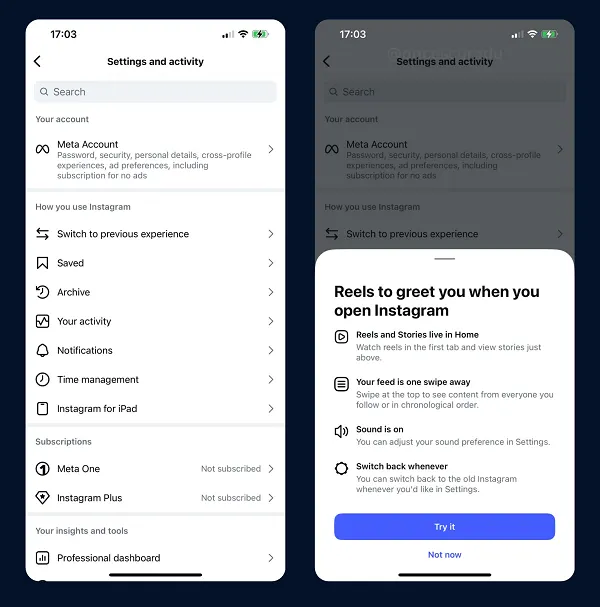
Industry analysts view this measured rollout as a textbook example of "choice architecture." By framing the Reels feed as a user-selected preference rather than an imposed default, Meta effectively diffuses potential outrage. If a user hates the Reels-first view, the in-app explainer clearly demonstrates how to revert to the traditional post feed with a simple swipe or tap.
However, market watchers also note the long-term trajectory of such tests. As tech analyst Sarah Perez points out, "Meta rarely builds an opt-in feature just for it to remain a niche setting forever. If adoption metrics show that users who select the Reels-first experience spend significantly more time in the app and retain better, this optional toggle will inevitably become the standard baseline for new accounts, and eventually, everyone else."
Future Outlook: The Road Ahead for Instagram and Social Media
As Instagram continues to evaluate the success of this interface test in emerging markets and localized testing groups, the implications extend far beyond a single app update. They point toward a future where the traditional chronological or chronological-algorithmic social feed may become an endangered species.
1. The Death of the Static Grid?
If Reels becomes the default opening screen for the majority of Instagram users, the psychological weight of the static grid will shift. Photographers and brands who built their entire visual identities on curated, highly polished square aesthetics may find themselves forced to adapt to a video-first paradigm. While Instagram has repeatedly insisted that photos will always have a home on the platform, the architectural realities of app design dictate that where content lives determines its value. Content buried three taps away from the home screen naturally receives less attention than content that greets the user the millisecond the app opens.
2. The Algorithmic Hegemony
This test further cements the transition of social media from social networking to media consumption. Traditional feeds were designed to connect you with people you know; algorithmic feeds (specifically Reels) are designed to connect you with content you might like, regardless of who made it. As Instagram tilts further toward the latter, its identity as a platform for keeping up with friends will continue to erode, positioning it more directly against TikTok and YouTube Shorts in an all-out war for global attention.
3. Granular Customization as a Safety Valve
Looking forward, Meta’s strategy of offering granular interface choices may become the industry standard for managing disruptive updates. Faced with aging user bases resistant to change on one side and hyper-engaged younger cohorts demanding modern features on the other, tech giants can no longer afford blunt-force updates. Expect to see more platforms adopt customizable home screens, allowing users to tailor their app launch experiences—whether they want a feed dedicated to news, entertainment, short-form video, or close friends.
Conclusion
Instagram’s exploration of an optional, Reels-first opening screen is a masterclass in calculated corporate evolution. It balances the urgent financial and engagement demands of short-form video dominance with the hard-earned wisdom of past UI disasters. Whether this feature ultimately rolls out globally as an opt-in toggle or quietly paves the way for an inevitable, video-dominated future, one thing is certain: the way we open, view, and interact with our favorite social apps is changing forever.