









Executive Overview
In the modern corporate ecosystem, human capital is the ultimate differentiator. Yet, when it comes to technical recruitment, organizations frequently stumble over a fundamental taxonomy error. Too many corporate leaders, human resource professionals, and hiring managers treat data analysts and software engineers as interchangeable technical talent. Job descriptions regularly blur these distinct disciplines, cobbling together overlapping technical requirements—such as proficiency in Python, SQL, and Git—as though either title could seamlessly fill the same seat.
This conflation is more than a minor administrative oversight; it is a structural vulnerability. At its core, a hiring decision should turn on the nature of the work itself. A software engineer is a system-builder, tasked with designing and constructing the reliable digital infrastructure that collects, processes, and stores information. A data analyst, conversely, is an investigator. They examine existing datasets to extract actionable insights, answer critical business questions, and guide executive decision-making.
When organizations misdiagnose their operational needs and hire a software engineer to perform analytical storytelling, or vice versa, the friction is immediate and costly. Dashboards may render flawlessly, yet leadership remains blind to whether a dip in customer conversion stems from genuine market shifts or broken tracking pixels. Alternatively, an analyst hired to build marketing reports suddenly finds themselves drowning in data pipeline maintenance, debugging multithreaded backend errors, or managing database migrations without corrupting state data.
To build resilient, high-performing technical teams, companies must move past surface-level tool overlap. By grounding recruitment strategies in rigorous role definitions, aligning training with daily habits of mind, and restructuring the technical interview process, enterprises can avoid expensive hiring mismatches before they destabilize operations.
Detailed Chronology: The Evolution of Technical Role Blurred Lines
The confusion surrounding data analysts and software engineers did not emerge overnight; it is the product of an evolving technological landscape that steadily democratized coding and database management.
The Era of Separation (Pre-2010s)
In the early days of enterprise computing, technical roles were rigidly siloed. Software developers wrote code, configured servers, and built monolithic applications within IT departments. Meanwhile, business intelligence (BI) professionals—often operating under titles like report writers or database administrators—worked out of legacy relational database management systems (RDBMS), pulling static numbers into spreadsheets for quarterly reviews. The two domains rarely intersected, as the compute power required to store raw data was expensive, and software engineering was viewed purely as a construction discipline.
The Open-Source Convergence and Tool Overlap (2010–2020)
The proliferation of cloud computing, open-source programming languages, and big data frameworks eroded these traditional boundaries. R and Python emerged as dominant languages across both disciplines. An analyst could write a Python script to run statistical regressions, while a software engineer might use Python to spin up a microservice.
Suddenly, Git workflows, command-line interfaces, and SQL queries were no longer the exclusive domain of backend engineers. Data analysts learned to write production-grade code, and software engineers began handling lightweight data transformations. Job boards flooded with hybrid requests for "full-stack data people," creating a false equivalence in the minds of recruiters who saw shared tools as interchangeable skill sets.
The Modern Reckoning (2020–Present)
Today, organizations face a reckoning. As data volumes scale exponentially—driven by artificial intelligence, automated telemetry, and ubiquitous digital tracking—the stakes of technical specialization have never been higher. Enterprise outages, corrupted pipelines, and flawed analytical insights regularly cost millions of dollars in unrealized revenue and reputational damage.
The industry is slowly realizing that while tools are shared, the fundamental "habits of mind" required for engineering versus analysis are diametrically opposed. Recognizing these as genuinely distinct disciplines is no longer an academic exercise; it is an urgent operational necessity.
Supporting Context & Metrics: Analyzing the Labor Market and System Vulnerabilities
To fully appreciate the divergence between these two career paths, one must examine the macro-level labor market trends and empirical engineering challenges that define them.
Macro Labor Dynamics: Divergent Growth Trajectories
The U.S. Bureau of Labor Statistics (BLS) maintains a clear structural distinction between software developers and data scientists, tracking their respective career outlooks with distinct metrics. According to BLS reports analyzing information technology and employment projections, the market demands rapid expansion in both sectors, albeit for entirely different organizational functions.
The BLS projects a staggering 33.5% employment growth for data scientists from 2024 to 2034—nearly triple the growth rate projected for software developers. Conversely, employment for software developers is projected to grow by a robust 15.8% over the same decade.
While data scientists represent a specialized tier distinct from traditional data analysts, this explosive growth underscores the corporate hunger for advanced analytical problem-solving. Organizations are drowning in information and starving for insight. Yet, analysts must remember that data science and analytics are distinct; data science frequently incorporates advanced machine learning model development and algorithmic optimization, whereas analytics focuses primarily on exploratory data analysis, business intelligence, and statistical inference.
Engineering Rigor and Real-World Failure States
While analysts gaze inward at datasets to find patterns, software engineers stare upstream, designing the architectures that prevent catastrophic system failures. Engineering rigor is measured by how software performs under duress, real-world traffic spikes, and unexpected hardware degradation.
A stark illustration of this engineering reality is documented in Cloudflare’s comprehensive incident report regarding a major storage failure. On June 12, 2025, Cloudflare experienced an infrastructure disruption that caused 90.22% of Workers KV requests to fail. Workers KV is Cloudflare’s globally distributed key-value data storage service. During the incident, requests requiring real-time interaction with the underlying storage layer failed outright, while already-cached data remained accessible at the edge.
This is the quintessential domain of the software engineer: designing fallback protocols, caching strategies, and robust distributed systems that gracefully degrade rather than catastrophically collapse when a storage dependency drops offline. An analyst looking at this scenario would query the access logs post-incident to measure the business impact; an engineer is the one writing the failover logic to ensure the system survives the next storage blackout.
Official Statements and Industry Frameworks
Leading technical and academic authorities emphasize that problem framing and professional governance must dictate hiring criteria, preventing organizations from falling into the trap of tool-based generalized hiring.
The INFORMS Analytics Framework
The Institute for Operations Research and the Management Sciences (INFORMS) places business problem framing first in its analytics framework. INFORMS stresses that rigorous data analysis begins long before a single query is written; it starts with properly structuring the business question.
According to professional development guidelines published by INFORMS, analysts must exhibit mastery in how data is interpreted, contextualized, and translated into operational recommendations. Raw statistical capability, while essential, is inert without the domain intuition required to bridge quantitative findings and executive decision-making.
The SWEBOK Guide and Systematic Engineering
Conversely, the IEEE Computer Society—through its definitive Guide to the Software Engineering Body of Knowledge (SWEBOK Guide)—establishes that software engineering is anchored in systematic design, validation, testing, and maintenance.
The SWEBOK framework treats engineering discipline as central to producing software artifacts that maintain structural integrity throughout their operational lifecycle. Software engineers must navigate software requirements, construction models, quality assurance paradigms, and operational deployment strategies. This constructive orientation is fundamentally different from the analyst’s investigative stance.
Future Outlook: Building Effective, Specialized Technical Teams
As artificial intelligence begins to automate routine coding syntax and boilerplate data queries, the human value in technical teams will shift decisively toward architectural design and deep analytical reasoning. This technological shift makes clarity in hiring more critical than ever.
1. Shift from Tool-Centric to Problem-Centric Job Descriptions
Organizations must purge generic job descriptions that demand unicorns capable of building distributed cloud microservices on Monday and delivering executive-ready churn models on Tuesday. Job postings should be anchored around the primary operational problem:
- If the primary bottleneck is a lack of visibility into user drop-off funnels, fluctuating conversion rates, or unmeasured marketing ROI, the organization needs an analyst.
- If the primary bottleneck is unstable data pipelines, slow query execution speeds, insecure API endpoints, or brittle backend microservices, the organization needs a software engineer.
2. Redesigning the Technical Interview Process
Interview loops must directly test the cognitive habits required by each role:
- For Data Analyst Candidates: Avoid merely testing SQL syntax or Python libraries. Instead, present an ambiguous business scenario coupled with a dataset containing known missing values, anomalies, or collection biases. Ask the candidate to explain how those missing records could skew business recommendations, and evaluate their ability to communicate nuance to non-technical stakeholders.
- For Software Engineer Candidates: Move away from abstract algorithmic puzzles that bear no resemblance to daily work. Instead, probe system design resilience. Ask how a microservice or data ingestion pipeline should behave when its primary storage dependency becomes completely unavailable. Establish ownership over recovery pathways and incident response protocols before production failures force those decisions upon the team.
3. Fostering Symbiotic Collaboration
Recognizing that data analysts and software engineers are distinct does not mean isolating them. In high-performing engineering cultures, these roles operate in a symbiotic feedback loop.
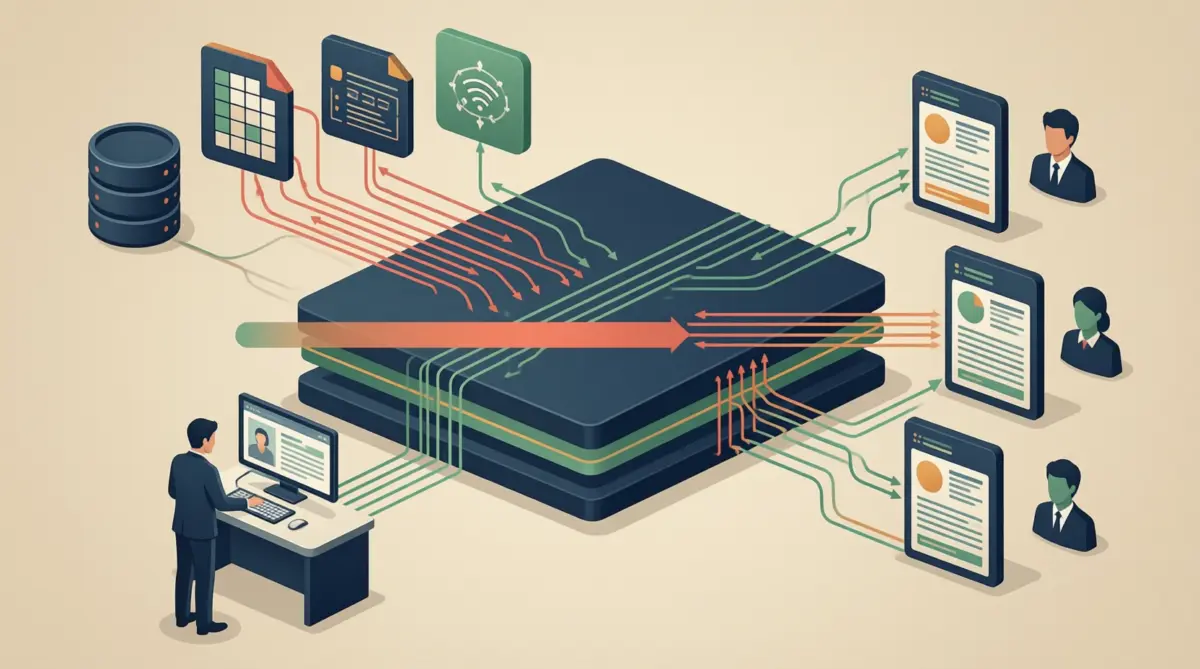
Software engineers build the reliable, scalable infrastructure that collects clean data and stores it efficiently. Data analysts consume that clean data, extract actionable business intelligence, and frequently uncover system anomalies that alert engineers to hidden bugs or tracking failures upstream.
By respecting the unique boundaries of both disciplines, organizations can build robust technical teams where every professional is empowered to excel at what they were trained to do. Clear role definitions protect morale, maximize productivity, and ensure that when critical business decisions are made, they are built on a foundation of sound code and uncompromised evidence.