







Executive Overview
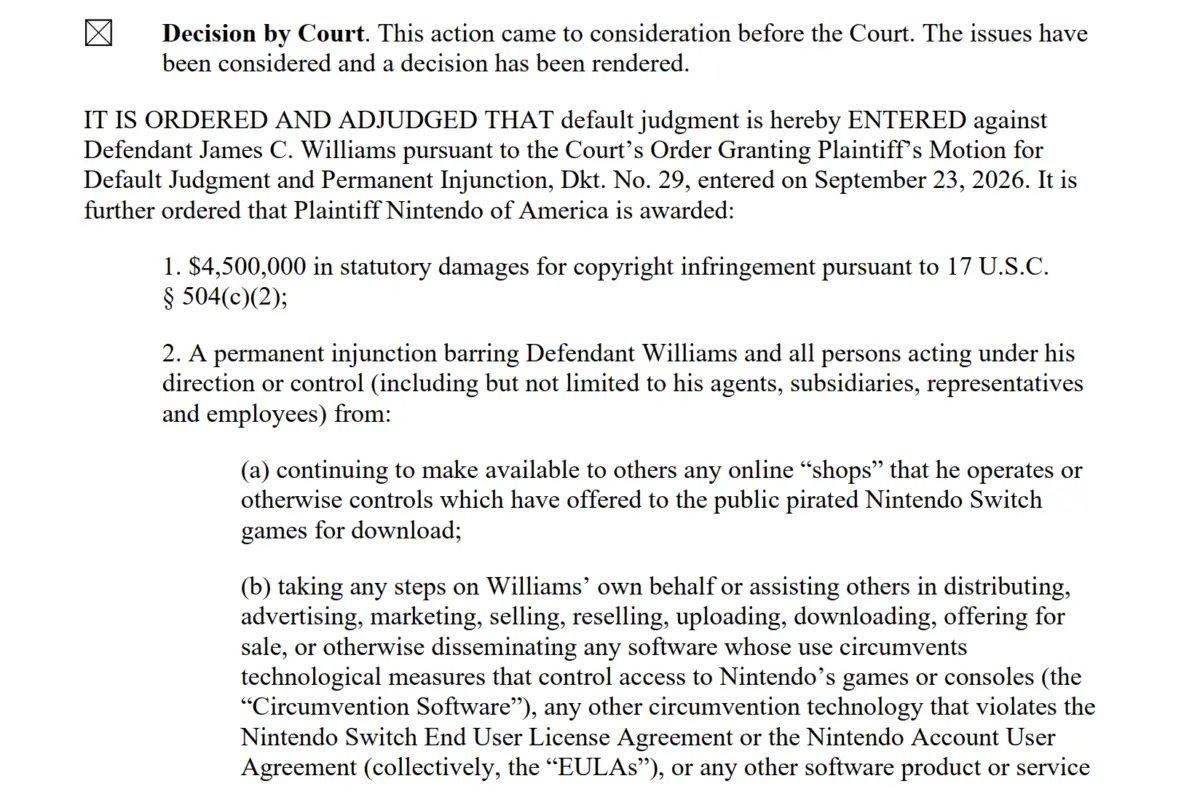
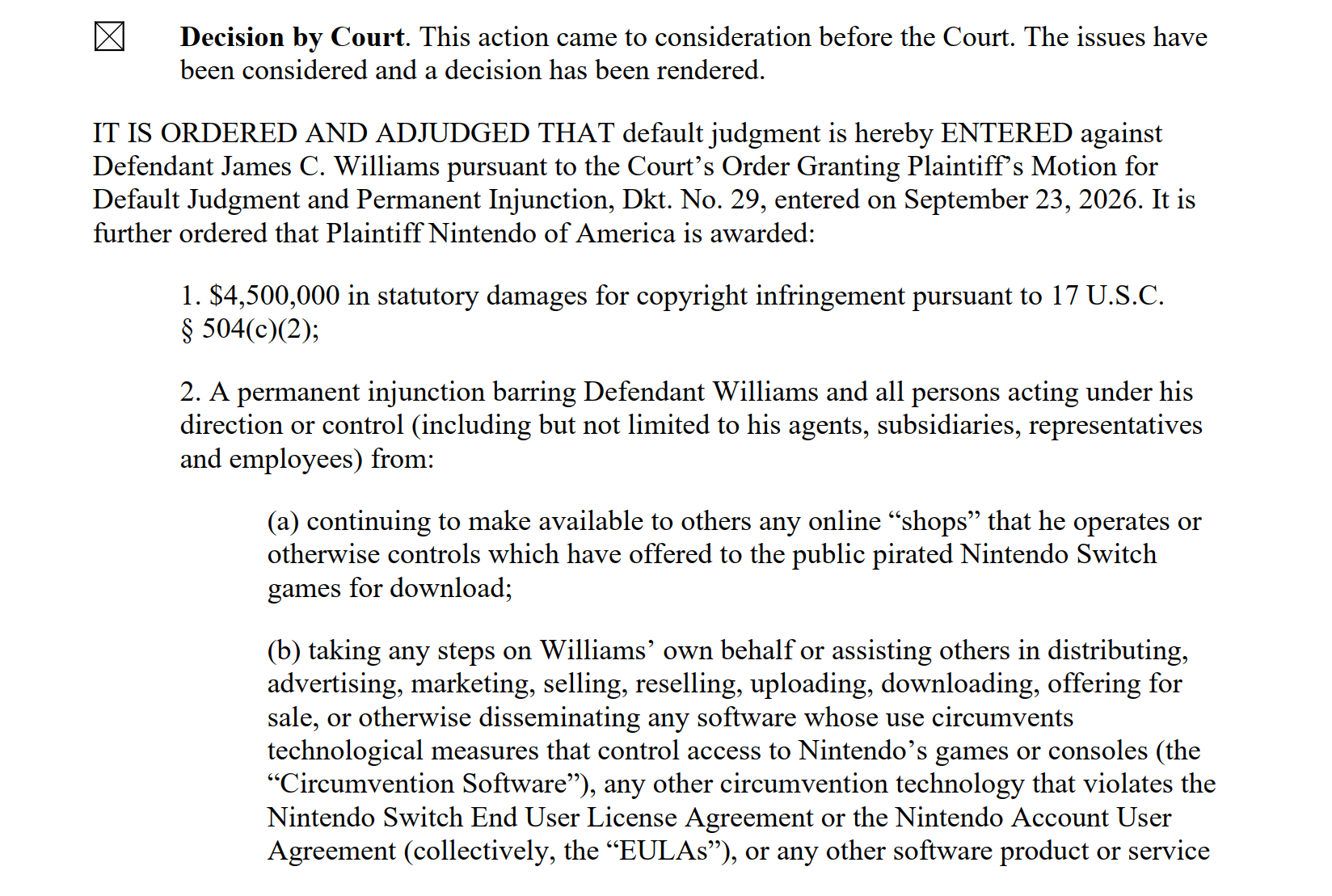
In a sweeping legal victory that underscores its zero-tolerance policy toward software piracy, Nintendo has secured a landmark $4.5 million default judgment against James C. Williams, an Arizona resident better known in online circles as the prominent Reddit moderator "Archbox." Handed down by U.S. District Judge Lauren King in a Washington federal court, the ruling concludes a high-profile copyright infringement lawsuit that targeted the heart of the Nintendo Switch piracy ecosystem.
The court’s final order imposes not only a staggering multi-million-dollar statutory damages award but also an expansive permanent injunction. This injunction legally bars Williams from ever again distributing pirated games, circulating circumvention devices, or incentivizing others to engage in intellectual property theft. The ruling marks another decisive chapter in Nintendo’s aggressive global campaign to protect its proprietary hardware and software ecosystems from unauthorized modification and distribution.
However, despite the sweeping nature of the judgment, the path forward remains murky. Because Williams largely stonewalled the proceedings—failing to file a formal answer to Nintendo’s initial allegations—the legal claims were never fiercely contested in a traditional courtroom battle. Furthermore, legal analysts note that collecting the $4.5 million from an unresponsive defendant will prove exceptionally challenging. Nevertheless, the judgment serves as a powerful deterrent, signaling to the broader emulation and piracy communities that Nintendo’s legal apparatus is fully prepared to seek maximum statutory penalties against those who commercialize or systematically promote copyright infringement.
Detailed Chronology of the Legal Battle
The Escalation: From Cease-and-Desist to Federal Court
Nintendo’s offensive against James Williams was not an isolated incident, but rather the culmination of a broader, methodical sweep targeting prominent figures within the Nintendo Switch emulation and modification scene. For years, Nintendo has utilized a traditional multi-tiered enforcement strategy: issuing cease-and-desist letters and filing platform-specific takedown notices as a first line of defense. When these measures fail to curb persistent, large-scale operations, the gaming giant does not hesitate to escalate matters to the federal court system.
In March 2024, Nintendo served Williams with a formal cease-and-desist letter, demanding the immediate cessation of his illicit activities. While the warning succeeded in shutting down several infrastructure components tied to his operations, Nintendo concluded that further legal accountability was necessary to address the scale of the infringement.
By June 2024, Nintendo escalated the matter by filing a formal civil lawsuit in the U.S. District Court for the Western District of Washington. The complaint accused Williams of orchestrating and operating a network of clandestine "pirate shops"—repositories that granted the public open access to massive libraries of unauthorized, pirated Nintendo Switch titles.
The Mechanism of Infringement: Inside the "SwitchPirates" Ecosystem
According to court filings, Williams leveraged his influential position as a leading moderator of the r/SwitchPirates subreddit to drive traffic to his illicit network. The operation went far beyond simple link-sharing; it relied on a coordinated ecosystem designed to strip away Nintendo’s digital rights management (DRM) protections.
Investigators detailed how Williams actively assisted community members in installing specialized circumvention software. To fuel the inventory of his pirate shops, Williams routinely solicited financial contributions via eShop gift cards from community members. These funds were pooled to purchase newly released Nintendo Switch titles, which were subsequently decrypted, ripped, and uploaded to his servers for global, unauthorized distribution.
The Default Judgment and Judicial Reasoning
Despite retaining legal counsel early in the proceedings for the narrow purpose of objecting to a third-party Google subpoena, Williams fundamentally abandoned his defense. He completely failed to file an answer to Nintendo’s comprehensive complaint within the mandated legal timeframes.
Recognizing the lack of a formal defense, Nintendo formally requested a default judgment in October 2024, petitioning the court for the statutory maximum of $150,000 per infringed work across 30 specific titles, alongside a permanent injunction.
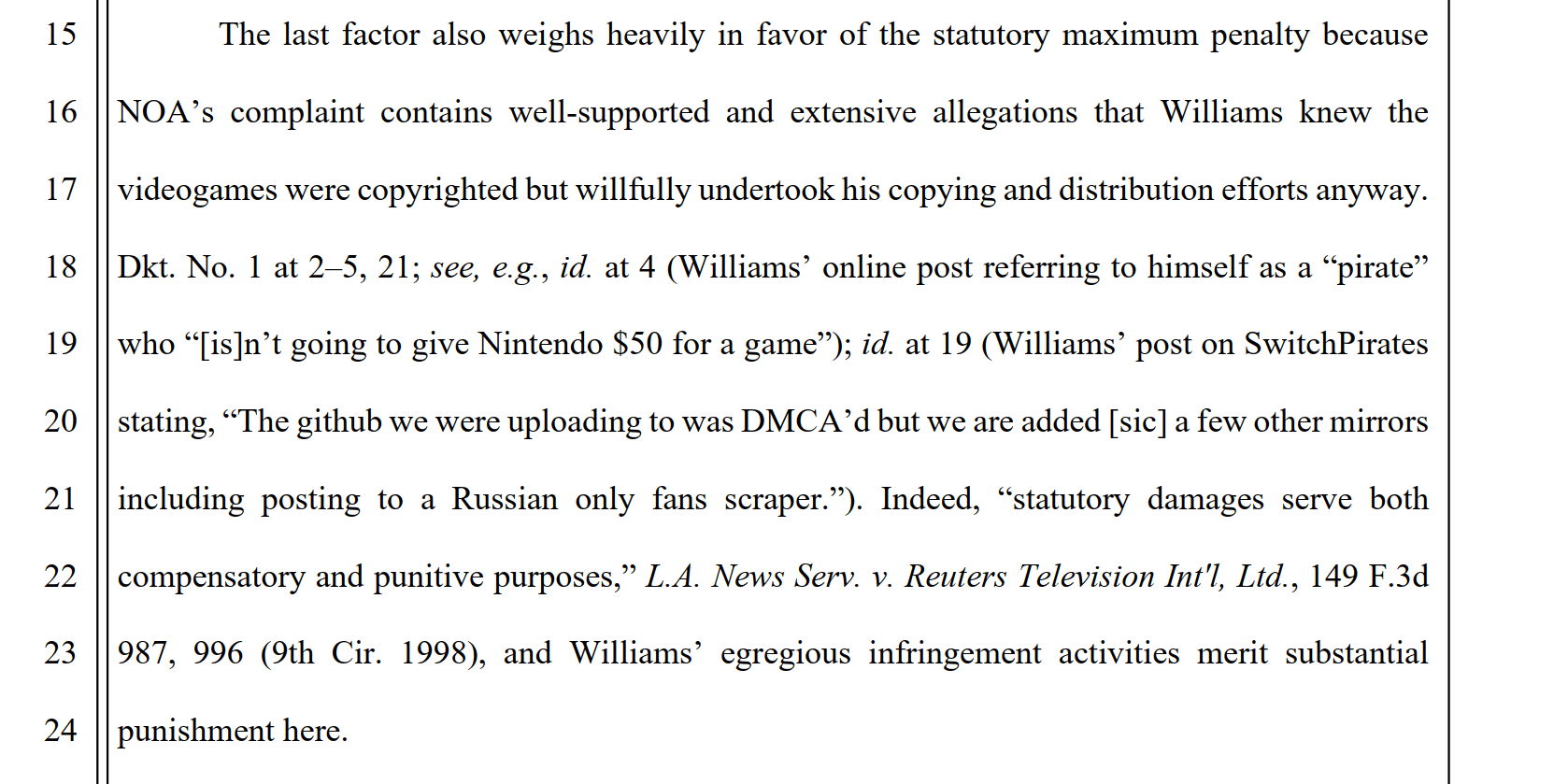
U.S. District Judge Lauren King granted Nintendo’s motion in its entirety. Central to the judge’s decision was the glaring evidence of willful infringement unearthed by Nintendo’s legal team. Citing numerous public statements made by Williams on Reddit—including a widely publicized comment in which he brazenly declared himself a "pirate" who "isn’t going to give Nintendo $50 for a game"—the court had little trouble establishing intent. Judge King underscored that Williams was fully aware that his actions violated federal copyright law, describing his behavior as "egregious infringement activities [that] merit substantial punishment here."
Supporting Context & Metrics: The Cost of Piracy
The Mathematics of the $4.5 Million Award
Under United States copyright law, copyright holders can elect to recover statutory damages rather than proving actual damages and lost profits. Statutory damages range from a standard baseline up to $30,000 per work infringed, but can be escalated up to $150,000 per work if the infringement is proven to be "willful."
Nintendo carefully selected 30 flagship titles for its statutory damage calculation, including industry-defining blockbusters such as:
- The Legend of Zelda: Tears of the Kingdom
- Mario Kart 8 Deluxe
- Super Smash Bros. Ultimate
By requesting the statutory maximum of $150,000 per title, Nintendo sought—and was granted—a cumulative total of $4.5 million. Judge King validated this figure by pointing out the economic reality of the marketplace. Given that a standard first-party Nintendo Switch title retails for approximately $50, the multiplication of lost sales across thousands of unauthorized downloads made the maximum statutory request "not an unrealistic estimate" of actual economic harm.
Furthermore, legal observers noted a strategic concession by Nintendo’s legal team: as a "gesture of reasonableness," Nintendo opted not to pursue additional Digital Millennium Copyright Act (DMCA) anti-circumvention damages or demand legal attorneys’ fees. Judge King explicitly noted this restraint, observing that Nintendo’s measured approach bolstered the justification for granting the maximum copyright infringement statutory damages.
Parallels in the Broader Enforcement Campaign
The Williams judgment did not occur in a vacuum. On the exact same day it initiated legal action against "Archbox," Nintendo filed a parallel lawsuit against another prominent entity within the modding and piracy community: Modded Hardware.
While the Williams case culminated in a default judgment due to the defendant’s refusal to participate, the Modded Hardware litigation took a different procedural route. That case concluded late last year when the operator reached a formal settlement with Nintendo, agreeing to a $2 million consent judgment. Together, these simultaneous legal actions illustrate Nintendo’s multi-pronged strategy to dismantle both the infrastructure providers and the community evangelists who facilitate hardware modding and software piracy.
Official Statements and Legal Implications
Nintendo’s legal strategy consistently emphasizes two core objectives: halting ongoing intellectual property violations immediately and broadcasting an unmistakable deterrent message to the broader gaming community.
Throughout the litigation, Nintendo representatives maintained that the primary goal of the lawsuit was to "put a stop to" Williams’ commercialized piracy network and disincentivize others from stepping into the vacuum left by his departure. By targeting high-profile community leaders who wield significant influence over subcultures dedicated to circumvention, Nintendo aims to raise the perceived risk profile of operating pirate repositories and distribution hubs.
From a procedural standpoint, the judgment offers a classic textbook example of the legal risks associated with ignoring federal litigation. Because Williams chose not to answer the complaint, the court legally accepted all of Nintendo’s factual allegations as absolute truth. Consequently, none of Nintendo’s specific copyright claims or technical arguments were legally contested or put to the test in an adversarial trial. While this streamlined Nintendo’s path to victory, it also means the case has established a swift, uncontested precedent for how federal courts handle default scenarios involving digital game piracy rings.
Future Outlook and Enforcement Realities
The Practical Limitations of the Injunction
The permanent injunction issued by Judge King is breathtakingly broad in scope. Beyond prohibiting the distribution of the 30 specific titles cited in the complaint, it legally bars Williams from distributing any unauthorized Nintendo games, as well as any software, firmware, or hardware tools designed to circumvent Nintendo’s technological protection measures.
Moreover, the injunction targets Williams’ digital footprint comprehensively, ordering him to deactivate all accounts used to promote or facilitate piracy. This includes specific mandates to shut down:
- The r/SwitchPirates moderator account (and associated Reddit presence)
- Infrastructure tied to his designated "pirate shops"
- Accounts across Instagram, X (formerly Twitter), TikTok, Discord, and Telegram
In a practical sense, however, the enforcement of these digital bans has largely been rendered moot by prior events. Long before the ink dried on Judge King’s order, the infrastructural components of Williams’ operation had already dissolved. The notorious archbox Reddit account was self-deleted, and the pirate shops named in the lawsuit had shuttered their virtual doors following Nintendo’s initial cease-and-desist letter in March 2024.
The Question of Recovery
The ultimate million-dollar question—quite literally—is whether Nintendo will ever see a fraction of the $4.5 million awarded by the court.
Legal experts remain skeptical regarding Nintendo’s ability to recoup the damages. Default judgments against unresponsive defendants frequently result in paper victories. Without cooperative asset disclosures or voluntary compliance from Williams, tracking down liquid assets or enforcing collection across jurisdictional lines can prove exceptionally difficult and costly for plaintiffs.
Nevertheless, for Nintendo, the monetary recovery may ultimately be secondary to the psychological and operational impact of the ruling. By systematically targeting community ringleaders, securing multi-million-dollar deterrent judgments, and effectively neutralizing key distribution hubs, Nintendo continues to reinforce its reputation as one of the most fiercely protective intellectual property holders in the modern entertainment industry.