




By Global Technology & Society Desk
Published: October 2026
Executive Overview
Over the past four years, public sentiment surrounding digital connectivity has undergone a profound and measurable transformation. What was once heralded as a utopian engine for global democracy, free expression, and borderless communication is increasingly viewed by populations worldwide as a structural threat to civic health.
According to a sweeping new multi-nation study conducted by the Pew Research Center spanning 37 countries, public perception of social media’s impact on society has experienced a significant, universal decline since the research organization last measured these metrics in 2022. Across virtually every demographic, culture, and economic bracket, a growing consensus suggests that the very platforms designed to bring humanity closer together are instead actively fracturing it.
Most notably, the research highlights a stark generational divide. While older adults harbor deep-seated reservations about the algorithmic architectures governing modern applications—frequently championing stringent regulatory frameworks, age restrictions, and outright bans for minors—younger demographics continue to view these ecosystems through a more favorable lens. Yet, even among younger cohorts, the erosion of trust is palpable.
As policymakers from Canberra to Washington grapple with rising concerns over mental health, political polarization, and the integrity of democratic elections, Pew’s data provides a timely empirical foundation. It suggests that the political appetite for sweeping legislative intervention in Big Tech has never been higher, setting the stage for what may become a defining regulatory era of the 21st century.
Detailed Chronology: The Trajectory of Digital Optimism to Skepticism
To understand the current climate of widespread disillusionment, one must trace the evolution of public attitudes over the past decade.
The Early Promise of Networked Communication (2010s)
For much of the 2010s, social media platforms operated under a broad societal assumption of net-positive utility. Celebrated as instruments of liberation during historic sociopolitical movements—such as the Arab Spring—platforms like Facebook, Twitter (now X), and Instagram were widely lauded for bypassing traditional, centralized media gatekeepers. They offered ordinary citizens a direct microphone, democratized information flow, and fostered a sense of global community.
The Turning Point and Algorithmic Realities (2018–2022)
The cracks in this foundation began to widen publicly following high-profile data privacy scandals, foreign interference revelations during democratic elections, and internal whistleblower leaks. By 2022, when the Pew Research Center first deployed its comprehensive multi-nation tracking survey, public sentiment had begun to turn negative. Citizens across developed and developing economies alike started recognizing the unintended side effects of engagement-driven business models: the rapid virality of misinformation, echo chambers, and the erosion of nuanced public discourse.

The Great Fracturing and Global Backlash (2022–Present)
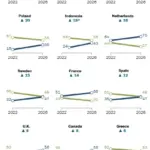
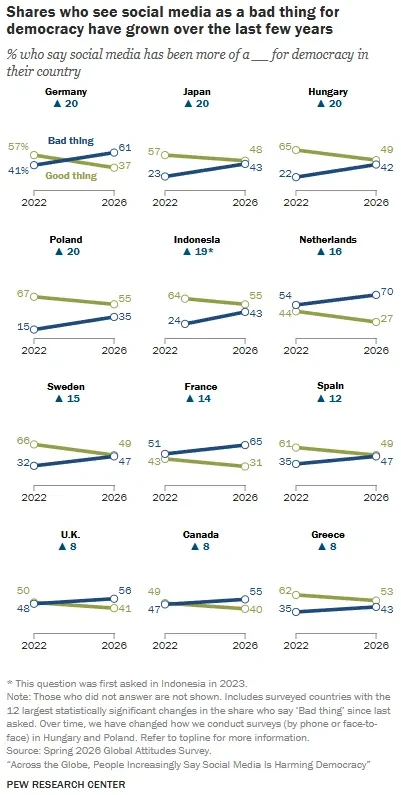
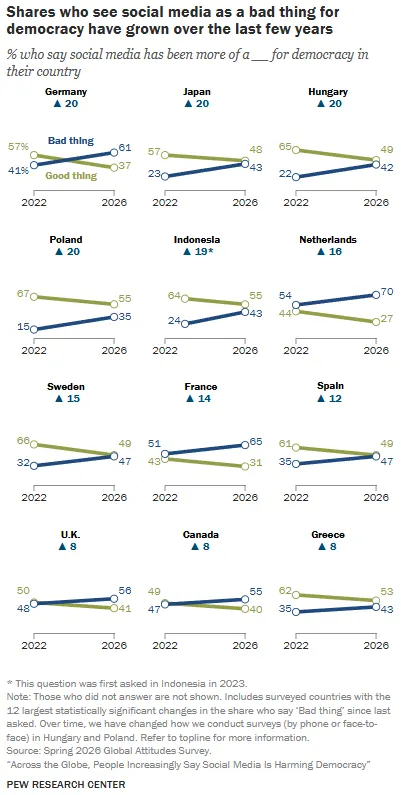
Between 2022 and 2026, the decline in public sentiment accelerated from cautious skepticism into outright alarm. Pew’s latest 37-nation data reveals that this downward trend is not localized to a single region or political system; it is a truly global phenomenon.
At the center of this shift is the realization that engagement algorithms—engineered explicitly to maximize user retention—prioritize emotionally charged, polarizing, and confrontational content. By rewarding outrage and sensationalism, these platforms have inadvertently stoked societal divisions, compelling individuals to retreat deeper into ideological silos and fundamentally altering how citizens engage with democratic institutions.
Supporting Context & Metrics: What the Data Reveals
The numbers compiled by the Pew Research Center paint a stark picture of a world growing weary of its digital infrastructure.
The American Disillusionment
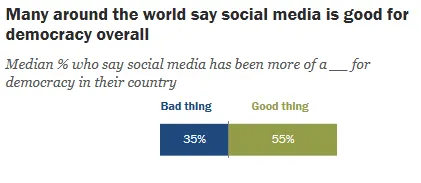
Nowhere is the sentiment more negative than in the United States. According to the 2026 report, a striking 64% of American adults believe that social media has a negative impact on democracy. This positions the U.S. near the top of the global index for public cynicism toward digital platforms.
The Wealth-Democracy Correlation
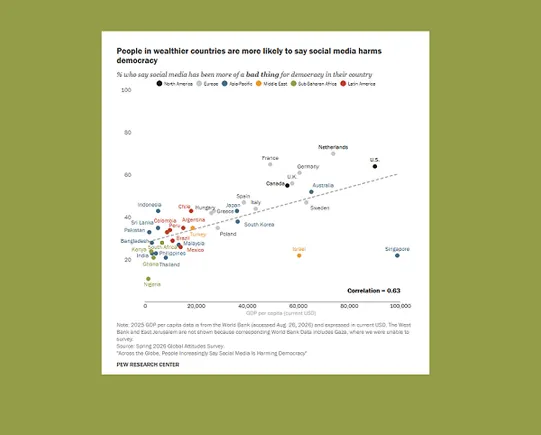
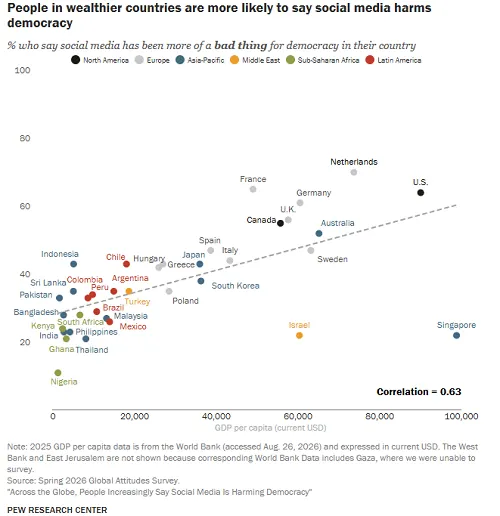
One of the most fascinating patterns emerging from the 37-nation survey is the socioeconomic divide regarding platform perception. Citizens residing in wealthier, high-income nations are statistically far more likely to view social media as a corrosive influence on political and social life. Conversely, developing nations often display more complex or moderately optimistic views, frequently citing the economic utility, educational access, and connectivity provided by these tools.
The Generational Fault Line: Adults vs. Teens
While adult populations have grown fiercely protective—and increasingly punitive—in their views toward youth digital consumption, younger populations retain a more forgiving outlook. Pew’s data indicates that younger adults are significantly more likely to perceive social platforms as beneficial tools for self-expression, community building, and social awareness.
However, this generational optimism stands in sharp contrast to the attitudes of parents and policymakers. In a parallel Pew Research survey focusing on regional regulatory measures, 82% of Australian adults expressed explicit support for restricting children’s access to social media platforms. Similar robust majorities supporting teen restrictions have surfaced across major Western democracies, including the United States, the United Kingdom, France, Italy, Norway, and Sweden.
Statistical cross-analysis of these findings reveals a clear behavioral trend: the older the respondent, the more likely they are to view sweeping platform bans and age-verification mandates as a necessary public safety measure.
Official Perspectives and Expert Analysis
The release of Pew’s latest findings has triggered an intense wave of debate among sociologists, policy analysts, and digital rights advocates regarding the appropriate response to the platform crisis.
The Case for Legislative Intervention
Proponents of strict regulatory oversight argue that self-regulation by technology conglomerates has failed entirely. Speaking on condition of anonymity, a policy researcher specializing in digital governance noted:
"When over sixty percent of a nation’s voting public believes that the primary communication infrastructure of the country is actively undermining democracy, it is no longer a matter of corporate preference or individual digital literacy. It is a national security and public health crisis."
Advocates point out that the business model of modern social media is fundamentally incompatible with healthy civic engagement. Because ad revenue depends directly on user attention spans, algorithms are mathematically optimized to exploit human psychological vulnerabilities—specifically fear, anger, and moral outrage. Legal scholars argue that just as society established age limits and safety standards for pharmaceuticals, automotive manufacturing, and broadcast media, the digital public square requires enforceable guardrails to protect vulnerable minds.
The Counter-Perspective: Preserving Open Expression
Conversely, civil liberties groups and digital rights advocates caution against heavy-handed government restrictions, warning of the slippery slope toward censorship and authoritarian control. Critics of sweeping bans argue that restricting social media access for teens may rob them of vital spaces for peer support, marginalized community connection, and political mobilization.
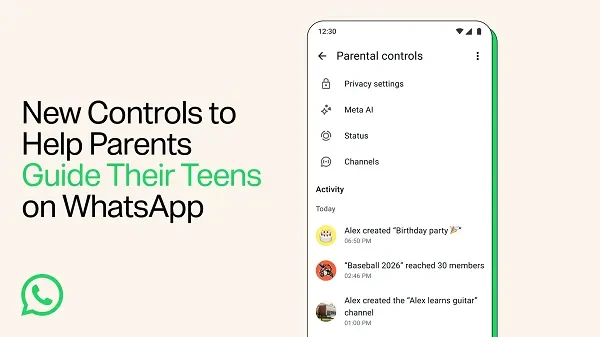
Furthermore, tech industry representatives have historically defended their ecosystems by highlighting the positive dimensions of their platforms—such as empowering small businesses, democratizing educational resources, and enabling instantaneous crisis communication. They argue that the solution lies not in locking users out, but in ongoing platform safety investments, parental control tools, and digital literacy education.
Future Outlook: The Inevitability of Reform
As public skepticism solidifies into a global consensus, the future trajectory of social media appears primed for radical disruption.
- The Rise of Mandatory Age Verification: Given that public support for teen social media restrictions commands majorities across the U.S., Europe, and parts of the Asia-Pacific region, policymakers are facing unprecedented constituent pressure to act. It is increasingly likely that government-mandated age-verification systems and strict liability laws for platforms failing to protect minors will become the global standard over the next several years.
- Algorithmic Transparency and Accountability: Future legislative frameworks will likely move beyond simple content moderation debates to scrutinize the underlying recommendation engines themselves. Regulators are expected to push for algorithmic transparency, granting independent researchers access to platform data to audit how information propagates through digital networks.
- Decentralized and Alternative Models: As disillusionment with mainstream, engagement-driven monoliths grows, consumer demand for alternative, privacy-first, and non-algorithmic social spaces is expected to rise. Platforms that prioritize chronological feeds, community-moderated spaces, and subscription-based models free from surveillance capitalism may find a newly energized market.
Conclusion
The Pew Research Center’s latest data serves as an unmistakable warning flare. The era of uncritical technological adoption has officially closed, replaced by a sober reckoning over the cost of hyper-connectivity. Whether governments, corporations, and civil society can successfully recalibrate the digital landscape to preserve democratic integrity without sacrificing open expression remains the defining challenge of our digital age.