








Executive Overview
Since its inception in 2015, the DevOps Dozen awards program has served as an essential barometer for the software engineering industry. Originally established by DevOps.com to honor the pioneers, trailblazing projects, and resilient enterprises moving the community forward, the awards have consistently provided a platform for practitioners to highlight the individuals and technologies driving true innovation.
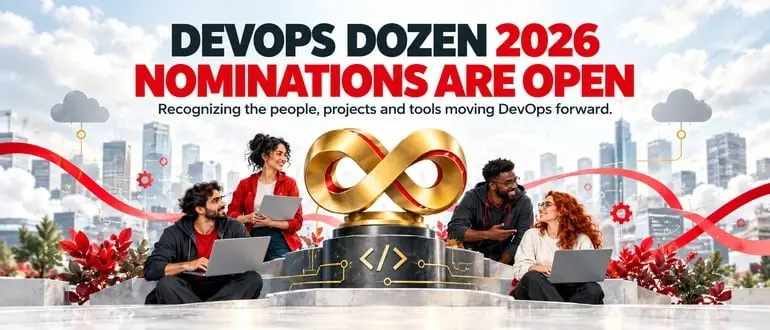
Now, more than a decade later, the software engineering landscape looks radically different. The proliferation of internal developer platforms (IDPs), the rapid integration of autonomous AI agents into software delivery pipelines, and the vital reliance on open-source maintainers have fundamentally transformed how code is built, secured, shipped, and maintained. To accurately reflect this modern era of development, the 2026 DevOps Dozen Awards have officially opened nominations—introducing a completely revamped suite of categories tailored to the realities of contemporary software engineering.
Running through October 18, 2026, at 5:00 p.m. ET, this year’s program spans 24 distinct awards divided into two core domains: Nine Community Categories and 15 Tools & Services Categories. By tightening category definitions and making room for breakthrough advancements in artificial intelligence, platform engineering, FinOps, and open-source sustainability, the 2026 program promises to be the most comprehensive and rigorous evaluation of DevOps excellence to date.
Detailed Chronology: The Evolution of the DevOps Dozen
To understand the weight of the 2026 DevOps Dozen Awards, it is instructive to look at the timeline of both the program and the industry it mirrors:
- 2015 (The Inception): DevOps.com launches the inaugural DevOps Dozen awards to spotlight emerging trends in continuous delivery, automation, and cultural transformation. At the time, the industry was heavily focused on breaking down silos between development and operations teams, automating monolithic or early-stage microservices deployments, and establishing basic CI/CD pipelines.
- 2016–2020 (The Scale-Out Era): As cloud-native technologies, Kubernetes, and containerization take over the enterprise landscape, the awards expand to recognize infrastructure-as-code (IaC), early DevSecOps initiatives, and enterprise digital transformations.
- 2021–2025 (The Platform & Intelligence Shift): The maturation of platform engineering teams, the explosion of cloud costs (spurring FinOps), and the sudden, seismic emergence of generative AI reshape the technological stack. The awards face growing pressure to differentiate between basic productivity tools and transformative, agent-driven workflows.
- The 2026 Lifecycle Schedule:
- Now Open: Nominations are officially live across all 24 categories.
- October 18, 2026 (5:00 p.m. ET): Nomination window closes.
- November 11, 2026: Finalists announced and public voting officially opens.
- Deciding Winners: Final results will be calculated using a balanced methodology comprising 60% expert judging and 40% public voting.
Supporting Context & Metrics: Navigating the 2026 Categories
A perennial challenge for any major industry awards program lies in the delicate balance of categorization. Definitions that are too broad force vastly different accomplishments into unfair head-to-head competition, while definitions that are too narrow fail to capture the nuanced, cross-functional realities of modern engineering.
The organizers of the 2026 DevOps Dozen have directly addressed this challenge by sharply updating category definitions, particularly regarding the intersection of artificial intelligence and software delivery.
1. Categorizing the AI Revolution
Artificial intelligence in the enterprise is no longer a monolith; it spans discrete operational layers. The 2026 commercial categories explicitly recognize these distinct tiers:
- Best AI-Assisted Software Development Solution: Focuses on tools where human developers direct the creative and technical process, utilizing AI to plan, write, review, document, and test software.
- Best Agentic Software Delivery Solution: Targets autonomous or semi-autonomous AI agents capable of planning and executing multi-step workflows across repositories, pipelines, deployments, and operational incidents.
- Best DevOps for AI Systems Solution: Addresses the specialized engineering required to build, deploy, evaluate, monitor, and govern AI models and applications in production (covering MLOps, LLMOps, and AgentOps).
- Best End-User Application of AI in Software Delivery (Community Category): Recognizes enterprise teams that have successfully implemented AI internally to optimize their delivery workflows.
2. Honoring the Open-Source Ecosystem
Open-source software remains the invisible infrastructure upon which the global digital economy runs. The 2026 program acknowledges this by splitting open-source recognition into multiple tracks:
- Established vs. Emerging Projects: Mature projects with widespread enterprise adoption are evaluated on their systemic impact, while younger, high-velocity projects are celebrated for innovative methodologies.
- Open Source DevOps Maintainer of the Year: Directly honors the human effort behind the code—reviewing pull requests, triaging issues, supporting contributors, and maintaining project security often entirely outside the corporate spotlight.
3. The Full Delivery Spectrum: Beyond AI
While artificial intelligence commands significant headlines, engineering organizations still face core operational realities. The Tools & Services track continues to honor excellence across:
- Software delivery platforms, CI/CD, and quality assurance.
- Platform engineering and internal developer platforms (IDPs).
- DevSecOps, software supply chain security, and observability.
- Infrastructure automation, cloud operations, and FinOps (reflecting the critical need to manage multi-cloud, engineering, and AI compute costs).
Official Guidelines & Expert Insights
Participating in the DevOps Dozen requires a clear understanding of the submission criteria and structural boundaries set by the committee.
Submission Rules & Eligibility
- Community Nominations: Free of charge. Anyone within the DevOps ecosystem can nominate themselves, their peers, their teams, or organizations whose work they admire.
- Tools & Services Nominations: $300 per nomination. Entities may enter multiple categories, provided each submission contains unique justification tailored to that specific category’s criteria.
- Vendor vs. End-User Distinction: End-user teams detailing their own internal achievements must submit within the appropriate Community categories. Conversely, commercial vendors submitting case studies of customer deployments must utilize the Best Customer DevOps Implementation category within Tools & Services. Furthermore, vendor employees qualify for Community awards only when their contributions serve the broader industry rather than simply promoting a commercial product.
The Judging and Voting Methodology
To ensure fairness, credibility, and authority, winners are chosen through a dual-weight system:
- 60% Expert Judging: Evaluated by an esteemed panel of industry veterans, including program co-founders Mitch Ashley and additional expert judges. Judges recuse themselves from evaluating any category where a direct conflict of interest exists.
- 40% Public Voting: Encourages community engagement, strictly regulated to one vote per person, per category.
"When we launched the DevOps Dozen in 2015, we wanted to recognize the people, projects, and companies helping this community move forward," note the organizers. "Eleven years later, there is a lot more ground to cover… Our awards need to keep up with the work."
Future Outlook: What the 2026 Awards Mean for the Industry
The release of the 2026 DevOps Dozen categories offers a window into the immediate future of software engineering. As we approach the late 2020s, several macro-trends are solidifying:
- The Codification of Platform Engineering: Internal Developer Platforms are no longer experimental experiments executed by elite tech firms; they are standard enterprise infrastructure. The awards’ heavy emphasis on platform engineering signals that reducing cognitive load for developers is now the primary metric of organizational efficiency.
- The Rise of Agentic Governance: As AI agents graduate from code-completion co-pilots to autonomous operators capable of pushing code, remediating pipeline failures, and managing infrastructure, the industry must grapple with new paradigms of compliance, trust, and auditing. The specialized AI categories in the 2026 awards will establish early benchmarks for what responsible, high-performing agentic deployment looks like.
- Sustainability of Open Source: The spotlight on individual maintainers points to a growing industry-wide reckoning regarding open-source sustainability. By honoring the human beings behind critical libraries and tooling, the DevOps Dozen encourages corporate sponsors and enterprise consumers to invest more deeply in the foundational health of the software supply chain.
How to Take Action
If you utilize a tool that has fundamentally transformed your workflow, rely on an open-source project maintained by tireless advocates, or work alongside a colleague who made a difficult enterprise transformation succeed, your voice is needed.
The software delivery community thrives on shared knowledge and mutual recognition. Review the full category descriptions, gather your metrics and specific impact examples, and submit your nominations before the October 18, 2026 deadline at DevOps Dozen Nominate.
Frequently Asked Questions (FAQ)
What are the DevOps Dozen Awards?
The DevOps Dozen Awards are an annual industry recognition program celebrating the individuals, teams, open-source projects, products, and services making exceptional contributions to the DevOps, platform engineering, and software delivery communities.
When do nominations for the 2026 DevOps Dozen close?
Nominations officially close on October 18, 2026, at 5:00 p.m. ET. Finalists will be announced on November 11, 2026, marking the launch of public voting.
How are the winners selected?
Winners are chosen through a hybrid model: 60% expert judging and 40% public voting. Public voting is capped at one vote per person per category, and judges are barred from scoring categories where they have a conflict of interest.
Is there a fee to submit a nomination?
Nominations within the Community categories are completely free. Submissions in the Tools & Services categories require a $300 entry fee per nomination to support the administration and judging process.