










Executive Overview
On the surface, the vast ecosystem of online content marketing courses can appear remarkably homogeneous. Program after program promises video libraries covering foundational keyword research, editorial calendar creation, and generic action items designed to follow established digital publishing best practices. Yet, a superficial review masks a profound divergence in efficacy.
When evaluating which curriculum will tangibly accelerate a professional’s career, generate measurable pipeline revenue, or scale a bootstrapped enterprise, the deciding factors narrow down to a select few criteria: instructor credibility, active feedback opportunities, breadth of multi-channel execution, and advice recency—specifically, how effectively the curriculum adapts to the rapidly shifting search landscape and the disruptive force of artificial intelligence.
This comprehensive analysis establishes an empirical framework for evaluating leading content marketing courses. By measuring programs against a rigorous matrix of instructor track records, content formats, community support, and pricing models, marketing leaders, entrepreneurs, and independent consultants can make an informed investment to turn content into a predictable revenue engine rather than a hollow exercise in chasing vanity metrics.
Content Marketing Course Evaluation Criteria
To strip away marketing hype and assess the true value of modern educational products, we measure each contender against a standardized evaluation matrix.
| Factor | Why it Matters |
|---|---|
| Instructor Credibility | Has the instructor successfully deployed content marketing to build and scale a real business? Are there verifiable, documented statistics to prove it? |
| Content Formats Covered | Modern publishing requires multi-channel dominance. Relying exclusively on traditional blog posts is obsolete; top-tier courses must integrate social media, email lifecycle marketing, and personal branding frameworks. |
| Advice Recency | The integration of generative AI and algorithmic shifts has rewritten the organic search playbook. Is the instruction tailored to contemporary digital paradigms, or is it recycling outdated 2020 strategies? |
| Feedback and Individual Support | Self-paced video modules often lead to high drop-off rates due to execution paralysis. Does the program offer direct, individualized critique and support? |
| Community | Peer-to-peer networking, masterminds, and collaborative ecosystems provide real-world troubleshooting and accountability that solitary study cannot match. |
| Pricing | Is the financial commitment structured as a sustainable membership, a one-time fee, or a freemium acquisition model? |
Below, we evaluate eight prominent industry offerings against these benchmarks.
1. Copyblogger Academy
Instructor Credibility & Course Content
Copyblogger Academy is operated by a duo of seasoned seven-figure entrepreneurs: Tim Stoddart and Charles Miller. Stoddart has built multiple multi-million-dollar enterprises—including the iconic digital marketing publication Copyblogger and a specialized healthcare marketing agency—leveraging organic search and content engines as his primary acquisition channels. Complementing this, Charles Miller commands a massive digital footprint with over 220,000 followers on X and 100,000+ on LinkedIn, specializing in personal branding architectures that have generated millions for independent founders.
Crucially, both founders remain active operators in the marketplace. This ensures that the insights shared reflect real-time algorithmic changes rather than historical theory.
The Academy departs from traditional blogging-only curriculums by offering six hyper-specific, multi-channel courses designed to turn attention into cash:
- Personal branding on X and LinkedIn
- Advanced copywriting frameworks
- SEO-driven content creation
- Email list architecture and conversion
- Client acquisition and closing strategies
Community and Support
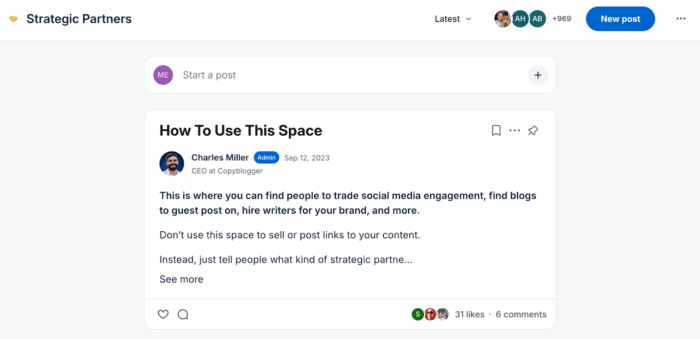
Rather than leaving students to navigate pre-recorded modules in isolation, Copyblogger Academy functions as an interactive workshop. Members can submit drafts directly into a dedicated critique channel for personalized feedback from Stoddart, Miller, and an active peer network. Furthermore, monthly exclusive mini-courses ensure members continuously acquire emerging digital skills.

Pricing
The platform features an accessible low-risk entry point, allowing users to test the ecosystem for just $1 before transitioning to a monthly membership model.
2. HubSpot Content Marketing Course
Overview and Credibility
HubSpot’s Content Marketing Certification Course is an 8.5-hour, free educational program encompassing 14 lessons, 54 video modules, and 11 interactive quizzes, culminating in a shareable LinkedIn certification badge. The curriculum is primarily fronted by Justin Champion, Global Head of Surround Sound Growth at HubSpot, alongside industry luminaries such as Andy Crestodina of Orbit Media and Matthew Howells-Barby.
Course Content and Limitations
While the foundational lessons on blogging strategies, guest blogging integration, and corporate video marketing are executed with polished professionalism, the curriculum exhibits notable modern limitations. It overlooks essential revenue-generation vectors such as direct-response email marketing and personal branding—critical disciplines for startup founders, consultants, and independent creators. Moreover, the syllabus lacks targeted strategies addressing how generative AI has transformed search engine results pages (SERPs).
Operating strictly as a self-paced, pre-recorded program, it provides zero one-on-one instructor support, peer feedback loops, or community networking avenues, placing the entire burden of execution squarely on the learner.
Pricing
Completely free of charge.
3. Grow and Convert’s "Customers From Content" Course & Community
Instructor Credibility and Methodology
Founded by agency owners Benji Hyam and Devesh Khanal, Grow and Convert has built its reputation on a single contrarian premise: content marketing should not be optimized merely for raw traffic volume, but strictly for bottom-funnel conversions and attributable ROI. Hyam and Khanal base their curriculum on systems deployed to scale organic traffic and customer acquisition for over 40 B2B and B2C brands, including Patreon, Leadfeeder, and CrazyEgg.
Course Content
The syllabus is divided into five rigorous modules covering granular execution:
- Advanced customer research and pain-point identification
- Designing conversion-focused content briefs
- Writing high-intent articles that rank and convert
- Systematic content promotion and distribution
- Tracking, attributing, and reporting content-driven ROI
The curriculum is continuously updated to reflect ongoing agency experiments, ensuring dynamic relevance.
Community and Pricing
Unlike passive video hubs, the program is housed inside an active private discussion forum where founders regularly participate in comment threads and host monthly Zoom workshops. It functions less like a traditional course and more like an agency apprenticeship. Lifetime access requires a one-time payment of $699 or six monthly installments of $135.

4. Superpath
Overview and Community Focus
Founded by content veteran Jimmy Daly (formerly of Animalz), Superpath is less of a rigid linear course and more of an elite professional network and continuous education hub for B2B and SaaS content leaders. While Daly anchors the platform, the primary educational value stems from contributions by marketing executives at industry leaders like Shopify, HubSpot, Intercom, and Clearscope.
Course Content and Support
Rather than traditional semester-length modules, Superpath delivers graduate-level mini-courses, teardowns, templates, and live workshops. The focus remains heavily anchored in enterprise blog strategy and content operations for software companies, intentionally omitting personal branding or short-form social video tactics.
Where Superpath excels is its peer support ecosystem, featuring 1:1 pairing loops, AMA (Ask Me Anything) sessions with industry executives, and direct career networking.
Pricing
Superpath utilizes a tiered membership model: a limited free tier, with Pro memberships starting at $50/month ($500/year) and Advanced tiers at $1,000/year.
5. Ahrefs’ Blogging For Beginners (Blogging for Business)
Overview and Credibility
Taught by Ahrefs CMO Tim Soulo, Blogging for Business is a free 5-hour video course hosted on YouTube and the Ahrefs platform. Comprising 40 lessons across 11 modules, the curriculum outlines the exact organic search strategies Soulo used to scale Ahrefs’ corporate blog into millions of monthly organic visitors. Guest interviews with industry authorities like Noah Kagan and Bryan Harris add supplementary perspective on list building and monetization.
Limitations
While the technical instructions on keyword research and fundamental SEO best practices are exceptionally thorough, the course suffers from a critical obsolescence issue: it was recorded in 2020. Consequently, it contains no operational frameworks for navigating algorithmic shifts driven by artificial intelligence. Furthermore, its scope is strictly restricted to traditional blogging, omitting email marketing, social distribution, and video formats. No interactive community or instructor feedback is provided.
Pricing
Free.
6. Semrush Academy Content Marketing
Overview and Instructors
Semrush Academy houses multiple specialized modules, most notably Advanced Content Marketing and Content-Led SEO, both featuring digital marketing pioneer Brian Dean, founder of Backlinko and Exploding Topics (subsequently acquired by Semrush).
Course Content
Dean’s instructional style is renowned for conciseness and actionable frameworks. The courses provide step-by-step templates covering advanced blogging architecture, content campaigns, link building, and conversion rate optimization.

However, these courses were recorded around 2022. While the underlying SEO principles remain sound, they lack contemporary case studies incorporating modern AI integration strategies. Furthermore, as self-paced modules, they do not feature dedicated student communities or instructor feedback loops.
Pricing
Free.
7. CXL Content Marketing Course
Overview and Credibility
The CXL Content Marketing Research Course is an intensive, one-hour strategic overview designed to teach operators how to plan and structure high-level publishing operations. It is taught by Derek Gleason, SEO and Content Lead at Shopify, who oversees a massive library of over 700 long-form assets and brings agency experience managing enterprise accounts for Twitter and Land O’Lakes.
Course Content and Pricing
The curriculum focuses entirely on macro-strategy, content distribution models, and editorial planning, intentionally omitting tactical instruction on how to draft copy. Published in 2024, the material is relatively fresh, though it avoids deep dives into generative AI frameworks.
Available as a single-course purchase for a one-time fee of $299, or via CXL’s comprehensive subscription tiers. It contains no dedicated peer community or direct instructor interaction.
8. Content Marketing Masterclass: Create Content That Sells (Udemy)
Overview and Course Content
Hosted on Udemy by Brad Merrill, CEO of Merrill Media, this masterclass spans nearly four hours across 95 individual lectures. It attempts an all-in-one approach, covering buyer personas, storytelling frameworks, AIDA copywriting models, SEO fundamentals, and email promotion.
Critical Evaluation
Because Merrill’s entrepreneurial background spans broad digital media rather than hyper-focused B2B execution, the course tends to cover topics at a surface level. Last updated in July 2023, it lacks modern AI integration frameworks and offers only limited student-to-instructor interaction via Udemy’s generic Q&A interface.
Pricing
Available via Udemy subscription or as a standalone purchase for $109.99.
Supporting Context & Metrics
To contextualize the financial and strategic value of these educational assets, consider the comparative structural breakdown of top-tier professional content accelerators versus legacy self-paced repositories:
| Metric Category | Community-Driven Academies (e.g., Copyblogger, Superpath) | Self-Paced Video Hubs (e.g., HubSpot, Ahrefs, Semrush) |
|---|---|---|
| Completion Rate | High (Driven by peer accountability and live feedback loops) | Low (Typically <10% due to isolation and lack of execution pressure) |
| Adaptability to AI | Real-time (Continuously updated by active operators) | Static (Locked to the original recording date) |
| Monetization Speed | Rapid (Direct frameworks for client closing and sales pipelines) | Delayed (Focused primarily on traffic generation theory) |
Official Statements and Industry Insights
Content marketing authorities increasingly emphasize that the era of producing high-volume, generic blog posts for the sake of keyword density has reached a structural dead end.
Industry analysts note:
"The democratization of content creation via generative tools means that volume is no longer a competitive advantage. Success in modern publishing requires proprietary insights, rigorous original research, multi-channel distribution, and an active personal brand that builds unshakeable trust with a target audience."
Programs that fail to integrate community feedback, real-time algorithmic adjustments, and conversion-focused copywriting risk teaching obsolete methods that fail to generate pipeline revenue.
Future Outlook
As artificial intelligence continues to saturate digital channels with automated text, the future of content marketing belongs entirely to human-centric differentiation. Courses that rely solely on static video tutorials recorded years ago will struggle to provide career-altering value.
Professionals seeking to future-proof their skills must look toward dynamic, community-backed academies that combine timeless copywriting fundamentals with real-time adaptation to search engine evolution. Whether choosing the holistic, operator-led community of Copyblogger Academy for multi-channel monetization, or niche technical communities like Superpath for B2B SaaS strategy, the modern marketer must demand actionable execution, peer accountability, and direct access to practitioners who are actively winning in the trenches today.