









Executive Overview
KING ABDULLAH ECONOMIC CITY, Saudi Arabia — For the entire history of the modern automotive age, the Kingdom of Saudi Arabia has operated strictly as a massive consumer market, importing millions of vehicles manufactured everywhere from Detroit and Stuttgart to Tokyo and Seoul. Until now, the Kingdom has never possessed a domestic automaker of its own.
That foundational paradigm is officially shifting with the emergence of Ceer, a groundbreaking automotive joint venture formed between Saudi Arabia’s formidable Public Investment Fund (PIF) and global electronics manufacturing giant Foxconn. Pronounced to evoke the Arabic word for "driving forward," Ceer represents far more than a mere vanity project for an oil-rich nation; it is a critical, highly calculated pillar of the Kingdom’s Vision 2030 framework. The overarching goal is to systematically diversify the national economy away from absolute reliance on crude oil production, foster advanced technological innovation locally, and build a sustainable manufacturing ecosystem by the end of the decade.
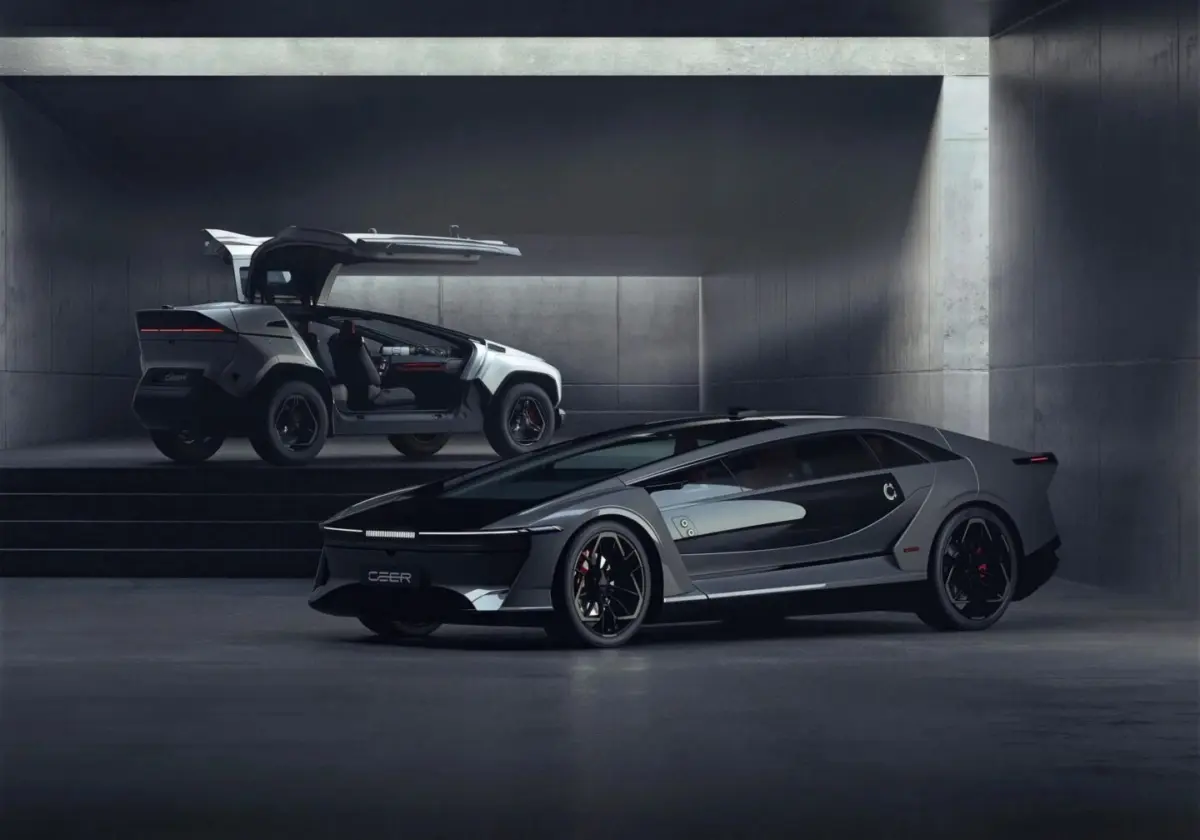
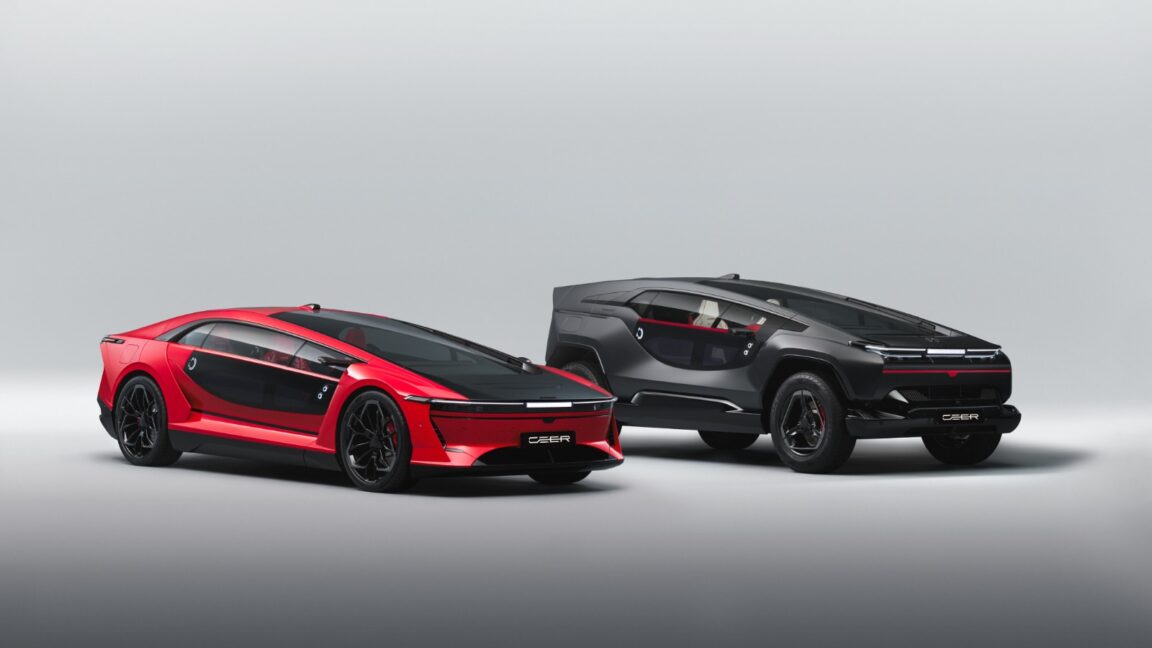
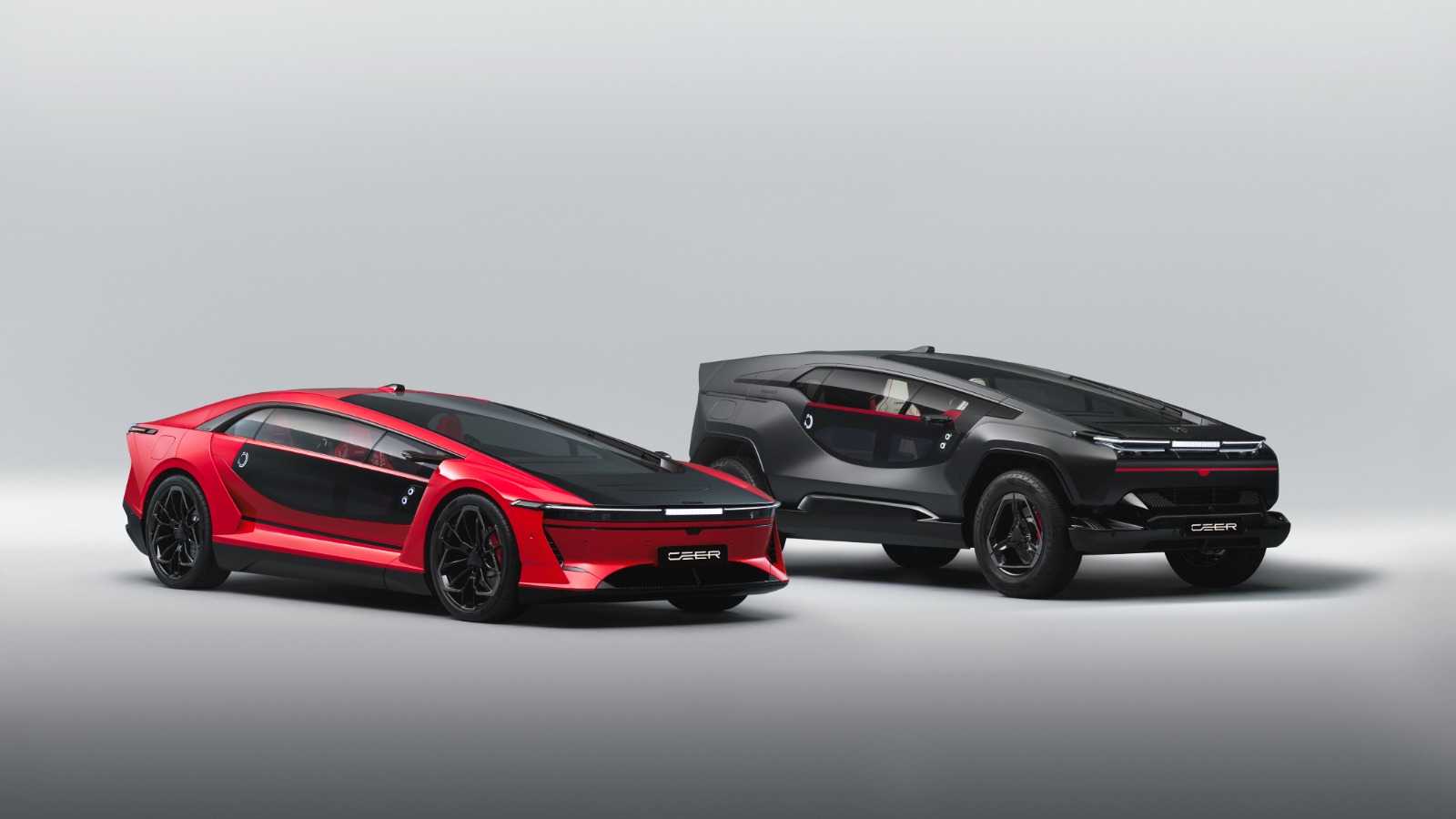
Unveiled with radical flair in King Abdullah Economic City, Ceer’s debut concept portfolio introduces two show-stopping flagship electric vehicles: the Exobot sedan and the Exobot SUV. These futuristic machines are designed to serve as technological showcases, signaling the design language, engineering capability, and holistic user experience that the startup plans to scale across an ambitious seven-vehicle lineup by 2030. Backed by the deep pockets of the PIF and engineered in close collaboration with elite industry veterans, Ceer is positioning itself to not only capture domestic imagination but eventually test the waters of the global EV marketplace.
Detailed Chronology and Genesis of the Project
The creation of Ceer did not happen overnight; it is the culmination of years of strategic planning aimed at embedding high-tech manufacturing into the Saudi industrial landscape.
- The Vision 2030 Genesis: Long before the first sheet of metal was stamped, Saudi leadership recognized that the global energy transition posed both an existential challenge and an unprecedented economic opportunity. Vision 2030 laid the groundwork for high-tech industrialization, paving the way for foreign joint ventures that could transfer critical knowledge directly to the Saudi workforce.
- The PIF and Foxconn Partnership: Recognizing that building a modern electric vehicle requires a synthesis of traditional automotive engineering and advanced consumer electronics, the Saudi Public Investment Fund joined forces with Hon Hai Precision Industry Co., better known as Foxconn. While Foxconn brings supply chain mastery and electronic architecture expertise, the PIF supplies the sovereign financial backing necessary to sustain a multi-billion-dollar automotive startup through its cash-burning foundational years.
- Recruiting Automotive Royalty: To steer the ship, Ceer tapped industry heavyweights. CEO James Deluca, drawing on a distinguished career spent managing manufacturing operations at General Motors and executive leadership at VinStart, brought operational rigor to the startup. Chief Technology Officer Markus Leitner and other seasoned veterans from legacy automakers and engineering powerhouses like Magna Steyr were brought onboard to ensure the vehicles met global homologation and performance standards from day one.
- The Debut Reveal: In a high-stakes presentation in King Abdullah Economic City, Ceer pulled the wraps off the Exobot sedan and SUV. During the reveal, CEO Deluca shared an inspiring mandate handed down by the Crown Prince during early design briefings: "If the world goes left, we go right." This philosophy inspired a radical design departure from homogenized global EV shapes, culminating in the striking, science-fiction-inspired Exobots.
Supporting Context & Metrics: Engineering the Exobot Fleet
To understand whether Ceer can succeed where other EV startups have stumbled, one must examine the raw engineering specs, performance metrics, and technological integrations packed into the Exobot series.
Exterior Design and Radical Doors
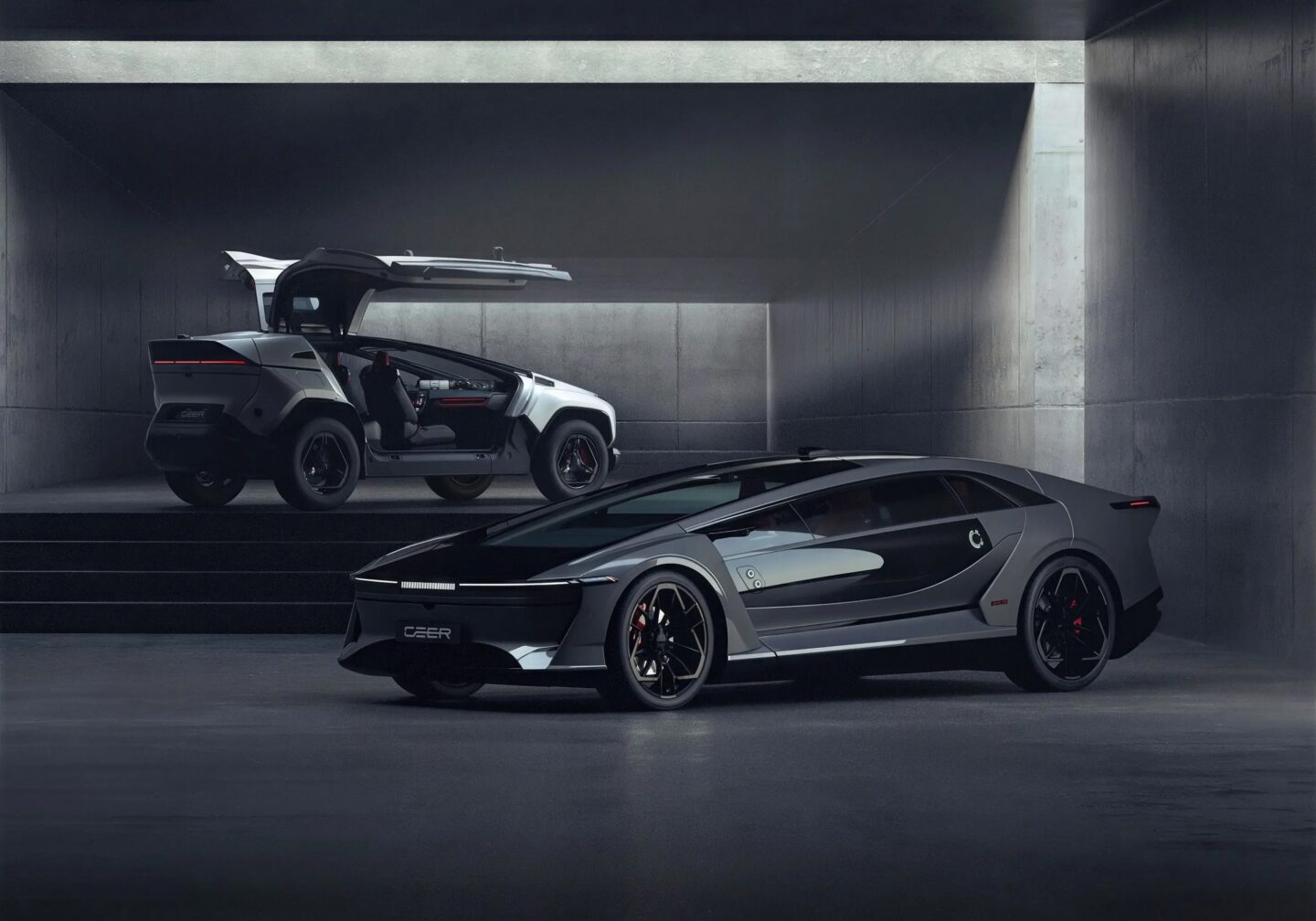
Neither the sedan nor the SUV looks like anything currently rolling off assembly lines in Europe or North America; both vehicles look remarkably at home in a cinematic sci-fi universe like Westworld. Automotive observers have noted that the Exobot SUV bears a striking visual resemblance to the cult-classic Isuzu VehiCross, serving as a spiritual, modern-day evolution of that radical design.
Adding to the dramatic road presence are falcon doors, branded here as Shahin Wings. Operating without a traditional B-pillar, these doors dramatically ease ingress and egress for second-row passengers. Furthermore, the lower portions of the doors incorporate electrochromatic glass, which can be dynamically dimmed or cleared at the push of a button—a clever feature designed to enhance driver side-visibility in tight spots, particularly in the bulky SUV variant.
Cabin Innovation and Thermal Management
The interior of the Exobots blends minimalist luxury with digital immersion. A sweeping 48-inch digital instrument cluster dominates the dashboard, running a proprietary custom infotainment system visually inspired by the glittering Riyadh skyline.
Combatting the Kingdom’s punishingly high ambient temperatures was a primary engineering hurdle. Ceer solved this via an innovative climate control feature dubbed Halo cooling, which establishes an engineered barrier of chilled air circulating between the roof glass and passengers’ heads.
Media controls are anchored by a 10-inch central touchscreen, while rear passengers get an dedicated 8-inch display. Eschewing the industry trend of burying every function inside menus, Ceer retained essential physical controls: a Mercedes-style column gear selector, tactile climate buttons, and physical volume knobs. Furthermore, CTO Markus Leitner confirmed in interviews that Apple CarPlay and Android Auto will be fully integrated at launch, supported by robust over-the-air (OTA) update capabilities.
Powertrain, Battery, and Charging Metrics
Beneath the striking sheet metal lies heavy-hitting EV hardware:
- Battery Capacity: Launch models will utilize a substantial 112-kWh battery pack.
- Driving Range: Estimated range stretches over 310 miles (500 km) for the heavier SUV and at least 373 miles (600 km) for the sleek sedan under the legacy New European Driving Cycle (NEDC). Real-world expectations point to a highly competitive 300-to-400-mile operational radius.
- Performance: Powered by a sophisticated tri-motor setup featuring advanced torque vectoring, the Exobots push out a staggering 1,111 horsepower (828 kW) and 1,100 lb-ft (1,500 Nm) of torque.
- Acceleration: The sedan rockets from 0 to 62 mph (100 km/h) in a hair over 2 seconds, while the SUV dispatches the same sprint in 2.4 seconds, with quarter-mile times clearing the ten-second mark.
- Charging Infrastructure: Built upon an 800-volt electrical architecture, the vehicles support DC fast charging capable of replenishing the battery from baseline to 80 percent in roughly 30 minutes, putting it on par with industry benchmarks like the Hyundai Ioniq 9.
- Steering Dynamics: The 800V system also powers an advanced steer-by-wire system, which pairs with a yoke steering interface designed to deliver ultra-precise steering ratios.
Official Statements and Strategic Vision
During the launch events and subsequent technical briefings, Ceer’s leadership team emphasized that the company’s competitive advantage does not lie in inventing entirely new component technologies, but in world-class integration.
"Everyone has triple motors," noted Chief Technology Officer Markus Leitner during a technical debrief. "Everyone has torque vectoring. Everyone has air suspension. What we do better than anyone else is integrate that all together to provide the best driving experience."
This sentiment was echoed by executive leadership, who stressed that the vehicles were engineered from the ground up to meet stringent global homologation standards. While initial sales will focus heavily on the domestic market and the broader Gulf Cooperation Council (GCC) region, the platform architecture leaves the door wide open for future expansion into Europe and potentially North America if international demand dictates.
Furthermore, production will take place at a purpose-built, state-of-the-art manufacturing complex located within King Abdullah Economic City, situated just north of Jeddah. By co-locating key Tier-1 automotive suppliers in the immediate vicinity, the project aims to ignite a massive multiplier effect across the local economy. Economic models project that the initiative will generate approximately 35,000 direct and indirect jobs by 2034.
Future Outlook: Will Ceer Succeed or Stumble?
Skepticism naturally accompanies any well-funded automotive startup attempting to break into a mature, capital-intensive global industry—particularly given the high-profile stumbles of peers like Fisker. However, industry analysts point out several crucial factors that differentiate Ceer’s trajectory:
- Sovereign Ownership vs. Passive Investment: Unlike Lucid Motors—where the PIF functions primarily as a major equity investor—the Saudi state fully owns Ceer via the PIF, ensuring virtually unmatched financial runway through the volatile startup phase.
- The "Saudi Made" Domestic Push: Under Vision 2030, the Kingdom is actively cultivating national pride and consumer preference for locally manufactured goods via the "Saudi Made" branding initiative. For Saudi consumers, buying a Ceer vehicle is not merely an automotive transaction; it is a direct investment in national industrial sovereignty and economic diversification.
- The Real Test Lies Ahead: While the Exobot sedan and SUV serve as halo models designed to capture headlines and demonstrate elite technical capability, Ceer’s long-term commercial survival will depend entirely on its forthcoming mainstream portfolio. Delivering affordable, high-volume EVs that can successfully undercut or outperform deeply entrenched Chinese import brands currently dominating the domestic Saudi market will be the ultimate proving ground.
As CEO James Deluca and his team push toward full-scale production, Ceer stands poised to rewrite the industrial history of the Middle East. Whether these radical EVs become ubiquitous sights on international highways or remain a localized symbol of national technological ambition, Ceer has firmly established that Saudi Arabia is no longer just watching the future of mobility unfold—it is actively trying to drive it.