








Executive Overview
In an era defined by intense public scrutiny over content moderation, algorithmic visibility, and digital sovereignty, social media platforms face relentless demands for operational transparency. X—formerly known as Twitter—is taking another calculated step toward demystifying its back-end operations. The company has announced a significant expansion of its “Under the Hood” initiative, building upon a feature set originally introduced to grant users clearer visibility into how its source code functions and how penalties are applied.
Under this latest update, X will now provide precise, granular insights into whether specific user accounts or individual posts have had their reach restricted due to compliance with local laws and government demands. Rather than leaving creators and everyday users guessing as to why their metrics have plummeted or whether they have been subjected to an opaque "shadowban," the platform will explicitly disclose if content has been withheld in specific jurisdictions following valid legal requests.
This development marks a crucial evolution in X’s ongoing quest to balance international regulatory compliance with user trust. By illuminating the mechanics behind geo-blocking and localized content suppression, the platform aims to empower creators, demystify algorithmic penalties, and offer unprecedented accountability. However, these features are not universally accessible upon account creation; X has instituted specific eligibility thresholds, limiting these expanded insights to accounts that are at least one year old and have maintained a consistent posting cadence of more than ten times in the preceding month.
This comprehensive report examines the technical, geopolitical, and creator-centric implications of X’s transparency expansion, charting its development, analyzing its underlying mechanics, and assessing what it means for the future of digital expression.
Detailed Chronology: From Source Code Curiosity to Geopolitical Clarity
To fully understand the significance of X’s latest disclosure update, it is necessary to trace the chronology of the platform’s transparency initiatives, particularly following its ownership transition and subsequent restructuring.
The Genesis of "Under the Hood"
For years, social media companies operated as veritable "black boxes," leaving independent researchers, legal scholars, and everyday users to reverse-engineer algorithms to understand why certain posts went viral while others languished in obscurity. Terms like "shadowbanning"—the clandestine reduction of a user’s content visibility without their explicit knowledge—became central to public debates regarding platform bias and censorship.
In response to these persistent concerns, X launched the "Under the Hood" update in the weeks prior to this latest announcement. This initial rollout was designed to pull back the curtain on the platform’s proprietary mechanics in two fundamental ways:
- Source Code Functionality: It provided users with deeper insights into how core components of the platform’s code function, bridging the gap between internal engineering and user-facing experiences.
- Simplified Reporting Functions: It introduced an intuitive reporting interface allowing users to view any active penalties, restrictions, or algorithmic flags that had been levied against their posts or profiles during the preceding month.
While this initial launch was widely praised by power users and digital rights advocates for addressing long-standing frustrations regarding hidden penalties, it remained incomplete. It categorized domestic and internal policy enforcement infractions, but it lacked the specific contextual framing required to explain cross-border regulatory compliance actions—namely, how international laws dictate local content availability.
The Expansion: Incorporating Local Law and Global Realities
Recognizing that users desired deeper clarity regarding why certain metrics shifted drastically across different geographic markets, X’s engineering and legal teams expanded the "Under the Hood" framework.
The turning point came as X observed positive user reception toward transparency regarding government-required content filtering. Rather than hiding behind generic compliance statements or forcing users to consult sparse, generalized transparency reports published biannually, X integrated these localized metrics directly into the user interface.
As of this update, if a government issues a valid legal demand resulting in a post being withheld within its borders, the affected user will see a direct notification. This notification identifies not only that a restriction occurred, but precisely which country enforced the legal mandate. By shifting this data from macro-level corporate reports down to the micro-level of individual user dashboards, X has fundamentally altered how platform governance is communicated to the public.
Supporting Context & Metrics: Navigating the Creator Economy and Algorithmic Realities
The timing of X’s transparency expansion is far from coincidental. It arrives at a critical juncture for the digital creator economy, where algorithmic predictability directly translates to financial sustainability.
The Stakes for Creator Monetization
In recent years, major social media platforms—including X—have rolled out aggressive monetization programs designed to attract and retain top-tier content creators. Programs centered around ad-revenue sharing, subscription models, and tipping depend heavily on consistent audience reach.
For a creator participating in X’s monetization program, a sudden drop in engagement can translate immediately into a loss of revenue. Historically, when reach plummeted, creators were left in a state of ambiguity, unable to determine whether the decline was caused by:
- A shift in audience interest or content quality;
- An algorithmic downgrade due to a minor community guidelines infraction; or
- A geo-restricted compliance action triggered by local laws in a region where their content gained traction.
By clarifying these distinctions, the expanded "Under the Hood" metrics provide vital data points for creators. Knowing whether a post has been legally withheld in a specific country allows creators to adjust their global strategy, understand regional sensitivities, and verify that their accounts are not suffering from erroneous internal algorithmic suppression.
Demystifying the "Shadowban" Mythos
The term "shadowban" has long been a catch-all grievance for users experiencing low engagement. While platforms have historically insisted that true shadowbans do not exist, they have frequently acknowledged the existence of "visibility filtering"—a mechanism whereby content that does not violate explicit terms of service, but nonetheless triggers safety, spam, or local legal thresholds, is distributed to a narrower audience.
X’s updated reporting dashboard bridges the communication gap between platform moderation teams and the user base. By categorizing restrictions clearly—distinguishing between internal policy violations, automated spam flags, and legally mandated geo-blocking—the platform reduces speculation. When users can see concrete documentation regarding account labels and regional penalties, conspiracy theories surrounding arbitrary algorithmic suppression begin to lose ground, replaced by verifiable data.
Eligibility Parameters: Who Gets Access?
Transparency, in this context, is not entirely unrestricted. To prevent potential abuse, data-scraping vulnerabilities, or system overload, X has established clear eligibility criteria for accessing these expanded insights.
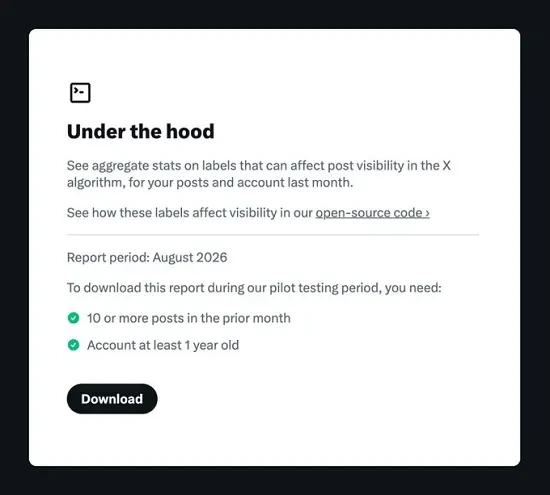
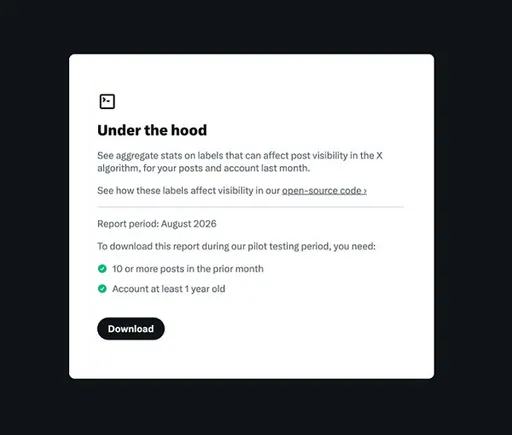
To view these advanced metrics via the "Under the Hood" dashboard, an account must meet two primary thresholds:
- Account Age: The account must be at least one year old. This requirement helps mitigate the rapid creation of burner or bot accounts designed to probe or exploit moderation systems.
- Posting Activity: The account must have published more than ten posts within the previous month. This ensures that the reporting infrastructure is dedicated to active, genuine participants in the platform’s ecosystem rather than dormant profiles.
These guardrails strike a balance between open data access and platform security, ensuring that the feature serves its intended audience: active creators, journalists, public figures, and engaged community members.
Official Statements and Industry Implications
While X has framed the update primarily as a victory for user empowerment and government transparency, the move has broader implications for the technology sector at large.
The Philosophy Behind the Update
In official communications detailing the rollout, X emphasized the positive feedback received from its initial transparency efforts:
"We’ve expanded Under The Hood after seeing people’s appreciation of more transparency into government-required content filtering. In addition to showing labels applied to your account and posts in the prior month, Under The Hood now shows if your account or posts had their visibility limited because of required compliance with local law(s). For example, you can see if any of your posts were withheld in a country following a legal demand — and which country."
This statement underscores a strategic philosophical shift: treating users as stakeholders in platform governance. By acknowledging that content moderation is frequently driven by external, sovereign legal pressures rather than purely internal corporate censorship, X positions itself as an intermediary navigating complex international laws rather than an arbitrary arbiter of global truth.
Industry-Wide Precedents
X’s willingness to expose localized legal restrictions directly to individual creators places pressure on competing platforms—such as Meta, TikTok, and YouTube—to follow suit. While these competing platforms publish regular transparency reports detailing government requests for content removal or restriction, none have integrated this data directly into the user’s personal settings dashboard with the same degree of individual post-level granularity.
Legal scholars and digital rights organizations have cautiously welcomed the move. While the reality of content suppression under local laws remains a contentious issue—particularly regarding authoritarian regimes where free speech rights are heavily restricted—providing visibility into when and where censorship occurs prevents gaslighting by platforms that previously kept such actions hidden behind closed doors.
Future Outlook: Challenges and Next Steps for Digital Transparency
As X continues to iterate on its "Under the Hood" initiative, several key challenges and opportunities lie ahead for the platform and its user base.
1. Navigating Geopolitical Complexities
The most significant hurdle for X’s localized transparency model involves navigating the starkly contrasting legal frameworks of different nations. A post protected as free speech under the First Amendment in the United States might violate strict hate speech, blasphemy, or defamation laws in European, Asian, or Middle Eastern jurisdictions.
As X provides clearer data on where content is withheld, the platform may face increased diplomatic and legal pressure from foreign governments uncomfortable with having their censorship demands publicly exposed to individual creators. Conversely, it provides human rights organizations and legal watchdogs with empirical data regarding the scope and frequency of international censorship requests.
2. Further Refinement of Algorithmic Insights
While knowing about legal withholding and account labels is a major step forward, users and developers continue to call for even deeper algorithmic transparency. Future iterations of "Under the Hood" may need to address broader algorithmic ranking factors—such as how the "For You" timeline weights engagement, multimedia content, and external link sharing.
As regulatory bodies worldwide—particularly the European Union under the Digital Services Act (DSA)—enforce stricter transparency mandates on large online platforms, initiatives like X’s may soon transform from voluntary features into mandatory industry standards.
3. Empowering the Next Generation of Creators
Ultimately, the success of this transparency expansion will be measured by how effectively creators utilize these insights to navigate the digital landscape. By demystifying the intersection of international law, platform policy, and algorithmic reach, X is equipping its user base with the informational tools necessary to thrive in a fragmented global internet.
Conclusion
X’s decision to expand its "Under the Hood" feature set represents a maturity in how social media platforms handle the delicate intersection of free expression, corporate policy, and sovereign law. By giving eligible users direct visibility into government-mandated content withholding and localized reach restrictions, the platform is replacing speculation with hard data.
While challenges remain regarding the global patchwork of internet regulations and the realities of cross-border censorship, this update establishes a new benchmark for platform accountability. For creators, journalists, and everyday users alike, the ability to see precisely what is happening behind the digital curtain marks a welcome and long-overdue advancement in the evolution of social media transparency.