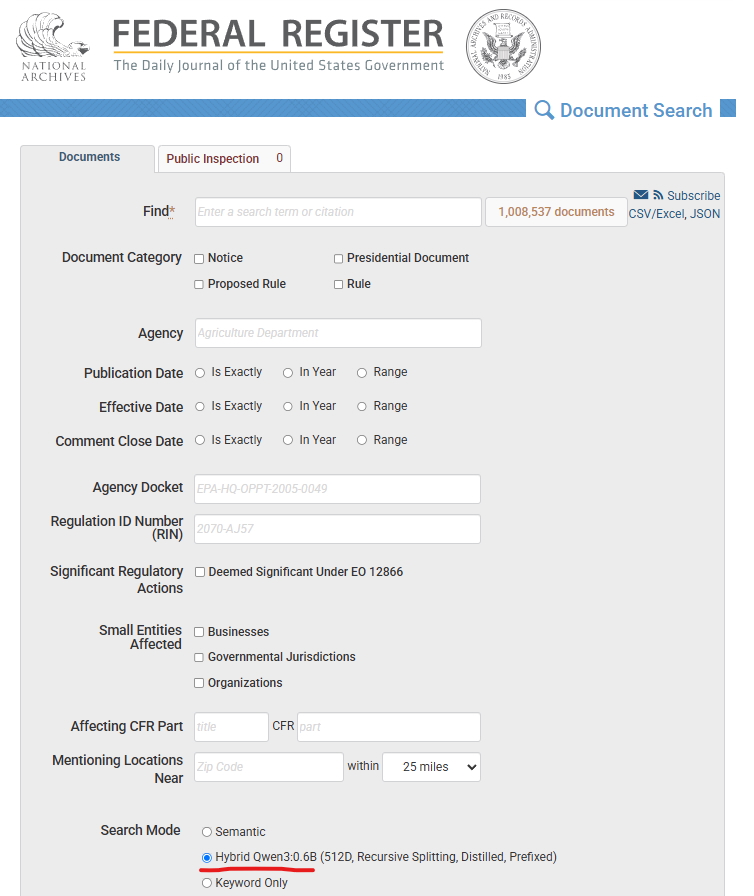
In a striking revelation that underscores the complex and rapidly evolving geopolitical landscape of artificial intelligence, U.S. government officials abruptly removed a Chinese-developed AI search tool from the official Federal Register website. The tool, powered by an open-weight model from Alibaba’s Qwen family, was quietly deployed to help users navigate public comments on proposed federal regulations.
However, its brief tenure on a foundational platform of American governance triggered an immediate public outcry and intense scrutiny from cybersecurity experts, lawmakers, and federal investigators.
The incident occurred against the backdrop of an escalating tech Cold War between Washington and Beijing. Just weeks prior to the discovery, the Federal Bureau of Investigation (FBI) and other national security agencies explicitly named Alibaba among a half-dozen major Chinese technology firms accused of engaging in "industrial-scale distillation." According to U.S. intelligence, these companies have systematically bypassed Western development costs by copying and adapting frontier American AI models.
The presence of a Chinese-engineered model on a U.S. government domain exposed a glaring policy disconnect. It forced lawmakers and policymakers to confront an uncomfortable reality: While top-tier federal officials warn against the dangers of integrating Chinese technology into critical infrastructure, American administrative bodies—operating under decentralized procurement or digital integration strategies—are increasingly drawn to the speed, cost-effectiveness, and local deployability of open-source models produced overseas.
This comprehensive report examines the chronology of the Federal Register incident, the technical realities of small-scale open-weight AI deployment, the broader policy and congressional backlash, and what this event reveals about America’s strategic blind spots in the global race for AI dominance.
Detailed Chronology of the Incident
The sequence of events leading to the removal of the Alibaba Qwen model from the Federal Register website highlights the power of open-source digital sleuthing and the lightning-fast velocity at which modern web infrastructure can inadvertently adopt foreign technology.
Discovery and Social Media Backlash
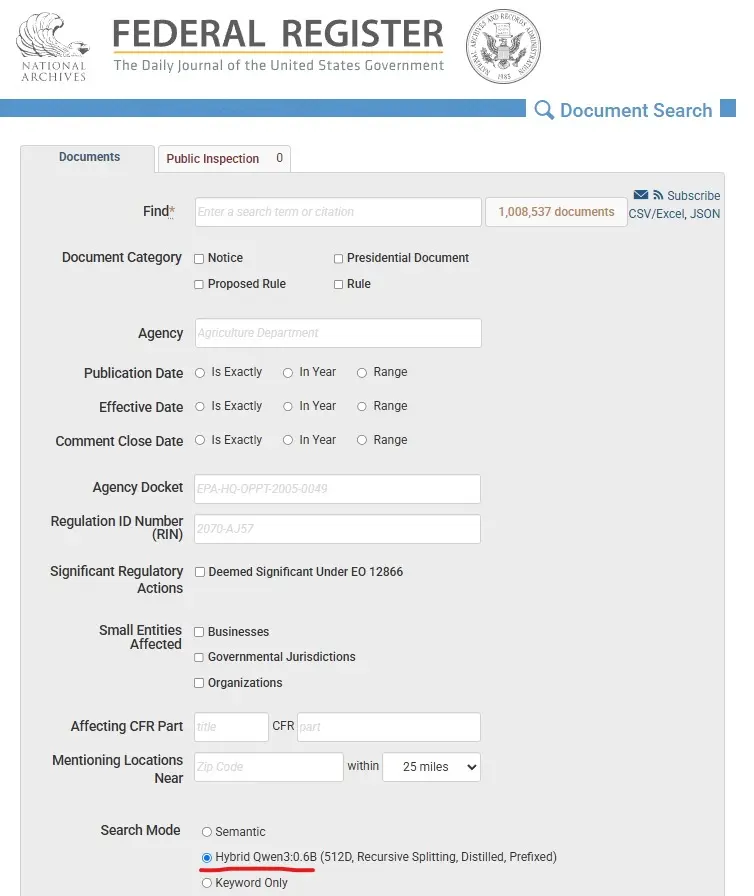
The controversy erupted on Monday, September 15, when an observant user on the social media platform X (formerly Twitter), posting under the handle @tleilax___, published a screenshot of the Federal Register’s search interface. The interface clearly indicated that visitors could leverage an Alibaba Qwen model to sift through complex and voluminous public comments regarding proposed federal rules and regulations.
The post quickly went viral within tech-policy circles. Cybersecurity researchers, journalists, and policy analysts immediately recognized the profound irony: the National Archives and Records Administration (NARA)—the independent federal agency responsible for managing the Federal Register—was actively utilizing technology explicitly flagged by the FBI as a vector for intellectual property theft and national security exposure.
Verification and Rapid Removal
Following the viral circulation of the screenshot, investigative journalists from major outlets, including Reuters, examined the website’s historical source code and live network traffic. Archival data confirmed that the Qwen integration had been quietly slipped into the site’s backend architecture, allowing public-facing users to interact with the Chinese model for at least a 24-to-48-hour window.
Upon realizing the mounting PR crisis and the policy contradiction, federal IT administrators moved swiftly. On Wednesday, September 17, government handlers quietly dismantled the integration, scrubbing all references to the Qwen search backend from the site’s source code and reverting to alternative infrastructure.
To date, neither the National Archives nor the White House has issued an official statement explaining how the Alibaba model was selected, vetted, or approved for deployment on a federal domain, despite multiple media requests for comment from major publications.
Technical Realities: Small Open-Weight Models vs. National Security Risks
While political leaders reacted with immediate alarm, computer scientists and technology policy experts urged a more nuanced evaluation of the technical architecture involved, distinguishing between high-risk cloud services and localized, small-scale open-weight models.
The Scope of the Model: Qwen3 0.6B
According to technical analysis published by the Chinese tech portal Sina.com, the Federal Register did not deploy one of Alibaba’s massive, resource-intensive proprietary flagship models. Instead, the implementation utilized a lightweight, open-weight iteration—specifically within the "Qwen3 0.6B" tier.
With approximately 600 million parameters, this model represents a fraction of the computational scale of premier frontier models like OpenAI’s GPT-4 or Anthropic’s Claude. Crucially, such models are distributed as "open-weight" packages, meaning that once downloaded, they can be operated entirely locally on a developer’s or agency’s own private servers.
Data Privacy and Local Control
Security experts pointed out that the technical deployment profile of the Qwen 0.6B model on the Federal Register likely posed zero risk to classified or sensitive government data.
Public Domain Information: The Federal Register exists explicitly to host public documents, notices, and citizen comments. None of the data being queried by users or processed by the search tool was classified, proprietary, or non-public.
No External Data Transmission: Because the model was downloaded and run locally to execute basic document retrieval tasks, user queries and federal data were not systematically piped back to Alibaba-controlled servers or third-party APIs.
Georgetown University Law Professor Anupam Chander noted to reporters that the actual security implications of utilizing such a model depend entirely on infrastructure control and data pipelines. If an agency downloads an open-source model and runs it on an air-gapped, domestically hosted server, the software functions essentially as a tool rather than a conduit for foreign intelligence gathering.
However, Senator Mark Warner (D-Va.) and other congressional watchdogs emphasized a different kind of risk: the risk of strategic dependency. Even if immediate data leakage is mitigated, building administrative workflows around foreign-derived architectures sets a dangerous precedent, potentially locking U.S. public institutions into an ecosystem defined, maintained, and continually optimized by strategic competitors.
Supporting Context & Strategic Metrics
The Federal Register incident is merely a symptom of a much larger, systemic vulnerability in the United States’ national technology strategy.
The FBI’s "Industrial-Scale Distillation" Claims
Earlier in September, the FBI and federal counterintelligence partners released sweeping warnings detailing how at least six prominent Chinese AI firms—including Alibaba—have aggressively utilized "distillation" techniques. According to the bureau, these companies harvest outputs from advanced U.S. frontier models to train and refine their own domestic models at a fraction of the cost.
By bypassing the multi-billion-dollar pre-training phases pioneered by American companies, Chinese labs have rapidly closed the technological gap. This strategy has allowed them to flood the global market with high-performing, low-cost, open-source alternatives that appeal strongly to cost-conscious enterprise and government buyers.
Congressional Policy Research and the "Small-Model" Blind Spot
A critical policy research document submitted to the U.S.-China Economic and Security Review Commission in March highlighted a profound strategic miscalculation by Washington policymakers:
"US export controls are calibrated to constrain frontier training by restricting access to advanced semiconductors. They do not address the small-model deployment cycle, which requires less advanced compute, draws on openly available base models, and generates advantage through application rather than pre-training. If the models that matter most for industrial AI are small, specialized, and open, the current US policy framework could be targeting the wrong layer of the competition."
While U.S. export controls have successfully restricted Chinese access to ultra-advanced ASICs and GPUs needed to train massive frontier models from scratch, they have failed to stop the proliferation of highly efficient, lightweight models that dominate day-to-day enterprise applications.
Furthermore, prominent business leaders and commercial developers who rely heavily on open-source frameworks have cautioned the federal government against knee-jerk protectionism. They warn that outright bans or overly restrictive domestic regulations on Chinese open-source models could backfire, forcing American developers to lag behind in practical applications while isolating the U.S. from global technical standard-setting bodies.
Official Statements and Political Fallout
The fallout from the Federal Register oversight has intensified the ongoing legislative battle in Washington over how aggressively the federal government should regulate—or outright ban—foreign artificial intelligence products.
Lawmaker Resistance: A Hardline Stance
U.S. Representative John Moolenaar (R-Mich.), who serves as the chairman of the House China Committee, voiced the most unyielding condemnation of the incident. In statements following the Reuters report, Moolenaar argued that any integration of Chinese AI within the federal apparatus represents an unacceptable self-inflicted vulnerability.
"No federal government entity should use a Chinese AI model," Moolenaar stated. "Doing so only makes the federal government more dependent on Chinese AI models, and that is not in the national interest."
Other lawmakers have echoed these sentiments, pointing out that public trust in federal institutions is severely undermined when administrative agencies inadvertently utilize software explicitly condemned by the nation’s top law enforcement bodies as a national security threat.
The Administration’s Dilemma
The executive branch currently finds itself caught between two competing imperatives:
National Security and Decoupling: Safeguarding government digital infrastructure, protecting intellectual property, and preventing reliance on adversarial technological ecosystems.
Economic Efficiency and Innovation: Maintaining competitive parity, reducing administrative costs, and leveraging the immense utility of the global open-source AI community.
With the Trump administration navigating complex debates over AI safety testing, deregulation, and trade posture, the Federal Register episode serves as an embarrassing wake-up call regarding the internal security hygiene of federal web properties.
Future Outlook: The Global Battle for AI Norms
As the dust settles on the brief appearance of Alibaba’s Qwen model on a U.S. government website, policymakers and technologists agree that the incident is a microcosm of the battles that will define the next decade of digital governance.
1. Tightening Federal Procurement Guidelines
In the immediate future, federal agencies can expect rigorous new directives from the Office of Management and Budget (OMB) and cybersecurity watchdogs like CISA (Cybersecurity and Infrastructure Security Agency). These guidelines are expected to explicitly audit and restrict the use of foreign-origin open-source models across all civilian and defense IT systems, regardless of whether those models operate locally or process non-sensitive data.
2. The Open-Source Reckoning
The broader technology sector must navigate a deepening ideological divide. While Western policymakers increasingly view open-source Chinese models as vectors of economic and political influence, international developers—particularly in the Global South—continue to embrace them for their affordability, transparency, and adaptability. If the U.S. retreats entirely behind a wall of proprietary domestic tooling, American influence over the foundational technical standards that govern global AI development risks severe erosion.
3. A Call for Domestic Open-Source Ecosystems
To counter the widespread adoption of Chinese models like Qwen, industry advocates emphasize that the U.S. must drastically accelerate its own open-source and small-model ecosystems. Initiatives led by domestic giants like Meta and Nvidia to foster accessible, high-performance American open-source models will be critical in providing federal agencies and private enterprises with secure alternatives that do not compromise on cost or capability.
Ultimately, the Federal Register’s fleeting flirtation with Alibaba’s AI was more than a mere administrative oversight; it was a flashing warning light for a nation attempting to navigate the uncharted waters of a global technological revolution.