By Investigative Tech Desk Updated September 19, 2026
Executive Overview
For years, Microsoft and OpenAI have aggressively defended their practices in high-stakes litigation brought by major news organizations, maintaining that scraping vast repositories of copyrighted journalism to train massive language models (LLMs) constitutes protected "fair use." The tech giants have fought tooth and nail in federal courts to keep internal deliberations, strategic concerns, and development telemetry concealed from the public eye.
That veil of secrecy was violently ripped away on Thursday. A heavily incriminating motion for summary judgment, unsealed by news plaintiffs spearheaded by The New York Times, exposes a treasure trove of internal communications, executive warnings, and proprietary data. The documents show that behind closed doors, tech executives and top-tier researchers harbored deep, acute anxieties that their generative AI products would cannibalize the news industry, trigger an unprecedented "doom loop," and ultimately starve their own models of the reliable information supply chains required to sustain them.
Far from being oblivious to the ethical and legal boundaries they were crossing, insiders at both companies explicitly flagged their data-gathering methodologies as parasitic. From a Microsoft applied science director labeling news scraping "perhaps the largest theft of labor in human history" to OpenAI engineers acknowledging that users have "no good reason to click" on original source links once an AI chatbot provides the answer, the unsealed papers dismantle the curated public relations narratives of both corporations.
As the legal battle careens toward trial, the revelations threaten to upend the delicate legal doctrines governing copyright in the age of generative AI, potentially forcing tech monopolies to finally compensate the publishers whose reporting fuels the digital economy.
Detailed Chronology and Internal Revelations: Inside the "Theft of Labor"
The unsealed motion for summary judgment reads like an investigative autopsy of corporate foresight meeting unchecked ambition. Long before the public rollout of consumer sensations like ChatGPT and Microsoft Copilot, technical leads within these organizations recognized the fundamental paradox of their business models: they were building foundational tools designed to consume the very ecosystem that gave them life.
The Microsoft Warnings: From "Astonishing Theft" to "Accidental Cover-Up"
Perhaps the most explosive internal disclosures emerged from Microsoft. Brent Hecht, Microsoft’s Director of Applied Science, circulated internal memorandums that bluntly demolished his own employer’s legal defense strategies. According to the news organizations’ filings, Hecht repeatedly warned colleagues that scraping journalistic output for AI training was "an astonishing theft of unprecedented proportions." In another memo, he characterized the endeavor as perhaps the "largest theft of labor in human history."
Hecht went further, directly attacking the core legal pillar of the tech companies’ defense. He asserted that the systematic, uncompensated harvesting of journalism made "a complete mockery of the idea of ‘fair use.’"
Yet, rather than halting the practice or pursuing enterprise-level licensing deals with publishers, Microsoft and OpenAI allegedly engineered workarounds to evade detection. Hecht flagged the creation of a specialized filtering system designed to obscure what content was being ingested—a mechanism he warned could easily be perceived by outsiders as an "accidental cover-up" because it systematically reduced visibility for content creators whose work was being weaponized against them.
OpenAI’s Evasion of Paywalls and the Pursuit of "Gazillions"
Over at OpenAI, the ethical guardrails appeared equally flexible. Internal communications unsealed in the filing demonstrate a calculated disregard for digital barriers protecting intellectual property.
In one exchange, OpenAI staffer Nick Ryder informed President Greg Brockman that a technical workaround—effectively "a hack"—had been identified to bypass The New York Times paywall for OpenAI web crawlers. Brockman’s reported response was succinct and unbothered: "Ah, nice."
This casual dismissal of digital boundaries was underpinned by an intense, gold-rush mentality. The unsealed documents quote Brockman as admitting he was "deeply motivated by the gazillions" that could be unlocked by aggressively commercializing OpenAI’s underlying technologies.
Meanwhile, Nick Turley, head of ChatGPT, penned internal messages warning colleagues that commercial products trained on news content represented an "existential threat" to publishers. Turley noted that chatbots effectively served as direct substitutes for news providers, rendering source visits obsolete.
Supporting Context & Metrics: The Mechanics of the "Doom Loop"
The fears articulated by Hecht, Turley, and other insiders were not merely philosophical; they were grounded in hard telemetry. Data generated and analyzed within both firms confirms that chatbots systematically divert audiences away from original reporting, initiating the very "doom loop" predicted by their own engineers.
Plummarishing Click-Through Rates
Metrics recorded by Microsoft during internal evaluations revealed catastrophic declines in referral traffic for publishing plaintiffs:
Severe Impacts: Certain news organizations experienced click-through rate (CTR) drops ranging from 83% to 93%.
Widespread Degradation: Other news plaintiffs recorded traffic drops between 51% and 94%.
When combined with independent analyses of ChatGPT’s search integration and publishers’ internal traffic analytics, a clear picture emerges. Chatbots intercept user queries, synthesize the answers using scraped journalism, and present the information natively on the AI interface.
As one Microsoft internal document pithily summarized:
"It is highly unusual that an end-product threatens the economic foundations of its essential suppliers, but that is the situation we have created for our LLM business with respect to its ‘content supply chain.’"
The "Doom Loop" and the Prisoners’ Dilemma
The internal Microsoft documents detailed a self-destructive economic cycle dubbed the "doom loop." Because generative AI models rely on a steady stream of fresh, factual, human-generated reporting to maintain their accuracy and relevance, killing the news industry ultimately poisons the AI data supply chain.
However, AI companies found themselves trapped in a classic game theory prisoners’ dilemma. As the news groups argued in their motion:
"AI companies remain powerless to break out of this ‘doom loop,’ because, while the industry as a whole would benefit if every company paid to sustain the continued production of the creative works their technology depends on, each individual company is better off taking content for free while others pay."
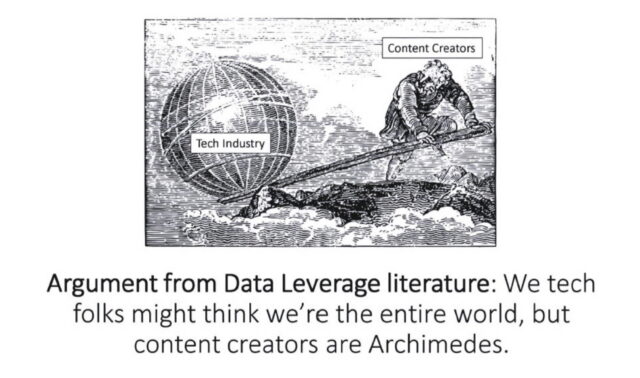
To illustrate this systemic risk, Microsoft’s internal memos even featured a cartoon depicting large language models actively destroying their own underlying supply chains—a visual admission of systemic self-sabotage that plaintiffs plan to exhibit prominently at trial.
Official Statements and Legal Posturing
The release of these documents has triggered a fierce war of words between legal counsel for the media plaintiffs and representatives for the tech titans.
Microsoft Disavows Its Own Scientists
In wake of the unsealing, a Microsoft spokesperson scrambled to distance the corporation from the explosive rhetoric penned by its own director of applied science. The spokesperson argued that Hecht’s internal memos merely "reflect one employee’s individual perspective, are not a legal analysis, and do not represent the company’s views."
Regarding CEO Satya Nadella’s deposition testimony—in which he acknowledged that chatbots act as substitutes for news platforms by supplying information directly on the interface—Microsoft’s representative claimed Nadella was speaking to "broad principles and changes underway in how people find and consume information." The spokesperson insisted these were casual "observations" that "should not be confused with conclusions about copyright questions before the Court."
Plaintiffs Cry Foul: "The Cat Is Out of the Bag"
Publisher legal teams expressed jubilation over the transparency forced by the unsealed filings. Steven Lieberman, counsel for the New York Daily News and seven sister publications, pulled no punches in his assessment of the evidence:
"The evidence revealed here for the first time shows that OpenAI and Microsoft knew that what they were doing was wrong," Lieberman said. "Throughout this case Defendants insisted that these documents be treated as confidential so that the public could not see them. Well, now the cat is out of the bag. Finally, the world can see what OpenAI and Microsoft thought all along about the fairness of their own behavior."
OpenAI declined immediate requests for comment from media outlets, choosing to let its upcoming courtroom filings address the substantive allegations of willful copyright infringement and unauthorized data laundering.
Future Outlook: The Road to Trial and the Stakes for Society
The unsealing of these documents marks a critical watershed moment in the intersection of intellectual property and generative artificial intelligence. For over three years, tech companies have hidden behind complex legal doctrines of transformative use, arguing that training AI models mirrors how human readers consume and learn from public information on the internet.
However, the evidentiary weight of internal admissions—where top engineers describe their products as "substitutive, period" and executives joke about bypassing paywalls—threatens to eviscerate those defenses.
The Legal Battleground: Verbatim Outputs and Substitution
News organizations have intentionally narrowed their immediate summary judgment arguments to instances where chatbots generate extensive verbatim overlaps when prompted with bias-rating requests, summary outlines, or homepage selections. By proving that AI models do not merely learn stylistic patterns, but routinely reproduce substantial portions of protected text while destroying referral traffic, plaintiffs believe they have met the legal threshold to prove market substitution.
If federal courts rule that scraping news for commercial LLM training does not qualify as fair use, the ruling will fundamentally restructure the artificial intelligence landscape. It will compel tech companies to negotiate licensing agreements, establishing a mandatory baseline compensation model for human creators.
As the news plaintiffs eloquently summarized in their closing arguments:
"The future not just of journalism but of responsible AI too depends on preserving incentives for humans to produce the creative works on which a healthy society depends. Finding that copying news for AI is not fair use would solve this prisoners’ dilemma by putting all AI companies, OpenAI and Microsoft included, on an even footing."
With the trial looming, the tech industry’s defense has been severely compromised. The internal panic once whispered across confidential corporate chat channels is now a matter of public record, and the courts will ultimately decide whether the architects of the AI revolution must pay for the foundations upon which their empires were built.