








Executive Overview
The landscape of digital rights enforcement and internet infrastructure has shifted dramatically in Europe following a landmark legal development in Belgium. On August 20, the President of the French-speaking Business Court of Brussels delivered a definitive ruling that upholds aggressive Domain Name System (DNS) blocking requirements targeting major global technology firms. The decision squarely impacts foundational internet infrastructure providers—specifically Google, Cloudflare, and Cisco’s OpenDNS—requiring them to actively filter pirate streaming domains under the threat of astronomical financial penalties.
This ruling concludes a high-stakes legal challenge that began earlier in the year when sports broadcaster DAZN leveraged Belgium’s newly minted, aggressive anti-piracy framework. The court’s verdict signals a resolute judicial appetite to hold public DNS resolvers accountable for facilitating access to unauthorized streams of live sports content, particularly elite football competitions like the Jupiler Pro League.
While Google and Cloudflare have navigated compliance through various operational adjustments, Cisco has taken a hardline stance. Asserting that its OpenDNS architecture is fundamentally incompatible with the dynamic, localized, and intermittent filtering demands of the court order, Cisco has announced its intention to pull OpenDNS out of Belgium entirely—mirroring a previous temporary withdrawal.
This clash between intellectual property enforcement and core internet infrastructure architecture raises critical questions about the extraterritorial responsibilities of global tech giants, the erosion of neutral network routing, and the operational viability of enforcing localized censorship on decentralized, global platforms. As the three-month implementation window ticks down, the Belgian ruling sets a profound precedent for how anti-piracy mandates will interact with foundational internet services across the European Union.
Detailed Chronology: From First Salvo to Final Ruling
The Genesis of a New Regime
Belgium historically lagged behind neighboring European nations in implementing systematic, rapid-response website blocking architectures to combat digital piracy. However, the operationalization of a dedicated anti-piracy department fundamentally accelerated the country’s posture. Rights holders gained a streamlined, highly effective administrative and legal mechanism to sever user access to illicit streaming domains.
The inflection point arrived in April 2025, when sports rightsholder DAZN secured a pioneering blocking order. Rather than restricting enforcement strictly to traditional Internet Service Providers (ISPs), DAZN cast a much wider net. The injunction commanded major public DNS providers—specifically Cloudflare, Google, and Cisco—to cease resolving domains linked to pirate streaming operations. Non-compliance carried a punitive threat: fines amounting to €100,000 per day.

Immediate Shockwaves and Corporate Pushback
The tech sector’s response to the April injunction laid bare the deep friction between intellectual property protection and infrastructure engineering:
- Cisco’s Abrupt Exit: Viewing the €100,000 daily penalty as an existential operational risk, Cisco pulled its OpenDNS service out of Belgium entirely within days of the order.
- Alternative Approaches: Google and Cloudflare elected to maintain their services while seeking legal recourse, implementing varied compliance methodologies to manage the directive.
- United Front in Court: All three infrastructure titans banded together to mount a formal legal challenge against the order, arguing that public DNS resolvers are mere conduits, technically unsuited for targeted censorship, and subjected to disproportionate legal liability.
Temporary Reprieve
The legal momentum shifted temporarily in July 2025, when the Brussels court suspended the DNS blocking requirements against Cisco pending a comprehensive final review. Following this judicial pause, Cisco reinstated OpenDNS within Belgium, and additional pending DNS-focused blocking orders were placed on hold. Industry observers briefly wondered if the courts would recognize the technical limitations inherent in global resolver networks.
The August 20 Verdict
Those hopes were dashed on August 20, when the President of the French-speaking Business Court of Brussels handed down its final ruling. Rejecting the core arguments put forward by the DNS providers, the court validated the legality of forcing public resolvers to block pirate domains. Although the complete text of the primary court order remains restricted, a subsequent implementation decision issued by Belgium’s anti-piracy department laid bare the mechanics, parameters, and operational expectations of the enforcement regime.
Supporting Context & Mechanics: The 90-Minute Window and Dynamic Blocklists
The implementation decision outlines a sophisticated, aggressive system designed specifically to neuter pirate broadcasts of live sports events. The mechanics of the blockade depart significantly from static, permanent internet censorship, introducing dynamic and time-sensitive operational parameters.
Operationalizing the Blocklist
The framework primarily targets live Belgian football competitions, most notably the Jupiler Pro League. To adapt to the fluid nature of pirate streaming networks—which frequently migrate across domain names to evade detection—the system permits rightsholders like DAZN to continuously evolve their target lists:
- Weekly Updates: DAZN is authorized to submit one blocklist update per week, capturing a maximum of 100 newly identified domains per submission.
- Advance Notice: DAZN must notify the anti-piracy department at least seven working days in advance regarding which specific matchday requires blocklist updates.
- Implementation SLA: Upon notification, DNS resolvers are granted a strict five-working-day window to integrate the changes into their resolution pipelines.
The 90-Minute Intermittent Countdown
Perhaps the most notable feature of the Belgian regime is its deliberate, intermittent nature. Rather than enforcing permanent domain blackholes that could easily be monitored and circumvented, the blocks operate on a tactical, match-day schedule:
- Pre-Match Trigger: Actual domain blocking must go live precisely 90 minutes before the kickoff of a targeted match.
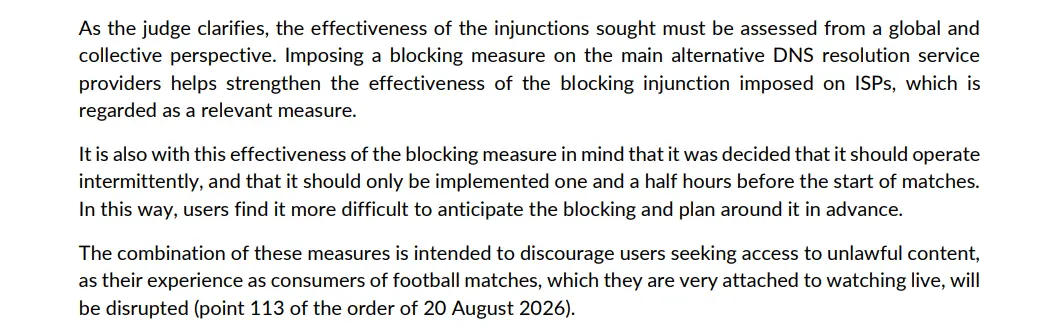
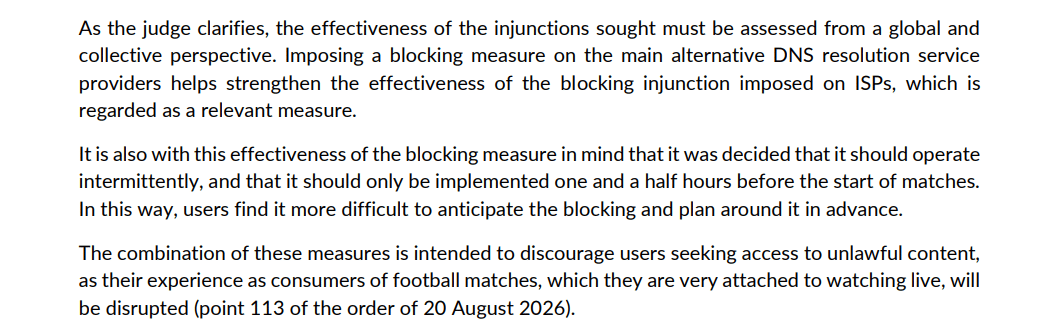
- Evading Anticipation: According to the implementation order, this transient, time-locked approach is calculated to disrupt consumer habits. By activating the blockades just an hour and a half before a game, pirates and consumers find it markedly more difficult to anticipate, plan around, or establish reliable workarounds in advance.
Scale of the Blockade
The velocity of this infrastructure is already evident in public data associated with the initial order. When the blocking mechanism was first deployed, the active blocklist comprised a modest 58 domains. Following subsequent updates and the expansion of the operational framework, that figure has surged to 258 blocked domains, illustrating a rapidly compounding catalog of internet censorship.
Official Statements, Concessions, and Legal Safeguards
While the court decisively ruled in favor of DAZN and the anti-piracy department, the final judgment did introduce minor concessions and safeguard mechanisms designed to temper the severity of the original April injunction.
Concessions to DNS Providers
- Removal of Warning Pages: The court explicitly scrapped a requirement compelling DNS resolvers to redirect blocked users to an informational warning page. The judiciary acknowledged that such intrusive UI-level interventions cannot reasonably be imposed on foundational network-layer resolvers.
- Refined Penalty Structures: While the €100,000 daily penalty remains codified, its application has been restricted. Fines now accrue only on days when DAZN matches are actively broadcast live. Furthermore, the court established a hard ceiling of €20 million per company in total accumulated fines.
- Geolocation Error Protections: Recognizing the technical limitations of IP geolocation—particularly regarding users residing near national borders—the court ruled that under-blocking incidents stemming from "an exceptional geolocation error" will not trigger punitive fines.
Judicial Rationale
Addressing the core arguments of the tech giants, the court dismissed claims that the costs of compliance were disproportionate or that alternative resolvers could not technically perform the filtering. The implementation decision emphasizes that targeting alternative DNS providers is a necessary complement to standard ISP-level blocks:
"Imposing a blocking measure on the main alternative DNS resolution service providers helps strengthen the effectiveness of the blocking injunction imposed on ISPs, which is regarded as a relevant measure," the decision states.
"The combination of these measures is intended to discourage users seeking access to unlawful content, as their experience as consumers of football matches, which they are very attached to watching live, will be disrupted."
Future Outlook: The Impending Exit of OpenDNS and Industry Implications
As the dust settles on the Brussels court’s August 20 ruling, the practical fallout is already materializing across the corporate landscape of the tech sector. Google and Cloudflare, having previously adapted their systems to remain compliant, are expected to absorb the new parameters under the refined penalty caps. For Cisco, however, the threshold of compromise has been reached.
Cisco’s Stand: Technical Incompatibility vs. Legal Mandate
During the court hearings, Cisco maintained an uncompromising technical position. The company informed the anti-piracy department that OpenDNS’s global architecture "does not allow for the implementation of selective, geolocated and dynamic blocking as required by the order." Furthermore, Cisco argued that attempting to retrofit the public DNS system to satisfy these bespoke legal demands "would compromise the performance, stability and security of that service."
Faced with a choice between compromising global network integrity or exiting the Belgian market, Cisco chose withdrawal. The Belgian anti-piracy department has formally accepted this drastic measure as a valid form of compliance, noting that pulling out entirely is the only concrete step Cisco is technically capable of executing.
In a brief statement following initial inquiries, a Cisco spokesperson reiterated the status quo: "OpenDNS currently remains available in Belgium." However, this availability is temporary. DNS resolvers have been granted a three-month implementation window to comply with the final ruling. While Cisco has indicated its intent to lodge an appeal against the decision, barring a dramatic legal reversal, Belgian users relying on OpenDNS can expect the service to go dark for a second time later this year.
Broader Industry Ramifications
The Belgian precedent establishes a worrying paradigm for digital rights advocates and infrastructure purists. By legally compelling recursive, public-facing DNS providers to act as enforcement arms for local copyright holders, the ruling blurs the traditional lines between network neutrality and content policing.
If other European jurisdictions adopt Belgium’s aggressive framework—particularly its dynamic, short-notice, 90-minute intermittent blocking windows—global tech providers may increasingly find that operating open public utilities in fragmented regulatory environments carries an unacceptable compliance burden. The choice between Balkanizing global infrastructure services or capitulating to localized censorship demands is rapidly becoming a defining crisis for the modern internet.