








Executive Overview
Nearly four years after the watershed public debut of OpenAI’s ChatGPT, followed closely by the introduction of Anthropic’s Claude, the broader digital marketing, search engine optimization (optimization (SEO)), and content strategy ecosystems remain largely operating in the dark. Despite the astronomical rise of generative artificial intelligence (genAI) as an everyday tool for hundreds of millions of consumers, brands and data scientists have been starved of granular, first-party data regarding how users construct their prompts, what underlying mechanics dictate platform response methodologies, and how conversational journeys unfold.
For years, digital analysts have been forced to rely on traditional, legacy search query data as a blunt instrument to infer user behavior inside genAI environments. Aside from Bing—which has historically provided a baseline of transparency by explicitly reporting "Grounding Queries" that drive "fan out" responses—major platforms have kept their cards close to their chests.
However, a quiet structural shift is now underway. Recent discoveries reveal that Google’s AI Mode is inadvertently capturing and recording both initial conversational prompts and subsequent follow-up interactions directly into Google Search Console (GSC) as standard search queries. This accidental data leakage represents a major turning point for the SEO and digital marketing communities. By deploying advanced regular expressions (regex) and leveraging third-party API tools, search marketers can finally reverse-engineer consumer conversational habits, isolate genAI prompts from legacy short-tail keywords, and decode the complex informational pathways that modern audiences take.
This article explores how this revelation came to light, the technical mechanics of identifying these prompts in Search Console, the specific frameworks shared by industry experts to parse the data, and what this means for the future of digital content optimization.
Detailed Chronology: From Accidental Discovery to Industry Validation
To understand how genAI interaction data began surfacing in traditional search monitoring platforms, we must trace a brief chronology of digital curiosity and platform transparency.
The Long-Standing Visibility Gap
When generative conversational agents first captured the global imagination, they fundamentally decoupled information retrieval from traditional web indexing. Users stopped typing fragmented keywords like "best project management software" and started inputting long, hyper-contextual narratives: "I am running a remote team of five developers across three time zones using an agile framework; what software stack can I use to track velocity while keeping administrative overhead under two hours a week?"
Because these interactions occurred inside walled-garden chat interfaces, webmasters saw zero referral traffic, and keyword tools registered zero volume. The traditional metrics of digital marketing—impressions, clicks, average position, and click-through rates (CTR)—seemed destined to become obsolete in a conversational search economy.

The LinkedIn Catalyst: Anastasia Kourou and John Mueller
The narrative shifted when Anastasia Kourou, SEO Manager at Greece-based Relevance Digital Agency, noticed anomalies within her clients’ Google Search Console performance profiles. She observed unusual, highly conversational strings pop up in her query reports—phrases that bore no resemblance to typical search behavior. Stranger still were ultra-short follow-up fragments such as "yes" or "yes, pricing," which generated impressions without any logical standalone search intent.
Kourou took her findings to LinkedIn, tagging Google’s Search Advocate, John Mueller, and directly asking why Search Console was indexing these genAI-style artifacts as standard search queries.
Mueller’s confirmation validated what forward-thinking SEOs had long suspected: these anomalous queries were not data glitches or crawling artifacts. They were genuine, real-world follow-up prompts generated by users interacting with Google’s AI Mode. Google’s ecosystem was ingesting the conversational history of AI-driven search sessions and passing them down the pipeline into the Search Console reporting interface.
Industry Amplification and Advanced Frameworks
Following Mueller’s confirmation, the SEO community mobilized. Analysts began experimenting with ways to isolate this hidden vein of user intent. Shortly after Kourou’s public inquiry, Jean-Christophe Chouinard, an SEO strategist at Tripadvisor, published an expanded, highly refined regular expression framework designed to capture not just the initial complex long-tail prompts, but also the nuanced, multi-turn conversational follow-ups that characterize modern genAI engagement—phrases like "yes, please" and "tell me more."
This collective discovery transformed what was initially viewed as noisy reporting data into an actionable treasure trove of consumer insights.
Supporting Context & Metrics: Decoding the Anatomy of a Prompt
To effectively utilize this newfound data stream, marketers must first understand the structural differences between legacy keyword queries and modern generative AI prompts.
The Mechanics of "Fan Out" and Grounding Queries
In traditional search engine optimization, a keyword query triggers an index lookup, matching strings against a pre-compiled database of optimized web pages. In contrast, generative search engines—and hybrid experiences like Google’s AI Mode—often utilize a "fan out" architecture. When a user enters a complex prompt, the system breaks the request down into multiple sub-queries ("Grounding Queries"), executes them simultaneously across the index, synthesizes the results, and structures a coherent conversational response.
While platforms like Bing historically exposed these grounding queries to give publishers visibility into how their content contributed to AI-generated answers, Google’s approach with AI Mode integrates the user’s conversational inputs directly into Search Console data pipelines.
Identifying Prompts via Regular Expressions (Regex)
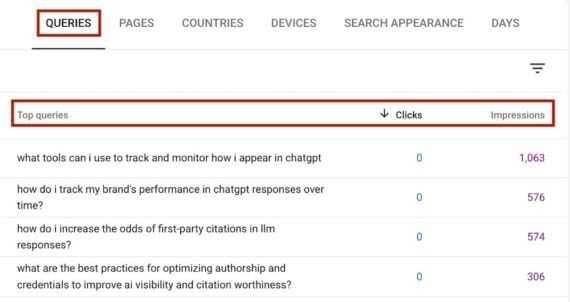
Because genAI prompts are structurally distinct from legacy keywords—frequently spanning ten or more words, incorporating conversational punctuation, and mimicking human-to-human dialogue—they can be effectively isolated using regular expressions within Google Search Console.
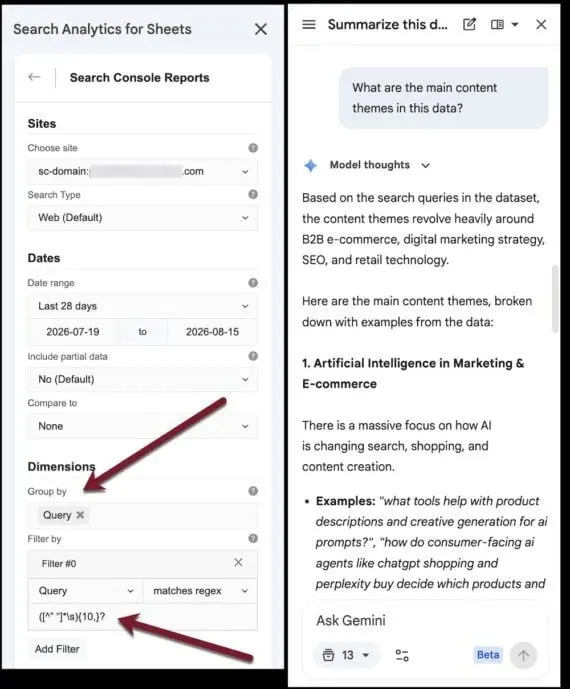
To extract these prompts via the standard GSC interface, analysts navigate to the Performance report, click Add Filter, select Query, and choose Custom (regex). Entering a regex filter designed to capture long word counts—such as:
([^” ”]*s)10,?…instantly strips away standard short-tail keywords. What remains is a raw feed of conversational queries.
A review of these filtered reports reveals fascinating metrics. Many of these prompt-based queries exhibit high impression counts coupled with zero clicks. This dichotomy occurs for two primary reasons:
- The Zero-Click Nature of AI Interfaces: Users often get the complete answer they need directly inside the AI-generated summary block or conversational dialogue box without ever needing to click through to an external web property.
- Competitive Monitoring Software: A portion of these high-impression long queries are generated by automated brand-monitoring and prompt-tracking software deployed by enterprise competitors trying to understand how their own brand entities appear inside generative outputs. Even this automated traffic yields high-value intelligence, revealing precisely what keywords and situational parameters your competitors are monitoring.
Leveraging External Tools and APIs
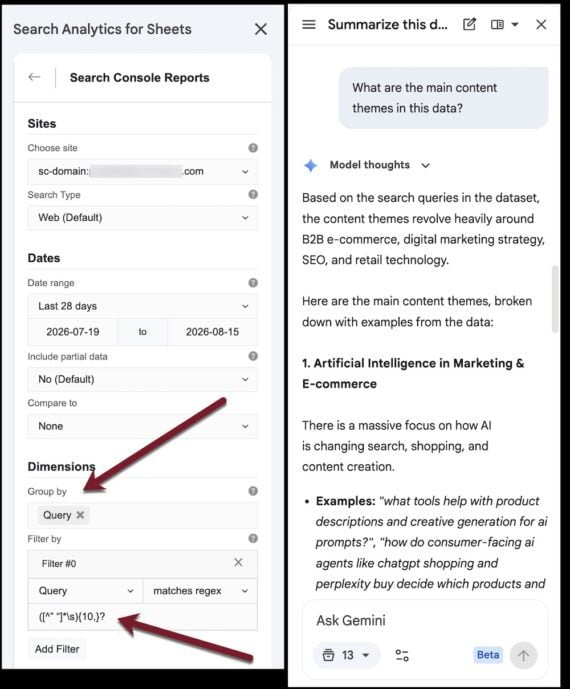
While the native Google Search Console web interface is sufficient for basic investigations, its frontend filtering caps and pagination limits can restrict deep analysis. To bypass these limitations, advanced practitioners rely on third-party API connectors.
Tools such as Search Analytics for Sheets allow marketers to pull comprehensive GSC data directly into Google Sheets without requiring bespoke developer resources. While privacy-conscious enterprises must weigh the security implications of routing proprietary performance data through third-party extensions, the analytical payoff is substantial. Once inside a spreadsheet, search data can be paired with generative AI panels (such as Google’s own Gemini sidebars) to automatically cluster thousands of long-tail prompts into cohesive thematic content buckets, revealing macro-trends in audience curiosity long before they register in keyword volume tools.
Official Statements and Industry Implications
The realization that genAI prompts are bleeding into Search Console forces a dramatic rethink of how digital marketers measure success.
John Mueller’s confirmation on LinkedIn—though concise—serves as an official acknowledgment of the blurring lines between traditional search and conversational AI interfaces. For years, Google’s official stance has emphasized that webmasters should focus on creating high-quality, people-first content rather than chasing algorithmic quirks. However, the exposure of multi-turn conversational data provides a rare window into the exact phrasing humans use when delegating cognitive tasks to machines.
The Shift from Keyword Optimization to Prompt Anticipation
For the digital marketing industry, the implications are profound:
- The Death of Keyword Density: Traditional on-page SEO metrics built around keyword density, exact-match variations, and superficial term frequency are increasingly obsolete. When users prompt AI with multi-sentence scenarios containing conditional logic ("If I run X platform, how do I integrate Y without breaking Z?"), content must be structured to answer deeply specific, situational questions.
- Optimizing for Multi-Turn Context: Because GSC is now capturing follow-up fragments like "yes, pricing" or "tell me more," content architects must recognize that user journeys are no longer linear single-search events. A user’s interaction with an AI model is a dialogue. Content must be organized into logical, modular hierarchies that satisfy both the primary query and the predictable downstream follow-up inquiries an AI engine will surface.
- Brand Visibility in Conversational Summaries: Tracking these prompts helps brands understand how their products are framed during the AI’s synthesis phase. If prompt data reveals that users are asking conversational engines to compare your software against a competitor under specific constraint parameters, your content footprint must proactively address those exact comparisons in clear, structured formats that AI models can easily parse and cite.
Future Outlook: The Next Frontier of Search Data Intelligence
As we look toward the horizon of digital search and content strategy, the accidental exposure of genAI prompts in Google Search Console is likely just the beginning of a larger structural evolution.
Toward Greater Transparency
The industry pressure for transparent genAI analytics will only intensify. As brands invest heavily in Generative Engine Optimization (GEO) and conversational visibility, relying on fragmented regex filters in Search Console will feel increasingly primitive. The digital marketing community will continue to push major search engines to provide dedicated, native reporting suites specifically designed for conversational search interactions, mirroring the historical evolution of traditional SEO reporting tools in the early 2000s.
The Rise of Conversational Intent Modeling
In the coming years, data science teams will move beyond manual regex filtering and begin building automated machine learning pipelines that ingest GSC prompt data, categorize user intent states, and automatically generate content briefs designed to capture conversational search share. The ability to reverse-engineer an AI model’s grounding queries and user prompt history will separate market leaders from legacy publishers who continue to optimize for static keywords.
Conclusion
The era of treating generative artificial intelligence as a black box is slowly coming to an end. Thanks to accidental data disclosures, community collaboration among global SEO experts, and agile data extraction techniques, marketers now possess the keys to unlock the conversational mind of the modern consumer. By embracing regular expression filtering, leveraging API-driven spreadsheet tools, and pivoting optimization strategies toward multi-turn prompt scenarios, digital strategists can future-proof their web properties for an increasingly conversational, AI-driven search landscape.