








Executive Overview
Nearly four years have passed since the public debuts of generative artificial intelligence flagships ChatGPT and Claude fundamentally altered the digital landscape. In that brief window, user habits have undergone a radical transformation. Consumers have largely pivoted away from abrupt, keyword-driven string searches—the bread and butter of traditional search engine optimization (SEO) for decades—and toward conversational, highly specific, multi-layered natural language queries.
Despite this profound behavioral shift, a stubborn opacity has plagued the digital marketing and SEO industries. Platforms like OpenAI, Anthropic, and Google historically guarded user prompt data and proprietary response methodologies like state secrets. Barring isolated transparency initiatives—most notably Microsoft Bing’s reporting of “Grounding Queries” that drive “fan-out” AI responses—marketers have been left largely in the dark. Professionals have had to rely on old-world search query metrics as blunt instruments to infer complex, multi-turn generative AI (genAI) interactions.
That paradigm is quietly shifting.
Recent discoveries confirm that Google’s AI Mode is tracking both initial and follow-up conversational prompts directly within Google Search Console (GSC). What initially appeared as anomalous noise—bizarre, ultra-long strings of text or cryptic single-word fragments like "yes" or "yes, pricing"—has been officially confirmed by Google’s Search Liaison team as genuine conversational baggage carried over from AI Mode interactions.
For SEO professionals, content creators, and digital strategists, this accidental data leak represents a long-awaited window into the black box of generative AI user behavior. By leveraging advanced regular expressions (regex), direct API integrations, and third-party analytical tools, marketers can now begin to unearth, isolate, and act upon these hidden AI prompts. This article explores the mechanics of this discovery, provides actionable frameworks for extracting prompt data from GSC, and assesses the long-term strategic implications for modern search optimization.
Detailed Chronology: How the "AI Mode" Data Leak Came to Light
To understand the magnitude of this development, it is necessary to trace the breadcrumbs left by vigilant SEO practitioners who noticed strange anomalies inside their organic performance reports.
The Anomaly in the Data
For months, digital marketers analyzing their Google Search Console dashboards had been spotting unusual queries. Standard keyword data usually consists of two-to-four-word phrases: "best project management software," "how to fix a leaky faucet," or "affordable digital marketing agencies."
Suddenly, reports were filling up with sprawling, fully formed human sentences—entire conversational paragraphs containing twenty or thirty words, complete with context, specific constraints, and zero historical search volume. Even more puzzling were ultra-short queries appearing right alongside them: strings like "yes," "yes, please," "tell me more," or "yes, pricing." These micro-queries made no sense in the context of traditional web searches, where a user typing just "yes" into a search bar would yield erratic, unhelpful results.
The Greek Agency Discovery
The puzzle began to unravel when Anastasia Kourou, SEO Manager for Greece-based Relevance Digital Agency, decided to investigate these bizarre entries. Noticing that Google Search Console was indexing genAI-like conversational fragments and excessively long contextual questions, Kourou took her findings directly to the source.
On LinkedIn, she tagged Google’s Search Advocate, John Mueller, publicly asking for clarification. She wanted to know why Search Console was suddenly registering conversational conversational debris—phrases that looked far more like prompt engineering than traditional web searches—as standard queries.
John Mueller’s Confirmation
In a subsequent industry revelation, Mueller confirmed Kourou’s suspicions. The queries in question were not flukes or crawler glitches; they were authentic follow-up prompts generated by real human users interacting with Google’s AI Mode.
This single acknowledgment bridged the chasm between traditional search behavior and generative AI utilization. For the first time, Google had inadvertently provided digital marketers with a direct pipeline to see how users converse with its generative AI features, using the very same dashboard historically reserved for traditional keywords.
Shortly after Mueller’s confirmation, other industry leaders piled on with advanced methodologies. Jean-Christophe Chouinard, an SEO strategist at Tripadvisor, published an expanded regular expression dataset capable of capturing not just the initial long-tail AI queries, but also the fragmented multi-turn follow-ups ("yes, please," "tell me more," "show me options") that characterize modern chatbot dialogs.
Supporting Context & Metrics: The Shift from Keywords to Conversations
To appreciate why this discovery changes the rules of engagement for digital marketers, one must examine the fundamental mechanics of how generative AI alters user intent and search architecture.
The Death of the Keyword String
Traditional SEO was built upon a foundation of finite data points: search volume, keyword difficulty, and cost-per-click (CPC). Marketers targeted specific phrases, built dedicated landing pages around those exact terms, and optimized metadata to match.
Generative AI shatters this linear model. When a user interacts with ChatGPT, Claude, or Google’s AI Mode, they do not think in terms of indexable keywords. Instead, they prompt the system with complex contextual scenarios:
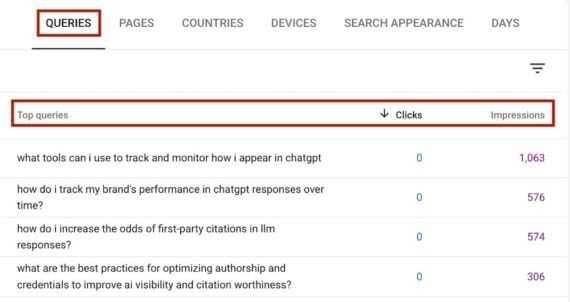
- Old Search Query: "best CRM for real estate"
- New AI Prompt: "What tools can I use to track and monitor how I appear in ChatGPT, considering I manage a boutique real estate firm with five agents and a restricted software budget?"
The disparity is staggering. The former is a keyword string designed to trigger a list of blue links; the latter is a complex prompt designed to elicit a synthesized, highly tailored advisory response. Because Search Console is now capturing these sprawling prompts, marketers can finally analyze the exact vocabulary, constraints, and pain points users feed into AI environments.
The Impressional Mirage vs. True Utility
A critical metric challenge arises when reviewing these AI prompts in GSC: zero clicks with massive impressions.
Many long-tail prompt queries exhibit high impression counts despite generating virtually zero organic traffic clicks. Why? There are two primary drivers:
- Prompt-Tracking Software: Automated enterprise monitoring tools and scraping bots frequently run simulated prompts to check brand visibility within AI overviews, inflating impression metrics.
- In-Engine Resolution: When a user asks a complex question directly inside Google’s AI Mode and receives a fully articulated, synthesized answer on the search results page, they have no reason to click through to an external website. The query is satisfied entirely within the UI.
Paradoxically, even the presence of automated prompt-tracking software is a goldmine for competitive intelligence. It reveals precisely what your competitors are monitoring and which conversational angles they are trying to infiltrate.
Step-by-Step Methodology: Identifying and Acting on AI Prompts in GSC
Because Google Search Console’s standard user interface does not feature a dedicated "AI Prompts" tab, marketers must use specialized filtering techniques to unearth this hidden data.
1. Harnessing Regular Expressions (Regex) in GSC
To isolate conversational prompts from traditional, short-tail keyword data, you must deploy regular expressions within the GSC performance report.
- Navigate to your Google Search Console property.
- Click on the Performance report tab.
- Click + New and select Query.
- In the dropdown menu, change "Exact match" to Custom (regex).
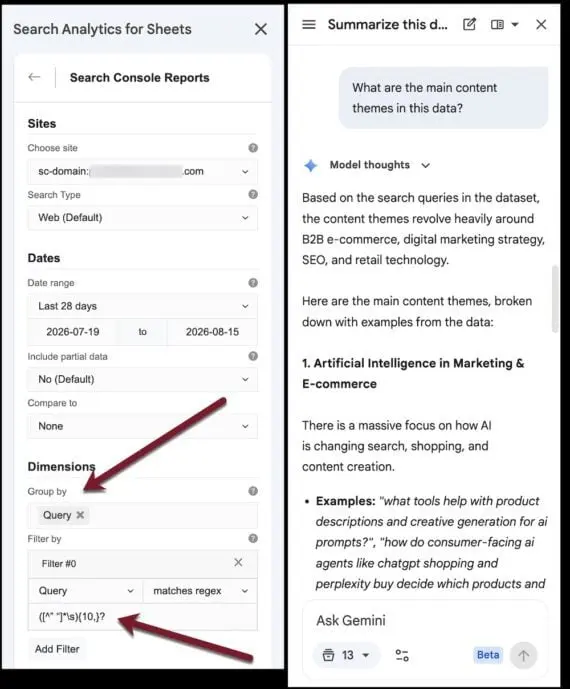
- Enter a regex filter designed to capture long strings of text. For example, to isolate queries containing ten or more words, input:
([^" "]*s)10,? - Apply the filter.
You will immediately see your dashboard populate with long, conversational, question-based search terms that bear all the hallmarks of generative AI prompts. To catch multi-turn follow-ups (such as "yes," "tell me more," or "show me the pricing"), adopt the expanded regex variations shared by industry experts like Jean-Christophe Chouinard, which filter for conversational continuity markers.
2. Bypassing Front-End Limits via API and Third-Party Tools
While the GSC front-end interface is helpful for quick spot-checks, it limits the depth of historical data and exportable rows. To conduct comprehensive text mining, you must tap into the Search Console API.
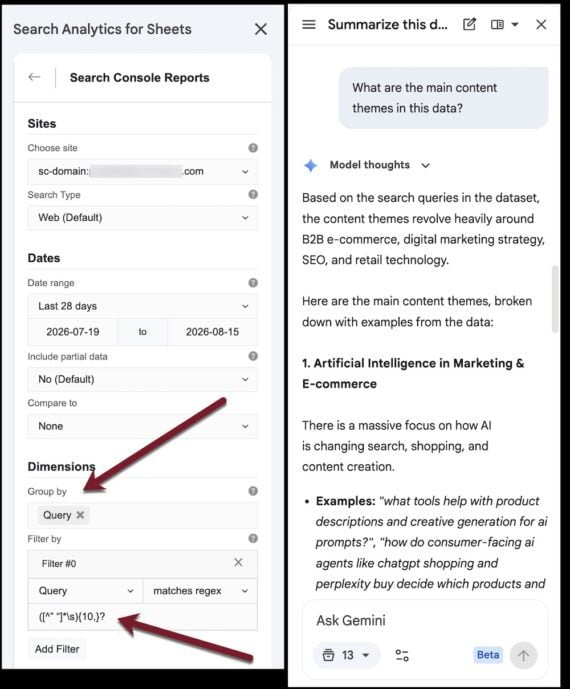
For marketers lacking dedicated engineering resources, free third-party tools provide a secure bridge:
- Search Analytics for Sheets: A widely trusted, free Google Sheets extension that pulls raw GSC data directly into a spreadsheet environment via the API.
- Custom Gemini/LLM Sidebars: Once the data is exported into Google Sheets, marketers can pair the spreadsheet with integrated AI sidebars (such as Gemini or ChatGPT plugins) to automatically categorize thousands of long-tail queries into cohesive content themes, intent clusters, and unaddressed consumer pain points.
Note: While third-party integrations require granting data access to external tools—a valid privacy consideration for enterprise brands—the analytical payoff in export capabilities, sorting efficiency, and thematic clustering is unmatched.
Official Statements and Industry Implications
The realization that AI Mode bleed is occurring inside Search Console forces an urgent re-evaluation of how brands measure digital visibility.
Google’s acknowledgment via John Mueller underscores a broader reality: the lines separating traditional organic search, programmatic answers, and generative conversational interfaces are blurring beyond recognition. Google is no longer just indexing web pages to match keywords; it is orchestrating multi-turn dialogues where the search engine acts as an intermediary consultant.
For SEO and content strategy teams, the implications are profound:
- Optimization is shifting from Keywords to Context: Ranking for a single keyword is no longer sufficient. Brands must structure their content to answer nuanced, multi-layered questions that mirror conversational prompts. If your content cannot be easily parsed and synthesized by an LLM answering a complex user prompt, you risk becoming entirely invisible in AI-driven interfaces.
- The Rise of "Zero-Click" Content Strategy: Because AI modes answer queries natively on the results page, traditional click-through rate (CTR) metrics are losing their predictive power. Success must be redefined around generative share of voice—ensuring your brand, product attributes, and proprietary data are cited as foundational sources within the AI’s synthesized response.
- Granular Intent Mapping: By analyzing the exact wording of discovered prompts through regex filtering, content creators can reverse-engineer the precise mental models of their target audience. Instead of guessing what buyers care about based on broad keyword tools, marketers can read verbatim prompts detailing specific budget constraints, technical limitations, and feature comparisons.
Future Outlook: The Next Frontier of Search Visibility
As we look toward the horizon of digital marketing, the accidental exposure of AI prompts in Google Search Console marks the end of an era of complete opacity, but it is merely the opening salvo in a much larger transformation.
In the coming years, search engines will inevitably build native, transparent reporting dashboards specifically designed for generative AI interactions. Until then, the burden falls on proactive digital marketers to manually extract, clean, and interpret this data using regex filters, API connectors, and AI-assisted text clustering.
The message to the SEO community is unequivocal: the tools of yesterday—static keyword research, basic volume metrics, and linear ranking trackers—are no longer enough to map the modern customer journey. The future belongs to those who learn to intercept, decode, and optimize for the conversational prompt. By treating Search Console not just as a keyword tracker, but as a window into generative AI dialogues, forward-thinking brands can decode the ultimate black box and secure their place in the conversational economy.