






Executive Overview
The rapid, relentless expansion of artificial intelligence (AI) and high-density GPU computing is pushing traditional data center infrastructure to its physical and thermodynamic limits. For decades, the electrical grid and the internal distribution systems of data centers have relied primarily on alternating current (AC). However, as rack densities skyrocket to accommodate power-hungry clusters of specialized AI accelerators, this legacy setup is revealing critical chokepoints.
To overcome these hurdles, the industry is undergoing a seismic architectural shift toward high-voltage direct current (HVDC) power distribution. At the center of this transition are solid-state transformers (SSTs)—advanced power electronics systems capable of converting medium-voltage (MV) grid alternating current directly into an 800V DC bus.
By eliminating multiple intermediate conversion steps, shrinking equipment footprints, and seamlessly integrating renewable energy sources and battery energy storage systems (BESS), SSTs are emerging as the holy grail for next-generation AI data centers. Yet, despite their immense potential to rewrite the rules of data center power delivery, the technology faces notable hurdles, including supply chain maturity, strict manufacturing tolerances, and divergent opinions among infrastructure engineers regarding the optimal path forward.
Detailed Chronology of the DC Shift and SST Evolution
The trajectory toward direct current data center architectures has accelerated dramatically over the past several years, driven by the unique power demands of generative AI workloads.
- The Pre-AI Baseline (Late 2000s to Late 2010s): Data centers operated almost exclusively on traditional low-frequency iron-core transformers. AC power stepped down progressively from utility transmission levels to medium voltage, low voltage, and finally to 12V or 48V at the server rack level. Energy conversion losses accumulated at every single handoff, but because rack densities remained relatively modest (under 10 kilowatts), these inefficiencies were manageable.
- The AI Inflection Point (2022–2023): The explosion of large language models (LLMs) caused rack power densities to jump exponentially, often exceeding 40kW to over 100kW per rack. Traditional AC distribution architectures began to buckle under the strain of voltage transients, massive copper cabling weight, and cumulative conversion losses. Hyperscalers and open-source hardware communities began exploring higher voltage configurations.
- The 800V DC Specification Emergence (2024): Organizations like the Open Compute Project (OCP), alongside industry leaders like NVIDIA, began formalizing specifications for 800V DC distribution inside data centers. This shift minimized internal resistance losses and allowed power to be routed more efficiently directly to server sleds before stepping down to 48V.
- Commercial Introductions and Public Demonstrations (2025): Power and thermal management leaders, such as Delta, unveiled groundbreaking solid-state transformer platforms capable of direct MV-to-800V DC conversion with efficiencies reaching up to 98.5%. These systems were showcased prominently at events like the OCP Global Summit 2025, transitioning from laboratory concepts to active pilot deployments across Asia and the United States.
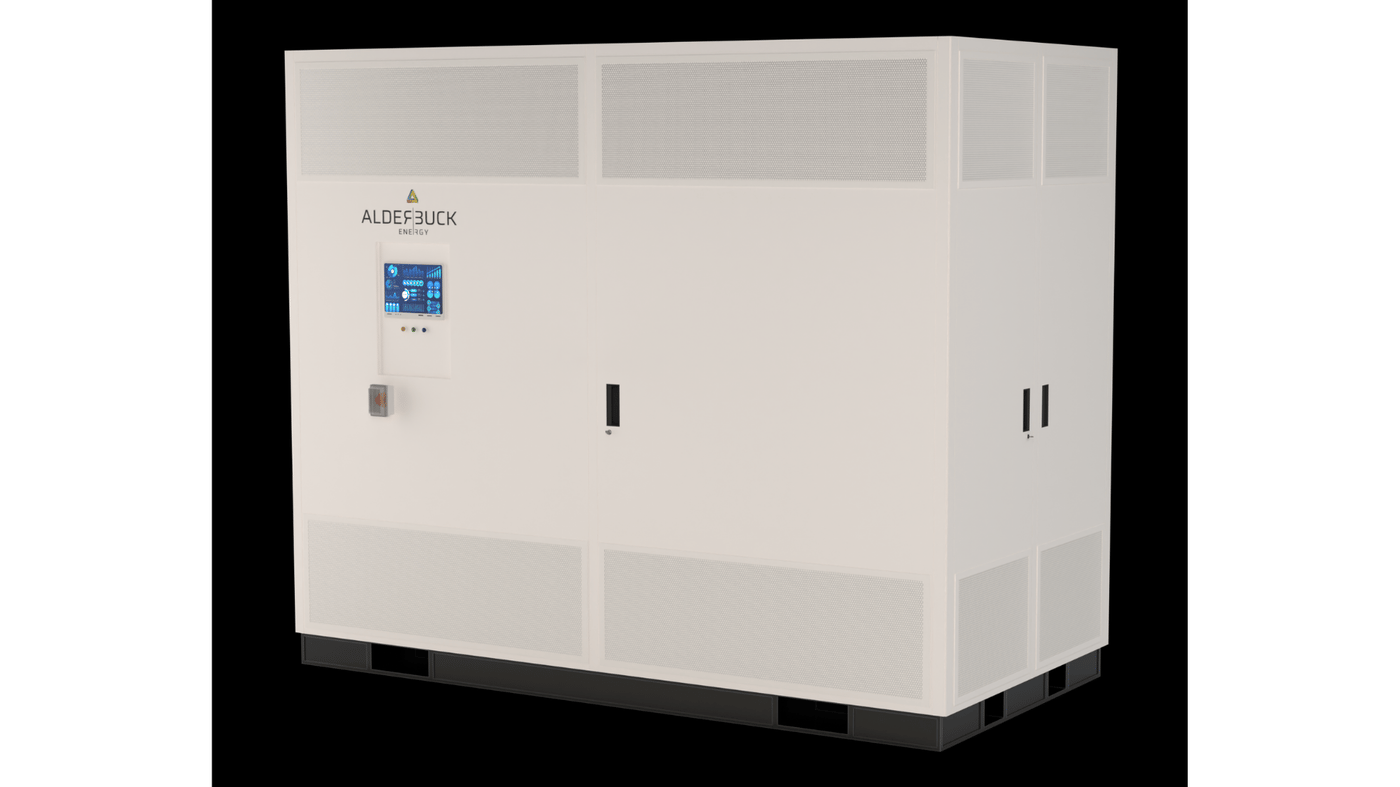
- Real-World Pilot Deployments (2026 and Beyond): Innovative hardware developers, including Alderbuck Energy, began field-testing software-defined SST units—such as the Nexus Power Unit—at premier research facilities like the San Diego Supercomputer Center at UC San Diego. Industry analysts project that scaled deployments among hyperscalers will ramp up aggressively through 2027, laying the groundwork for widespread commercial dominance by the mid-2030s.
Supporting Context & Metrics: Why Traditional AC Fails AI Workloads
To understand why solid-state transformers are capturing the attention of infrastructure directors, one must examine the fundamental arithmetic of modern AI workloads.
Traditional data center designs rely on bulky, heavy iron-core transformers that drop medium-voltage utility power (typically 15kV to 35kV) down to a low-voltage AC bus, which is then converted to DC via Uninterruptible Power Supply (UPS) systems, only to be inverted and reconverted multiple times before reaching the server processor. Each conversion stage introduces thermal waste and energy loss, resulting in cumulative efficiency penalties.
[Utility Grid: MV AC (15-35 kV)]
       │
       ▼ (Solid-State Transformer)
[Direct Conversion: 800V DC Bus] ──► (Integrates Solar & BESS Bidirectionally)
       │
       ▼ (Server Rack Level)
[Step-Down Conversion: 48V DC Rails] ──► (AI Accelerators / GPUs)
By contrast, modern SST technology consolidates these disparate electrical functions into a single, highly integrated power electronics package.
Key Performance Metrics & Advantages:
- Efficiency Gains: Advanced silicon carbide (SiC) semiconductor architectures allow Delta’s SST platforms to achieve up to 98.5% conversion efficiency directly from medium-voltage AC to an 800V DC bus.
- Footprint and Weight Reduction: Because SSTs leverage high-frequency magnetics instead of massive copper-and-iron coils, their physical cores are drastically smaller. This drastically shrinks the physical equipment footprint inside the data center, freeing up valuable whitespace for revenue-generating compute servers.
- Bidirectional Power Flow: Unlike legacy transformers that manage power in a single direction, SSTs enable seamless, two-way energy flow. This makes it significantly easier for data center operators to discharge onsite battery energy storage systems (BESS) or harvest local solar generation during peak grid demand periods.
- Power Conditioning: SSTs act as dynamic active filters. They scrub electrical noise, smooth out voltage and current oscillations, and protect sensitive downstream AI GPUs from catastrophic voltage transients.
Official Industry Perspectives and Expert Statements
The transition to solid-state transformers and high-voltage DC is far from a settled monolith; it represents a frontier where pioneering enthusiasm meets seasoned engineering caution.
The Bull Case for Direct MV-to-DC Conversion
Proponents of the technology emphasize that legacy power infrastructure is no longer compatible with the computational velocity of AI.
"The move from AC to DC can be hastened by the introduction of solid-state transformers that act as a higher-voltage foundation," notes Shen Wang, partner at Fortune Virtue Capital and former practice lead for global data center infrastructure research at Omdia.
Echoing this sentiment, Waqas Arshad, vice president of product and technology for microgrid solutions at Delta, highlights how engineering advancements have finally closed the gap between theoretical design and commercial reality:
"Power delivery has become a performance bottleneck… fueling conversion to 800V DC distribution, along with the chips (SiC) and control software finally catching up enough to make this kind of MV-to-DC conversion practical at scale and at the needed reliability."
Hardware developers like Rick Sander, CEO of Alderbuck Energy, see software-defined SST platforms as essential prerequisites for greenfield AI builds. Alderbuck’s Nexus Power Unit replaces traditional, discrete layers of equipment—including transformers, rectifiers, and inverters—while utilizing proprietary AI software to orchestrate energy flows across utilities, renewables, and storage in real time. Sander estimates that by 2028, the majority of new high-density installations will incorporate SSTs, with total industry dominance expected by 2035.
The Cautious Counterpoint: Risks, Tradeoffs, and Alternatives
Despite the enthusiasm surrounding solid-state architecture, several veteran power system manufacturers and grid equipment suppliers urge a measured approach.
Clayton Gibbons, head of power systems at power-conversion system manufacturer SPOC Energy, argues that pure solid-state MV-to-DC architectures still lack the universal supply-chain depth and long-term field maturity required for zero-failure data center operations. As a pragmatic bridge, SPOC advocates for a hybrid transformer-plus-rectifier approach. This alternative method leverages existing, mature medium-voltage supply chains while still achieving roughly 97.3% grid-to-rack efficiency, allowing operators to capture many of the benefits of DC power without betting the entire facility on an emerging platform.
Similarly, manufacturing giant Hitachi Energy points out the immense engineering physics challenges inherent in stepping down medium voltages like 34.5 kV within ultra-compact form factors. Vishak Gopinath, a spokesperson for Hitachi Energy, notes that maintaining a 20-year operational service life under high thermal and electrical stress demands exceptionally stringent insulation systems and flawless manufacturing quality. While Hitachi continues to invest heavily in underlying SST components—such as medium-voltage SiC semiconductors and advanced converter products—the company maintains that the technology must be carefully matched to specific use cases rather than applied universally overnight.
Future Outlook: A Phased Horizon
The transformation of data center power architecture will not happen overnight. Traditional AC-based infrastructure is deeply entrenched, and capital expenditures in mission-critical facilities demand absolute operational certainty.
Industry consensus points toward a phased evolution. Over the next 24 months, hyperscalers and cloud service providers are expected to lead the charge, deploying hybrid architectures that transition gradually from AC-native designs to intermediate 400V DC configurations, before ultimately standardizing on robust 800V DC ecosystems driven by solid-state transformers.
As software-defined energy management systems mature, semiconductor manufacturing yields improve, and pilot projects validate long-term reliability under grueling AI workloads, the solid-state transformer is poised to graduate from an innovative alternative to the absolute backbone of the 21st-century digital economy.