








Executive Overview
PostgreSQL has firmly established itself as the open-source relational database standard for modern enterprise applications. Renowned for its strict standards compliance, extensibility, and robust ecosystem, PostgreSQL powers critical workloads ranging from fast-growing cloud startups to mission-critical financial systems. However, as organizations scale their data footprints, technical decision-makers face a pivotal architectural choice: whether to deploy PostgreSQL as a self-managed infrastructure component or transition to a fully managed Platform-as-a-Service (PaaS) database solution.
This strategic evaluation revolves around balancing direct operational control against engineering capacity and platform resilience. Self-managed PostgreSQL—deployed on bare-metal servers, virtual machines (VMs), or custom Kubernetes clusters—offers total flexibility over operating system tuning, change schedules, and extension support. Conversely, managed cloud database environments, such as Azure Database for PostgreSQL and cloud-native decoupled engines like Azure HorizonDB, offload undifferentiated platform administration to the cloud provider.
                                  CLOUD SHARED RESPONSIBILITY MODEL
+-------------------------------------------------------------------------------------------------+
|   CUSTOMER RESPONSIBLE FOR: Data, Schema Design, Queries, Access Policies, Application Code    |
+----------------------------------------------------+--------------------------------------------+
|        SELF-HOSTED / IaaS DEPLOYMENT               |              MANAGED PaaS SERVICE          |
|  Customer manages:                                 |  Provider manages:                         |
|  - OS Patching & Kernel Tuning                     |  - Automated OS & Engine Patching          |
|  - Physical & Virtual VM Provisioning              |  - High Availability & Multi-Zone Failover |
|  - Manual High Availability & Failover Setup       |  - Storage Auto-Scaling & Backup Retention |
|  - Storage Monitoring & Disk Management            |  - Physical Infrastructure & Datacenter    |
|  - Local Credential Stores & Static Passwords      |  - Native Cloud IAM / Entra ID Integration |
+----------------------------------------------------+--------------------------------------------+
By reallocating engineering bandwidth from routine database maintenance to application logic, data architecture, and query optimization, managed services directly mitigate the growing "operational tax" inherent in operating relational databases at scale. This report provides an in-depth analysis of the architectural trade-offs, operational trajectories, security paradigms, and strategic criteria necessary to guide database hosting decisions.
Detailed Chronology: The Operational Lifecycle & Decision Trajectory
To understand why enterprise engineering teams eventually re-evaluate their database hosting strategies, it is necessary to examine the operational trajectory of a PostgreSQL deployment as it scales from initial rollout to enterprise maturity.
+--------------------------------------------------------------------------------------------------+
| PHASE 1: INITIAL DEPLOYMENT                                                                      |
| - Rapid deployment on VMs or local infrastructure.                                               |
| - Custom OS kernel parameters and tailored extensions applied.                                   |
| - Full root-level control over OS and filesystem configurations.                                 |
+--------------------------------------------------------------------------------------------------+
                                                 |
                                                 v
+--------------------------------------------------------------------------------------------------+
| PHASE 2: SCALE & THE "OPERATIONAL TAX" BOTTLE-NECK                                               |
| - Workload growth demands multi-node replication and high availability (HA).                     |
| - Maintenance burden escalates: OS patching, kernel upgrades, manual failover risks.              |
| - Incident risks peak: Storage exhaustion, WAL archive buildup, split-brain scenarios.            |
+--------------------------------------------------------------------------------------------------+
                                                 |
                                                 v
+--------------------------------------------------------------------------------------------------+
| PHASE 3: THE STRATEGIC RE-EVALUATION                                                             |
| - Cloud Shared Responsibility Model assessed across IaaS and PaaS alternatives.                  |
| - Engineering capacity re-evaluated: Infrastructure maintenance vs. Core feature velocity.       |
| - Shift toward managed solutions (e.g., Azure Database for PostgreSQL) initiated.               |
+--------------------------------------------------------------------------------------------------+
                                                 |
                                                 v
+--------------------------------------------------------------------------------------------------+
| PHASE 4: MODERNIZATION & CLOUD-NATIVE SCALING                                                    |
| - Implementation of automated lifecycle management, zero-downtime HA, and point-in-time recovery.|
| - Deployment of decoupled architectures (e.g., Azure HorizonDB) for high-scale IOPS and scale.  |
+--------------------------------------------------------------------------------------------------+
Phase 1: Initial Adoption & High-Control Deployment
In the early lifecycle of a product or platform, engineering teams frequently select self-hosted PostgreSQL deployed on virtualized infrastructure (e.g., cloud IaaS virtual machines or on-premises infrastructure). During this phase, the database footprint is modest, and the primary objective is custom flexibility. Systems administrators and database administrators (DBAs) configure specific operating system kernel parameters, install custom compilation flags, and deploy specialized C-based PostgreSQL extensions tailored to niche domain requirements. Root access to the underlying OS allows teams complete freedom over directory structures, local file systems, and custom process monitoring scripts.
Phase 2: System Growth and the Emergence of the "Operational Tax"
As transaction volumes increase and business requirements demand 24/7 availability, the operational overhead expands exponentially. The engineering team must construct, test, and maintain secondary infrastructure components:
- High Availability & Clustering: Setting up multi-node replication clusters using tools like Patroni or pg_auto_failover, along with distributed consensus stores (e.g., etcd or Consul) to handle automated leader election.
- Disaster Recovery Orchestration: Managing Write-Ahead Logging (WAL) archiving pipelines to object storage, configuring base backups, and regularly performing dry-run restoration validation.
- Capacity Management: Monitoring physical storage bounds to prevent out-of-disk conditions, which freeze database operations when Write-Ahead Logs consume all available storage space.
- Security & Patch Maintenance: Manually applying operating system security updates, database minor version patches, and managing static database user credentials across distinct application environments.
At this stage, the team encounters an "operational tax"—an ongoing allocation of skilled engineering capacity dedicated entirely to keeping the platform online, secure, and recoverable, rather than advancing application capabilities.
Phase 3: The Strategic Re-Evaluation & Crossroads
When senior engineering leadership observes that senior staff spend significant time handling routine database administration, on-call paging for disk alerts, and complex multi-node failover testing, a strategic crossroads is reached.
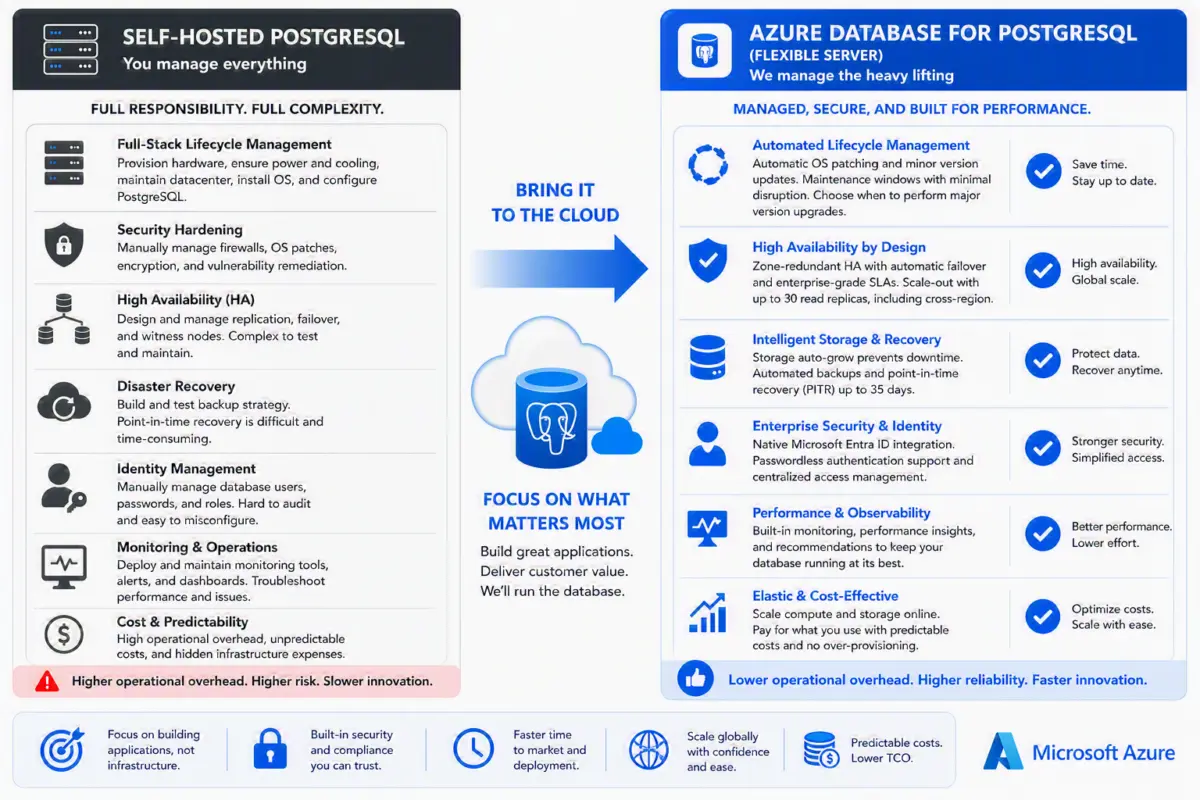
The organization re-evaluates its operational posture using the Cloud Shared Responsibility Model. Decision-makers evaluate whether maintaining operating systems, OS-level security patches, and complex replication topology scripts constitutes a core competitive advantage for the business.
Phase 4: Modernization and Cloud-Native Migration
Upon selecting a managed service model, the organization migrates workloads to platform services like Azure Database for PostgreSQL. Routine infrastructure maintenance, OS-level security patching, disk expansion automation, and multi-zone physical availability are transferred to the cloud provider.
For mission-critical enterprise workloads requiring extreme scale, organizations adopt decoupled compute-and-storage architectures, such as Azure HorizonDB, allowing compute nodes and storage layers to scale independently while offering built-in zone resilience and rapid read scale-out capabilities.
Supporting Context & Metrics: Evaluating the Operational Models
To rigorously compare self-managed PostgreSQL against managed PaaS offerings, technical teams must analyze operational realities across four primary engineering domains: Lifecycle Management, High Availability, Storage and Disaster Recovery, and Enterprise Security.
1. Automated Lifecycle Management
In a self-hosted configuration, minor version updates (e.g., updating PostgreSQL from version 15.2 to 15.4) and host operating system kernel updates require manual orchestration. System engineers must drain connections, execute updates during maintenance windows, and manage potential rollbacks.
Conversely, managed PostgreSQL services abstract operating system maintenance and automate minor version updates. Cloud providers execute service patching within user-defined maintenance windows, eliminating the need for manual kernel updates while preserving customer control over major-version upgrades (e.g., migrating from PostgreSQL 14 to 16) to ensure application compatibility testing.
2. High Availability (HA) and Fault Tolerance
Architecting high availability for self-hosted PostgreSQL requires deploying multiple nodes across distinct isolation zones, maintaining synchronous or asynchronous physical replication, and managing split-brain scenarios where network partitions lead two nodes to act as primary simultaneously.
In a managed PaaS model, high availability is provisioned as an architecture configuration rather than built manually. Providers deploy primary and standby nodes across separate Availability Zones with automated health monitoring, automated heartbeat detection, and automatic failover mechanisms backed by financially guaranteed Service Level Agreements (SLAs).

SELF-HOSTED HIGH AVAILABILITY (Manual Complexity)
+-----------------------+      Replication     +-----------------------+
|  Primary PostgreSQL   |--------------------->|   Standby PostgreSQL  |
|  (Requires Patroni/   |                      |   (Manual Monitoring &|
|   Consul Management)  |                      |    Failover Triggers) |
+-----------------------+                      +-----------------------+
            ^                                              ^
            +------------------- Network ------------------+
             (Risk of Split-Brain during partition events)

MANAGED PaaS HIGH AVAILABILITY (Provider Automated)
+----------------------------------------------------------------------+
| Cloud Provider Managed Availability Zone Control plane              |
|                                                                      |
|  +------------------------+      Sync      +----------------------+  |
|  |  Primary Engine (AZ1)  |===============>| Standby Engine (AZ2) |  |
|  +------------------------+                +----------------------+  |
|               |                                      |               |
|               v                                      v               |
|  +----------------------------------------------------------------+  |
|  |  Automated Health Checks, Multi-Zone DNS Routing & Failover    |  |
|  +----------------------------------------------------------------+  |
+----------------------------------------------------------------------+
3. Intelligent Storage, Backup, and Point-in-Time Recovery (PITR)
Storage management in self-hosted environments presents ongoing risk. Running out of disk space can lead to database corruption or forced shutdowns. Expanding disk volumes requires OS-level storage management (LVM allocation, file system resizing) and continuous physical capacity planning.
Managed services integrate dynamic storage scaling, automatically expanding disk capacity as data volumes grow. Backups are continuous and non-disruptive, taking advantage of underlying storage snapshots and automated WAL archiving. This enables point-in-time restoration (PITR) down to the second without custom backup scripts or external storage pipeline maintenance.
4. Enterprise Identity and Access Security
Security management varies significantly between operational models, particularly regarding credential management and identity integration:
| Security Domain | Self-Hosted PostgreSQL | Managed Service (e.g., Azure Database for PostgreSQL) |
|---|---|---|
| Authentication Paradigm | Static database passwords; manual credential rotation scripts; siloed database user stores. | Native cloud identity integration (e.g., Microsoft Entra ID); centralized IAM policies. |
| Credential Attack Surface | High risk of credential leaks in configuration files; static DB password management. | Passwordless authentication options; temporary short-lived access tokens. |
| Role Administration | DBAs manually provision roles and sync with corporate directories via custom LDAP. | Centralized group-based access management tied directly to corporate identity providers. |
| Network Isolation | Manual configuration of OS firewalls, iptables, and VPC security groups. | Built-in private networking, Private Link support, and automated network isolation options. |
Comparative Operational Framework
The following matrix provides a technical baseline for evaluating self-managed PostgreSQL against a managed PaaS service across core execution vectors:
+--------------------------------------------------------------------------------------------------------------------------+
| OPERATIONAL VECTOR     | SELF-MANAGED POSTGRESQL                          | MANAGED CLOUD SERVICE (PaaS)                         |
+------------------------+--------------------------------------------------+------------------------------------------------------+
| Infrastructure Control | Absolute access to OS, filesystem, & sysctl flags| Abstraction of OS layer; API/Portal configuration   |
+------------------------+--------------------------------------------------+------------------------------------------------------+
| Maintenance Burden     | Manual OS/engine patching and upgrade testing    | Automated minor updates & OS maintenance windows     |
+------------------------+--------------------------------------------------+------------------------------------------------------+
| High Availability      | Manual deployment of Patroni/etcd clustering     | Built-in multi-zone replication & auto-failover      |
+------------------------+--------------------------------------------------+------------------------------------------------------+
| Disaster Recovery      | Custom WAL archiving, pg_dump, manual dry-runs   | Automated, non-disruptive continuous PITR backups    |
+------------------------+--------------------------------------------------+------------------------------------------------------+
| Scalability Pattern    | Manual provisioning, storage expanding, sharding | Auto-scaling storage, read replicas, decoupled compute|
+------------------------+--------------------------------------------------+------------------------------------------------------+
| Security & Identity    | Local user tables, manual static password cycles  | Passwordless IAM / Entra ID, centralized audit logs  |
+------------------------+--------------------------------------------------+------------------------------------------------------+
| Engineering Focus      | Platform maintenance & infrastructure plumbing   | Application development, indexing, schema design     |
+--------------------------------------------------------------------------------------------------------------------------+
Strategic Evaluation Checklist for Technical Leaders
When deciding between a self-managed environment and a managed database service, engineering leadership should evaluate the following structural questions:
                           DECISION EVALUATION FLOWCHART
                                         |
                                         v
            +----------------------------------------------------------+
            | Do you require custom OS kernel access, non-standard OS  |
            | level tuning, or unverified custom C-extensions?         |
            +----------------------------------------------------------+
                                  /
                            YES  /              NO
                                /
                               v                v
                 +-------------------+   +---------------------------------------+
                 | PREFER:           |   | Do you have dedicated 24/7 DBA teams  |
                 | Self-Managed      |   | to manage HA, failovers, and recovery?|
                 | PostgreSQL        |   +---------------------------------------+
                 +-------------------+                 /
                                                 YES  /              NO
                                                     /
                                                    v                v
                                      +-------------------+   +-------------------+
                                      | EVALUATE:         |   | PREFER:           |
                                      | Both Models based |   | Managed PaaS      |
                                      | on TCO & Velocity |   | Service           |
+-------------------+ +-------------------+- Custom Extensibility Requirements: Does the workload depend on obscure, custom-compiled C-based extensions that are not supported by major cloud managed services?
- Infrastructure OS-Level Access: Does the engineering team require direct SSH root access to the database host or specific operating system sysctl kernel parameters?
- Engineering Capacity Allocation: Does the enterprise possess dedicated 24/7 platform engineering and DBA bandwidth to manage failover drills, storage expansion, and security patching?
- Recovery Time and Point Objectives (RTO / RPO): Are failover mechanics, cross-region disaster recovery, and point-in-time recovery required out of the box with defined SLAs?
- Identity & Governance Integration: Is there a mandatory requirement to bind database access directly to centralized cloud identity infrastructure (e.g., Microsoft Entra ID) without storing static passwords in configuration files?
Official Statements & Industry Perspective
Industry consensus among cloud platform architects and enterprise technology leaders emphasizes that the choice of database operating model directly reflects an organization’s internal resource strategy.
"The shift from self-hosting core infrastructure to managed platform services is fundamentally an architectural trade-off between absolute low-level control and product delivery velocity. When engineering teams spend their on-call shifts managing disk utilization alerts, recovery testing, and manual replication failovers, that energy is subtracted from core product innovation. Cloud PaaS models like Azure Database for PostgreSQL re-establish the demarcation line: the cloud platform manages operational resilience, while the enterprise focuses on data modeling, query optimization, and application value creation."
— Cloud Infrastructure & Database Architecture Perspective
Technical decision-makers view managed services as a method for reallocating risk. By delegating physical hosting, OS patching, hardware redundancy, and multi-zone failover mechanisms to hyperscale providers, organizations leverage platform SLAs to reduce the risk of downtime caused by operational oversight or manual configuration errors.
Future Outlook: The Evolution of Cloud-Native PostgreSQL
The landscape of PostgreSQL deployments continues to shift toward cloud-native abstractions that resolve the traditional trade-off between control and operational overhead.
                                NEXT-GENERATION PARADIGM
+--------------------------------------------------------------------------------------+
| DECOUPLED COMPUTE & STORAGE ARCHITECTURE (e.g., Azure HorizonDB)                      |
|                                                                                      |
|  +-------------------+  +-------------------+  +-------------------+                 |
|  | Read/Write Engine |  | Read Replica Node |  | Read Replica Node | (Stateless)     |
|  +-------------------+  +-------------------+  +-------------------+                 |
|            |                      |                      |                           |
|  ==========+======================+======================+=========================  |
|                                High-Speed Storage Bus                                |
|  ==========+======================+======================+=========================  |
|            |                      |                      |                           |
|  +-----------------------------------------------------------------+                 |
|  | Distributed, Auto-Scaling Shared Storage Layer (Zone-Resilient) | (Stateful)      |
|  +-----------------------------------------------------------------+                 |
+--------------------------------------------------------------------------------------+
1. Cloud-Native Decoupled Architectures
Traditional relational database engines tightly couple compute resources (CPU/RAM) with attached storage media. Modern architectures, exemplified by solutions like Azure HorizonDB, decouple compute processing nodes from underlying distributed storage layers.
This architectural decoupling enables:
- Independent Elasticity: Scaling processing compute up or down instantly without dynamic storage re-provisioning or continuous block-copying.
- Rapid Read Scaling: Deploying multiple stateless read replicas that attach to the shared underlying storage layer, significantly lowering replication latency.
- Zone Resilience: Ensuring state persistence at the distributed storage tier so compute node failures can be resolved without risk of data loss.
2. AI-Driven Performance Tuning and Maintenance
Future cloud database platforms are increasingly integrating artificial intelligence and machine learning pipelines directly into the database engine control plane. Managed PostgreSQL services will increasingly offer:
- Autonomous Query Tuning: Automated identification of missing indexes, missing query execution statistics, and suboptimal query plans.
- Predictive Storage & Compute Scaling: Machine learning models that project upcoming traffic spikes or disk growth based on historical trends, dynamically scaling resources ahead of demand.
- Self-Healing Security Configurations: Real-time detection of anomalous query behavior, automated mitigation of potential SQL injection vectors, and automatic quarantine of compromised credentials.
3. Integrated Vector & Hybrid Search Workloads
With the rapid integration of Generative AI and vector search technologies into enterprise applications, extensions like pgvector have positioned PostgreSQL as a hybrid database capable of serving traditional relational data alongside vector embeddings. Managed services are streamlining the execution of these workloads by providing hardware acceleration, optimized vector indexing strategies, and automated scaling designed specifically for enterprise AI query workloads.
Conclusion
Choosing between self-managed PostgreSQL and a managed cloud service is a strategic decision that aligns engineering bandwidth, risk tolerance, and platform capabilities with core business goals.
While self-hosting offers ultimate control for specialized use cases with unique OS-level requirements, managed cloud database services—including Azure Database for PostgreSQL and Azure HorizonDB—provide an operating model designed to eliminate undifferentiated heavy lifting. By adopting a managed platform approach, enterprise decision-makers can reduce operational risk, enforce enterprise-grade security standards, and focus engineering resources directly on delivering application innovation.