








Executive Overview
For nearly three decades, corporate cybersecurity strategies have rested on a predictable foundation: a vulnerability is identified, a Common Vulnerabilities and Exposures (CVE) identifier is assigned, security operations teams assess their risk, patches are verified in staging environments, and code updates are deployed to production before adversaries can execute exploits at scale.
That traditional remediation lifecycle is now structurally broken.
An unprecedented convergence of factors—hyper-distributed multicloud architectures, zero-downtime business imperatives, and the integration of artificial intelligence by malicious actors—has drastically compressed the time between vulnerability disclosure and active weaponization. Where defensive teams once measured their response windows in weeks or days, threat actors now execute automated internet-scale scanning and exploit campaigns within hours of public disclosure.
+-------------------------------------------------------------------+
|                   TRADITIONAL REMEDIATION TIMELINE                |
|  Disclosure ---> Assessment ---> Testing ---> Deployment (Weeks)  |
+-------------------------------------------------------------------+
|                     MODERN THREAT TIMELINE                        |
|  Disclosure -> Automated PoC -> Global Scanning (Hours)           |
+-------------------------------------------------------------------+
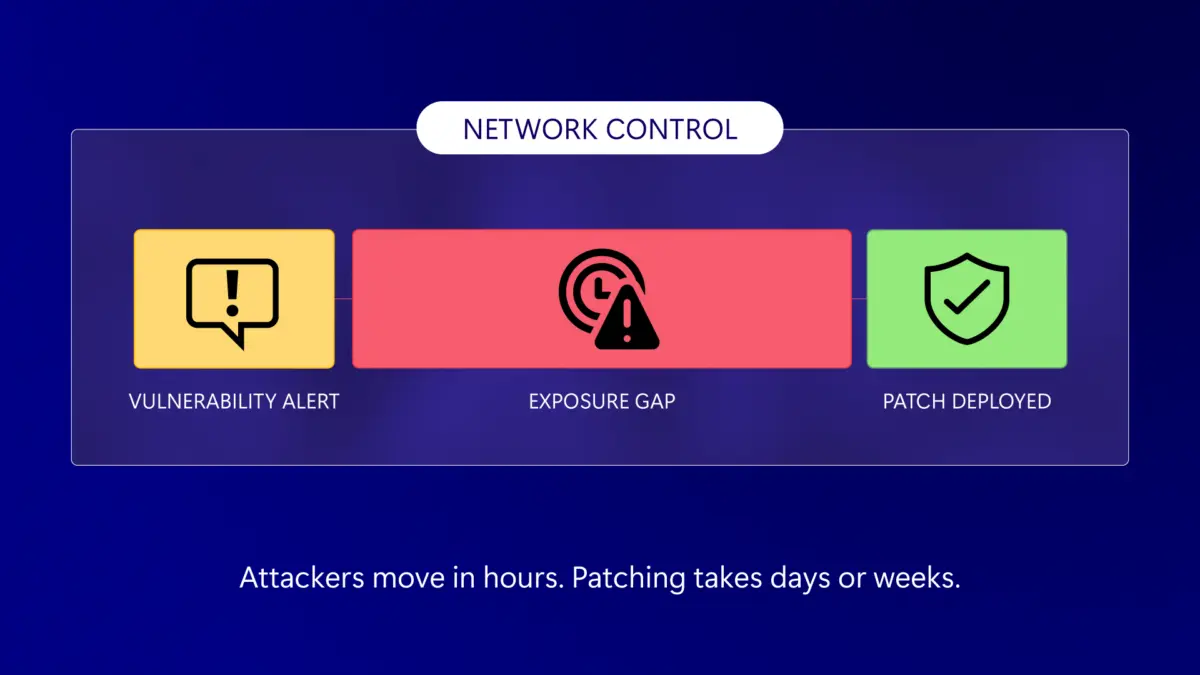
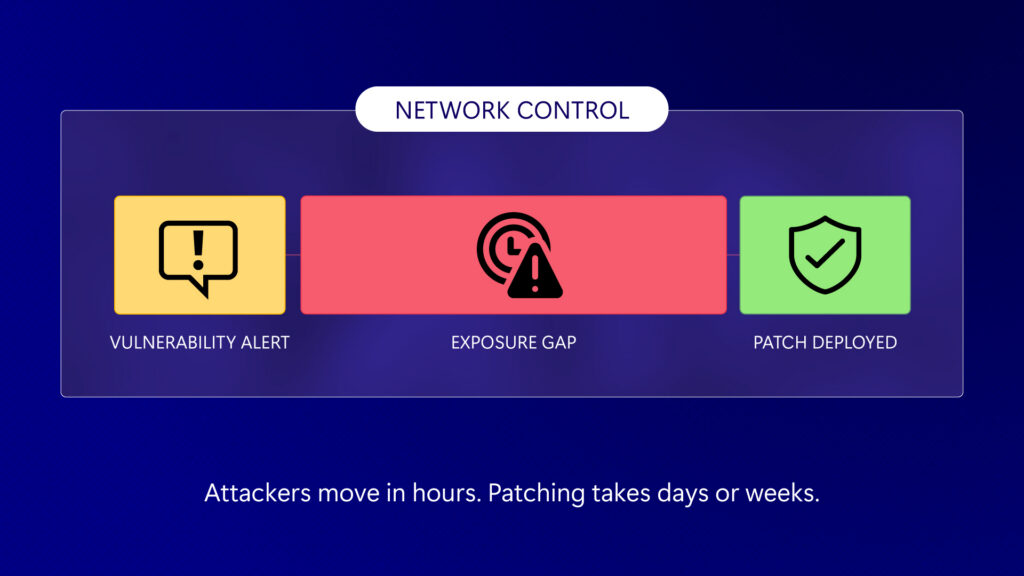
Because modern enterprise applications power non-negotiable revenue streams, operations teams cannot simply take core systems offline for emergency patching without causing severe operational disruption. As a result, organizations face an expanding exposure gap—the period during which a flaw is widely known, actively targeted, but operationally unpatchable at the code level.
To survive this era of collapsed response windows, enterprise defense is undergoing a fundamental architectural shift. Security leaders are moving beyond passive "exposure awareness" toward dynamic "exposure reduction," leveraging the network layer as an adaptive, pre-emptive enforcement fabric capable of containing threats at machine speed before permanent patches can be deployed.
Detailed Chronology: The Collapse of the Vulnerability Lifecycle
The structural failure of traditional patch management did not occur overnight. It is the result of a multi-decade evolution in how software is built, deployed, and exploited.
       1990s - 2010s                 2010s - 2020                  2023 - Present
+-------------------------+   +-------------------------+   +-------------------------+
|    Monolithic Era       |   |    Cloud & API Era      |   |   AI-Accelerated Era    |
| • On-prem infrastructure|   | • Hybrid/multicloud     |   | • LLM-assisted exploit  |
| • Scheduled patch cycles|   | • Microservices & APIs  |   |   generation            |
| • Manual PoC development|   | • 24/7 uptime demands   |   | • Automated internet-   |
| • Windows measured in   |   | • Windows measured in   |   |   scale exploitation    |
|   weeks or months       |   |   days                  |   | • Windows measured in   |
|                         |   |                         |   |   hours                 |
+-------------------------+   +-------------------------+   +-------------------------+
Phase 1: The Monolithic Era (1990s–2010s)
In the early days of enterprise IT, infrastructure was primarily on-premises, centralized, and monolithic. Software update cycles were slow, predictable, and manageable.
- Security advisories were published periodically (such as Microsoft’s establishing of "Patch Tuesday" in 2003).
- Security teams maintained explicit maintenance windows, frequently shutting down servers overnight or over weekends to apply hotfixes.
- Developing a reliable proof-of-concept (PoC) exploit required deep reverse engineering, manual shellcode assembly, and substantial time, granting defenders a natural buffer.
Phase 2: The Cloud & API Expansion (2010s–2020)
The rapid migration to hybrid cloud environments, microservice architectures, and continuous delivery models expanded the corporate attack surface exponentially.
- Enterprise footprints decentralized across third-party infrastructure, container platforms (Kubernetes), and software-as-a-service (SaaS) APIs.
- Business units began enforcing strict high-availability service level agreements (SLAs), drastically narrowing or eliminating maintenance windows.
- Public exploit repositories, automated security research tools, and specialized bug-bounty markets accelerated the circulation of exploit code, cutting the average patch window from months down to a few days.
Phase 3: The AI-Accelerated Present (2023–Present)
The integration of large language models (LLMs) and advanced machine learning into defensive and offensive toolkits marked a permanent shift in adversary economics.
- Offensive tools now utilize AI to parse security advisories, analyze open-source code commits, synthesize technical dependencies, and generate functional PoC scripts in near-real time.
- Automated botnets execute global, protocol-level scanning campaigns within minutes of a bug’s publication.
- Defenders, bound by compliance mandates, strict regression testing, inter-dependency mapping, and change-management approvals, remain trapped in multi-day operational workflows while threats move at network speed.
Supporting Context & Metrics: The Asymmetry of Modern Enterprise Defense
The fundamental challenge confronting modern Security Operations Centers (SOCs) is a structural asymmetry: Defenders must successfully defend every workload, application, microservice, and network interface; attackers only need to find a single unpatched entry point.
                                ENTERPRISE DEFENSE ASYMMETRY

         DEFENDER RESPONSIBILITY                        ATTACKER ADVANTAGE
+---------------------------------------+      +----------------------------------+
|  • Thousands of hybrid workloads      |      |  • Needs only ONE viable path    |
|  • Legacy databases & containers      |  VS  |  • AI-driven automated scanning   |
|  • Complex multi-app dependencies     |      |  • Instant global propagation    |
|  • Mandated validation & testing      |      |  • Zero change-control barriers   |
+---------------------------------------+      +----------------------------------+
The Operational Realities of Enterprise Patching
Delaying a patch is rarely the result of defensive negligence. Rather, it is driven by the legitimate risks associated with updating production infrastructure. Modern enterprise environments must regularly navigate complex operational constraints prior to deploying code fixes:
- Dependency and Regression Testing: Modern software relies heavily on deeply nested third-party libraries. Updating a single core component can cause cascading failures across interconnected business logic.
- Uptime and Revenue SLAs: Industrial manufacturing lines, financial transaction processing engines, and healthcare infrastructure operate under zero-downtime mandates. Taking systems offline without planned, business-approved windows can cost millions of dollars per hour.
- Legacy and Unsupported Systems: Organizations frequently depend on legacy applications that lack active vendor support, making native code patching impossible without expensive re-architecting.
- Regulatory and Compliance Oversight: Highly regulated sectors (such as defense, banking, and pharmaceutical production) require documented validation procedures before applying changes to certified IT systems.
The Weaponization Speed Gap
+----------------------------------------------------------------------------------+
|                              THE EXPOSURE GAP                                    |
|                                                                                  |
| Threat Timeline:    [ Disclosure ] =======> [ AI Exploitation ] (Hours)          |
|                                                     |                            |
|                                                     | <--- CRITICAL EXPOSURE     |
|                                                     |      WINDOW                |
|                                                     v                            |
| Defense Timeline:   [ Disclosure ] ==========================> [ Patch ] (Days)   |
+----------------------------------------------------------------------------------+
Data from threat intelligence research highlights a stark reality: the time between the public disclosure of a high-severity CVE and the detection of active internet-wide scanning has dropped below 24 hours for critical vulnerabilities, with targeted exploitation frequently observed within 3 to 6 hours. Conversely, the average enterprise enterprise Mean Time to Remediation (MTTR) for critical vulnerabilities continues to range between 15 and 30 days.
This disconnect reveals a crucial limitation in current security investments. Over the last decade, organizations spent billions on vulnerability scanners, threat intelligence feeds, and Security Information and Event Management (SIEM) tools. While these technologies successfully improved exposure awareness, they provided little capacity for immediate risk reduction. Knowing that a critical core server is vulnerable offers zero protection if applying the fix requires a two-week testing cycle.
Case Study in Adaptive Mitigation: Protocol-Level Bounding
To understand the difference between rigid application updates and dynamic network mitigations, consider a high-severity vulnerability discovered in the handling of the HTTP/2 protocol (such as continuous frame flooding or stream manipulation attacks).
                      STRATEGIC RESPONSE COMPARISON

     TRADITIONAL / BLUNT RESPONSE            CONTEXT-AWARE ADAPTIVE RESPONSE
+--------------------------------------+  +-------------------------------------+
| • Disable HTTP/2 globally            |  | • Retain HTTP/2 protocol enabled    |
| • Forces downgrade to HTTP/1.1       |  | • Limit max concurrent streams      |
| • Causes major latency & app degradation|  | • Apply dynamic connection rate limits|
| • Requires server restarts & downtime|  | • Zero application downtime         |
+--------------------------------------+ +-------------------------------------+- The Traditional / Rigid Approach: The primary mitigation guide might instruct administrators to disable HTTP/2 entirely across reverse proxies and application gateways. While this stops the attack vector, it forces applications back to HTTP/1.1, triggering severe performance degradation, network latency, and broken client experiences. Alternatively, organizations must wait for emergency software builds, run them through staging environments, and schedule off-hours cluster restarts.
- The Adaptive Network Approach: Instead of taking applications offline or disabling essential protocols, an adaptive network control layer evaluates the precise mechanism of the exploit. It dynamically applies traffic constraints—such as capping concurrent stream creation, tightening frame size limits, and enforcing rate limiting on abusive request patterns—specifically neutralizing the exploit path while keeping legitimate HTTP/2 application traffic fully operational.
Technical Comparison: Endpoint Patching vs. Network-Enforced Virtual Control
To address the vulnerability window effectively, security architectures are prioritizing edge- and network-level enforcement mechanisms over exclusive reliance on host-level fixes.
| Capability / Dimension | Host/Application-Level Patching | Network-Enforced Adaptive Control |
|---|---|---|
| Deployment Speed | Slow (Days to Weeks due to testing/approvals) | Near-Instantaneous (Minutes via policy distribution) |
| Operational Risk | High (Potential regression bugs, server downtime) | Very Low (No application code changes required) |
| Scope of Coverage | Fragmented (Requires individual host/agent access) | Universal (Protects heterogeneous multicloud workloads) |
| Enforcement Mechanism | Code modification / binary replacement | Context-aware protocol filtering & dynamic rate-limiting |
| Business Impact | Potential disruption to active services | Zero disruption; preserves application availability |
| Primary Objective | Permanent structural remediation | Immediate risk containment & exposure reduction |
Official Statements and Industry Perspectives
Security executives, public cloud architects, and threat researchers increasingly agree that traditional vulnerability management lifecycle models must evolve to handle modern threat speeds.
"The assumption that enterprises can out-patch modern, AI-assisted threat actors through manual or standard change-management pipelines is no longer viable," notes enterprise cloud security architects. "We must accept that systems will remain unpatched for periods of time. The operational mandate is to place intelligent, adaptive controls in the communication path that neutralize exploit mechanics without disrupting the underlying business service."
In official technical briefs regarding next-generation cloud infrastructure, platform engineers at Microsoft emphasized the shift toward inline network capabilities:
"As AI compresses the time between vulnerability disclosure and exploitation, organizations need a defensive layer that can act immediately, without waiting for every workload to be patched, every application to be modified, or every endpoint agent to understand a new threat. Microsoft is investing in new and innovative capabilities able to provide immediate protection from the storm, buying organizations the time they need to safely validate and deploy a permanent patch without exposing their environment to unnecessary risk."
Industry analysts reinforce this perspective, emphasizing that the primary resource modern SOCs lack is not visibility or threat intelligence, but time. By deploying inline adaptive controls, enterprises convert emergency operational fire-drills into structured, predictable remediation processes.
Future Outlook: The Era of Autonomous, Adaptive Cyber Defense
As the security landscape matures, the industry is moving away from static, signature-based defenses and scheduled maintenance cycles toward Adaptive Security Architectures. Driven by real-time telemetry and cloud-scale machine learning, these systems dynamically adjust defensive posture as threat conditions evolve.
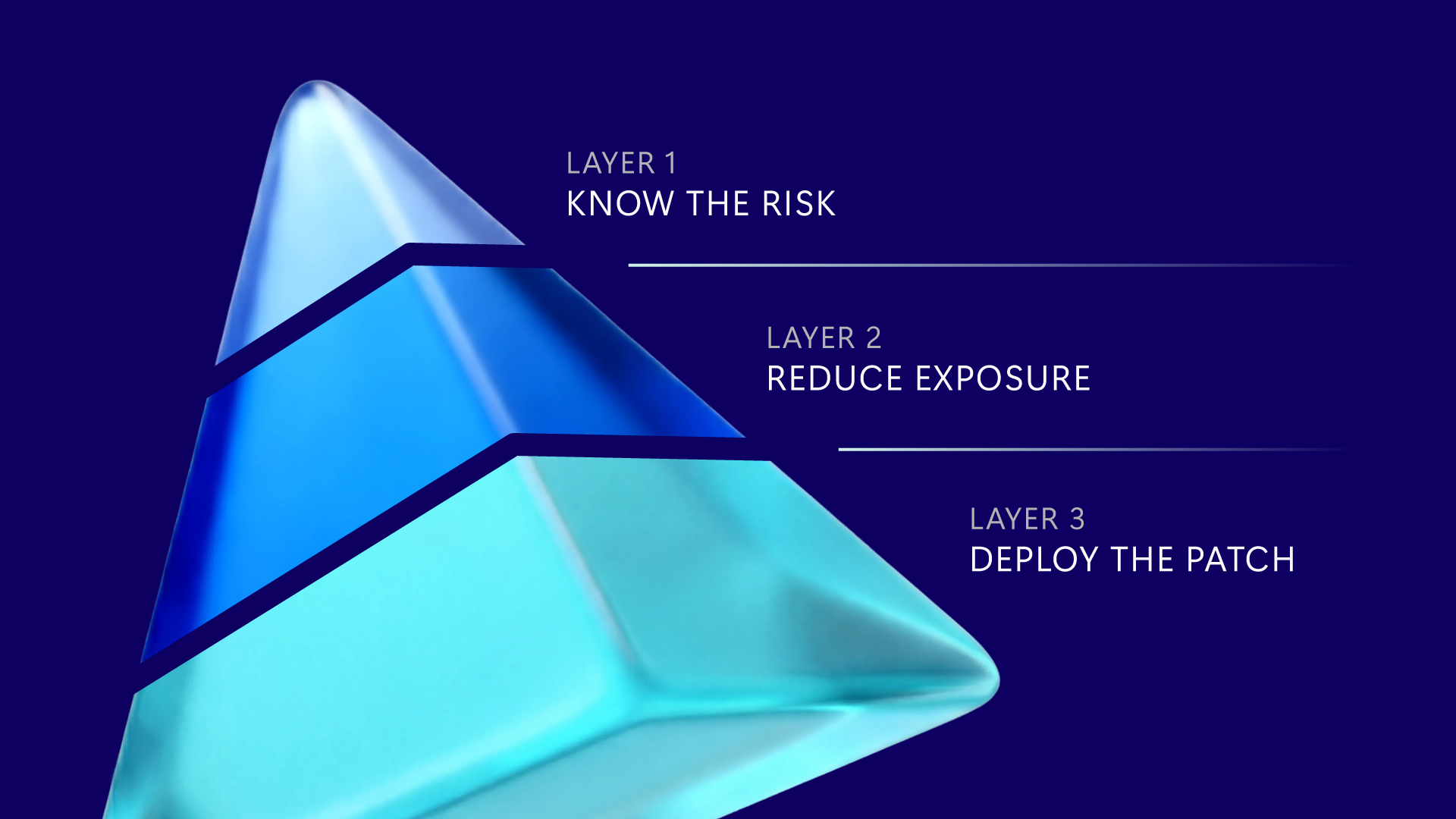
                  THE THREE-PILLAR ADAPTIVE DEFENSE FRAMEWORK

  +------------------------------------------------------------------------+
  |  1. DEEP VULNERABILITY INTELLIGENCE                                    |
  |     • Automated parsing of advisories, research, & PoC structures     |
  +------------------------------------------------------------------------+
                                     |
                                     v
  +------------------------------------------------------------------------+
  |  2. REAL-WORLD ENVIRONMENTAL CONTEXT                                   |
  |     • Mapping connectivity, topologies, asset exposure, & flows        |
  +------------------------------------------------------------------------+
                                     |
                                     v
  +------------------------------------------------------------------------+
  |  3. AUTOMATED NETWORK ENFORCEMENT                                      |
  |     • Dynamic behavior bounding, traffic filtering, & isolation        |
  +------------------------------------------------------------------------+
The Three Pillars of Adaptive Security
Future-ready enterprise security ecosystems are built upon three core operational capabilities:
- Automated Vulnerability Comprehension: Utilizing generative AI and natural language processing to continuously ingest vulnerability disclosures, security research papers, threat feeds, and code diffs. The system automatically extracts the precise mechanisms an exploit requires (e.g., specific HTTP headers, payload sizes, or protocol sequences).
- Environmental & Contextual Correlation: Automatically mapping extracted vulnerability profiles against the enterprise’s live infrastructure context. The defensive architecture assesses topology, active connection paths, application dependencies, and existing security postures to determine actual exposure—eliminating false alarms for isolated systems.
- Automated, Dynamic Enforcement Fabric: Translating contextual intelligence into immediate network-level mitigations. Instead of relying on manual firewall configuration changes, the network infrastructure dynamically adjusts policy—implementing temporary virtual patches, rate-limiting suspect behaviors, restricting inter-service communication, and altering trust requirements.
Moving Beyond IP and Port Restrictions
The network fabric of the future operates well beyond traditional Layer 3 and Layer 4 controls. Legacy approaches that simply block IP addresses or close transport ports are too blunt for modern application environments, where traffic is routinely multiplexed over shared endpoints and encrypted connections.
Next-generation adaptive fabrics act at the application and protocol layer. By monitoring traffic behavior in real time, these platforms can isolate malicious transactions while maintaining full connectivity for legitimate users. This capability effectively bridges the gap between threat discovery and vendor patch deployment.
Conclusion
Vulnerabilities are an inevitable reality of complex software systems, and threat actors will continue leveraging automation and AI to target exposed code faster than ever before. However, the breakdown of the traditional patch window does not render enterprise environments defenseless.
By prioritizing rapid exposure reduction over reactive patching, enterprise security teams can neutralize emerging zero-day threats at the network boundary. Leveraging adaptive, context-aware network protections allows organizations to break the speed advantage of modern adversaries—buying security operations teams the most critical asset in modern cybersecurity: time to patch safely.