







Executive Overview
For decades, corporate content marketing operated on a foundation of creative intuition, guesswork, and vanity metrics. Organizations poured millions of dollars into publishing volumes of blog posts, whitepapers, and videos, relying on crude measurements like page views and raw traffic to justify budgets to executive leadership. In today’s hyper-competitive digital economy, that legacy approach is no longer viable. Publishing content without connected measurement and precise distribution is not a strategy; it is a financial liability that leads to wasted ad spend, unread assets, and missed revenue targets.
A modern content marketing ecosystem only generates direct, measurable business value when marketing teams distribute assets through data-backed channels to reach buyers at the precise moment of intent. Bridging the gap between creative output and financial return requires the integration of modern marketing business intelligence (BI). By fusing audience research, cross-channel distribution networks, and advanced performance analytics into one aligned system, organizations can transform content from a cost center into a predictable, high-yielding revenue driver.
According to recent industry research, 58% of B2B marketers describe their current strategy as only moderately effective. This widespread underperformance is rarely a failure of creative talent; rather, it stems from a fundamental structural flaw: producing assets in a vacuum without clear goals, rigorous data collection, or a deep understanding of buyer intent. When enterprises align their editorial calendars with real-time user signals, they eliminate waste, optimize conversion pathways, and build sustainable engines for growth.
Detailed Chronology: The Evolution of Content Measurement
To understand the urgent need for business intelligence in marketing, it is necessary to examine how the discipline has evolved over the past twenty years. The transition from art-driven publishing to science-driven distribution has fundamentally reshaped corporate organizational structures.
Phase 1: The Age of Volume and Vanity Metrics (Late 2000s – Mid 2010s)
In the early days of corporate blogging and content marketing, the primary objective was establishing an online footprint. Search engine optimization (SEO) was largely transactional, focusing on keyword density and backlink accumulation rather than user intent or comprehensive value. During this era, marketing success was measured almost exclusively through top-of-funnel indicators: unique visitors, page impressions, and social media likes.
Leadership teams accepted these metrics because digital channels were still nascent. However, this approach created a dangerous disconnect. Millions of visitors could land on a website, read an article, and leave without the company ever knowing who they were, what problems they faced, or whether they had any intention of purchasing. Content production scaled exponentially, but accountability remained stagnant.
Phase 2: The Rise of Marketing Automation and Lead Scoring (Mid 2010s – 2020)
As digital channels matured, the introduction of marketing automation platforms (MAPs) and CRM integrations allowed organizations to track user behavior past the initial click. Marketers began capturing email addresses through gated whitepapers and webinars, assigning numerical scores to prospect activities based on downloads, form fills, and email opens.
While this era introduced greater accountability, data silos remained a persistent obstacle. Content teams operated within content management systems (CMS), demand generation teams worked inside email platforms, and sales teams lived in CRMs. Data rarely flowed seamlessly between these systems, resulting in fragmented customer journeys and inaccurate attribution models. Content creation was still frequently disconnected from the hard operational realities of pipeline velocity and customer acquisition costs.
Phase 3: The Business Intelligence and AI-Driven Era (2020 – Present)
Today, content marketing has merged with enterprise data science. The contemporary ecosystem relies on centralized business intelligence platforms that ingest real-time behavioral data, cross-channel engagement metrics, and CRM revenue data into unified dashboards.
Instead of asking, "How many people read this article?" modern marketing leaders ask, "Which specific content assets, distributed across which precise channels, accelerated pipeline velocity for enterprise accounts closing this quarter?"
This paradigm shift is further accelerated by artificial intelligence. According to Gartner (2024), 95% of data-driven business decisions will be automated or augmented by AI by 2025. This technological leap transforms content measurement from a static, retrospective reporting exercise into a predictive, real-time science capable of anticipating market shifts before they impact quarterly financial statements.
Supporting Context & Metrics: The Anatomy of a Data-Driven Ecosystem
Building an enterprise-grade, analytics-driven content ecosystem requires a methodical approach across four core pillars: audience insights, channel distribution, scalable architecture, and continuous improvement.
1. Start With Audience Insights
High-performing marketing campaigns begin with concrete customer data rather than subjective internal assumptions. By analyzing buyer demographics, search behaviors, and historical purchase data, organizations can target topics that solve immediate customer pain points with surgical precision.
Consider how consumer-facing giants operate. Platforms like Spotify analyze real-time streaming habits, listening histories, and skip rates to curate hyper-personalized daily playlists for millions of users. This demonstrates how operational data directly informs product delivery and user retention.
In B2B organizations, the principle remains identical, though the execution involves longer sales cycles. Advanced business intelligence tools track which whitepapers, case studies, and technical documentation actually convert anonymous prospects into active pipeline opportunities. Without this visibility, companies continue to pour resources into producing content that resonates with the wrong audiences or addresses obsolete problems.
+-----------------------------------------------------------------+
|                       AUDIENCE INSIGHTS                         |
|   (Demographics, Search Behavior, Purchase History, CRM Data)   |
+-----------------------------------------------------------------+
                                 |
                                 v
+-----------------------------------------------------------------+
|                     MULTICHANNEL DISTRIBUTION                   |
|     (Website, Newsletters, Social Feeds, Virtual Events)        |
+-----------------------------------------------------------------+
                                 |
                                 v
+-----------------------------------------------------------------+
|                    PERFORMANCE ANALYTICS                        |
|   (Pipeline Velocity, Qualified Leads, CAC, Conversion Rates)   |
+-----------------------------------------------------------------+
                                 |
                                 v
+-----------------------------------------------------------------+
|                   CONTINUOUS IMPROVEMENT                        |
|        (Asset Audits, Consolidation, AI-Driven Updates)         |
+-----------------------------------------------------------------+
2. Distribute Content Across Multiple Channels
Publishing great content is only half the battle. Once an asset goes live, it must be distributed across the exact channels your target buyers frequent. Owned websites, corporate newsletters, organic and paid social feeds, and virtual events each serve distinct, complementary roles in moving prospects down the marketing funnel.
Applying business intelligence in marketing helps leaders track how individual platforms perform in tandem rather than evaluating them in isolation. For example, enterprise retail brand Sephora famously syncs its email marketing campaigns with real-time in-app notifications and loyalty reward program updates. This ensures that messaging remains perfectly aligned across every customer touchpoint, maximizing engagement and lifetime value.
To manage this complexity without losing consistency, many organizations implement specialized channel marketing solutions. These platforms streamline messaging across diverse distribution networks while maintaining rigorous reporting standards. Building an analytics-driven content marketing strategy ensures that every channel contribution directly supports broader business goals.
3. Building a Scalable Ecosystem
Simple page views and social shares do not prove business impact. To evaluate real performance, executive leadership must focus on metrics tied directly to pipeline revenue:
- Marketing-Qualified Leads (MQLs) and Sales-Qualified Leads (SQLs): Measuring the quality of leads generated by specific content assets.
- Conversion Rates: Tracking the percentage of readers who take high-value actions (e.g., booking a demo, requesting a consultation).
- Customer Acquisition Cost (CAC): Evaluating how efficiently content production and distribution lower the cost of acquiring new business.
- Pipeline Velocity: Analyzing how rapidly content-engaged prospects move from initial awareness to closed-won deals.
Modern content performance analytics give decision-makers instant visibility into which assets drive real revenue. Automated dashboards aggregate cross-platform data into a single pane of glass, allowing teams to spot audience shifts before they impact quarterly performance.
4. Turn Data Into Continuous Improvement
Every publishing cycle yields actionable behavioral data that can sharpen subsequent campaigns. Evaluating search queries, form submissions, customer service support logs, and sales enablement feedback highlights critical gaps in your current resource library.
Structured marketing data management allows teams to audit their content assets efficiently. This process identifies outdated articles that require updates, consolidation, or complete removal. Enterprise firms like Salesforce rely on centralized data architectures to keep thousands of sales enablement documents organized, searchable, and up to date. Maintaining a structured repository makes top-performing assets easier to reuse across campaigns, saving countless production hours while preserving messaging quality and brand integrity.
Official Statements and Industry Insights
Industry leaders and research institutions emphasize that the future of marketing belongs to organizations capable of unifying data governance with creative execution.
Dr. Elena Vance, Head of Enterprise Data Analytics at Global Insights Group, notes:
"For too long, marketing departments operated as creative agencies detached from the balance sheet. The integration of business intelligence changes the fundamental nature of content creation. When you tie every published word and distributed video directly to pipeline velocity and customer acquisition costs, marketing ceases to be a cost center. It becomes a predictable, quantifiable growth engine."
Furthermore, recent findings from the Content Marketing Institute reinforce this operational shift. According to their 2025 B2B benchmarks, marketers who leverage centralized analytics and structured audience insights are nearly three times more likely to report high-performing campaigns than those relying on anecdotal feedback.
Marcus Thorne, Chief Marketing Officer at Vantage Enterprise Systems, adds:
"The proliferation of artificial intelligence in data analytics means we no longer have to wait weeks for campaign reports. Predictive dashboards tell us where our audience’s attention is shifting before search volume even reflects it. Brands that master this feedback loop will dominate their respective markets."
Future Outlook: The Next Decade of Content Intelligence
As we look toward the future, the boundary between data science and content marketing will continue to dissolve. Several key trends are set to define the next decade of digital strategy:
- Hyper-Personalization at Scale: Powered by machine learning algorithms, B2B and B2C brands alike will dynamically alter content phrasing, visual assets, and delivery timing for individual buyers based on real-time intent signals.
- Predictive Content Modeling: Rather than reacting to historical performance data, predictive AI models will forecast which topics, formats, and distribution channels will yield the highest return on investment before a single sentence is written.
- Unified Enterprise Taxonomies: Siloed marketing stacks will give way to fully integrated data architectures, where CRM, CMS, BI, and customer support platforms share a single source of truth regarding customer engagement.
- Autonomous Content Optimization: Routine audits, meta-tag updates, and content refreshing will increasingly be handled by automated AI agents operating within structured governance frameworks, freeing human strategists to focus on high-level narrative development and creative direction.
Conclusion
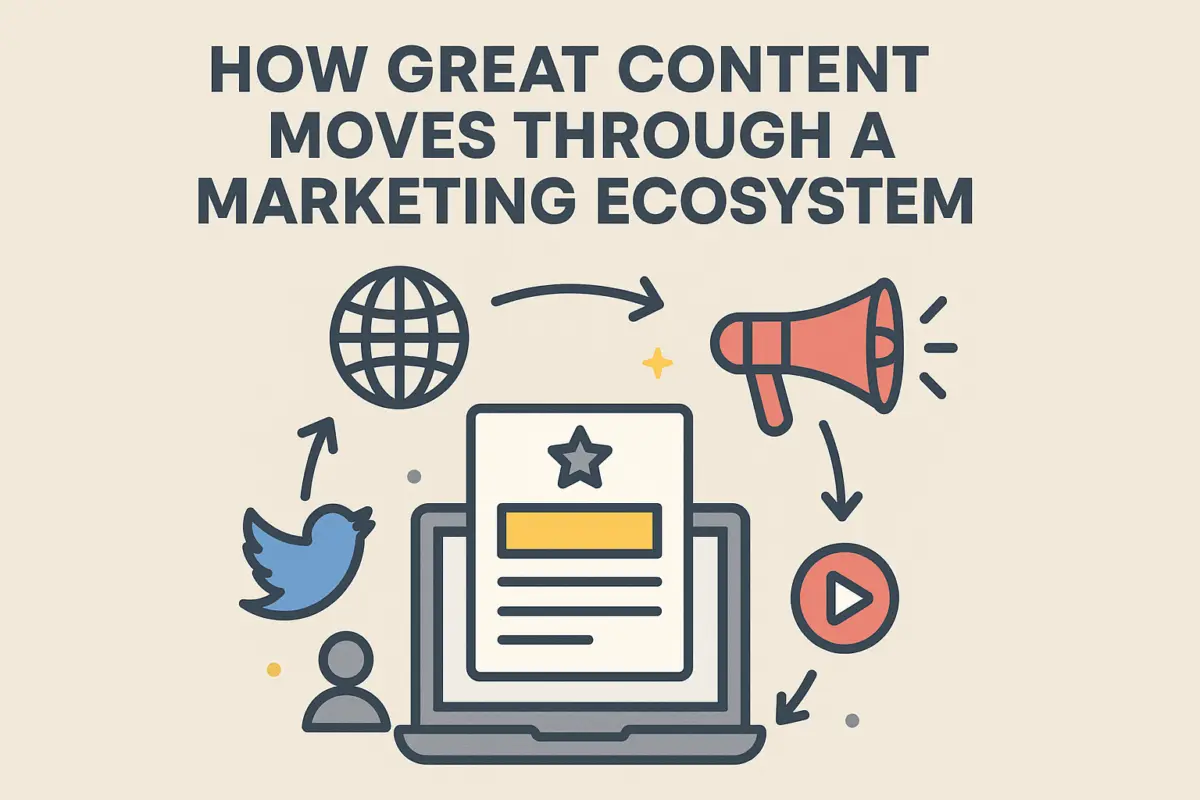
Great marketing does not happen by accident; it succeeds when content moves through a structured, data-informed workflow. By pairing rigorous audience research with unified channel distribution and advanced performance tracking, organizations can build sustainable content marketing ecosystems that deliver compounding value over time.
As enterprises refine their digital strategies, the primary objective must remain connecting every publish action to clear, measurable business outcomes. In doing so, marketing leaders ensure that each new campaign builds securely upon past data, securing a lasting competitive advantage in an increasingly crowded marketplace.