







Executive Overview
In the modern digital economy, the friction of daily life has been largely streamlined through biometric and document-based verification. Whether checking into a hotel, renting a vehicle for a weekend getaway, or entering a regulated establishment, handing over a driver’s license or state-issued identification card has become an almost mindless routine. Consumers are conditioned to trust that these physical credentials—and the sensitive personal identifiable information (PII) embedded within them—are handled with strict regulatory compliance, transient processing, and robust cryptographic security.
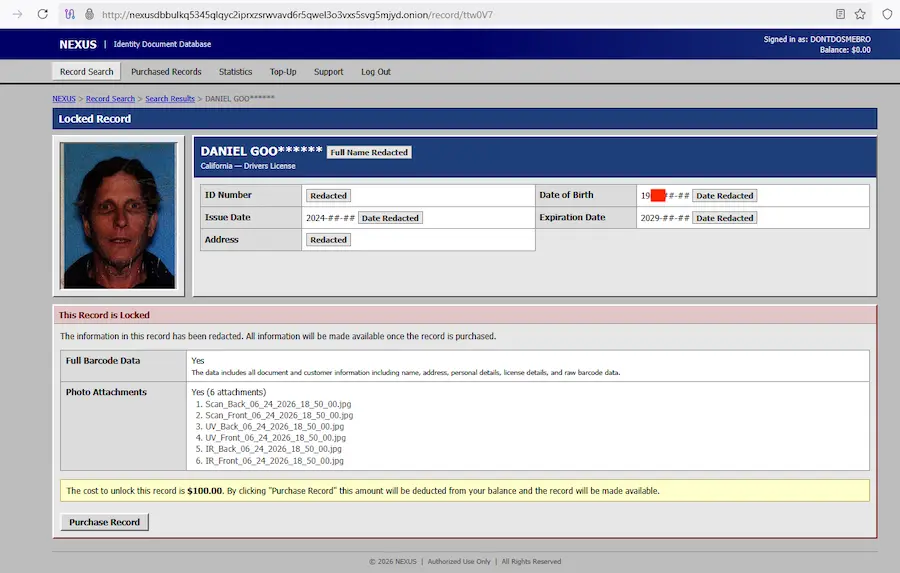
A groundbreaking investigative report by cybersecurity journalist Brian Krebs has shattered this reassuring illusion. The investigation exposes a sprawling cybercriminal enterprise operating under the moniker "Nexus," which has managed to curate a massive, real-time repository of stolen driver’s licenses and state-issued identification documents. More alarming than the sheer scale of the cache—which grew by nearly 400,000 unique records in a single 24-hour window—is the velocity at which these documents are being harvested. Victims have discovered their freshly scanned credentials available on illicit marketplaces mere hours after presenting them to legitimate commercial entities, such as car rental counters.
This digital heist points directly to a systemic vulnerability lurking within the supply chain of modern commerce: the reliance on third-party identity verification and document-scanning service providers. Publicly available digital footprints suggest that platforms like IDScan.net—a prominent New Orleans-based verification firm boasting high-profile clients across the car rental, hospitality, and cannabis industries—may be central to the data pipeline exploited by Nexus.
The implications of this breach extend far beyond traditional credential stuffing or static data dumps. Because these modern scanning systems capture advanced authentication layers, including infrared and ultraviolet (UV) spectral data, the stolen files are not mere digital photographs of a cardstock rectangle. They are hyper-detailed, multi-spectral digital twins of physical IDs. These assets possess the fidelity required to bypass sophisticated liveness checks, fool biometric onboarding protocols at digital banks, and facilitate high-level financial and corporate fraud.
Although the Nexus marketplace went dark shortly after the KrebsOnSecurity publication—and the Federal Bureau of Investigation (FBI) has launched an active inquiry—the incident serves as a glaring warning flare. It highlights the profound risks associated with outsourcing the custody of sensitive citizen data to an opaque network of third-party vendors whose security postures remain largely shielded from public scrutiny.
Detailed Chronology of the Nexus Operation
The Discovery of Real-Time Infiltration
The unraveling of the Nexus operation began not with a sophisticated enterprise network intrusion detection alert, but through personal observation and empirical testing. Following tips regarding a newly emerged underground data bazaar, cybersecurity researchers and victims began testing the platform by inputting newly generated identification scans.
The results were chillingly immediate. Within a day—and in some cases, a matter of hours—after a victim presented their physical driver’s license to a car rental agency or commercial service desk, a digital copy of that exact scan appeared within the Nexus database. This rapid turnaround time bypassed the traditional lag associated with batch data exfiltration, dark web brokering, and manual database compilation.
Instead, the velocity of the additions suggested an automated, near-real-time synchronization mechanism. The inference drawn by cybersecurity experts was clear: Nexus had likely established unauthorized, persistent access to the data pipelines flowing through the third-party scanning services utilized by these commercial entities. The system was not merely historical scraping; it was a live tap on active corporate data streams.
The 24-Hour Spike and Exponential Growth
The dynamic nature of the Nexus repository was further underscored during active observation by investigative journalists. Over a compressed 24-hour monitoring window, the catalog of available driver’s licenses spiked by an astonishing 400,000 unique records.
This meteoric surge invalidated initial theories that the marketplace was merely recycling legacy data breaches from historical incidents. The influx of hundreds of thousands of freshly minted IDs proved that the harvesting operation was ongoing, automated, and operating at industrial scale. Every time a consumer rented a vehicle, checked into a hotel, or verified their age at a commercial venue utilizing compromised scanning architecture, their credentials were being systematically duplicated and routed to the cybercriminal marketplace.
The Footprint of IDScan.net
As researchers raced to map the technological infrastructure enabling this real-time harvesting, attention focused on the software and hardware vendors bridging physical documents with digital systems. Cross-referencing public corporate press releases, customer case studies, and marketing collateral revealed a tangled web of integrations centered around IDScan.net, a New Orleans-based enterprise specializing in identity verification and age-validation technology.
Publicly accessible records demonstrate that IDScan.net maintains a diverse and high-volume client portfolio. Notably, the firm announced an exclusive integration partnership with Planet 13, a major operator in the regulated cannabis retail space. Furthermore, marketing documentation and historical case studies published by IDScan.net explicitly listed global car rental giant Hertz, alongside at least 11 other major commercial entities, as active consumers of its verification services.
Crucially, technical literature published by IDScan.net highlights the advanced capabilities of its scanning hardware and software suites. The company heavily markets its ability to capture not just visible light imagery, but also data across the infrared (IR) and ultraviolet (UV) spectra. These specialized light bands are utilized by modern verification terminals to read security features embedded in government-issued identification cards—such as holographic elements, specialized inks, and microprinting—designed to prevent counterfeiting.
When these multi-spectral scans are captured, processed, and subsequently leaked into the hands of criminal actors like Nexus, the resulting data package is infinitely more valuable than a standard flatbed scan or smartphone photograph. It provides bad actors with the precise blueprints needed to replicate or digitally emulate physical security features that financial institutions and digital onboarding platforms rely upon to establish trust.
The Abrupt Shutdown and the Fog of War
Faced with mounting public exposure, regulatory inquiries, and the publication of the KrebsOnSecurity investigative report, the operators behind Nexus took swift evasive action. Within hours of the story breaking, the Nexus platform abruptly went dark, pulling its infrastructure offline and severing public access to the searchable database.
While the shutdown successfully neutralized the immediate, public-facing storefront of the criminal enterprise, it created a secondary crisis for privacy advocates and affected consumers: total opacity. With the portal offline, individuals who had recently patronized car rental agencies, hotels, or other businesses utilizing third-party scanners lost any mechanism to check whether their personal identification documents were compromised during the breach.
The sudden disappearance of the marketplace also highlights the transient, highly resilient nature of modern cybercrime syndicates. Operations frequently utilize decentralized infrastructure, rapid-deployment hosting providers, and cryptocurrency obfuscation to vanish at the first sign of investigative pressure, only to reconstitute under a new brand weeks or months later.
Supporting Context & Metrics: The Anatomy of Modern ID Theft
The Devaluation of Traditional PII Protections
To fully grasp the gravity of the Nexus breach, one must contextualize it within the broader landscape of modern data security failures. For the average adult consumer living in the industrialized world, the concept of a pristine digital privacy footprint is already an obsolete relic of the past.
Decades of catastrophic corporate data breaches—spanning credit bureaus, healthcare conglomerates, telecommunications providers, and federal government databases—mean that most citizens’ fundamental personal identifiable information is already circulating on underground forums. Current and former residential addresses, Social Security numbers, date-of-birth records, demographic profiles, and historical phone numbers have been repeatedly harvested, bundled, and sold for pennies on the dark web.
Consequently, when a new breach occurs, public fatigue often sets in. Consumers shrug off headlines announcing millions of exposed records, feeling helpless against an omnipresent tide of digital surveillance and corporate negligence. However, security analysts emphasize that treating the Nexus breach as "just another data dump" is a dangerous mistake.
Why Multi-Spectral Scans Change the Game
The true menace of the Nexus repository lies in the granular quality of the data captured. A standard data breach exposes text fields: strings of ASCII characters representing a name, an address, or an account number. While damaging, these fields can often be mitigated through credit freezes, two-factor authentication, and monitoring services.
By contrast, the documents indexed by Nexus included multi-spectral captures containing infrared and ultraviolet data layers.
- Infrared Data: Many state-issued driver’s licenses feature patterns and portraits rendered in infrared-absorbent or infrared-reflective inks. These are invisible to the naked eye and standard smartphone cameras, serving as a primary defense against basic forgery.
- Ultraviolet Data: UV features—such as ghost images, state seals, and intricate background guilloche patterns—glow under blacklight illumination, providing an additional layer of physical authentication.
When a criminal syndicate acquires scans containing these multi-spectral layers, they obtain a cryptographic and visual template of the credential. In the era of biometric onboarding, where fintech startups, online banks, cryptocurrency exchanges, and telecommunications carriers rely on automated document verification (such as "take a selfie holding your ID"), these advanced scans act as master keys. They can be injected directly into virtual camera feeds or utilized to manufacture physical counterfeit cards of such astonishing fidelity that they easily defeat automated optical inspection kiosks and human tellers alike.
The Scale of the Pipeline
While the exact total number of records accumulated by Nexus before its sudden blackout remains under investigation by federal authorities, the metric captured during Krebs’ observation window—400,000 new driver’s licenses in a single 24-hour period—provides a chilling window into the throughput of modern industrial cybercrime.
To put this figure into perspective, consider the daily foot traffic of major transportation hubs, regional airports, and metropolitan car rental facilities. A single national rental car agency processing thousands of transactions an hour across hundreds of localized branches feeds a continuous, high-volume stream of high-resolution identity data into third-party verification clouds. If even a fraction of those verification nodes are compromised via misconfigured API endpoints, insecure S3 buckets, compromised vendor credentials, or malicious insider access, the resulting data harvest accumulates at an exponential rate.
Official Statements and Industry Silence
The Wall of Corporate Deflection
In the wake of investigative disclosures pointing toward potential supply chain vulnerabilities, the response from corporate stakeholders has been characterized by cautious delay, procedural investigations, and, in many instances, outright silence.
Representatives from IDScan.net—the New Orleans verification firm whose technology ecosystem intersects directly with prominent enterprise clients utilizing multi-spectral scanning—did not immediately answer detailed technical and operational questions sent via email by journalists. However, a corporate spokesperson subsequently acknowledged the gravity of the situation, confirming to KrebsOnSecurity that the company had initiated an internal investigation to determine whether its software, API integrations, or client endpoints were leveraged or compromised in the Nexus data flow.
Simultaneously, representatives for the major car rental agency utilized by the primary reporting victims remained conspicuously silent. Inquiries regarding what specific third-party scanning vendors were contracted at the physical rental counter, what data retention policies govern customer identity scans, and what breach notification protocols would be enacted went unanswered in the immediate aftermath of the report.
This institutional hesitation is symptomatic of a broader systemic flaw in corporate incident response. When third-party vendors are introduced into a business workflow, accountability often becomes diffused. The primary merchant (e.g., the car rental company or hotel) assumes the software vendor is securing the data pipeline; the vendor assumes the hosting provider or API gateway is managing perimeter defense; and the end consumer is left entirely in the dark, trusting that their most sensitive documents are being treated with institutional care.
Federal Law Enforcement Intervention
While commercial entities retreat behind legal counsel and public relations buffers, law enforcement has stepped into the void. The Federal Bureau of Investigation (FBI) has launched an active, ongoing investigation into the Nexus marketplace, its operators, and the digital infrastructure that facilitated the large-scale harvesting and monetization of stolen driver’s licenses.
Federal cybercrime investigators are currently analyzing the remnants of the Nexus network infrastructure, tracing cryptocurrency transaction ledgers used to purchase access tiers, and subpoenaing logs from cloud service providers, domain registrars, and hosting companies. However, the transient nature of underground cybercrime infrastructure—frequently deployed behind multi-layered proxy services and hosted in jurisdictions with limited international law enforcement cooperation—presents formidable hurdles to swift asset recovery and perpetrator arrest.
Future Outlook: Securing the Identity Supply Chain
The Imperative for Zero-Trust Document Handling
The Nexus breach is not an isolated anomaly; it is a preview of the systemic vulnerabilities that will continue to plague digital commerce until foundational changes are enacted across the identity verification industry. As organizations race to digitize, automate, and accelerate customer onboarding, they have built an interconnected web of third-party vendors, APIs, and cloud repositories that exponentially expands the enterprise attack surface.
To mitigate the recurrence of real-time harvesting operations like Nexus, the commercial sector must transition away from legacy data-handling practices toward a Zero-Trust architecture specifically tailored for identity documents:
- Data Minimization and Transient Storage: Commercial entities—particularly in the hospitality, rental, and retail sectors—must question the necessity of retaining high-resolution, multi-spectral scans of government-issued identification cards after identity verification is successfully completed. If a physical license is verified at a rental counter, the raw multi-spectral image file should be immediately purged from local caches and downstream vendor databases, retaining only a cryptographic proof of verification rather than the raw document itself.
- End-to-End Encryption and Access Auditing: Verification vendors must implement rigorous cryptographic controls, ensuring that identity scans are encrypted both in transit and at rest using keys managed strictly by the end-client rather than shared third-party cloud infrastructure. Continuous automated monitoring and behavioral analytics must be deployed across API gateways to detect anomalous, high-frequency data extraction patterns before millions of records are compromised.
- Regulatory Scrutiny and Supply Chain Accountability: Regulatory bodies—including the Federal Trade Commission (FTC) and state privacy regulators—must expand their enforcement lens beyond direct corporate breaches to scrutinize the security postures of third-party software vendors. Commercial entities outsourcing customer data processing must be held legally accountable for the security hygiene of their entire vendor supply chain.
Consumer Empowerment in an Era of Pervasive Surveillance
For the individual consumer, the fallout from the Nexus incident offers sobering lessons on the limits of personal cybersecurity hygiene. Unlike a compromised credit card number—which can be canceled and replaced with a phone call—a compromised driver’s license scan containing infrared and ultraviolet spectral data cannot be easily revoked or reissued by a state Department of Motor Vehicles.
As identity theft evolves from static database scraping to real-time, multi-spectral harvesting, consumers must adopt an increasingly defensive posture when interacting with physical and digital commerce:
- Demand Transparency: When asked to hand over a driver’s license to be scanned by handheld terminals, tablet devices, or desktop kiosks, consumers should feel empowered to ask basic operational questions: Where is this scan being sent? Who is the vendor processing this data? How long is my document retained?
- Alternative Verification: Whenever feasible, consumers should push for alternatives that minimize the exposure of physical identity documents—such as leveraging decentralized digital identity wallets, cryptographic age-verification tokens, or temporary credentials that do not transmit full multi-spectral copies of government-issued cards.
- Proactive Monitoring: In the wake of widespread supply chain breaches, consumers must maintain rigorous vigilance over their financial accounts, utilize credit freezes across all major credit bureaus, and monitor digital identity protection services for unauthorized onboarding attempts tied to financial and telecommunications institutions.
The Nexus marketplace may have gone dark, but the structural flaws that enabled its operation remain deeply entrenched within the global commerce ecosystem. Until corporations, software vendors, and regulatory bodies treat physical identity documents with the same cryptographic rigor and protective custody traditionally reserved for financial ledgers, the digital pipeline will remain wide open to the next generation of cybercriminal enterprises.