








Executive Overview
Fresh data released by ICONIQ Capital covering the period from 2022 through the second quarter of 2026 offers an illuminating, data-driven window into the post-hype and AI-infused realities of modern tech and B2B software companies. While the prevailing narrative across Silicon Valley and corporate boardrooms has painted artificial intelligence as an inevitable workforce terminator—a sweeping technological wave destined to freeze hiring and flatten organizations—the ground truth revealed by the numbers is far more nuanced.
Yes, AI is fundamentally altering how organizations scale, but its impact is fragmented, highly stratified, and deeply dependent on an enterprise’s top-line revenue growth. According to the ICONIQ dataset (which draws on quarterly financial and operating metrics from private venture-backed portfolios alongside select public software firms, tracking sample sizes ranging from 390 companies in 2022–2023 down to 57 companies in H1 2026), the tech sector is not experiencing a uniform headcount freeze. Instead, it is splitting into three distinct operational realities.
At the very top of the market, hypergrowth firms—primarily AI-native B2B companies locked in a high-stakes, well-funded land grab—are hiring with an aggression that eclipses even the dizzying peaks of the 2021–2022 market boom. Conversely, mid-tier companies growing at a healthy 50% to 100% clip have executed a sharp, unprecedented pivot, dramatically scaling back their headcount growth to capture newfound AI leverage. Meanwhile, slower-growing enterprises have abandoned the painful layoff cycles of recent years, settling into a permanent state of operational stasis where headcount growth has flatlined near zero.
This deep-dive investigation examines the structural shifts underlying the ICONIQ data, dissecting why the fastest-growing companies are paradoxically becoming less efficient on a per-employee basis, how mid-market firms are quietly capturing AI productivity, and what these diverging playbooks mean for the future of tech employment.
Detailed Chronology: The Evolution of Tech Headcount (2022–H1 2026)
To understand where tech talent acquisition stands today, one must trace the macroeconomic whiplash of the past four years. The industry has swung wildly from the pandemic-era hiring frenzy through a painful period of post-bubble discipline, and finally into the current bifurcated era defined by generative AI deployment.
2022–2023: The Great Correction and Post-Bubble Hangover
The period spanning 2022 and 2023 (utilizing an $N$-size of 390 companies in the ICONIQ dataset) represents the violent hangover that followed the 2021 market apex. As zero-interest-rate policies evaporated and public market multiples collapsed, private software companies were forced into rapid introspection. Layoffs dominated tech headlines.
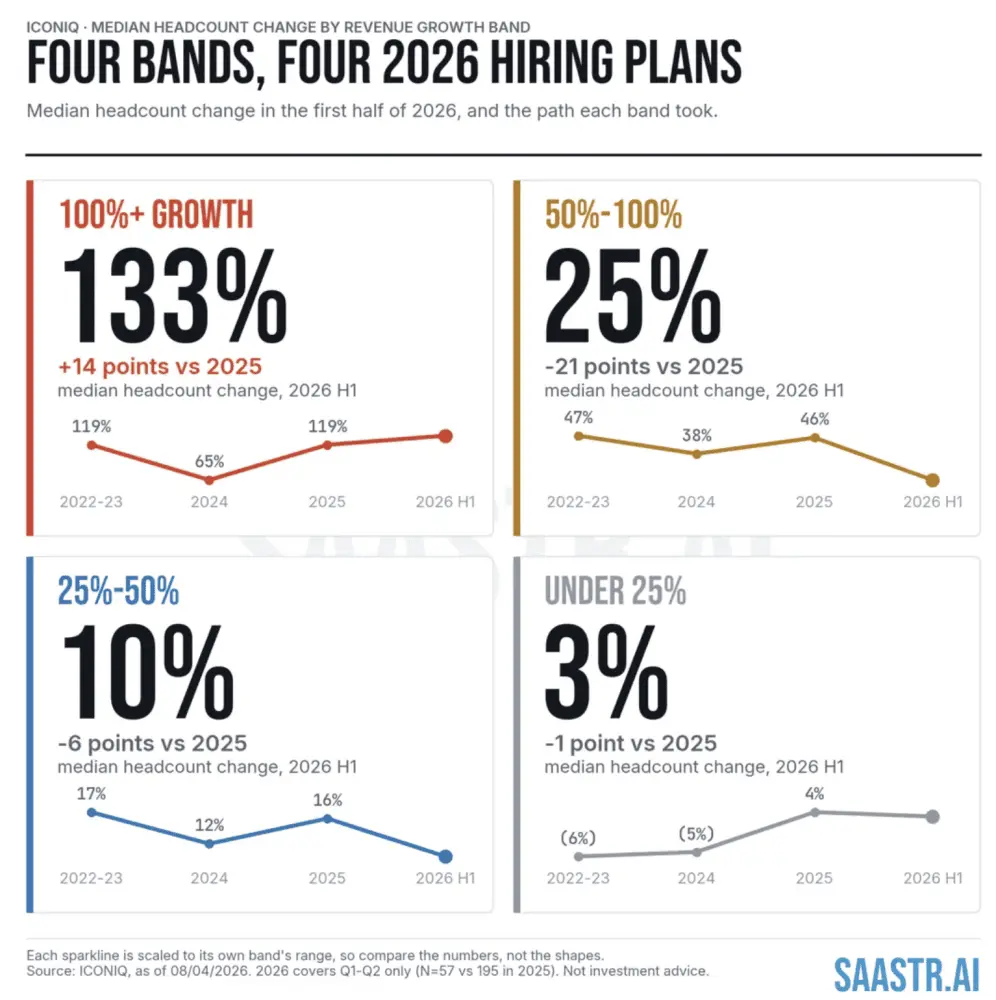
During this window, even hypergrowth companies—those expanding their top-line revenue by over 100% annually—maintained a median headcount growth rate of 119%. While robust, this number masked a growing internal anxiety. Meanwhile, companies in the 50% to 100% growth band were adding headcount at a median clip of 46%. At the bottom of the spectrum, sub-25% growers were actively shedding staff, posting negative headcount growth rates of roughly -6%. The industry was bruised, defensive, and scrambling to extend runway.
2024: The Year of Radical Discipline
By 2024 ($N=200$), the tech sector retreated into a collective discipline year. Venture capitalists and boards demanded operational efficiency, path-to-profitability metrics, and strict burn-multiple controls.
The immediate casualty of this discipline was aggressive recruitment. Even the elite tier of companies—those maintaining 100%+ revenue growth—cut their median headcount growth rate roughly in half, dropping from 119% down to 65%. It was widely assumed that this leaner operational posture was the new normal: a permanent structural shift toward "doing more with less" catalyzed by early experimentation with enterprise AI tools. However, as subsequent data would prove, this austerity was a temporary adjustment rather than a permanent evolution for the market leaders.
2025–H1 2026: The Bifurcation and AI-Native Land Grab
Entering 2025 ($N=195$) and the first half of 2026 ($N=57$), the illusion of uniform tech austerity shattered entirely. The data reveals a dramatic divergence.
For the elite 100%+ growers, headcount growth bounced violently back up to 119% in 2025 and surged to a staggering 133% in H1 2026. Rather than staying lean, these companies are now hiring harder than they did at the height of the 2022 market boom.
At the same time, the middle tier of the market—firms experiencing healthy, respectable revenue growth between 50% and 100%—did something remarkable: they decoupled revenue growth from headcount expansion. Their median headcount growth plummeted from 46% down to just 25% in a single year, marking the most significant structural movement captured across the entire dataset.

Supporting Context & Metrics: Deconstructing the Three Playbooks
A surface-level glance at the ICONIQ findings might lead casual observers to conflicting conclusions. Are we in an era of unprecedented AI-driven efficiency, or are tech companies repeating the undisciplined over-hiring cycles of the past? The answer depends entirely on which growth bracket an enterprise occupies. The data exposes three distinct hiring playbooks currently running in parallel across the B2B software ecosystem.
Playbook #1: The 100%+ Growers — The AI Land Grab Overrides Efficiency
The most counterintuitive revelation in the dataset centers on the top tier of performers. Companies achieving triple-digit revenue growth today are overwhelmingly AI-native B2B startups or established players undergoing rapid AI transformation. Well-funded and heavily capitalized, these firms are locked in a relentless, winner-take-all competitive race against three or four direct rivals.
When a company is doubling or tripling its revenue year-over-year, internal discussions rarely revolve around headcount efficiency exercises. While these modern AI-native startups may feature leaner organizational structures at smaller scales than their pre-AI predecessors, they do not stay lean as they scale past early milestones.
- The Efficiency Paradox: Using rough math based on the dataset’s floors and midpoints, companies growing at 100%+ in 2024 added roughly 65% more headcount, leading to a temporary spike in revenue per employee. By H1 2026, however, that same cohort is adding 133% more headcount. Unless the median company in this band has simultaneously accelerated its revenue growth well past 133%, revenue per employee at the very top of the market is flat to down.
- The Talent Mix: Why are these hypergrowth firms swelling their ranks? They are not hiring traditional, legacy administrative or bloated middle-management layers. Instead, they are aggressively recruiting specialized engineering talent, forward-deployed software engineers, and complex solutions architects required to customize and integrate AI models for enterprise clients. The complexity of selling and deploying generative AI solutions demands high-touch human intervention, fueling a hiring spree that outpaces prior tech cycles.
Playbook #2: The 50%–100% Growers — The True Beneficiaries of AI Leverage
While the hypergrowth tier hogs the headlines with its massive hiring numbers, the true story of AI productivity leverage is quietly unfolding in the 50% to 100% revenue growth band.
These are not struggling businesses; scaling a company by 60% to 80% annually represents an elite commercial performance. Yet, the ICONIQ data shows that companies in this cohort slashed their median headcount growth from 46% down to 25% in a single year—a movement of 21 percentage points that dwarfs every other shift in the survey. The adjacent 25% to 50% band mirrored this trend at a smaller scale, dropping from 16% down to 10% headcount growth.
- Doing More With Less: For a healthy, mid-sized B2B SaaS company growing at 35% annually, adding only 10% more staff represents a profound structural shift. In 2022–2023, that same growth rate would have necessitated a 17% expansion in headcount; a decade earlier, it would have demanded 25% to 30%.
- The Quiet ROI of AI: If enterprise software and generative AI tools are truly delivering productivity gains, those gains are manifesting here. Mid-tier companies are not conducting mass layoffs; rather, they are maintaining robust top-line momentum while quietly planning significantly leaner teams to achieve those targets. They are leveraging automated coding assistants, AI-driven customer support deflection, and streamlined internal operations to decouple revenue scaling from headcount bloat.
Playbook #3: Sub-25% Growers — The Flat-Line Permanent Stasis
At the lower end of the spectrum—companies experiencing sub-25% revenue growth—the data tells a story of stabilization followed by permanent structural flattening.
- The End of the Layoff Cycle: During the 2022–2023 correction, this cohort was actively shrinking, posting negative headcount growth of roughly -6%, which slipped slightly to -5% in 2024. By 2025 and H1 2026, however, those painful workforce reductions ceased entirely.
- The New Baseline: The cessation of layoffs did not trigger a hiring rebound. Instead, headcount growth settled into a stagnant +4% in 2025 and +3% in H1 2026. For a mature B2B software company that crossed the $50M to $100M revenue threshold during the 2021 boom and settled into steady, predictable 15% to 25% growth, the flat team is no longer viewed as a temporary holding pattern—it is the permanent operational plan. At a 200-person company, a 3% headcount growth rate translates to a meager six new hires across every department for an entire year.
Official Perspectives and Industry Implications
The divergence highlighted by ICONIQ’s data forces a critical reassessment of how executives approach workforce planning in an AI-dominated economy. Industry analysts and venture capital leaders point out that executive teams can no longer rely on blunt, industry-wide benchmarks to dictate their hiring budgets. Instead, leadership must intentionally choose their organizational strategy based on their specific growth velocity and market position.
The strategic takeaway for modern corporate leadership can be distilled into three fundamental choices regarding the capital-to-headcount ratio:
- The Hypergrowth Bet (100%+ Growth): If an enterprise is backed by venture capital and locked in a winner-take-all land grab, efficiency must take a temporary backseat to velocity. Leadership must accept that scaling headcount at triple-digit percentages is necessary to deploy complex technology, capture market share, and out-execute direct competitors, even if short-term revenue-per-employee metrics decline.
- The Efficiency Sweet Spot (50%–100% Growth): Companies enjoying healthy, sustainable growth can—and should—actively capture AI productivity dividends. By deliberately engineering workflows that require fewer incremental hires per dollar of new revenue, mid-tier firms can expand operating margins without sacrificing top-line momentum.
- The Mature Stasis (Sub-25% Growth): Mature organizations must embrace fiscal discipline and operational maturity. Attempting to artificially inflate headcount in a slow-growth environment is a relic of the zero-interest-rate era. The flat-line team model is a sustainable, profitable reality for software businesses that have matured past their hypergrowth phase.
Future Outlook: Navigating the Post-AI-Hype Workforce
As the tech sector moves deeper into 2026 and looks toward the horizon, the ICONIQ data serves as a sobering reminder that technological revolutions rarely play out in a straight line.
The widespread prediction that generative AI would instantly cause a universal freeze or collapse in tech headcounts has proven false. The reality is far more complex: AI is acting as an accelerator for some and an efficiency multiplier for others. Hypergrowth companies are proving that when a market is up for grabs, human capital remains the ultimate weapon, even if it temporarily depresses per-employee efficiency metrics. Meanwhile, the broader mid-market is successfully utilizing AI tools to grow revenue without ballooning payrolls, fundamentally altering the unit economics of building a modern software company.
For founders, CEOs, and human resources leaders, the mandate moving forward is clear. Blindly following generalized hiring trends is a recipe for strategic failure. Whether an organization chooses the aggressive, talent-heavy land grab of the elite hypergrowth tier or the lean, AI-optimized efficiency of the mid-market, that ratio must be chosen deliberately, measured rigorously, and executed with absolute clarity of purpose.
Data Source: ICONIQ Capital, incorporating quarterly financial and operating metrics from private venture-backed growth portfolios alongside select public software enterprises, spanning 2022 through Q2 2026 (data current as of August 4, 2026). Published for educational and analytical purposes; this report does not constitute financial or investment advice.