









Executive Overview
In the world of aviation and autonomous systems, the holy grail has long been unconstrained persistence. Traditional aircraft are inextricably chained to the physical and chemical limitations of their energy sources—whether burning dense fossil fuels or hauling heavy battery packs that degrade over time. Once that onboard reserve is exhausted, the aircraft must land.
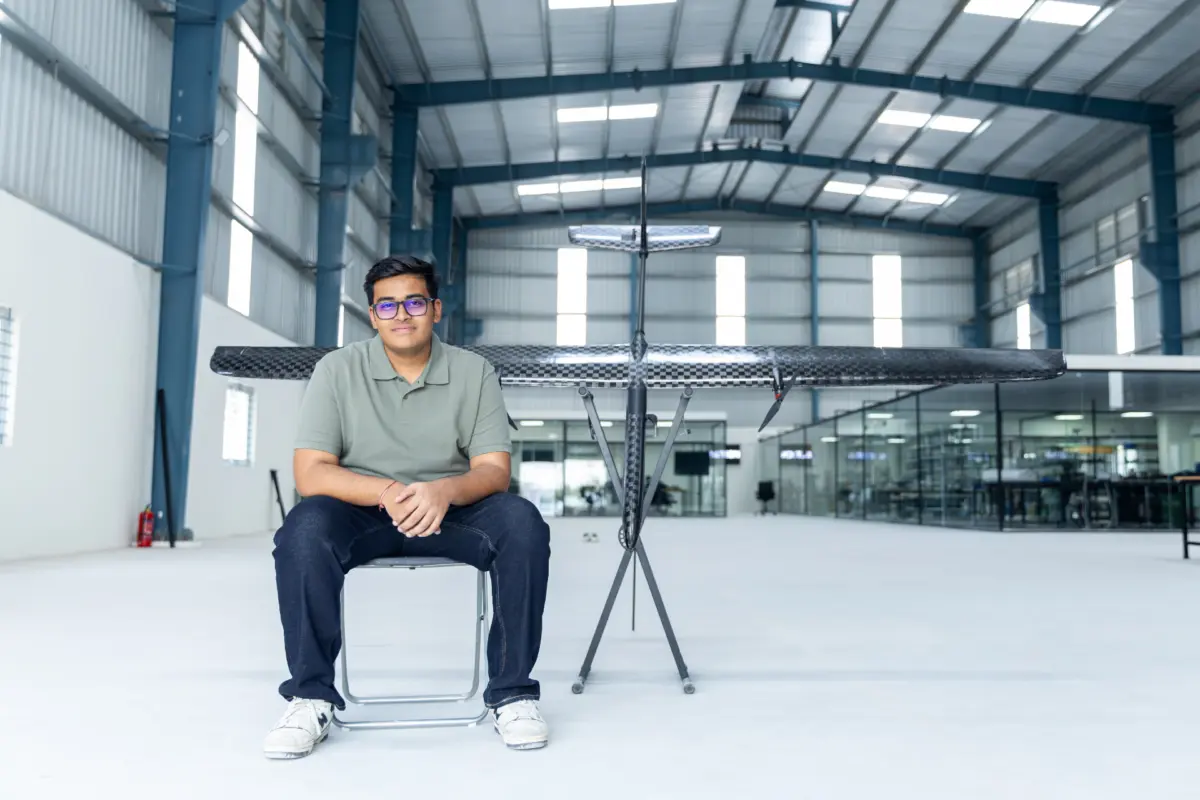
Enter Alteon, an ambitious Bengaluru-based deep-tech startup that is turning to nature for a radical redesign of flight physics. Founded by 20-year-old visionary Samay Sanghvi, Alteon is developing autonomous, fixed-wing aircraft designed to stay aloft for more than a year continuously. Instead of relying on conventional fuel storage, Alteon’s craft harvest kinetic energy directly from ocean winds through a natural phenomenon known as dynamic soaring—the exact same technique perfected by albatrosses to circumnavigate the globe without ever touching land.
This audacious proposition has captured the imagination of Silicon Valley venture capital. Alteon announced a $2.5 million pre-seed funding round led by prominent solo investor Lachy Groom, with additional participation from the Together Fund. Groom, known for spotting generational outlier companies early, was so convinced by the startup’s vision that he committed to the investment within the first 30 minutes of their initial meeting.
While the funding provides a crucial runway, Alteon’s journey is fraught with immense technical hurdles. The startup has yet to prove its aircraft can achieve sustained, energy-neutral flight using dynamic soaring alone. However, rapid iteration, a growing 20-person team operating out of a 10,000-square-foot facility in Bengaluru, and over 200 test flights conducted in just the last month indicate that this young aerospace player is moving at breakneck speed. If successful, Alteon’s technology could unlock unprecedented capabilities for maritime surveillance, environmental monitoring, and global telecommunications.
Detailed Chronology: From High School Model Crashes to Venture Backing
Alteon’s trajectory reads like a classic modern engineering fable, accelerated by raw ambition, relentless physical prototyping, and the democratization of rapid hardware manufacturing.
The Genesis (2023–2024)
The foundation for Alteon was laid straight out of high school in 2023. Samay Sanghvi did not begin his journey in a pristine academic laboratory with multi-million-dollar wind tunnels. Instead, he learned the visceral realities of aerodynamics the hard way: by building and repeatedly crashing radio-controlled model aircraft.
Through trial, error, and meticulous iteration, Sanghvi transitioned from building makeshift RC models to engineering sophisticated early-stage autonomous prototypes. Recognizing the severe endurance limitations plaguing the drone and UAV markets, he zeroed in on dynamic soaring as the theoretical key to unlocking perpetual flight. Early recognition of his potential came from niche, forward-thinking backers like Emergent Ventures and 1517, providing the initial validation needed to transition from a solitary garage project into a structured enterprise.
Formalization and Rapid Scaling (2025–2026)
Sanghvi formally incorporated Alteon in 2025, setting up operations in Bengaluru, India’s burgeoning deep-tech and software hub. The company quickly transitioned from a conceptual entity into an active hardware manufacturer.
By early 2026, Alteon had expanded its footprint to a 10,000-square-foot facility in Bengaluru, housing a dedicated team of 20 engineers and technicians. Demonstrating an agile manufacturing philosophy rarely seen in traditional aerospace, the startup’s assembly lines now produce four to five custom aircraft every single week. This prolific production rate directly feeds an aggressive testing cadence, culminating in over 200 test flights executed across a tight 30-day window.
The Pre-Seed Milestone (Mid-2026)
The crescendo of Alteon’s early lifecycle arrived with its $2.5 million pre-seed funding announcement. Led by Lachy Groom—a legendary solo investor who has backed foundational infrastructure companies—alongside the Together Fund, this capital injection provides Alteon with the financial cushion required to move from basic autonomous flight testing to the much more complex phase of energy-harvesting validation. For Groom, the investment was a bet not just on a technology, but on the relentless drive of a founder who refused to let conventional aerospace dogma limit his ambitions.
Supporting Context & Metrics: The Science of Dynamic Soaring
To understand why Alteon’s proposition is revolutionary—and why aerospace veterans view it with a mixture of awe and skepticism—one must examine the physics of dynamic soaring and the operational metrics guiding the startup’s development.
Breaking the Energy Barrier
Conventional Unmanned Aerial Vehicles (UAVs) face a brutal mathematical trade-off between payload capacity, aerodynamic drag, and energy storage. Solar-powered drones can extend flight times significantly, but they remain vulnerable to seasonal weather changes, nighttime energy deficits, and geographic latitude constraints.
Alteon aims to bypass these limitations by exploiting wind shear—the variation in wind speed and direction over relatively short vertical distances—found immediately above the ocean’s surface.
[High-Speed Air Layer (Upper)]
   ▲
   │   (Aircraft climbs, gains kinetic energy)
   │
───┼───────────────────────────────────────────── (Boundary)
   │
   │   (Aircraft dives, extracts momentum)
   ▼
[Low-Speed Air Layer (Lower, near water surface)]
How Dynamic Soaring Works
Albatrosses utilize dynamic soaring to cross thousands of miles of open ocean without flapping their wings. The mechanics involve a repetitive, repeating cycle:

- The Low-Altitude Run: The aircraft flies mere meters above the ocean surface, moving through a slower-moving layer of air.
- The Climb: The craft pulls up sharply, ascending into a higher layer of air where wind speeds are substantially greater.
- Momentum Extraction: By transitioning between these two airmasses with differing velocities, the aircraft harvests kinetic energy from the wind gradient.
- The Dive: The aircraft executes a tactical turn and dives back toward the surface, converting the captured wind momentum into forward thrust.
Alteon’s Technical Roadmap and Metrics
- Current Prototype Scale: Alteon’s primary test platform features a compact ~3-meter wingspan, designed for optimal maneuverability close to the water interface.
- Recent Flight Test Milestones: In a recent breakthrough test over the Bay of Bengal, Alteon’s autonomous flight system successfully executed seven continuous O-shaped cycles at speeds exceeding 62 miles per hour (100 km/h), maintaining a razor-thin altitude margin of within one meter of the water’s surface.
- Manufacturing Output: The Bengaluru facility churns out 4 to 5 fixed-wing aircraft per week, enabling rapid hardware prototyping and immediate field testing.
- Testing Velocity: Over 200 test flights were conducted in a single 30-day period, reflecting an iterative software and hardware feedback loop.
- Future Generation Turbines: Beyond simply using the wind for propulsion, Alteon eventually plans to configure its onboard propellers to act as micro-turbines, converting excess harvested energy into electricity to actively recharge onboard batteries during flight.
Official Statements: Industry Perspectives and Expert Analysis
The audacity of Alteon’s engineering goals has drawn sharp scrutiny and cautious optimism from aerospace engineers and financial backers alike.
The Investor’s Perspective: Lachy Groom’s Conviction
Reflecting on his decision to back the 20-year-old founder, Lachy Groom was remarkably candid about the inherent risks involved in funding breakthrough deep-tech hardware:
"Ambitious problems are always going to come with risks," Groom stated in an interview with TechCrunch. "For me, it came down to believing Samay and the Alteon team are the ones to figure them out."
For Sanghvi, the alignment of vision was instantaneous. He noted that Groom made the definitive decision to invest within the first 30 minutes of their very first pitch meeting.
The Aerospace Engineering Verdict
While the financial backing is secured, external engineering experts emphasize that the path from successful trajectory testing to true energy-neutral persistence is fraught with extreme physical challenges.
Dr. Gabriel Bousquet, a Silicon Valley-based aerospace and robotics engineer who specialized in dynamic soaring during his PhD at MIT, evaluated Alteon’s recent Bay of Bengal test:
"It’s a promising first result," Bousquet noted. However, he was quick to contextualize the difficulty of the road ahead, pointing out that maintaining stable flight close to the water requires contending with "turbulence, waves, spray, rain, and changing light conditions while continuously sensing and reacting to a moving ocean surface."
Similarly, Dr. Bharath Swaminathan, an alumnus of IIT Madras whose doctoral research focused on the stability of dynamic soaring, praised the foundational physics underlying Alteon’s approach:
"Keeping an aircraft airborne for several days using dynamic soaring would itself be a very big step, and a big achievement," Swaminathan remarked.
However, Swaminathan sounded a note of caution regarding real-world unpredictability: while macro-scale meteorological data can be modeled, localized wind shear, sudden micro-gusts, and unpredictable marine turbulence introduce variables that theoretical models cannot fully anticipate—variables that can only be ironed out through relentless real-world flight testing.
Future Outlook: Commercial Applications and the Horizon
Alteon’s ultimate technological benchmark is what founder Samay Sanghvi terms “energy-neutral dynamic soaring.” Reaching this milestone means the aircraft can completely shut off its propulsion systems and remain permanently aloft, relying exclusively on the continuous mechanical extraction of energy from ocean winds.
Initial Use Case: Maritime Surveillance
The commercial and strategic utility of a year-long autonomous aircraft is immense. Alteon’s immediate go-to-market strategy focuses on maritime surveillance.
- National Security: Governments worldwide struggle to maintain persistent real-time visibility over vast Exclusive Economic Zones (EEZs). Traditional satellites offer intermittent passes, while naval vessels are slow and expensive to operate.
- Border and Resource Protection: An autonomous fleet of low-cost, year-long loitering aircraft could provide continuous, real-time tracking of illegal fishing, smuggling, and unauthorized naval movements, fundamentally altering maritime domain awareness.
Beyond surveillance, Sanghvi envisions a near-infinite array of secondary applications. Once an aircraft can defy standard endurance limits, it transforms from a tactical drone into an atmospheric satellite—capable of providing localized meteorological sensing, emergency communication relays in remote oceanic corridors, and ecological tracking without the prohibitive launch costs of traditional space-based assets.
The Road Ahead
Alteon enters the latter half of the decade with capital in the bank, a rapidly scaling manufacturing pipeline in Bengaluru, and a fearless engineering culture. Yet, the laws of fluid dynamics remain an uncompromising arbiter. Whether Samay Sanghvi and his team can successfully bridge the gap between algorithmic theory and the chaotic, unforgiving reality of ocean-surface turbulence will determine if Alteon redefines the very boundaries of modern aviation.