









Executive Overview
The landscape of cybersecurity is undergoing a radical shift, moving away from simple credential harvesting toward the sophisticated extraction of non-human identities (NHIs). As software development grows increasingly automated and reliant on cloud-native architectures, artificial intelligence, and distributed services, the keys to the digital kingdom are no longer just human-facing passwords. They are machine credentials—API keys, OAuth tokens, personal access tokens (PATs), and automated service accounts.
To combat this emerging threat vector, Lunar Cyber has officially announced the launch of Token Exposure Monitoring. This cutting-edge capability is engineered to identify, attribute, validate, and contextualize machine credentials stolen from developer and employee endpoints via modern infostealer malware.
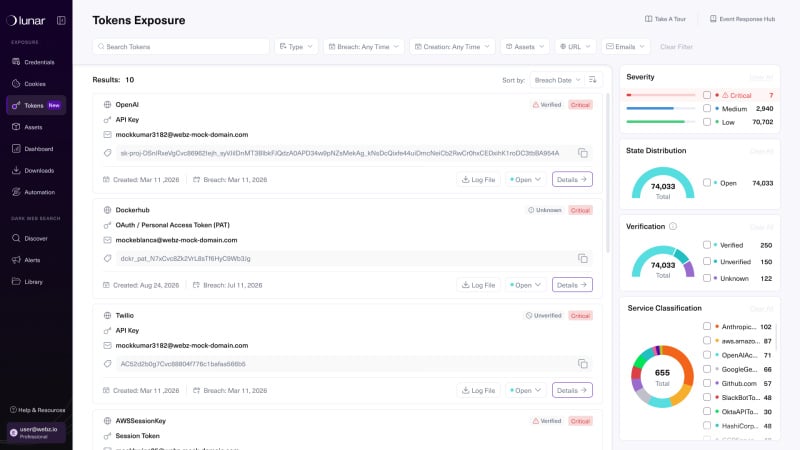
By combing through raw infostealer logs, Lunar Cyber’s platform connects anonymous, opaque strings found in malware payloads back to specific organizations and individual employees. This solves a critical visibility gap that has long plagued security operations centers (SOCs): the inability to easily trace an orphaned API key back to its source. Furthermore, the platform automatically assesses whether a token is still active, empowering security teams to prioritize high-risk exposures, mitigate the fallout from attacks like "LLMjacking," and preemptively revoke compromised access before catastrophic breaches occur.
Detailed Chronology: The Evolution of Endpoint Threats and Lunar Cyber’s Response
The Shift from Passwords to Machine Identities
For decades, cybersecurity incident response frameworks were built around a simple triad: clean the infected machine, reset the user’s password, and invalidate active browser sessions. While effective against traditional phishing and credential-stuffing attacks, this methodology is rapidly becoming obsolete.
Modern software development relies heavily on continuous integration and continuous deployment (CI/CD) pipelines, multi-cloud environments, and AI-assisted coding tools. To keep these automated environments humming, developers frequently authenticate against powerful external platforms—including Amazon Web Services (AWS), GitHub, OpenAI, Anthropic, Slack, and Okta—directly from their local workstations.
These authentication tokens and API keys are often stored in plain sight or locally cached environments. Common resting places include .env files, application configuration directories, command-line interface (CLI) authentication files, local shell histories, and browser caches.
Enter the Modern Infostealer
Over the past several years, commodity malware families known as "infostealers" (such as RedLine, Raccoon, and Vidar) have evolved far beyond simple cookie-grabbers and keyloggers. Armed with sophisticated file-grabber components, these malware variants are meticulously programmed to scour local developer endpoints for the precise configuration files, caches, and local databases where machine credentials reside.
The integration of artificial intelligence tools has drastically accelerated this trend. Developers now utilize persistent API and OAuth credentials to power AI models, command-line agents, and localized development sandboxes. Because these tools require continuous, persistent authentication, their corresponding keys often lack short expiration windows. Consequently, when an infostealer breaches an endpoint, it harvests keys that provide deep, long-term access to proprietary source code, cloud infrastructure, and expensive compute resources.
Bridging the Gap with Token Exposure Monitoring
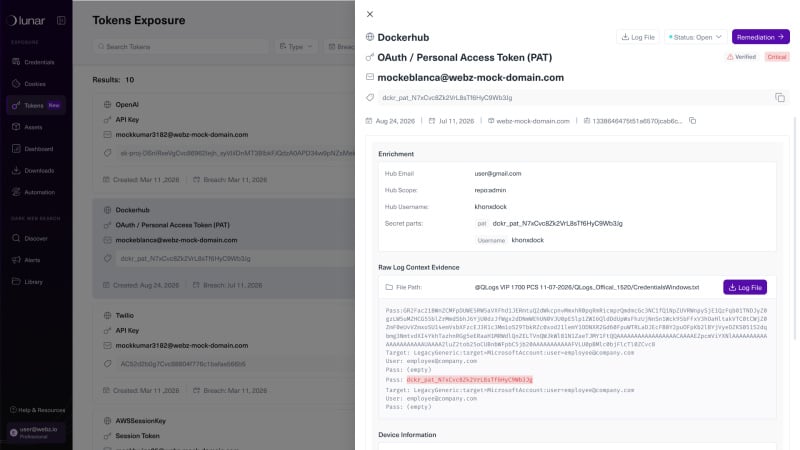
Recognizing this blind spot, Lunar Cyber developed Token Exposure Monitoring to extend infostealer response workflows past traditional user credentials. When an endpoint is compromised, Lunar’s collection infrastructure captures the raw infostealer logs and processes them through advanced analytic pipelines.
The system executes three vital functions upon encountering a machine credential:
- Identification and Attribution: It links an otherwise anonymous, opaque token string to the specific compromised employee, workstation, and internal file path.
- Forensic Context Preservation: It retains the original log context, malware metadata, and endpoint telemetry, providing forensic investigators with an unalterable trail of the exposure.
- Validation State Assessment: For supported credential types, the platform actively checks whether the token remains live and valid, allowing analysts to triage threats based on actual risk rather than speculative alerts.
Supporting Context & Metrics: The Anatomy of Machine Identity Vulnerability
To understand why Lunar Cyber’s Token Exposure Monitoring is a vital addition to the cybersecurity stack, one must examine the unique economic and operational realities of machine credential theft.
The Problem of Attribution
Traditional corporate credentials carry inherent metadata. An exposed email address like [email protected] instantly informs an incident responder of the organizational domain, the identity of the affected user, and the likely scope of impact.
Machine credentials, however, present a starkly different intelligence challenge. An API key typically manifests as an opaque, randomized string of characters (e.g., sk-ant-api03-... or ghp_...) with zero internal clues regarding its owner, organizational affiliation, or associated service tier. To a standard security team, an unindexed token found in a dark-web infostealer dump is effectively anonymous noise.
Lunar Cyber overcomes this barrier by cross-referencing surrounding infostealer artifacts—such as browser profiles, local paths, machine names, and associated user accounts—to reconstruct the chain of custody. This turns an anonymous string into an actionable corporate incident.
The Rise of LLMjacking and Cloud Compromise
The commoditization of AI has introduced entirely new monetization vectors for cybercriminals. Security researchers have documented a dramatic spike in LLMjacking, a technique where threat actors steal enterprise AI API keys (such as OpenAI or Anthropic tokens) and route massive, expensive generative AI workloads through the victim’s account. Organizations can incur thousands of dollars in cloud computing bills within hours of a credential leak, often without realizing their keys have been exfiltrated.
Beyond AI endpoints, the stakes are remarkably high for other developer secrets:
- GitHub and GitLab Tokens: Provide direct access to proprietary source code repositories, intellectual property, and internal CI/CD secrets.
- Cloud Infrastructure Keys (AWS, Azure, GCP): Allow attackers to provision unauthorized crypto-mining rigs, deploy ransomware across enterprise environments, or exfiltrate sensitive customer databases.
- SaaS and Collaboration Credentials (Slack, Okta): Enable lateral movement, social engineering attacks via trusted internal communication channels, and identity federation bypasses.
Complementing Existing Security Layers
It is important to note where Token Exposure Monitoring fits within the broader enterprise security architecture. Organizations typically rely on repository secret scanning tools (such as GitHub Secret Scanning or GitGuardian) and internal secrets management platforms (like HashiCorp Vault) to prevent developers from accidentally committing keys to public repositories or to manage secrets internally.
However, these internal tools are largely blind to what happens on the endpoint when malware circumvents standard development controls. Lunar Cyber acts as the critical external intelligence layer—identifying when a machine credential has already been successfully stolen by an infostealer and exfiltrated outside the perimeter.
Official Statements and Industry Perspective
The launch of Lunar Cyber’s new capability underscores a fundamental pivot in how the security industry views endpoint hygiene. Ran Geva, Founder and CEO of Webz.io (Lunar Cyber’s parent collection infrastructure provider), emphasized the urgency of treating developer credentials with the same gravity traditionally reserved for administrative passwords.
"Developer tokens have become valuable credentials in their own right," stated Ran Geva. "A stolen AI key can be converted into compute almost immediately. A GitHub token can provide access to source code, and a cloud credential can open infrastructure. Security teams need visibility into these credentials at the moment they appear in an infostealer log, with enough context to understand who they belong to and what needs to be revoked."
Geva further elaborated on the necessity of updating incident response playbooks for the modern threat landscape:
"Passwords and cookies have been at the center of infostealer response for years. Developer tokens now deserve the same treatment. If the malware took the credential, the incident response process needs to find it, validate it, and rotate it."
Industry analysts have echoed these sentiments, noting that as organizations scale their engineering output, the attack surface expands directly onto the developer’s local machine. By streamlining the path from raw infostealer log to validated remediation, Lunar Cyber aims to drastically reduce the dwell time of compromised machine identities.
Future Outlook: The Next Generation of Credential Intelligence
As we look toward the future of enterprise defense, the boundary between traditional IT security and software development security (DevSecOps) will continue to blur. The introduction of Lunar Cyber’s Token Exposure Monitoring points toward several inevitable industry trends:
1. Automated Remediation Loops
While current workflows empower security analysts to manually investigate, triage, and rotate exposed tokens via a centralized dashboard, the next evolution will likely involve deep API integrations with identity providers and cloud platforms. Future iterations of exposure monitoring systems may automatically trigger token revocation the moment an infostealer log is indexed, neutralizing threats in real-time before human analysts even review the alert.
2. Heightened Scrutiny on Non-Human Identities (NHIs)
Regulatory bodies and compliance frameworks are beginning to place heavier emphasis on non-human identity management. As standards for auditing API access tighten, organizations will be mandated to maintain rigorous inventories of all active machine credentials. Solutions that can audit endpoints for unauthorized credential hoarding will become core components of compliance and cyber-insurance readiness.
3. The Proliferation of Multi-Platform Malware
Infostealer developers are constantly refining their payloads to target emerging development environments, specialized IDEs, and local container caches. As developer tooling shifts toward decentralized architectures, threat intelligence providers like Lunar Cyber will need to continuously expand their parsing engines to capture novel, proprietary token formats across an ever-growing ecosystem of cloud and AI platforms.
Conclusion
Lunar Cyber’s introduction of Token Exposure Monitoring marks a pivotal milestone in endpoint security and threat intelligence. By bridging the gap between raw, anonymous infostealer logs and actionable developer credential management, Lunar Cyber equips security teams with the visibility required to combat modern cyber threats.
Available now in Lunar’s Essential & PRO Tiers, Token Exposure Monitoring ensures that as organizations accelerate their adoption of AI and cloud-native development, their security posture evolves in lockstep—keeping machine identities secure against the persistent threat of endpoint malware.