The legal battle surrounding the unauthorized pre-release distribution of Grand Theft Auto VI (GTA 6) has taken a dramatic turn. Publisher Take-Two Interactive has informed United States federal courts that its ongoing investigation into the massive gameplay leaks is "rapidly evolving."
Hot on the heels of a major promotional preview via Netflix, the gaming giant filed a brand-new Digital Millennium Copyright Act (DMCA) subpoena request in a New York federal court. However, unlike its initial broad-net legal maneuvers, Take-Two is asking the court to keep this latest filing strictly under seal. The publisher argues that public disclosure would compromise the integrity of the probe by tipping off alleged infringers, potentially leading to the destruction or concealment of critical digital evidence.
Concurrently, Take-Two has opted to formally withdraw its previous DMCA subpoena request targeted at Google’s YouTube, signaling a strategic pivot in how the company gathers intelligence. As the gaming community awaits the anticipated November launch of what is arguably the most expensive and highly anticipated entertainment product in history, Take-Two’s legal division is aggressively tightening the noose around those responsible for breaching its digital security.
Detailed Chronology: From ‘Cyberleek’ to the Federal Courtroom
The Breach and Immediate Fallout
The saga began several weeks ago when an anonymous entity operating under the moniker "Cyberleek" began disseminating gameplay footage of Grand Theft Auto VI across various online platforms. The leak arrived months ahead of Rockstar Games’ scheduled marketing rollout and final release window, catching the publisher flat-footed and triggering an immediate, aggressive corporate response.
Take-Two Interactive, the parent company of Rockstar Games, reacted swiftly with a wave of automated and manual copyright takedown notices. Simultaneously, the company launched a cluster of DMCA subpoenas in a U.S. federal court, a specialized legal mechanism designed to allow copyright holders to compel third-party platform operators to hand over identifying information about suspected infringers without the immediate necessity of filing a formal lawsuit.
The First Broad Sweep
The initial wave of subpoenas cast a wide net, targeting thousands of individual user accounts across popular communication and hosting platforms. Investigative reports soon revealed that Take-Two had expanded its legal crosshairs to include tech heavyweights such as Microsoft, X (formerly Twitter), and Google’s YouTube, alongside a primary focus on Discord.
This first set of subpoenas was entirely public. Consequently, media outlets and legal watchdogs were able to comb through the documentation, identifying specific community servers named in the filings—including a server tied to prominent content creator DarkViperAU. This transparency, while standard for many civil filings, ultimately allowed public scrutiny of Take-Two’s roadmap, alerting both supporters and targets to the scope of the publisher’s inquiry.
The Second Wave: Going Under Seal
Recognizing that public filings create a paper trail that suspected leakers can monitor, Take-Two changed tactics. On Friday—just one day after Rockstar streamed an extended promotional look at the game on Netflix—Take-Two returned to the New York federal court.
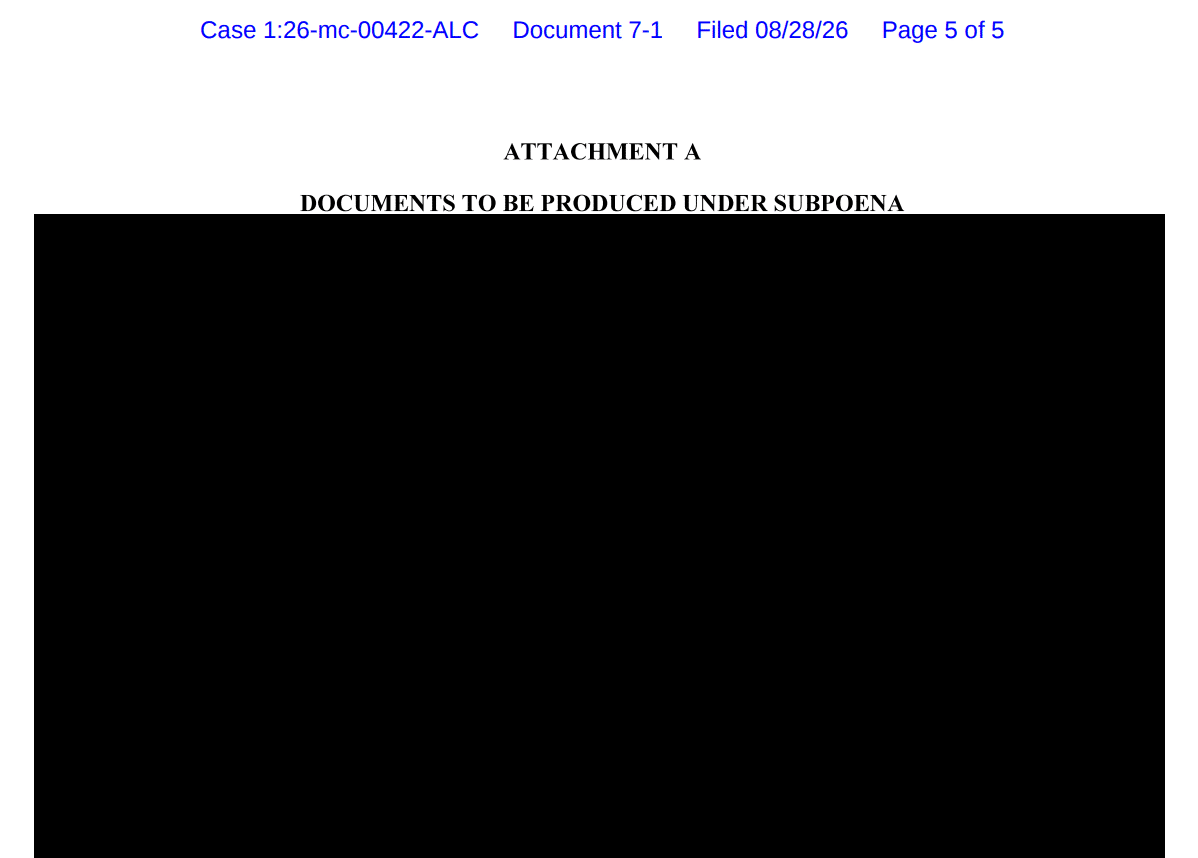
The company submitted a second subpoena request directed at Discord. This time, however, the filing was accompanied by a motion to seal. By requesting that the court keep the details out of public view, Take-Two successfully blacked out the names of the specific targets, community servers, and exact data points requested.
According to unsealed portions of the accompanying legal letters, this second request is far more focused than its predecessor. Take-Two stated that it has successfully identified one additional Discord user and gathered deeper identifying information regarding a previously flagged user, prompting the need for more targeted administrative data from the platform.
Supporting Context & Metrics: The Mechanics of DMCA Subpoenas
Understanding 17 U.S.C. § 512(h)
To fully grasp the significance of Take-Two’s actions, one must understand the legal instrument being deployed. Under Section 512(h) of the Digital Millennium Copyright Act, a copyright owner can file a request for a subpoena to a clerk of a U.S. district court to compel a service provider to identify an alleged infringer.
Crucially, this can be done without filing a formal civil complaint. The service provider—whether it is Discord, Microsoft, or Google—is legally obligated to process the request and provide the available account details (such as names, IP addresses, billing details, and email addresses) unless they successfully challenge the subpoena’s validity.
The Friction Between Platforms and Publishers
The execution of these subpoenas is rarely frictionless. For instance, Take-Two’s initial August 21 subpoena was reportedly "promptly served on Discord," yet initial court docket entries lacked the standard clerk’s issuance notation.
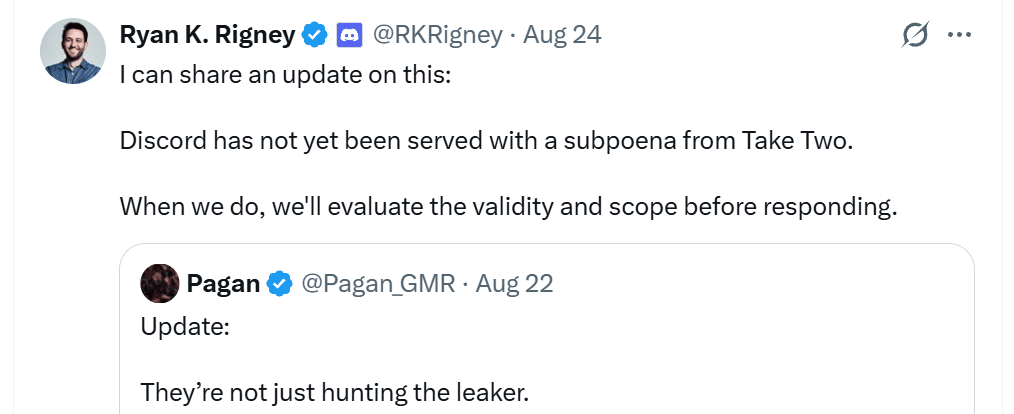
Adding to the complexity, Ryan Rigney, a representative for Discord, publicly stated on X (formerly Twitter) on August 24 that the platform had not yet been formally served with a subpoena from Take-Two. Rigney added that Discord intended to carefully evaluate the validity and scope of the demands before issuing a response.
While it remains unconfirmed whether Discord’s pushback directly influenced Take-Two’s decision to pursue a more narrowly tailored, sealed second subpoena, the timeline highlights the strategic tug-of-war between tech platforms committed to user privacy and media corporations fiercely protecting billion-dollar intellectual property.
Official Statements and Legal Arguments
The Danger of a Paper Trail
In its motion to seal the second Discord subpoena, Take-Two’s legal counsel articulated a clear rationale for secrecy. The filing argues that the subpoena attachments contain "highly sensitive, confidential information about an ongoing investigation into copyright infringement and the misappropriation of Take-Two’s confidential information."
The publisher explicitly warned the court that transparency could backfire:
"Public disclosure of this information could compromise Take-Two’s ongoing investigation and even tip off the alleged infringers as to the nature and progress of Take-Two’s investigation and information Take-Two has gathered about the infringement."
Furthermore, Take-Two expressed grave concern that if the targets are made aware of the exact scope of the government-backed data gathering, they could actively destroy, conceal, or encrypt important digital evidence before platforms can hand over server logs and account metadata. The company emphasized that its investigative apparatus is "rapidly evolving and ongoing," justifying the need for distinct, non-public categories of data that differ from the initial August requests.
Reevaluating the YouTube Front
While the Discord front is heating up, Take-Two is simultaneously streamlining its operations elsewhere. Initially, the publisher targeted Google to unmask the individuals behind three YouTube personas—CyberLeeks, Surfer24k, and CyberLeek_ar_io—who uploaded or discussed leaked video content.
However, U.S. District Judge John P. Cronan pushed back against the initial request, declining to sign off without clearer evidence linking those specific channels directly to the core security breach. While Take-Two attempted to supply supplemental details, the publisher ultimately chose to withdraw the YouTube subpoena entirely.
In its formal withdrawal notice to the court, Take-Two noted that its investigative priorities had shifted:
"Take-Two has determined it no longer needs the particular information requested. Thus, Take-Two respectfully withdraws its subpoena request."
Legal analysts point out that withdrawing the subpoena does not mean Take-Two has abandoned its grievances against YouTube-based uploaders. The publisher explicitly reserved the right to return to Google with a revised, more robust request at a later date if the evolving investigation uncovers new links between the YouTube personas and the primary leakers.
Future Outlook: What Lies Ahead for Take-Two and GTA 6
As the legal proceedings in the New York federal court continue behind closed doors, several key questions remain unanswered:
The Court’s Decision on Sealing: Judge Cronan has yet to officially rule on whether Take-Two’s second Discord subpoena details will remain permanently sealed or if they will eventually see the light of day once enforcement actions are complete.
Discord’s Compliance: How Discord responds to the new, targeted demands—and whether it chooses to move to quash the subpoena based on overbreadth or jurisdictional arguments—will set a crucial precedent for future gaming leaks.
The Identity of ‘Cyberleek’: Whether these digital breadcrumbs will successfully lead federal investigators to the masterminds behind the breach remains to be seen. However, Take-Two’s relentless pursuit demonstrates that the company is willing to exhaust every legal avenue available under U.S. copyright law to punish those who compromise its assets.
With Grand Theft Auto VI slated for its monumental release, the gaming industry will be watching closely to see if Take-Two’s aggressive legal strategy results in accountability or if the elusive leakers manage to stay one step ahead of the law.