Executive Overview
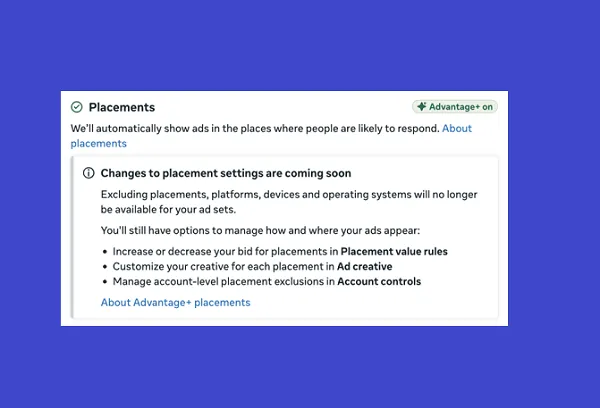
Meta is fundamentally reshaping the digital advertising landscape. According to recent platform alerts shared by prominent digital marketing experts like Jon Loomer, the tech giant is moving to eliminate manual placement and platform-exclusion options from its ad sets. This strategic shift represents a seismic departure from traditional campaign management, effectively stripping advertisers of their long-held ability to handpick where, when, and across which Meta-owned apps their promotional content appears.
For years, digital marketers have relied on granular placement controls to fine-tune their brand safety parameters. If an enterprise preferred to keep its creatives out of Facebook search results or prevent in-stream video breaks between Reels, the native user interface (UI) allowed them to simply opt out. Those days are numbered. By phasing out these controls, Meta is compelling brands to lean entirely into its algorithmic engine—Advantage+ systems that dynamically distribute ads across Facebook, Instagram, Messenger, and the Audience Network based on real-time computational performance predictions.
While presented as an optimization milestone designed to maximize return on ad spend (ROAS) through machine-learning efficiency, this evolution has ignited intense debate across the digital marketing ecosystem. On one side of the ledger, Meta’s leadership envisions a frictionless, fully automated ecosystem where human intervention is minimized. On the other, seasoned media buyers face a stark reality: surrendering granular control in exchange for blind trust in black-box algorithms.
This article explores the mechanics of Meta’s latest removal of controls, analyzes the broader macroeconomic and technological strategy driving the company toward fully autonomous ad creation by 2026, and weighs the profound implications this shift holds for brand safety, creative homogeneity, and the future of digital marketing.
Detailed Chronology: The Step-by-Step Erosion of Manual Ad Controls
To understand the weight of Meta’s most recent announcement, one must trace the evolutionary arc of the company’s ad manager interface over the past half-decade. Meta has systematically minimized manual toggles, replacing human strategic decisions with algorithmic automation under the banner of performance optimization.
Phase 1: The Era of Granular Targeting (Pre-2020)
For the better part of the 2010s, digital advertising on Meta ecosystems was defined by hyper-specific targeting. Media buyers spent hours building complex audience matrices based on detailed demographic filters, granular interest targeting, and explicit behavioral exclusions. Advertisers maintained absolute sovereignty over their budgets, defining strict boundaries regarding whether their assets appeared in desktop feeds, mobile feeds, right-hand columns, or Instagram stories.
Phase 2: The Introduction of "Advantage+" and Automated Expansion (2021–2023)
As privacy regulations tightened—most notably Apple’s App Tracking Transparency (ATT) framework introduced in iOS 14.5—Meta’s traditional deterministic tracking mechanisms suffered a severe blow. In response, the platform accelerated its pivot toward probabilistic modeling and machine learning.
- Advantage+ Shopping Campaigns (ASC): Introduced to streamline ecommerce performance, ASC stripped away much of the manual targeting overhead, encouraging brands to feed broad parameters to the algorithm and let the system hunt for conversions.
- Advantage+ Placements: Meta began aggressively nudging advertisers away from manual placement selections by making "Advantage+ Placements" the default setting. While marketers could still override this default, the UI heavily favored automated distribution.
Phase 3: The Upcoming Removal of Placement and Platform Exclusions (Present)
The current phase marks a definitive escalation. As highlighted by Jon Loomer and confirmed via automated platform alerts sent to select advertisers, Meta is removing two core pillars of manual campaign architecture:
- Ad Placement Controls: Advertisers will soon lose the ability to exclude specific sub-placements (e.g., removing Reels in-stream placements or Facebook search result ads).
- Platform Exclusions: Marketers will no longer be able to restrict campaigns from running on specific Meta-owned applications. Instead, the delivery system will fluidly shift budgets between Facebook, Instagram, and other ecosystem properties based purely on algorithmic assessments of where an ad is projected to convert best.
While Meta has not yet published a universal hard timeline for the global rollout of this feature deprecation, the direction of travel is unmistakable. The walls of the manual control room are being systematically dismantled.
Supporting Context & Metrics: The Mechanics of Black-Box Optimization
To justify stripping away foundational controls, Meta relies on the immense computational power of its underlying artificial intelligence architecture. Understanding why Meta believes its systems can outperform human media buyers requires looking closely at how modern machine-learning models process digital signals at scale.
The Power of Scale and Pattern Recognition
Traditional media buyers are inherently limited by cognitive bandwidth, sample sizes, and the speed at which they can manually analyze data. A human strategist might review campaign performance weekly or daily, adjusting budgets across a handful of predefined audience segments and placement configurations.
Conversely, Meta’s AI infrastructure evaluates billions of data points simultaneously. Modern large-scale recommendation and ad-ranking engines process:
- Contextual Signals: Time of day, device type, network connection speed, and immediate viewing environment.
- Behavioral Intent: Historical user interactions, micro-pauses on video content, scrolling velocity, and conversion pathways across millions of distinct user profiles.
- Dynamic Creative Matching: Assessing which specific visual-textual pairing resonates with a hyper-niche user cohort at a precise micro-moment.
Meta’s core argument is simple: An algorithm operating in real-time can optimize ad delivery across 20 different placement permutations far more efficiently than a media buyer manually restricting placements out of precautionary intuition.
The Efficiency vs. Control Trade-Off
Empirical data from early implementations of automated placement tools suggests that expanding the surface area of ad delivery often lowers average Cost Per Acquisition (CPA). When algorithms are unfettered by artificial guardrails (such as a brand banning its ads from appearing on Facebook Marketplace or Audience Network), they can unearth low-cost, high-converting inventory that human buyers routinely overlook due to bias or habit.
However, this statistical efficiency comes with built-in systemic risks. When the system decides to distribute an ad across every available surface based purely on conversion propensity, it disregards qualitative nuances. A luxury fashion brand might care deeply that its cinematic video asset does not get sandwiched between low-production user-generated clips in a Reels in-stream break. Under the new paradigm, the algorithm’s singular metric of success is conversion probability—not aesthetic adjacency or brand safety context.
Official Statements and the 2026 Vision for Fully Autonomous Ads
Meta’s aggressive pruning of ad-set controls is not an isolated UX update; it is a calculated waypoint on a direct road map toward fully autonomous, AI-driven advertising. The company’s long-term vision was articulated most transparently by Meta CEO Mark Zuckerberg during a comprehensive interview with Ben Thompson of Stratechery.
The Zuckerberg Blueprint
Outlining the future of Meta’s advertising ecosystem, Zuckerberg described an environment where the traditional concept of building an ad campaign is entirely eradicated:
"We’re going to get to a point where you’re a business, you come to us, you tell us what your objective is, you connect to your bank account, you don’t need any creative, you don’t need any targeting demographic, you don’t need any measurement, except to be able to read the results that we spit out. I think that’s going to be huge, I think it is a redefinition of the category of advertising."
This quote serves as the ideological north star for Meta’s product development teams. By 2026, the company plans to offer an end-to-end generative AI advertising suite. In this envisioned workflow:
- Input: A business provides a simple destination URL and a budgetary constraint.
- Processing: Meta’s generative models scrape the website, analyze product offerings, synthesize value propositions, and autonomously generate custom ad copy, imagery, and video variations.
- Execution & Distribution: The system deploys the creative assets across the entire Meta application family, dynamically optimizing placements, budgets, and bidding strategies in real time.
- Output: The business receives a clean dashboard displaying revenue generated against spend, with zero human touches required in between.
Removing placement and platform exclusions is a necessary psychological and technical stepping stone toward this future. If advertisers retain the habit of micromanaging where their ads appear, they cannot effectively transition into passive supervisors of fully automated pipelines.
Future Outlook: Challenges, Risks, and the Evolution of the Media Buyer
As Meta inches closer to its fully autonomous ideal, the industry must grapple with the downstream consequences of automated ad optimization. While large enterprises and direct-to-consumer (DTC) brands may welcome the time-saving efficiencies, several profound challenges loom on the horizon.
1. The Brand Safety Dilemma
For Fortune 500 companies and risk-averse corporate brands, the loss of placement and platform exclusions is deeply alarming. Without the ability to explicitly block sensitive inventory, brands risk having high-value campaigns associated with volatile content, unvetted Audience Network third-party apps, or placements misaligned with corporate ethos. While Meta maintains that its brand safety filters are robust, algorithmic assurances rarely satisfy legal and compliance departments that demand absolute deterministic control over brand environment exposure.
2. Creative Homogeneity and Algorithmic Inbreeding
Perhaps the most fascinating theoretical risk of fully autonomous, AI-driven ad generation and placement lies in the realm of feedback loops.
- Today, diverse human creators supply millions of distinct, idiosyncratic ad creatives to Meta’s ecosystem.
- Tomorrow, if Meta’s AI systems are generating the majority of ad creative and deciding where and how to place them based on automated performance metrics, the ecosystem risks developing a monoculture.
- If all automated campaigns draw from similar generative design principles optimized by the same core algorithms, ads will begin to look, sound, and feel identical.
Worse still, an ecosystem dominated by AI-generated ads evaluated by AI algorithms creates a closed-loop feedback system. The AI trains on data generated by its own past iterations, potentially leading to creative stagnation and diminished long-term campaign effectiveness—a digital equivalent of genetic inbreeding. Meta will undoubtedly need to build sophisticated entropy and diversity mechanisms into its generative models to prevent aesthetic and strategic calcification.
3. The Transformation of the Digital Marketer’s Role
For marketing professionals, agencies, and media buyers, the writing is on the wall: tactical execution is dead. The days of spending hours adjusting bids, configuring audience lookalike percentages, and toggling placement checkboxes are rapidly drawing to a close.
However, the death of tactical execution does not spell the death of the marketer. Instead, it forces a profound elevation of the discipline. As Meta and competing platforms absorb the mechanical labor of campaign setup, the value of human marketers will shift entirely toward:
- Strategic Vision: Defining core business objectives, pricing models, and market positioning that AI cannot deduce on its own.
- First-Party Data Infrastructure: Feeding clean, high-integrity customer data into Meta’s conversion APIs to guide the underlying algorithms intelligently.
- Creative Direction: Acting as executive producers who curate, audit, and direct the foundational brand messaging that generative AI models use as raw material.
Conclusion
Meta’s decision to phase out ad placement controls and platform exclusions is much more than a routine interface update. It is a calculated, inevitable milestone in the platform’s relentless march toward total algorithmic autonomy. By forcing advertisers out of the weeds of manual configuration and into the passenger seat of AI-driven optimization, Meta is betting that raw computational power will consistently outperform human intuition.
Whether this gamble delivers an era of unprecedented marketing efficiency or sparks a new crisis of brand safety and creative fatigue remains to be seen. What is certain, however, is that the era of the manual media buyer is fading fast—replaced by a brave new world where human intent meets machine-driven execution.