What began several years ago as a legal novelty in France has steadily transformed into a streamlined, high-stakes annual ritual. Ahead of each new football season, media conglomerate Canal+ marches into the Paris Judicial Court, armed with legal petitions designed to choke off the lifeblood of pirate streaming sites and unauthorized IPTV services. However, the scope of these interventions has expanded far beyond simple domain name system (DNS) blocks or traditional internet service provider (ISP) filtering.
A newly uncovered batch of fourteen court orders, signed on July 17 by Vice-President Irène Benac at the Tribunal Judiciaire de Paris, lays bare a comprehensive, multi-layered defensive strategy. Split evenly between the 2026/2027 UEFA Champions League and English Premier League (EPL) seasons, these coordinated orders target every single layer of internet infrastructure. From major telecommunications operators and recursive public DNS resolvers to content delivery networks (CDNs), search engines, and privacy-focused virtual private networks (VPNs), Canal+ has woven a digital dragnet designed to make unauthorized sports streaming practically unviable in France.
This sprawling legal offensive targets dozens of prominent sports-streaming domains—including high-traffic brands like Totalsportek, LiveTV, and Kevinsport—while forcing tech giants and infrastructure providers to actively participate in copyright enforcement. Yet, even as these orders set a robust precedent under current French law, they represent a transitional phase. Handed down just days before the French Parliament adopted groundbreaking legislation paving the way for automated, real-time stream blocking, these rulings capture the zenith of the traditional, court-mandated blocking framework before artificial intelligence and automated regulators take the wheel.
Detailed Chronology: The July 17 Rulings and Infrastructure Scope
The fourteen orders signed by Vice-President Benac on July 17 represent the culmination of years of judicial refinement. Initially, rightsholders pursued scattered, isolated injunctions against individual web hosts or telecom providers. Today, those efforts have matured into massive, synchronized campaigns. The July 17 batch is split directly down the middle: seven orders govern the Premier League season (running until May 30, 2027), and seven govern the Champions League campaign (expiring June 5, 2027).
The Multi-Tiered Intermediary Strategy
To fully understand the reach of Canal+’s campaign, one must examine the diverse categories of intermediaries roped into the judicial mandates:
ISPs and Telecom Operators: The most immediate and blunt instruments of enforcement fall upon France’s foundational telecom infrastructure. Major providers—including Orange, SFR, Free, and Bouygues Telecom—alongside various overseas operators (such as SPM, Telco OI, UTS Caraïbe, and Zeop), are legally compelled to block subscriber access to a combined total of 73 unique domains across both leagues (47 for the Premier League, 26 for the Champions League).
Alternative and Public DNS Resolvers: Recognizing that tech-savvy users easily bypass standard ISP-level DNS blocks by switching to alternative resolvers, Canal+ targeted public DNS providers. Google Public DNS, Cloudflare DNS, Quad9, and Whalebone (operating DNS4EU) were all ordered to block domain name resolution for French users. Notably, Quad9 and DNS4EU opted not to present a defense in court, resulting in default judgments.
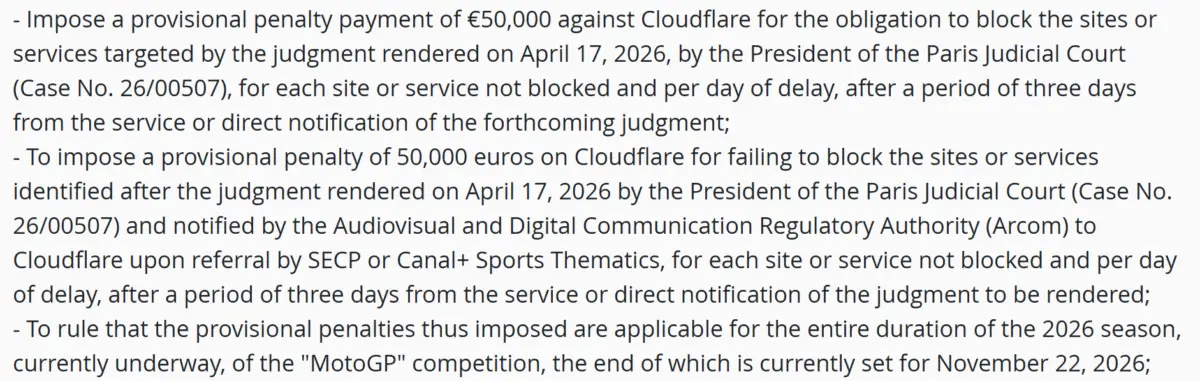
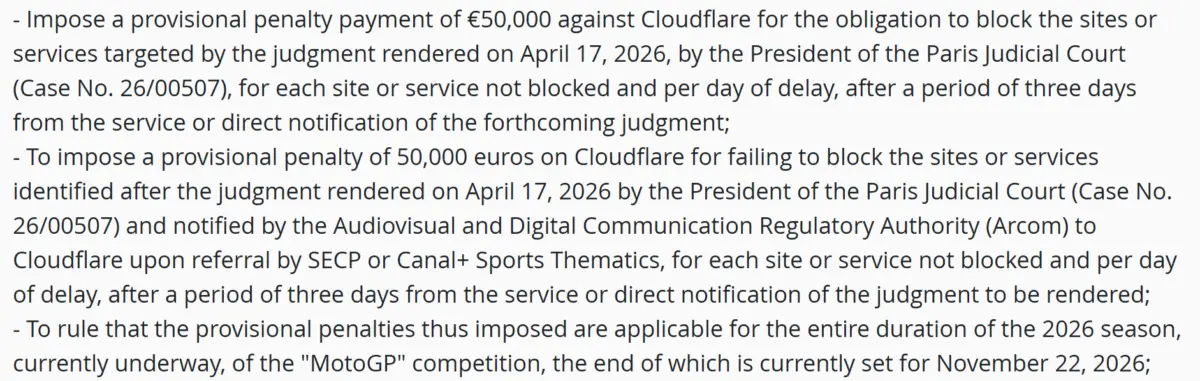
Content Delivery Networks and Proxies: Infrastructure giant Cloudflare was singled out not merely for its 1.1.1.1 DNS service, but across its entire operational footprint. Under the rulings, Cloudflare must block the targeted domains across its Content Delivery Network (CDN) and reverse proxy services using whatever technical means it deems appropriate.
Search Engines: In an effort to wipe pirate operations from public discovery, Google Search and Microsoft Bing were ordered to de-index (déréférencement) all targeted domains. Consequently, these pirate portals should no longer surface in search results for users querying streams from within French territory.
VPN Providers: To close the final major loophole, Canal+ targeted commercial VPN services. While previous seasons saw five VPN providers dragged into court, this round focused on Proton VPN, CyberGhost, and ExpressVPN.
Implementation Deadlines and Dynamic Updating
The operational clock ticks fast once these orders are handed down. ISPs and intermediaries are generally required to implement the mandated blocks within three days (extended to five days for overseas operators like UTS Caraïbe). Furthermore, these orders are dynamically designed. Rather than locking the blacklist in stone for the entire football season, ARCOM—France’s audiovisual and digital communications regulator—has the authority to approve additional domains throughout the year, dynamically expanding the scope of the blocklists without requiring rightsholders to initiate entirely new lawsuits for every emerging clone site.
Supporting Context & Metrics: The Anatomy of the Blocklists
The sheer volume of domains neutralized by these fourteen orders demonstrates the persistence and adaptability of pirate operators. The Premier League mandate alone ropes in 47 distinct domain names and subdomains, while the Champions League order encompasses 26.
Targeted Domains Overview
The blacklists feature a mix of established aggregation brands and ephemeral redirect networks designed to evade automated detection:
Premier League Target Highlights:abcsport.tel, akhtv.online, antenasport.org, empire-sports.store, kevinsport.org, livetv880.me, livetv882.me, sports24.cc, streamonsport.art, totalsporteki.com, witv.team, xuperlive.com, alongside various dynamic IPTV portals and obscure proxy nodes.
Champions League Target Highlights:empire-sport.live, empire-sports.store, kevinsport.org, kzontop.site, sports24.cc, sportsonline.vc, streamonsport.art, witv.team, kevinsport.lat, kevinsport.quest, lovetier.bz, kevinsport.homes, kzontop.space, wilderness.click, and multiple automated streaming subdomains.
Summary of Judicial Orders (July 17, 2026)
Category
Targeted Services
Action Mandated
EPL Reference (RG)
UCL Reference (RG)
ISPs & Telecoms
Orange, Free, SFR, Bouygues, overseas operators
Block domains/subdomains for subscribers in France.
Official Legal Arguments and Intermediary Defenses
While many tech infrastructure providers chose not to contest the rulings—or defaulted entirely—the legal battle waged by commercial VPN providers CyberGhost and ExpressVPN proved to be a defining moment of the litigation.
The VPN Counter-Offensive and EU Jurisprudence
Anticipating the legal onslaught, CyberGhost and ExpressVPN mounted a sophisticated defense. Initially, they urged the Paris court to stay the proceedings pending a referral to the Court of Justice of the European Union (CJEU). The VPN providers pointed toward the landmark Anne Frank Stichting case, a ruling delivered shortly before the Paris decision which shielded VPNs from liability in certain copyright disputes.
However, Vice-President Benac’s court firmly rejected the request for a stay. The bench distinguished the Anne Frank precedent, noting that it involved a completely different legal directive and pertained to a publication that was inherently lawful in nature—a stark contrast to commercial pirate streaming portals explicitly dedicated to unauthorized re-transmissions of premium sports broadcasts.
Furthermore, the VPN providers argued that Article L. 333-10 of the French Sports Code directly conflicts with the EU E-Commerce Directive and should therefore be set aside by the national court. The court dismissed this argument as well, emphasizing a fundamental tenet of European Union law: because this is a private-law dispute between corporate entities, an EU directive lacks "horizontal direct effect," meaning a national statute cannot be unilaterally disapplied on that basis alone.
Defining the Role of Neutral Intermediaries
Addressing the core defense of passive neutrality—the argument that VPNs merely encrypt data traffic without hosting or promoting pirate content—the court laid out an expansive doctrine of intermediary liability. The ruling stresses that even if an intermediary acts entirely passively, it can still function as an essential pipeline for copyright infringement:
"The mere act of serving as a bridge enabling access to the infringing sites fulfills the transmission function," the court stated, translating passive data transit into active legal exposure.
The judiciary maintained that neutrality does not exempt an infrastructure provider from responsibility when its network architecture acts as an indispensable conduit for widespread digital piracy.
Concurrently, tech titan Google pushed back against the DNS and search de-indexing orders. Google questioned whether Canal+ possessed fully enforceable exclusive broadcasting rights across all claimed channels in France, and argued that the broadcaster had failed to establish a legally sufficient pattern of repeated infringements for every single disputed domain. The Paris court systematically rejected both objections, clearing the path for full enforcement.
Future Outlook: The Shift Toward Automated, Real-Time Blocking
Though the July 17 rulings represent a tour de force for Canal+ under the prevailing legal framework, they occupy a fascinating historical footnote. The orders were handed down just four days before the French Parliament officially adopted a revolutionary new sports law fundamentally rewriting the nation’s digital enforcement mechanisms.
For years, the French blocking apparatus has relied on a manual, bureaucratic workflow: ARCOM agents had to manually verify individual domains before a court could issue an injunction. While effective against static websites, this system struggled to keep pace with agile pirate operators who constantly spin up new domains, mirror sites, and throwaway streaming nodes during live matches.
The newly approved legislation sweeps away this procedural bottleneck. It replaces the manual verification system with an automated framework capable of appending new targets to blocklists in real time during live broadcasts. Under the new paradigm, ARCOM retains an oversight role, but shifts its interventions to a post-hoc review process rather than a pre-approval hurdle.
What Lies Ahead for Rightsholders and Intermediaries?
As of writing, the newly minted sports law awaits full administrative implementation, anticipated later this year. Until those automated systems go live, court-mandated injunctions like the July 17 batch remain the primary weapon of choice for rightsholders.
Nevertheless, the writing is on the wall. Once ARCOM’s automated real-time blocking infrastructure becomes operational, rightsholders like Canal+ are expected to migrate away from slow, court-heavy seasonal petitions in favor of instantaneous, algorithmically driven takedowns. Until that automated future arrives, however, the digital borders of France remain firmly guarded by the heavy iron gates of judicial injunctions—ensuring that ISPs, DNS providers, CDNs, search engines, and VPNs alike remain front-line soldiers in the ongoing war against sports piracy.