EXECUTIVE SUMMARY
For enterprise software companies, the traditional definition of account health is built on a comforting premise: happy customers are vocal, unhappy customers file support tickets, and quiet customers are thriving. But in the era of artificial intelligence, this foundational tenet of SaaS business models is rapidly disintegrating.
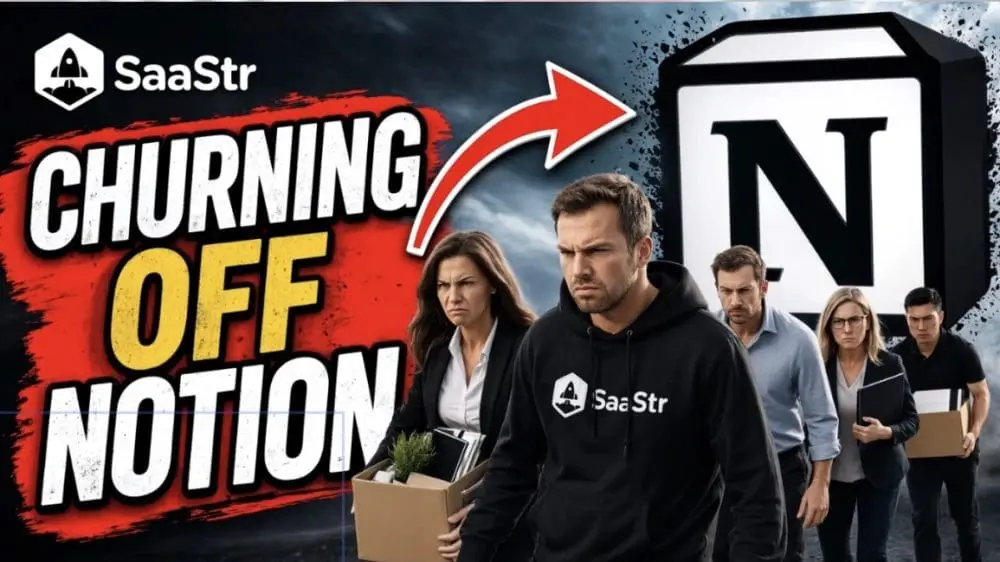
A stark wake-up call arrived recently when Jason Lemkin, founder of SaaStr, casually announced on The Agents podcast that his team had officially canceled their Notion subscription after seven years. There was no pricing dispute, no service outage, no competitive bake-off, and no disgruntled employee. In fact, SaaStr had been such a loyal advocate that one of their team members had previously presented at Notion’s user conference.
Notion did nothing wrong. Rather, SaaStr simply stopped needing it.
As teams increasingly delegate operational workflows—such as Monday morning staff meetings, financial reporting, and data consolidation—to proprietary internal AI agents, software stacks are experiencing a new phenomenon: silent, invisible churn. No customer success dashboard on the market could have flagged SaaStr’s drift because there was no decline in feature satisfaction. The product’s core utility was quietly absorbed by an autonomous internal agent.
This deep dive investigates the structural breakdown of B2B retention metrics, the double-edged sword of automated re-engagement campaigns, the hidden liabilities of zombie software subscriptions, and why legacy Customer Success (CS) playbooks are dangerously blind to the agentic revolution.
1. Executive Overview: The Death of Traditional SaaS Metrics
For over a decade, software-as-a-service (SaaS) metrics have relied on predictable indicators. Monthly active users (MAU), feature adoption rates, log-in frequencies, and Net Promoter Scores (NPS) formed the trinity of account health. Customer Success teams lived and died by these telemetry signals, intervening when usage dipped or doubling down on expansion plays when engagement spiked.
Today, that entire infrastructure is facing an existential crisis.
When internal AI agents—often built natively on top of large language models and integrated directly into accounting software, CRMs, and communication tools—take over administrative and executive workflows, human engagement metrics flatline or shift in ways traditional tracking cannot interpret.
[Traditional B2B Health Model]
User Log-ins ---> Feature Adoption ---> Low Ticket Volume ---> Assumed High Health

[The Agentic Reality]
AI Agent Consumes Data ---> Human Interfaces Disappear ---> Zero Human Log-ins ---> Silent Churn
The SaaStr-Notion case study illustrates this paradigm shift with brutal clarity. Notion’s account health indicators for SaaStr would have read as pristine right up until the moment of cancellation. There were zero support tickets, zero feature requests, and zero escalations across seven years. Yet, the software was rendered obsolete not by a competitor’s superior product roadmap, but by an internal AI utility named "10K"—SaaStr’s proprietary AI Vice President of Revenue and Finance.
As autonomous agents become the primary operators of daily business execution, B2B software companies are flying blind. The quietest, most loyal, lowest-touch accounts are no longer safe havens of predictable recurring revenue; they are the most exposed to silent replacement.
2. Detailed Chronology: How Seven Years of Loyalty Evaporated Overnight
To understand how a seven-year enterprise relationship can vanish without a trace, it is necessary to examine the incremental evolution of workplace technology at SaaStr.
The 2019 State-of-the-Art Workflow
SaaStr first onboarded Notion around 2019 during a period of team expansion. At the time, the platform represented the cutting edge of B2B productivity. The organization transitioned its staff meetings away from static Google Docs into dynamic Notion workspaces.
Every team member maintained a customized dashboard, a company designer optimized the layout for aesthetic clarity, and the platform served as the central nervous system for internal communication and project tracking. For a growing organization, it was indispensable.
The Slow Narrowing of Scope
Over the subsequent years, however, natural operational drift occurred. As workflows matured and specialized tools were integrated across departments, SaaStr’s reliance on Notion began to contract.
The team systematically phased out Notion for general documentation, project management, and cross-functional wikis. Eventually, its utility was winnowed down to a single function: hosting the weekly Monday staff meeting. By the end, running that one meeting was the entire justification for keeping the subscription active.
The Rise of "10K"
The definitive pivot arrived when Amelia, a member of the SaaStr team, engineered an internal AI system initially dubbed "10K." What began as a simple dashboard progressively evolved—first into an AI head of marketing, and ultimately into an autonomous AI VP of Revenue and Finance.
Team members began interacting with 10K daily. Because the AI agent already housed live revenue metrics, active campaign data, collections queues, and pipeline forecasts, it naturally absorbed the responsibilities of the Monday staff meeting.
The meeting agenda, status updates, and strategic reviews began running directly out of 10K. The software no longer needed a human-curated document repository because the underlying data layer was already synthesized and conversational.
The Catalyst: An Automated Re-Engagement Email
Ironically, the final act of the relationship was triggered by Notion itself.
Amelia had not logged into the platform for months. Standard B2B lifecycle marketing logic dictates that prolonged dormancy represents an existential threat that must be addressed via automated re-engagement campaigns. Notion dutifully dispatched an email notifying her of her inactivity.
Upon reading the notification, Amelia’s reaction was instantaneous: “You’re right, I need to go cancel this.”
This highlights a blind spot in modern product-led growth (PLG) and customer success strategies: dormancy is not always a problem the customer wants solved. Sometimes, dormancy is simply a finalized decision that the customer has not yet gotten around to executing. Automated re-engagement emails run the high-stakes risk of waking up dormant accounts only to remind them that they are paying for software they no longer use.
3. Supporting Context & Metrics: The Illusion of High Usage and Zombie Accounts
The fragility of modern customer retention is further underscored when looking at the inverse scenario: how companies misinterpret high usage, and how internal agents expose hidden liabilities within their own billing systems.
The Adobe Marketo Trap: High Usage Does Not Equal Loyalty
During the same operational window, SaaStr experienced a parallel breakdown in vendor relations with marketing automation giant Adobe Marketo, culminating in the termination of a decade-long relationship.
Marketo approached SaaStr for an annual renewal, resting their retention case entirely on raw telemetry data: SaaStr’s platform usage was exceptionally high. Consequently, the vendor offered a minor concession by waiving an 8-percent price increase, assuming that high consumption equaled deep product lock-in.
Marketo’s data analytics fundamentally misread the operational reality. SaaStr’s usage was high not because the team loved the platform, but because SaaStr’s company list had expanded by 50 percent and revenue had surged by over 40 percent over the course of the year.
High volume was a byproduct of raw business growth, not emotional attachment. In fact, because Marketo was so deeply embedded in daily operations, its API integration failures with SaaStr’s internal agents transformed high usage from a sign of stickiness into a source of friction. Once the technical friction outweighed the switching cost, the decision to leave was clear.
The Mirror Image: Six Years of Involuntary Payments
The blindness of traditional account management systems cuts both ways. While Notion lost an account due to invisible workflow migration, SaaStr discovered that it had been inadvertently committing the exact same error as a software vendor.
When SaaStr connected their internal AI agent, 10K, to financial systems like Brex and QuickBooks, the AI discovered two corporate customers who had been paying $300 a month for SaaStr Pro—a legacy learning management product designed to train executive teams.
The product had been abandoned six years prior when the internal champion departed and support was officially sunsetted. Yet, two enterprise clients had continued quietly paying their monthly subscription fees for over half a decade.
- No complaints were filed.
- No support tickets were raised.
- No human at SaaStr was monitoring the billing ledger for those specific legacy accounts.
It required an autonomous financial agent auditing raw ledger data to surface the anomaly. The parallel is exact: a quiet, uninterrupted financial relationship running on autopilot, completely detached from human oversight.
4. Official Statements & Industry Perspectives
The structural shifts highlighted by the SaaStr case have ignited intense debate across the B2B software ecosystem. Industry analysts and SaaS founders are increasingly questioning whether traditional Customer Success departments are structured to survive the AI transition.
"We just churned Notion after 7 years. Zero complaints. Never filed a support ticket. Never asked for a feature… We just stopped needing it. 10K, our AI VP of Revenue, became our…"
— Jason Lemkin, Founder of SaaStr (via X/Twitter)
Lemkin’s commentary underscores a brutal truth for software executives: traditional churn analysis focuses heavily on customer dissatisfaction. Retention models assume that if a customer is not complaining, they are secure.
However, in an environment where non-human agents orchestrate tasks, satisfaction is irrelevant if utility has been internalized. When a company builds an internal utility that renders an external SaaS tool redundant, the cancellation is frictionless. There is no negotiation, no executive sponsor meeting, and no opportunity for a Customer Success Manager (CSM) to step in with a discount or a feature roadmap promise.
5. Future Outlook: How B2B Customer Success Must Adapt
As autonomous agents proliferate across the enterprise landscape, software companies must radically revise how they measure account health, model churn risk, and structure customer success organizations. Relying on legacy telemetry will guarantee blind spots.
1. Shift from Usage-Based to Workflow-Dependency Metrics
Traditional SaaS tracks how much a product is used (e.g., clicks, logins, time-in-app). In the agentic era, vendors must track where their product sits in the customer’s broader architectural workflow. If a product can be bypassed by an API query or an internal LLM prompt, high usage is a lagging indicator of imminent replacement.
2. Redefine the Role of the Customer Success Manager
CSMs can no longer operate as reactive firefighters who step in only when ticket volumes spike or usage drops. Because agentic churn happens invisibly and instantaneously, CSMs must evolve into strategic consultants who continuously demonstrate compounding ROI that an internal agent cannot easily replicate. If a tool only handles a narrow, single-purpose administrative task, it is prime for automated replacement.
3. Re-Evaluate Lifecycle Marketing and Re-Engagement Campaigns
Automated dormant-user campaigns must be overhauled. Blithely asking inactive users why they haven’t logged in can inadvertently prompt a cancellation review for accounts that had simply forgotten to sever a billing link. Enterprises need smarter behavioral heuristics to distinguish between neglected accounts (who need help re-engaging) and superseded accounts (who have permanently moved on).
Conclusion
The cancellation of Notion after seven years without a single support ticket is not an isolated anecdote; it is the opening salvo of a structural transformation in B2B software. As internal AI agents become the primary operational layer for modern businesses, the silent, happy, low-touch customer is no longer the bedrock of predictable recurring revenue. They are the frontline casualties of the agentic revolution.