Executive Overview
The professional filmmaking industry is facing a quiet crisis of technological obsolescence. For over a century, motion picture production equipment was bought with the expectation of multi-decadal utility. Heavy-duty tripods, mechanical cameras, and analog lighting fixtures were long-term capital investments, serviced by dedicated technicians and handed down through generations of filmmakers. However, the rapid digitization of the film set—specifically the transition to software-defined hardware controlled via mobile applications—has fundamentally disrupted this paradigm.
As we progress through 2026, a worrying trend has crystallized: the sudden closure of several respected, legacy manufacturing brands has left production crews holding expensive hardware that is entirely dependent on defunct software ecosystems. When a hardware manufacturer ceases operations, its proprietary control applications are quickly purged from or abandoned on the Apple App Store and Google Play Store. Without these apps, highly sophisticated LED lighting fixtures, wireless follow-focus systems, timecode generators, and audio recorders are rendered partially or completely non-functional.
This investigative report examines the structural vulnerabilities of the "app-dependent" film set, analyzes the economic and technical incentives that drove manufacturers to abandon physical user interfaces, and explores potential open-source and local-hosting solutions to prevent thousands of dollars of professional equipment from becoming high-tech landfill.
Detailed Chronology: The Migration to the Screen (2010–2026)
To understand how the film industry arrived at this point of vulnerability, it is necessary to trace the evolution of on-set control systems over the past fifteen years.
+-----------------------------------------------------------------------------+
|                                  CHRONOLOGY                                 |
+-----------------------------------------------------------------------------+
|  2010–2015: The Analog-to-Digital Transition                                |
|  - High-power LED fixtures emerge.                                          |
|  - Physical ballasts feature basic segmented LCDs and tactile dials.        |
|                                                                             |
|  2016–2020: The Proliferation of "App-cessories"                            |
|  - Manufacturers realize offloading UI to smartphones slashes R&D costs.   |
|  - Bluetooth Low Energy (BLE) and local Wi-Fi chips replace physical dials. |
|                                                                             |
|  2021–2024: The Cloud-Native Shift and App-Store Monopolies                |
|  - Setup and activation require cloud accounts and internet connections.    |
|  - Legacy open protocols (DMX-512) are bypassed for proprietary APIs.       |
|                                                                             |
|  Late 2025: The Legacy Collapse                                             |
|  - Several legacy brands, including Mole-Richardson, shutter operations.    |
|  - Assets auctioned off; cloud-dependent digital lines face "bricking."     |
|                                                                             |
|  Early 2026: The On-Set Reality                                             |
|  - Crews juggle dozens of unmaintained apps on aging mobile OS versions.    |
|  - Growing demand for local web-server hosting and open-source control.      |
+-----------------------------------------------------------------------------+
2010–2015: The Analog-to-Digital Transition
The early 2010s saw the rapid rise of high-power LED lighting and digital wireless audio. Early fixtures relied on physical ballasts with robust, tactile controls—rotary encoders, robust toggle switches, and monochrome LCD screens. While simple, these interfaces were impervious to software deprecation. A light built in 2012 operated exactly the same way in 2022.
2016–2020: The Proliferation of "App-cessories"
As mobile processors grew more powerful and touchscreens became ubiquitous, film equipment manufacturers realized they could drastically cut production costs by offloading the user interface (UI) to consumer smartphones. By replacing physical buttons, dials, and high-resolution screens with a cheap Bluetooth Low Energy (BLE) or Wi-Fi chip, manufacturers slashed bill-of-materials (BOM) costs while offering customers flashy, color-wheel-driven mobile interfaces.
2021–2024: The Cloud-Native Shift and App-Store Monopolies
What began as an optional convenience quickly became a operational requirement. New generations of pocket-sized LED fixtures, wireless microphones, and electronic lenses were designed with zero physical interface on the chassis itself. Configuration required downloading a proprietary app. Increasingly, these apps demanded internet connectivity for initial registration, cloud-based preset syncing, and firmware updates, tying the physical hardware to the manufacturer’s active web servers.
Late 2025: The Legacy Collapse
The industry was rocked by a series of high-profile bankruptcies and corporate restructuring events, most notably the winding down of legacy giant Mole-Richardson in December 2025. While Mole-Richardson’s classic, purely electrical incandescent inventory found eager buyers at auction due to its indestructible, analog nature, several younger, digital-first startups quietly collapsed during the same period. For users of these digital startups’ products, the closures were catastrophic: proprietary control servers went dark overnight, and their apps were removed from app stores, leaving thousands of active production units orphaned.
Supporting Context & Technical Analysis
The fundamental vulnerability of modern production equipment lies in the mismatch between the lifecycles of professional hardware and consumer software.
+------------------------------------------------------------------------+
|                      HARDWARE VS. SOFTWARE LIFECYCLES                  |
+------------------------------------------------------------------------+
|  PROFESSIONAL HARDWARE (e.g., LED Fixtures, Wireless Receivers)        |
|  Expected Lifespan: 10–15 Years                                        |
|  Obsolescence Driver: Physical wear, physical component failure.       |
|                                                                        |
|  CONSUMER MOBILE SOFTWARE (iOS / Android Ecosystems)                   |
|  Expected Lifespan: 1–3 Years (Before breaking API updates)            |
|  Obsolescence Driver: OS updates, App Store policy shifts, API changes.|
+------------------------------------------------------------------------+
The Economics of the Smartphone UI
For a niche manufacturer of cinema equipment, designing a custom physical interface is incredibly expensive. A ruggedized, weather-sealed, daylight-viewable color screen with tactile buttons requires years of specialized mechanical engineering, custom injection molding, and extensive environmental testing.
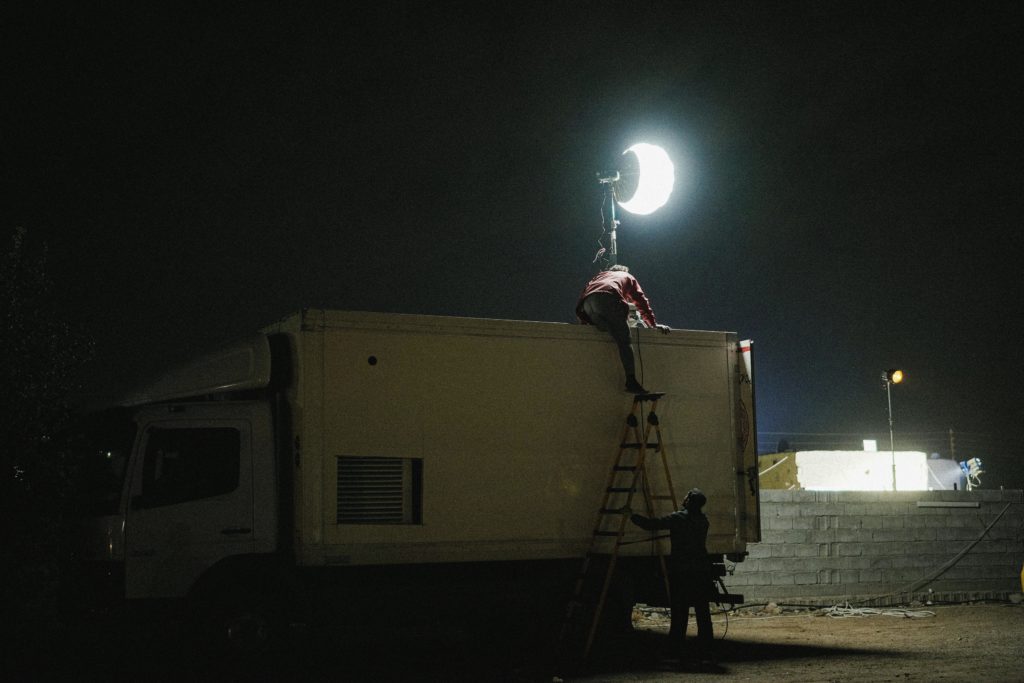
In contrast, Apple, Google, and Samsung spend billions of dollars refining handheld computing devices with high-resolution displays, multi-gigabyte storage, advanced graphics processing, and robust wireless transceivers. By shifting the control interface to a smartphone app, film equipment manufacturers bypass these hardware development costs entirely.
However, this shifts the financial burden from hardware engineering to continuous software maintenance. Mobile operating systems (iOS and Android) undergo major updates annually. An app left unupdated for two to three years will eventually fail to launch, be flagged as insecure, or be removed from app stores entirely due to changing developer guidelines.
The Limits of Legacy Protocols
In the lighting sector, the industry has long relied on DMX-512 (Digital Multiplex), a digital communication protocol developed in 1986. Because DMX is an open, standardized, serial protocol, any DMX-compatible light console can control any DMX-compatible light, regardless of who manufactured either device.
+-----------------------------------------------------------------------------+
|                          DMX-512 vs. Proprietary App Control                |
+-----------------------------------------------------------------------------+
| Feature                  | DMX-512 (Standard)     | Proprietary Mobile App  |
+--------------------------+------------------------+-------------------------+
| Protocol Openness        | Open, public standard  | Closed, encrypted API   |
| Hardware Interoperability| Universal (Any brand)  | Single-brand lock-in    |
| Interface Type           | Physical fader/console | Touchscreen, virtual UI |
| Lifespan                 | Decades                | Dependent on OS updates |
| Remote Setup Complexity  | High (Requires cables) | Low (Wireless/Ad-hoc)   |
+--------------------------+------------------------+-------------------------+
However, DMX-512 is fundamentally limited. It operates on a simple 8-bit scale (0 to 255 values) across 512 channels. Modern multi-spectral LED fixtures (employing Red, Green, Blue, Amber, Lime, and Cyan emitters) require complex, multi-dimensional control algorithms to accurately calculate color spaces, XY coordinates, and dynamic effects.
Attempting to map these advanced features to standard DMX channels without a visual user interface is incredibly difficult for end-users, requiring complex control maps and specialized lighting consoles. To bypass this friction, manufacturers designed proprietary wireless protocols and app interfaces that handle these complex calculations on the smartphone itself, sending custom commands to the light. The moment that proprietary app disappears, the user is locked out of the fixture’s advanced capabilities, forced to revert to basic DMX control—if the fixture even features physical DMX ports.
The "Stepladder in the Rain" Reality
On-set ergonomics highlight the practical failure of app-centric design. Film sets are chaotic, fast-paced, and often subject to harsh environmental conditions.
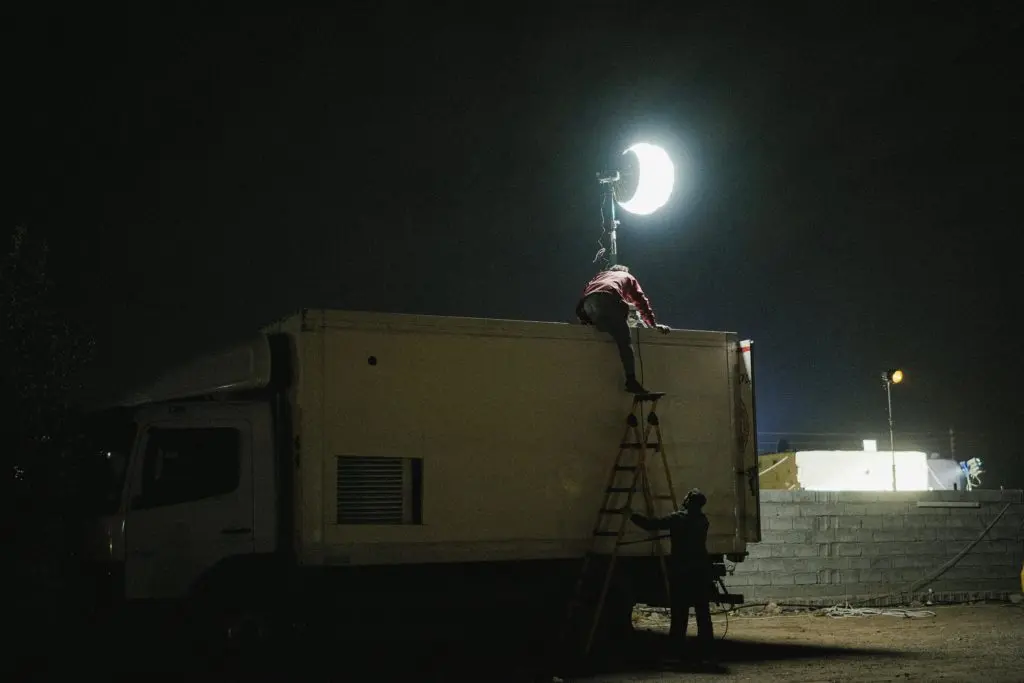
Consider a gaffer standing on top of a 12-foot stepladder in a driving rainstorm, attempting to adjust the color temperature of a light rigged high above a truck.
- The Tactile Method: With a traditionally designed fixture, the gaffer reaches out, feels for the physical, rubberized rotary dial, and rotates it. The dial has physical detents, allowing the user to make precise adjustments by feel without even looking at the screen. The physical screen on the ballast is shielded, bright, and works perfectly when wet.
- The App-Centric Method: The gaffer must take off their wet work gloves, pull a fragile $1,000 consumer smartphone out of their pocket, wipe the rain off the screen so the capacitive touch interface registers their fingers, open the phone, find the specific control app, wait for it to search for and connect to the fixture via local Wi-Fi or Bluetooth, and slide a virtual fader on a wet glass screen.
If the local wireless environment is congested—a common occurrence on modern sets filled with wireless video transmitters, wireless focus systems, and crew personal devices—the app may drop connection repeatedly, turning a five-second physical adjustment into a multi-minute troubleshooting ordeal.
Historical Context: The Era of Intergenerational Gear
The current state of disposable, software-dependent equipment stands in stark contrast to the historical practices of the motion picture industry.
For decades, camera and lighting manufacturers operated under a covenant of long-term support. Legendary camera designers like Bolex (founded in 1927) and Beaulieu (founded in 1951) built mechanical cameras that could be serviced by any competent watchmaker. Even today, specialized workshops continue to repair, recalibrate, and modify mid-century Bolex H16 cameras for modern film productions.
+-----------------------------------------------------------------------------+
|                       HISTORICAL SUPPORT COMPARISON                         |
+-----------------------------------------------------------------------------+
|  MITCHELL CAMERA CORP (Analog Era)                                          |
|  - Production of classic cameras ceased.                                    |
|  - Spare parts and factory support remained guaranteed for nearly a decade. |
|  - Gear remained fully operational for 40+ years.                           |
|                                                                             |
|  MODERN "APP-CENTRIC" STARTUPS (Digital Era)                                |
|  - Company ceases operations or gets acquired.                              |
|  - App Store developer accounts lapse; app is removed from circulation.     |
|  - Gear becomes partially bricked or unconfigurable within 12–24 months.    |
|                                                                             |
|  MOLE-RICHARDSON (Hybrid/Analog Era)                                        |
|  - Closed operations in Dec 2025.                                           |
|  - Inventory auctioned off; simple electrical ballasts and mechanical       |
|    chassis remain highly functional with standard, non-proprietary parts.   |
+-----------------------------------------------------------------------------+
When the Mitchell Camera Corporation wound down manufacturing of its legendary studio cameras, the company maintained a massive inventory of spare parts and offered technical support for nearly ten years, ensuring that rental houses and studios could amortize their massive capital investments over decades.
Similarly, the closure of Mole-Richardson in late 2025, while a blow to the industry, did not render their iconic fixtures useless. Because their lights rely on standardized electrical ballasts, heavy-duty switches, and standard cables, they can be maintained indefinitely by local electricians using off-the-shelf industrial components. There are no software updates to run, no firmware images to flash, and no mobile operating systems to maintain.
Future Outlook & Technical Mitigations
As the film industry grapples with the realities of software transience, engineers, rental houses, and crew members are beginning to push back, demanding more resilient control standards. Several technical alternatives and philosophies are gaining traction to prevent the next wave of equipment brickings.
+-----------------------------------------------------------------------------+
|                      FUTURE MITIGATION ARCHITECTURES                        |
+-----------------------------------------------------------------------------+
|  CURRENT VULNERABLE MODEL:                                                  |
|  [Fixture] <---(Proprietary BLE/Wi-Fi)---> [App Store] ---> [Proprietary App]|
|                                                                (Fails if    |
|                                                                 Co. Dies)   |
|                                                                             |
|  PROPOSED EMBEDDED WEB SERVER MODEL:                                        |
|  [Fixture w/ Embedded Web Server] <---(Standard Wi-Fi)---> [Any Web Browser]|
|  - No App Store needed.                                                     |
|  - UI is hosted on the fixture itself as an HTML/JS page.                   |
|  - Platform-agnostic (Works on phone, tablet, laptop, or legacy device).   |
+-----------------------------------------------------------------------------+
1. Onboard Micro-Webservers
The most elegant technical solution to the app-dependency problem is the implementation of onboard micro-webservers. Rather than requiring a dedicated, compiled iOS or Android app, modern low-cost microcontrollers (such as the ESP32) can act as a local Wi-Fi access point and host a lightweight, responsive web server directly on the physical fixture.
When a crew member needs to control the device:
- They connect their smartphone or tablet to the fixture’s local Wi-Fi network.
- A captive portal automatically opens, or the user types a simple IP address (e.g.,
192.168.4.1) into any standard web browser. - The fixture serves an HTML5/JavaScript user interface directly to the browser.
Because this interface relies entirely on open web standards rather than proprietary operating system APIs, it is completely platform-agnostic and immune to app-store deprecation. It will run just as effectively on a smartphone in 2036 as it does in 2026, requiring zero software maintenance from the manufacturer.
2. Mandatory Sideloading and Firmware Archiving
Industry advocacy groups are beginning to demand that if a hardware manufacturer goes out of business, they must release their compiled application files (such as .apk files for Android) and firmware source code to the public domain. This allows users to "sideload" the software directly onto mobile devices without going through official app stores.
While this does not solve the issue of future operating system incompatibilities, it allows rental houses and owner-operators to maintain dedicated, offline "control tablets" running older OS versions specifically dedicated to managing legacy gear.
3. The Return of Physical "Fallback" Controls
A growing segment of filmmakers is voting with their wallets, choosing to purchase equipment from manufacturers that refuse to compromise on physical controls. Even on highly compact, miniature devices, the inclusion of a small, bright OLED screen and a single clickable rotary dial ensures that every single menu setting remains accessible in the field, completely independent of wireless connectivity or external devices.
Ultimately, the film set of 2026 is learning a hard lesson about the ephemeral nature of modern software. While touchscreens and mobile apps offer unparalleled convenience and complex control interfaces, they must not come at the expense of fundamental hardware utility. For professional gear to remain a sound investment, the industry must demand a return to open standards, local control architectures, and robust physical fallbacks—ensuring that the tools used to create lasting art are not themselves designed to vanish into the cloud.