Executive Overview
Encrypted messaging applications have long walked a fine line between championing digital privacy and inadvertently fostering illicit ecosystems. Among them, Telegram has evolved into one of the most prominent hubs for unauthorized media distribution. While the platform’s architecture—featuring massive broadcast channels, automated bots, and peer-to-peer file-sharing integrations—is designed for seamless communication, it has simultaneously cultivated a sprawling, highly resilient black market for copyrighted video content.
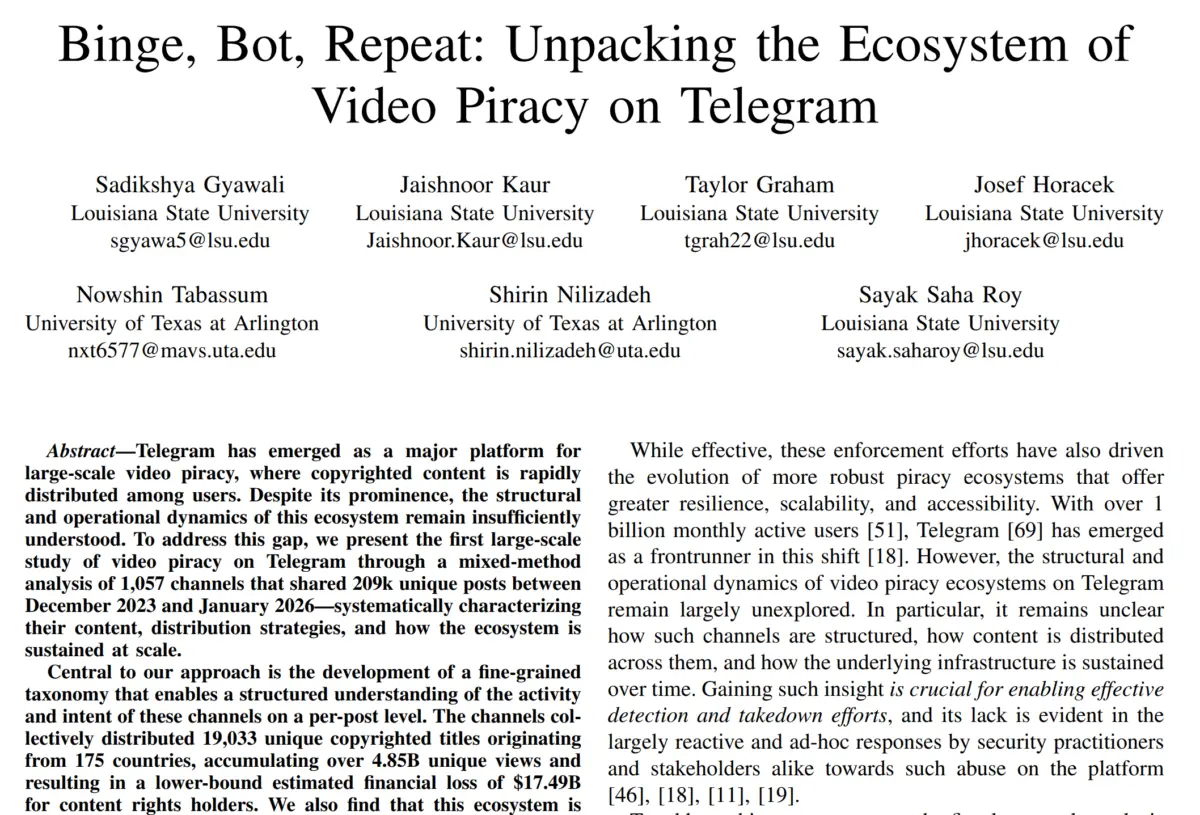
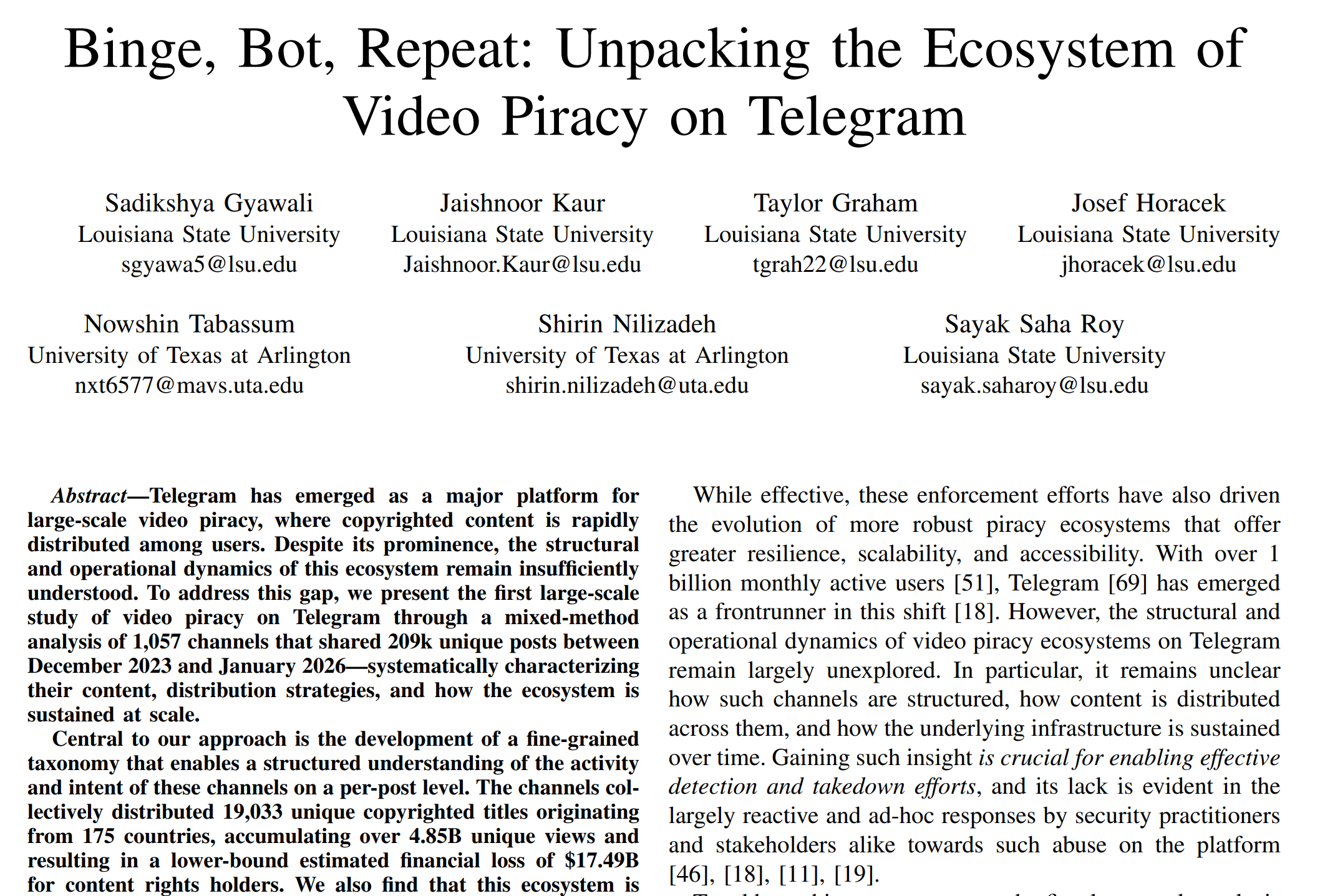
Until recently, this vast underground economy operated largely in the shadows, defying comprehensive empirical study. However, a groundbreaking academic paper titled “Binge, Bot, Repeat: Unpacking the Ecosystem of Video Piracy on Telegram” has pulled back the curtain. Authored by researchers from Louisiana State University and the University of Texas at Arlington, the study provides the first large-scale, quantitative mapping of video piracy on the messaging platform.
Analyzing more than a thousand interconnected channels and nearly 209,000 individual posts between December 2023 and January 2026, the study reveals staggering metrics: billions of post views, tens of thousands of unique pirated titles, and billions of dollars in estimated revenue losses for major global rightsholders. Crucially, the researchers did not stop at observation. They engineered “Anti-RIP,” a real-time, artificial intelligence-powered framework designed to hunt down emerging piracy hubs, successfully facilitating the takedown of hundreds of illicit channels and bots.
This comprehensive report explores the mechanics of Telegram’s piracy ecosystem, the staggering economic toll it extracts from media giants, the architecture of resistance built by digital black-market operators, and the dawn of an AI-driven cat-and-mouse game that is redefining digital enforcement.
Detailed Chronology: Mapping the Underground and Deploying Anti-RIP
To understand the scale of the operation, the research team embarked on a multi-phase investigative timeline spanning over two years of data collection and subsequent algorithmic deployment.

Phase 1: Data Harvesting and Large-Scale Mapping (December 2023 – January 2026)
During this foundational period, the researchers deployed localized large language models (LLMs) to scan, categorize, and label content across Telegram. By monitoring 1,057 channels and extracting approximately 209,000 distinct posts, the team sought to understand how media was ingested, shared, and monetized. This phase was critical in identifying the intricate web of dependencies that allows pirate networks to survive automated and manual moderation efforts. Rather than existing as isolated boards, the vast majority of these channels were found to be part of complex, multi-tiered topologies featuring automated redirect bots, auxiliary backup channels, and external cloud-storage links.
Phase 2: Algorithmic Calibration and Testing (Early 2026)
With the initial dataset classified, the researchers transitioned from passive observation to active intervention. They developed Anti-RIP, an automated scanning framework capable of proactively generating and probing candidate Telegram handles to spot newly emerging piracy operations before they could build substantial follower bases. In controlled testing environments, the detection model achieved a reported 98% accuracy rate, proving its efficacy in separating legitimate public channels from underground distribution rings.
Phase 3: The Live Scan and Takedown Campaign (February 3 – April 10, 2026)
Armed with the Anti-RIP framework, the team executed a live sweep across the platform, examining 249,133 newly discovered channels over a compressed 66-day window. The tool successfully flagged 802 piracy channels (which had a median age of less than five days), along with 299 connected channels and 108 automated bots.
Rather than dumping raw, unorganized URLs onto rightsholders, the researchers packaged their findings into granular evidence reports. These dossiers provided contextual labels detailing the specific function of each flagged node—whether it acted as a primary host, a secondary redirect, or a monetization gateway. These reports were systematically transmitted to Telegram’s abuse department and 17 major U.S. entertainment conglomerates.
Phase 4: Measurable Enforcement and Open-Sourcing (Mid-2026)
The intervention yielded immediate, quantifiable results. Within two weeks of receiving the intelligence reports, 524 of the 1,101 flagged channels were rendered entirely inaccessible, alongside 71 bots, while Telegram concurrently purged thousands of individual flagged posts. Following these successful real-world trials, the research team open-sourced the Anti-RIP framework and released their entire dataset publicly via GitHub, inviting rightsholders and platform administrators to adopt the defense mechanism.

Supporting Context & Metrics: The Scale of Telegram Piracy
The empirical data compiled in the study shatters the misconception that Telegram piracy is merely a fringe phenomenon involving a handful of isolated users. Instead, it operates with the efficiency and reach of a commercial streaming competitor.
Volume and Media Breakdown
Through the assistance of locally executed LLMs, the researchers identified 19,033 unique pirated titles circulating within the studied ecosystem. This expansive catalog was broken down into:
- 14,632 unique movies
- 4,401 unique television series
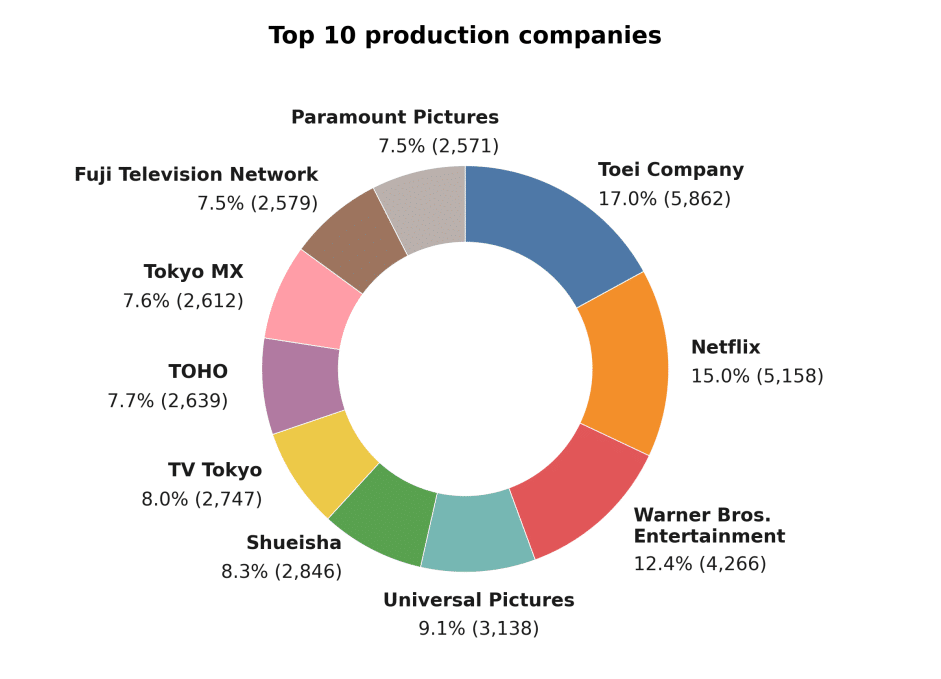
These assets originated from 3,941 distinct corporate rightsholders. Mirroring trends observed on traditional web-based torrent and cyberlocker sites, Japanese anime proved to be exceptionally popular among Telegram’s user base. Toei Company—the legendary Japanese studio behind global blockbusters such as One Piece and Dragon Ball—was the single most heavily pirated rightsholder, accounting for 17% of all identified titles.
Western media giants closely followed:
- Netflix: 15% of titles
- Warner Bros.: 12.4% of titles
Viewer Engagement and Economic Impact
The sheer volume of consumption on these channels is staggering. The researchers cataloged pirate posts spread across 983 active channels that collectively amassed an astronomical 4.85 billion post views.
To quantify the financial damage inflicted by this traffic, the researchers developed a conservative economic model. Assuming that just 1% of those 4.85 billion views translated directly into lost sales—benchmarked against the cheapest legal subscription or purchase option available—and capping losses at a single subscription cost when multiple titles from the same service were bundled, the estimated total economic loss reached $17.49 billion.
Geographically, the financial impact was most acutely felt by American and Japanese media industries:
- U.S. Content Losses: Estimated at $8.17 billion.
- Japanese Content Losses: Estimated at $3.72 billion.
Infrastructure: Engineered for Survival
Unlike historical piracy models heavily reliant on BitTorrent protocols and magnet links—which the researchers spotted a mere nine times across the entire dataset—Telegram pirates rely on a diversified, cloud-integrated infrastructure.
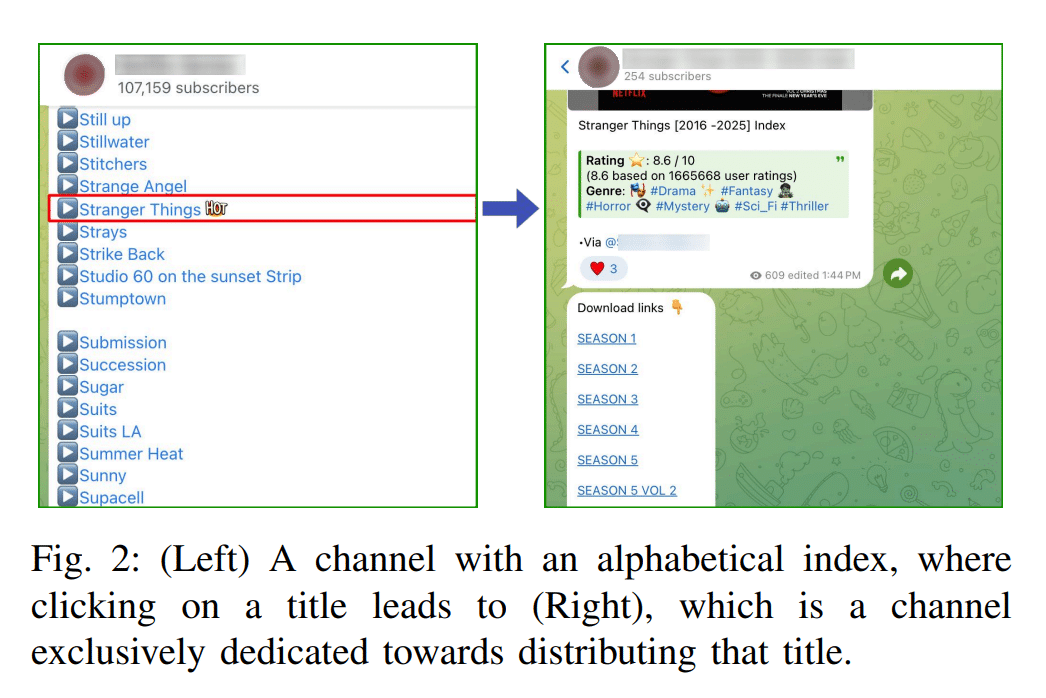
The vast majority of media files are not hosted directly on Telegram’s servers. Instead, channels act as indexing and distribution layers, pointing users toward external third-party cloud hosting and file-sharing platforms such as TeraBox, Terashare, and GoFile.
Furthermore, the ecosystem displays remarkable structural redundancy. Approximately 94% of the AI-mapped channels were interconnected, forming resilient swarms. If law enforcement or platform moderators manage to take down a primary broadcast channel, automated bots and secondary redirect channels instantly guide users to mirror accounts, ensuring uninterrupted service. Beyond media links, certain sophisticated channels even distributed compromised premium account credentials for mainstream platforms like Netflix, Hulu, Disney+, and Crunchyroll, alongside specialized VPN tutorials designed to bypass regional blocks and network-level censorship.
Official Statements and Industry Reception
The introduction of academic data combined with actionable, AI-generated intelligence marks a paradigm shift in how intellectual property (IP) holders approach encrypted messaging platforms. Historically, copyright enforcement on apps like Telegram was a reactive, tedious game of Whac-A-Mole, bogged down by manual reporting of individual URLs.
The proactive nature of the Anti-RIP framework received a notably positive, albeit pragmatic, reception from the industry. Of the 17 major U.S. rightsholders that received the research team’s evidence dossiers, 14 formally acknowledged receipt of the reports. Crucially, 4 studios explicitly confirmed that the contextual labeling provided by the AI tool was instrumental in helping their legal and compliance teams rapidly assess, prioritize, and process takedown notices. By categorizing channels based on their specific utility—differentiating between passive host accounts and active monetization or discovery bots—the tool cut through the administrative noise that typically delays digital enforcement.
Despite these victories, industry stakeholders and the academic researchers maintain a realistic view of the limitations inherent in automated tools. During validation testing of 1,000 randomly sampled posts, human coders discovered that the LLM model generated a minor margin of error, incorrectly classifying four legitimate posts as piracy. While a 98% accuracy rate in controlled laboratory environments is impressive, scaling such models to monitor millions of dynamic, encrypted messages in real time inevitably introduces the risk of false positives—a challenge that must be carefully managed to avoid inadvertently censoring legitimate public speech or legal media discussions.
Future Outlook: The AI-Driven Cat-and-Mouse Game
The publication of “Binge, Bot, Repeat” and the open-sourcing of the Anti-RIP framework signal the official escalation of the digital piracy wars into the domain of artificial intelligence.
As academic institutions and rightsholders leverage LLMs to preemptively hunt down and dismantle underground networks, malicious actors are predictably following suit. Security analysts and researchers anticipate that black-market operators will soon deploy their own AI-driven countermeasures. These could include adversarial machine learning techniques designed to obfuscate channel metadata, dynamically alter naming conventions to fool automated scanners, or utilize decentralized, autonomous bot networks that adapt to takedown attempts faster than traditional reporting pipelines can process them.
Telegram itself sits at a critical crossroads. As regulatory pressures mount globally regarding moderation practices on encrypted platforms, the company faces mounting incentives to integrate more robust, automated detection mechanisms natively into its infrastructure. Whether Telegram will adopt frameworks akin to Anti-RIP or if the responsibility will remain delegated to third-party academic tools and coalition-based rightsholder initiatives remains to be seen.
Ultimately, the study proves that while total eradication of digital piracy on decentralized, privacy-focused platforms is nearly impossible, proactive AI-driven intelligence gathering can severely disrupt underground economies. The digital landscape has entered a new era where algorithms fight algorithms, transforming the age-old struggle between creators and copyright infringers into a high-speed, automated chess match.