Executive Overview
In the volatile ecosystem of digital piracy, few sagas match the dramatic trajectory of YggTorrent. Once reigning supreme as France’s premier torrent community—housing an astonishing community of over 10 million registered users—the platform appeared to suffer a fatal blow in March following a catastrophic security breach. That debilitating cyberattack, which leaked user data and drained cryptocurrency reserves, effectively crippled the operation and forced its original administrators to throw in the towel.
The chaos deepened in July when the French National Gendarmerie executed a sweeping coordinated crackdown, arresting twelve individuals suspected of operating the underground platform. To legal authorities, industry observers, and the millions who relied on the site for French-language media, YggTorrent was officially dead and buried.
Yet, in the shadowy underworld of elite torrent infrastructure, powerful brand equity rarely disappears without a fight. Following a high-stakes period that saw the platform’s primary domains listed for a staggering $700,000 portfolio asking price, YggTorrent is staging a defiant resurrection.
A mysterious new collective has seized control of the infrastructure, routing traffic through newly minted extensions and setting a public countdown clock to a midnight launch in Paris. While the platform promises that "nothing has changed" and that its catalog and community spirit remain intact, the revival raises intense questions about the security of the platform, the origins of the new anonymous operators, and whether law enforcement agencies—who recently paraded their successful arrests—are already preparing their next move.
Detailed Chronology: From Dominance to Devastation and Rebirth
The Rise and Fall of a French Sharing Titan
Before its sudden collapse, YggTorrent was not merely a file-sharing website; it was an entrenched cultural institution for French-language internet users seeking movies, television shows, software, and literature. Over the years, the site grew exponentially, serving as a haven for a massive, fiercely loyal community that routinely bypassed traditional geoblocking and licensing restrictions.

However, maintaining an illegal digital empire of that scale requires walking a perpetual tightrope between copyright enforcement agencies and rival hackers. In March, that tightrope snapped. A sophisticated cyberattack gutted the platform from the inside out. Hackers exfiltrated sensitive databases, exposed internal operations, and made off with the site’s cryptocurrency holdings. The psychological and financial toll on the core team was insurmountable, prompting an abrupt and uncharacteristic shutdown that left millions of users stranded in the digital dark.
The Police Sweep and the $700,000 Domain Sale
The power vacuum left by the shutdown did not go unnoticed by either law enforcement or opportunistic speculators. In July, the French Gendarmerie announced a major breakthrough, confirming the arrests of twelve suspected key operators associated with the infrastructure of YggTorrent. Law enforcement officials praised the operation as a monumental blow against commercial-scale intellectual property infringement in Europe.
Concurrently, curious internet users browsing the site’s flagship yggtorrent.org domain were greeted not by an error message, but by an astonishing commercial pitch. The domain—alongside a bundle of 59 other digital assets grouped into a "comprehensive portfolio"—was put up for sale with an astronomical asking price of $700,000. The listing marketed the asset explicitly as an "established brand with millions of users."
Whether the $700,000 transaction was ever fully executed remains shrouded in mystery, particularly given the chilling effect the July police arrests must have had on prospective buyers. Nevertheless, the domain listing served as a clear indicator: the intellectual property and routing paths of YggTorrent were up for grabs to the highest bidder or the most cunning successor.
The "Grand Return" Countdown
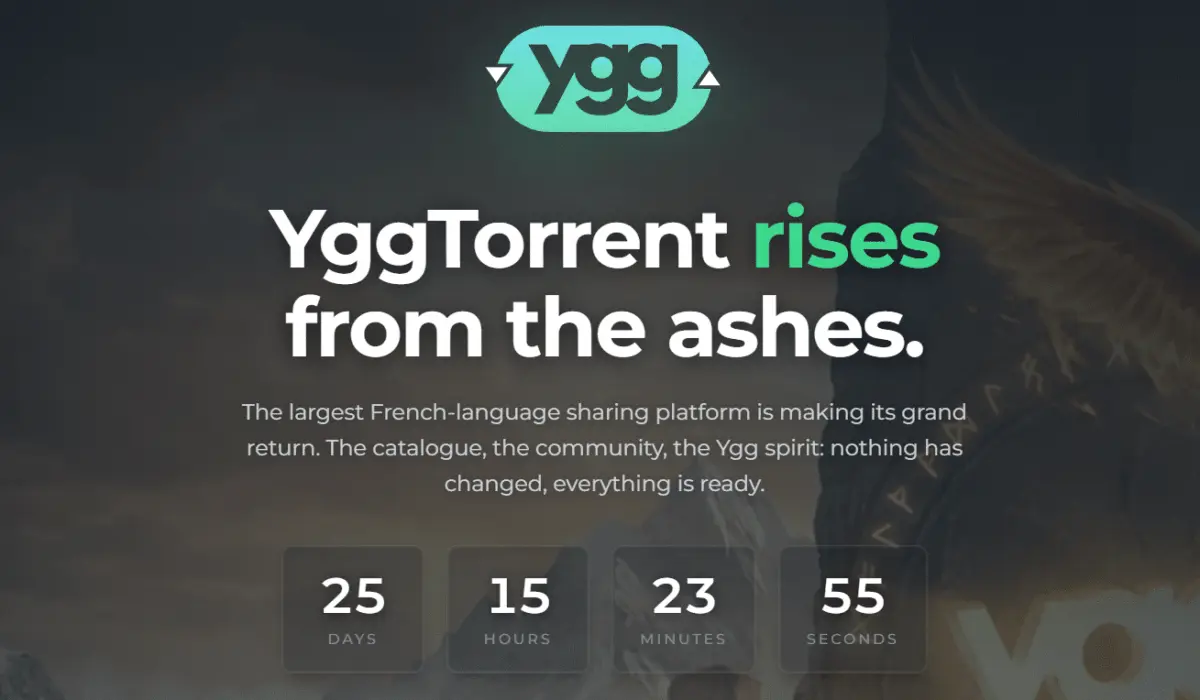
That speculation has now materialized into tangible action. Visitors navigating to yggtorrent.org are automatically redirected to yggtorrent.to, where a prominent digital countdown timer is steadily ticking down toward a scheduled relaunch on September 1 at midnight, Paris time.

Accompanying the countdown is a bold, defiant manifesto written on behalf of a self-proclaimed "new team." Translated from French, the announcement proclaims:
"YggTorrent rises from the ashes. The largest French-language sharing platform is making its grand return. The catalogue, the community, the Ygg spirit: nothing has changed, everything is ready."
The message underscores a deliberate effort to inherit the historical goodwill and user base of the defunct platform, bypassing the scars of the March hack as if they were merely a temporary bureaucratic hurdle.
Supporting Context & Metrics: Analyzing the Digital Remnants
While marketing slogans and dramatic countdowns are standard operating procedure for underground platforms seeking attention, the technical reality of YggTorrent’s underlying architecture tells a more verifiable story. The new administrative team is not starting from scratch; they have plugged directly into a surprisingly resilient infrastructure that survived the spring turmoil.
The Resilient Tracker and Peer Ecosystem
In their comeback teasers, the anonymous operators point skeptics directly to a live tracker status page hosted at connect.drago-server.org:8080. Rather than acting as a ghost town, current operational metrics reveal a thriving ecosystem that has continued to hum quietly in the background despite the absence of a polished front-end web portal.

An analysis of the tracker metrics at the time of publication highlights remarkable continuity:
- Total Tracked Torrents: Approximately 455,300 active torrent files remain cataloged within the system.
- Connected Peers: More than 1.5 million active peers are currently communicating with the tracker network.
- Seeder-to-Leecher Ratio: An overwhelming 94% of the connected swarm consists of seeders—users who are actively uploading files rather than merely downloading them.
This exceptionally high ratio of seeders to leechers indicates that a core group of dedicated community members never abandoned the network. Furthermore, the fact that the new team successfully integrated or routed through this exact tracking mechanism strongly implies that they either possess the original backend database or have established a seamless technical bridge with the remnants of the old guard.
The WHOIS Anonymity and the Mystery Ownership
Despite the monumental shift in administrative control, public records offer few clues regarding the identities behind the new iteration of YggTorrent. A query of the domain name’s WHOIS registration data reveals no recent updates or changes in contact details.
Cybersecurity experts note that this lack of movement in public registry records does not automatically mean ownership hasn’t changed hands. Sophisticated actors frequently trade entire domain registrar accounts, utilize privacy protection proxies, or execute private transfers that leave no footprint on public ledger queries. Consequently, the individuals steering the September 1 relaunch remain entirely anonymous, shielded by layers of operational security designed to thwart both copyright lawyers and the French Gendarmerie.
Official Statements and Institutional Impact
The sudden re-emergence of YggTorrent presents a profound administrative and legal challenge for French authorities. The July arrests of the twelve alleged operators were heavily publicized by the French Gendarmerie as a definitive victory for intellectual property rights holders, such as the Association de lutte contre la piraterie audiovisuelle (ALPA) and various major entertainment conglomerates.

Law enforcement agencies have historically relied on the theory that decapitating the leadership of a major piracy hub permanently neutralizes the threat. By arresting administrators, seizing cryptocurrency wallets, and capturing central domain names, authorities aim to make the operational risk too high for potential successors.
However, the YggTorrent saga exemplifies the "Hydra effect" of modern decentralized file sharing: cut off one head, and multiple replacements emerge from the shadows. Neither the National Gendarmerie nor the Paris public prosecutor’s office has yet issued a formal public statement regarding the September 1 relaunch countdown. Behind closed doors, however, cybercrime units are undoubtedly analyzing the new infrastructure, tracing IP hops, and evaluating whether the "new team" consists of former associates attempting a rebrand or entirely new opportunistic actors eager to claim the lucrative French file-sharing crown.
Future Outlook: What Lies Ahead for the French Torrent Community?
As the countdown clock on yggtorrent.to ticks closer to midnight on September 1, the digital piracy landscape in France stands at a critical crossroads. Several key questions will dictate the platform’s long-term viability and safety:
- User Trust and Security: Can a community that suffered a catastrophic data breach and cryptocurrency theft in March truly trust a "new team" promising that "nothing has changed"? Security analysts warn that historical databases leaked during the hack could still pose privacy risks to returning users, and vigilance will be paramount.
- Law Enforcement Escalation: Having already demonstrated their willingness and ability to track down physical persons behind the platform, French law enforcement agencies are unlikely to ignore a high-profile relaunch. The new operators face a constant, high-stakes game of cat-and-mouse against digital forensics teams.
- Domain and Hosting Stability: Given the history of the
.orgdomain being listed for sale and subsequent migrations to alternative extensions like.to, the platform’s infrastructure remains vulnerable to registrar seizures, court-ordered ISP blocking, and targeted distributed denial-of-service (DDoS) attacks from rival groups or security contractors.
Whether the impending relaunch of YggTorrent marks a triumphant second act for France’s largest file-sharing community or a precarious trap for unsuspecting users remains to be seen. What is certain, however, is that the war over digital copyright distribution in Europe is far from over, and the digital battleground is about to become significantly more volatile.