Executive Overview
The long-running global war against digital piracy continues to yield complex legal battles that blur the lines between systemic platform administration, individual culpability, and digital footprints. In the latest development concerning the demise of the infamous cyberlocker Uptobox, a French appellate court has issued a nuanced ruling regarding a technical contractor widely known online by his pseudonym, "Starouille."
While the Paris Court of Appeal explicitly rejected media and studio assertions that Starouille served as a foundational co-director or executive of the file-hosting behemoth, it nevertheless ruled to keep his personal assets frozen. The justification? His own historical social media activity, specifically posts instructing users on how to bypass Internet Service Provider (ISP) blocks using alternative Domain Name System (DNS) configurations and mirror links.
The ruling marks a significant moment in intellectual property litigation, illustrating how modern copyright enforcement leverages a target’s public digital trail—from boasts about server locations to troubleshooting advice posted on X (formerly Twitter)—to establish plausible liability. Although the court heavily slashed entertainment giant Disney’s astronomical €16.127 million damage claim down to a more modest €306,000, the defendant’s bank accounts remain frozen as the broader legal merits of the case grind forward. This comprehensive report examines the chronology of the raid, the technical arguments presented by both legal teams, the economic metrics of copyright damage modeling, and the broader implications for digital infrastructure contractors worldwide.
Detailed Chronology: From the Rise of Uptobox to the Fall of Servers
To understand the weight of the recent appellate decision, one must look back at the trajectory of Uptobox, a service that weathered the storm during an era when regulatory forces dismantled many of its contemporaries.
The Cyberlocker Golden Age and Resilience
During the early 2010s, the cyberlocker ecosystem experienced a massive boom. Services like Megaupload, Hotfile, and RapidShare revolutionized how large files were shared across the internet, capturing billions of page views and drawing the ire of Hollywood studios. While iconic platforms fell one by one amid aggressive anti-piracy crackdowns led by federal agencies and international coalitions, Uptobox managed to survive. Operating out of various data centers and shifting its technical framework to dodge scrutiny, the platform carved out a resilient niche, serving millions of unique visitors monthly.
The September 2023 Simultaneous Raids
Uptobox’s era of defiance definitively ended in September 2023. A formidable coalition of major entertainment production companies—including Disney, Amazon, Apple, Netflix, Paramount, and Warner Bros.—amassed enough evidence to secure a coordinated judicial strike. Operating under the banner of the Alliance for Creativity and Entertainment (ACE), law enforcement and technical specialists executed simultaneous raids in France and the United Arab Emirates. The operation effectively neutralized Uptobox by seizing its servers across multiple data centers, including critical infrastructure housed at Scaleway and Opcore. Despite subsequent legal appeals and desperate bids by the platform’s operators to resurrect the file-storage service, French courts systematically kept the site offline.
The Parallel Pursuit of "Starouille"
Behind the high-profile corporate takedown, The Walt Disney Company quietly initiated a parallel legal offensive against a French national living in the UAE. Identified by French investigative tech blog L’Informé by his online moniker "Starouille" and in legal documents as "M. [U]," the individual became the primary target of Disney’s private enforcement actions.
In October 2023, Disney secured an ex parte order from a Paris enforcement judge enabling the immediate protective seizure of up to €16.127 million from the defendant’s personal bank accounts. Executed through BNP Paribas, the initial sweep froze approximately €197,000 in personal savings, with subsequent orders following shortly thereafter. Crucially, these seizures did not represent a final damages payout; rather, under French civil procedure, they served as a protective security measure while the parties battled over the merits of the underlying case.
Technical Context & Legal Arguments: The "Director" vs. "Contractor" Debate
The core legal friction before the Paris Court of Appeal centered on Starouille’s actual function within the Uptobox corporate and operational structure.
Disney’s Case: The Self-Proclaimed CTO
Disney’s legal team painted the defendant not merely as a minor player, but as one of the "founders, operators, and de facto co-directors" of Uptobox. To substantiate this claim, Disney leaned heavily on the defendant’s digital footprint. For years, Starouille had openly described himself on social media platforms, including Facebook and X (formerly Twitter), as the "Chief Technical Officer" (CTO) of Uptobox.

Furthermore, investigators pointed to a since-deleted tweet featuring a photo of a car entering a parking lot tagged with a direct reference to a Scaleway data center ("@online DC2"). This specific post inadvertently helped copyright investigators pinpoint the exact physical location of Uptobox servers at Scaleway’s second data center in Vitry-sur-Seine, directly facilitating the September 2023 raids.
The Defense: Limited Infrastructure Management
Represented by attorney Me Damien Faupin, the defendant vehemently pushed back against Disney’s characterization. Faupin argued that the grandiose "CTO" title brandished on social media was a casual exaggeration rather than an accurate reflection of corporate governance or decision-making power.
The defense maintained that Starouille was strictly a freelance technical contractor hired to manage server infrastructure, handle hardware upgrades, and perform basic maintenance. Supporting this narrative, records seized from hosting provider Opcore explicitly designated him as "interlocuteur technique N1" (Technical Liaison Level 1)—a boots-on-the-ground operational role focused on keeping hardware functional rather than formulating business strategy or directing platform policy.
The Appellate Court Verdict on Governance
In its landmark ruling, the Paris Court of Appeal sided with the defense on the question of corporate leadership. The judges concluded that Disney failed to provide concrete evidence proving that Starouille exercised any managerial authority, strategic direction, or ownership stake in Uptobox.
The court explicitly noted in its translated judgment:
"The fact that [the defendant] presented himself on social media, notably on his Facebook and Twitter accounts, as ‘Chief Technical Officer’ (CTO) of Uptobox does not in itself constitute, even assuming this title to be accurate, a sufficient element to establish that, beyond operations of installation, maintenance, and upgrading of servers, he was more generally engaged in management or technical development of the service."
Evidence confirmed that Starouille had indeed worked as a freelancer dating back to 2012, but his duties remained strictly confined to operations, maintenance, and server upgrades. Consequently, the court initially favored the release of the seized funds based on the absence of a verified director-level role.
The Pivot Point: Social Media "How-To" Posts and Circumvention
Despite winning the battle over his corporate title, the defendant suffered a critical defeat regarding his liability for active facilitation. The appellate court discovered that while Starouille might not have been a director, his public social media activity crossed the line from passive infrastructure maintenance into active assistance of copyright infringement.
Tweaking DNS to Evade ISP Blocks
During active legal crackdowns, rightsholders frequently secure court orders compelling local Internet Service Providers to block domain names associated with pirate repositories. However, these blocks are notoriously porous, easily bypassed by modifying DNS settings or utilizing mirror URLs.
The court reviewed archived and deleted posts from Starouille’s X account where he openly coached users on how to render ISP-level blocks useless. In one notable post, he instructed followers:

"For those who can no longer access Uptobox/Uptostream, change your DNS on all your devices (procedure here: uptobox.info/dns). You can also use uptobox.link."
When an inquisitive user pressed him on whether these instructions were prompted by "yet another court order," Starouille casually replied:
"Yes, where Uptobox is not condemned, just 4 ISPs. As usual…"
He subsequently published explicit, step-by-step walkthroughs detailing how users could configure custom DNS settings directly inside the download managers of Freebox routers.
Dismantling the Defense’s Narrative
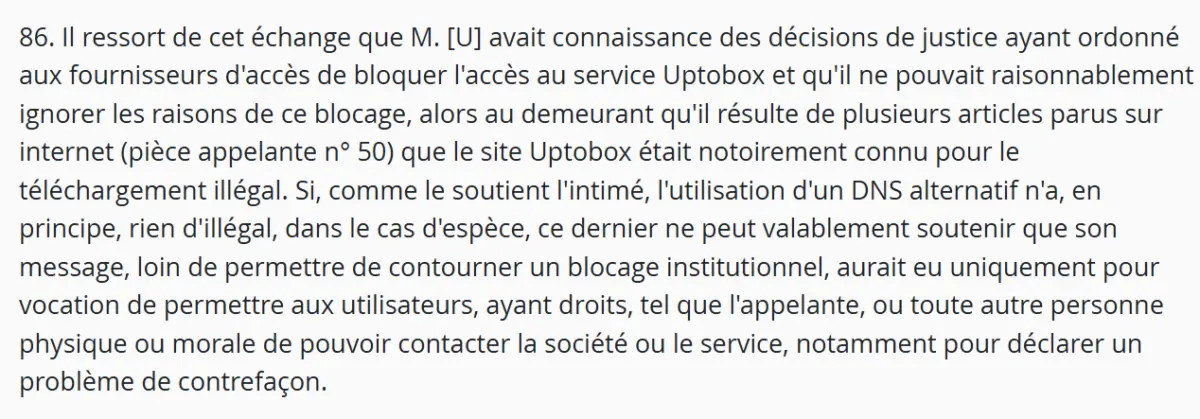
Faced with these damaging posts, the defense offered an imaginative counter-argument: they claimed the DNS adjustment instructions were never meant to help pirates evade blocks, but were instead published to assist rightsholders—such as Disney—in easily contacting the hosting service to report copyright infringements.
The Paris Court of Appeal swiftly and decisively dismissed this rationale as untenable. The judges ruled that publishing clear guides on how to route around institutional blockades could not logically be construed as a customer service initiative for intellectual property owners.
The court concluded that this conduct demonstrated full awareness of the platform’s copyright-infringing nature and showed an active willingness to help users bypass legal restrictions. Because of these specific July-August 2023 social media posts, the court ruled that sufficient legal plausibility existed to keep the asset freeze in place, regardless of his lack of a formal executive title.
Economic Metrics & Damages Calculation: Slashes and Realities
Aside from the operational findings, the appellate court’s review delivered a fascinating critique of how massive multinational corporations calculate theoretical damages in modern copyright litigation.
The Flawed €16 Million Formula
To justify freezing over €16 million in the initial phase of the litigation, Disney utilized an aggressive economic model. The studio calculated its purported losses by estimating lost Disney+ subscription revenues spanning from 2020 to 2023. They multiplied Uptobox’s estimated volume of one million monthly unique visitors by Disney+’s market share percentage (approximately 15% in the relevant streaming sector), assuming every single visitor represented a lost paying customer.
The Reality Check: Overlapping Subscriptions
The Paris Court of Appeal heavily criticized this methodology, siding with independent empirical data and economic studies demonstrating that the dynamics of piracy are far more complex. Citing a comprehensive study, the court noted that roughly 80% of digital pirates already maintain active subscriptions to legal streaming services.

Consequently, assuming that every visitor to a file-hosting platform equates to a lost subscription is fundamentally flawed, as the vast majority of users access these sites for content unavailable on their existing paid platforms or out of transient convenience rather than subscription substitution.
Narrowing the Liability Window
Compounding the adjustment of the lost-subscription metric, the court ruled that Starouille’s actionable wrongful conduct—specifically his public social media circumvention posts—was temporally constrained to a brief window during July and August 2023.
By combining the corrected consumer overlap metrics with this shortened two-month liability window, the court drastically recalibrated the financial scope of the case:
- Original Authorized Seizure: €16,127,000
- Revised Provisional Ceiling: €306,000
Despite the astronomical 98% reduction in the authorized freeze amount, the newly calculated ceiling of €306,000 still sits higher than the €197,000 currently frozen in Starouille’s BNP Paribas accounts. As a direct result, no funds will be returned to the defendant at this stage. His assets remain completely locked while the overarching civil case proceeds toward a final judgment on the merits.
Future Outlook & Industry Implications
The protracted legal saga surrounding Uptobox and its technical contractors establishes several vital precedents that will resonate across the European digital landscape and beyond.
1. The Perils of the Public Digital Trail
For developers, sysadmins, and freelance contractors operating within grey-market digital infrastructure, this ruling serves as a cautionary tale. Modern anti-piracy coalitions like ACE and individual conglomerates no longer rely solely on corporate registry documents or bank account ownership to establish culpability. They conduct exhaustive forensic audits of public social media profiles.
Bantering online, boasting about architectural roles via inflated job titles (like "CTO"), or offering public troubleshooting tips to bypass ISP censorship can instantly strip away the protective legal wall between a corporate entity and an independent technical vendor.
2. A Reality Check on Copyright Damage Modeling
Disney’s attempt to secure a €16 million asset freeze based on a blanket assumption that every pirated site visitor equals a lost subscriber highlights the aggressive nature of modern copyright claims. The appellate court’s willingness to adjust this figure downward—incorporating empirical data showing that most pirates are also paying streaming customers—creates a vital legal benchmark. It signals that European courts are increasingly demanding grounded, realistic economic modeling rather than speculative multipliers when assessing the financial impact of digital file-sharing.
3. What Lies Ahead for Starouille and Uptobox
While the ultimate liability trial on the merits is still pending and no definitive piracy damages have been formally awarded, the legal writing is clearly on the wall. Uptobox remains permanently shuttered, its server architecture dismantled across France and the UAE. For Starouille, the immediate battle is focused on preventing the €197,000 in frozen savings from being permanently absorbed into corporate coffers as damages.
Ultimately, the ruling reinforces an uncompromising message for the digital age: maintaining the hardware of a platform utilized for large-scale copyright infringement—combined with public social media posts that actively teach users how to evade legal blocks—creates a dangerous legal exposure that can freeze a technician’s financial life for years. As international rightsholders continue to deploy sophisticated forensic tools, the boundary between infrastructure support and active copyright facilitation will remain a high-stakes battleground.