







SYDNEY — In late 2024, Australia positioned itself at the vanguard of a global regulatory crusade, enacting landmark legislation designed to lock underage users out of mainstream social media. Proponents of the under-16 social media ban hailed it as a bold, necessary intervention to protect mental health, curb cyberbullying, and restore a semblance of traditional childhood.
Yet, nearly a year after the initial rollout and following months of incremental enforcement by major tech conglomerates, the reality on the ground tells a vastly different story.
According to a comprehensive new evaluation report released by Australia’s eSafety Commissioner, the legislation has morphed into a high-stakes game of digital cat-and-mouse. Rather than successfully locking out minors, the sweeping bans have catalyzed a profound behavioral shift. Underage teens are bypassing traditional account barriers through guest viewing, shared family credentials, and platform blind spots, while migrating laterally to less-regulated corners of the internet.
The findings offer a sobering reality check for policymakers worldwide—particularly in regions like the European Union, the United Kingdom, and several U.S. states that are actively contemplating or drafting similar age-verification and restriction mandates. As lawmakers grapple with how to govern the digital public square, the Australian experiment serves as a critical case study in the unintended consequences of blunt-instrument digital policy.
Executive Overview
The latest findings from the eSafety Commissioner’s ongoing longitudinal evaluation challenge the foundational assumptions of the legislative ban. Based on a robust, nationally representative survey of 4,121 children aged 10 to 16 living across Australia—alongside parallel surveys of their parents—the data reveals that the overwhelming majority of underage teens remain tethered to age-restricted social media ecosystems.
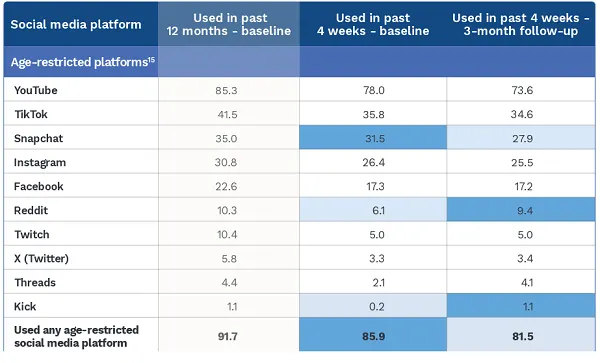
While the policy has successfully reduced the raw number of underage users holding direct, officially registered accounts on major platforms, it has done little to suppress overall platform consumption. Before the legislation went into effect, 85.9% of Australian teens reported regular usage of at least one major age-restricted platform. Following the implementation of the ban and subsequent platform enforcement efforts, that metric has budged only marginally. Currently, 81.5% of underage users continue to access restricted apps through various alternative mechanisms.
Crucially, the report highlights a profound disconnect between account ownership and active consumption. Millions of children are circumventing formal registration barriers by consuming content via guest modes, logging in through accounts belonging to parents, siblings, or friends, or exploiting sluggish age-assurance rollouts by platforms.
Furthermore, rather than driving teens toward offline pursuits, nature walks, or analog hobbies—as many optimistic proponents of the bill had predicted—the restrictions have simply accelerated a migration toward adjacent digital spaces. Usage metrics show notable spikes in engagement with alternative communication tools, unmoderated niche forums, streaming services, and online multiplayer gaming environments.
As governments globally look to Australia as a regulatory laboratory, these insights suggest that modern digital consumption habits are too deeply entrenched to be severed by regulatory edicts alone. Without addressing the underlying demand for digital connectivity, bans risk driving youth behavior into darker, less accountable digital corners.
Detailed Chronology: From Legislative Zeal to Implementation Realities
To understand the current state of youth social media access in Australia, it is necessary to trace the timeline of the initiative from its legislative inception to its current empirical evaluation.
The Legislative Push and Initial Implementation
The journey toward the ban began amid mounting public anxiety over algorithmic radicalization, mental health crises among adolescents, and the addictive design features of modern feeds. Lawmakers, responding to intense parental lobbying and advocacy groups, drafted legislation that effectively shifted the onus of age enforcement onto technology corporations.
Platforms were given strict directives to implement robust age-assurance measures or face severe financial penalties. In response, major tech companies—ranging from Meta to ByteDance—began rolling out phased verification protocols, requiring users to submit government IDs, undergo biometric facial estimation scans, or verify their ages through third-party services.
The Three-Month Milestone (April Update)
The first cracks in the policy’s facade became apparent in April of the following year, when the eSafety Commission published its initial three-month impact assessment. That preliminary brief sent shockwaves through policy circles by revealing that roughly 70% of Australian teens were still finding ways onto restricted platforms despite the new rules.
While the report noted early, tentative compliance efforts by major platforms, it also flagged widespread user adaptation. Teens were already demonstrating high degrees of digital literacy when it came to evading friction.
The Comprehensive Follow-Up Report
Building upon the April baseline, the eSafety Commissioner’s latest publication expands the scope of inquiry. By surveying a wider demographic tranche—incorporating children as young as 10 up to 16, paired with parental observations—the new study shifts from a short-term snapshot to a structural analysis.
The timeline of implementation has exposed a fatal flaw in the architecture of the ban: while platforms have cracked down on new account creations for minors, they have moved at vastly different speeds regarding retroactive age-auditing. Consequently, millions of pre-existing minor accounts remained active long after the legislation took effect.
More importantly, the timeline reveals that tech companies’ compliance efforts have created a "balloon effect." Squeezed out of mainstream photo- and video-sharing giants, teens have laterally redistributed their attention. Platforms with weaker verification frameworks or decentralized governance structures have seen sudden surges in youth traffic, entirely undermining the public health rationale of the original legislation.
Supporting Context & Metrics: Unpacking the Data
The statistical picture painted by the eSafety report is both nuanced and contradictory. While traditional compliance metrics show progress for tech companies, behavioral metrics show stubborn resilience among teens.
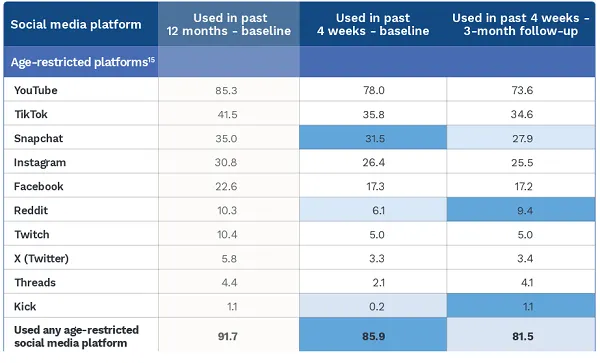
Account Ownership vs. Active Consumption
The most striking revelation in the data is the divergence between holding an account and consuming content.
[Pre-Ban Regular Usage of Restricted Apps] ----> 85.9%
[Post-Ban Active Access (Logged In or Out)] ---> 81.5%
[Primary Bypass Method: Unchecked Accounts] ----> 50.2%
[Primary Bypass Method: Self-Declared Age] -----> 37.1%
As the data illustrates, a mere 4.4 percentage point drop in overall access indicates that locking the front door has done little to stop minors from climbing through the windows. The report explicitly notes:
"Several social media platforms can be accessed without logging into an account. Children may also use social media through accounts belonging to others… the data reported here likely reflects usage both with and without children being logged into their own account."
While being logged out diminishes the full personalization of the algorithmic feed—thereby shielding users from hyper-targeted, highly addictive algorithmic loops—it does not eliminate exposure entirely. Teens continue to view trending videos, consume influencer content, and maintain parasocial relationships with creators without ever holding a registered profile.
Platform-Specific Winners and Losers
The enforcement of the ban has not impacted all tech platforms equally.
- Snapchat: Notably, Snapchat emerged as the only major mainstream app to register a statistically significant decrease in underage usage, falling from 31.5% of teens at the launch of the ban to 27.9% at the three-month mark. This decline is attributed to aggressive friction introduced by the platform regarding peer-to-peer messaging networks and stricter location-sharing checks.
- Alternative Ecosystems: Conversely, the vacuum left by mainstream apps has benefited less-scrutinized platforms. The report highlights increased youth migration toward text-based and decentralized discussion forums like Reddit, as well as live-streaming and alternative video-hosting sites like Kick. These platforms often lack the stringent, mandatory identity-verification checks deployed by larger social networks, making them prime digital real estate for displaced teens.
The Mechanics of Evasion: Why the Bans are Being Sidestepped
Critics of age-restriction laws frequently predicted that tech-savvy youth would instantly deploy Virtual Private Networks (VPNs) to spoof their geographic locations or utilize complex technical workarounds to defeat verification gates. Interestingly, the eSafety data disproves this hypothesis.
- Platform Inaction (50.2%): The leading reason cited by children for maintaining age-restricted accounts was astonishingly mundane: the platform simply had not asked them to confirm their age yet. Slow compliance rollouts and selective enforcement left massive enforcement blind spots.
- Self-Declaration Loopholes (37.1%): A significant portion of underage users bypassed restrictions simply by inputting a birthdate that placed them at 16 or older during initial account setup, exploiting the lack of robust, friction-heavy verification checks (such as biometric scanning or government ID matching) across numerous secondary apps.
- Niche Technical Bypasses: Conversely, sophisticated methods such as parental assistance to fake verification or the deployment of VPNs proved statistically marginal, accounting for only a fraction of reported bypass methods. Teens did not need sophisticated hacking tools; they merely relied on corporate inertia and lax design standards.
Official Statements and Policy Implications
The release of the report has ignited intense debate among Australian lawmakers, child safety advocates, and technology sector representatives, forcing a re-evaluation of how digital governance should proceed.
In an official statement accompanying the release, the eSafety Commissioner emphasized that while technological interventions can impose administrative hurdles, they cannot replace digital literacy or address the root causes of online dependency.
"We are seeing clear evidence that children possess immense adaptability," noted a senior policy analyst close to the Commission. "When you restrict one avenue of socialization, youth culture does not evaporate—it redirects. The policy has changed the geometry of how teens access the internet, but it has failed to reduce their fundamental reliance on digital peer networks."
Child psychologists and sociologists interviewed in the wake of the report have echoed these concerns, pointing out the flawed logic underpinning the "offline return" hypothesis. Proponents of the ban frequently argued that cutting off social media access would force teenagers back into physical neighborhoods, sports fields, and face-to-face community spaces.
However, contemporary youth socialization is fundamentally paradigm-shifted. Modern teenagers have developed peer relationships, humor, identity markers, and support structures that are inextricably bound to digital communication channels. Deprived of mainstream social feeds, adolescents have simply pivoted en masse to private messaging applications, Discord servers, and online multiplayer video games.
Significantly, the eSafety data indicates that at the three-month evaluation mark, there was little to no measurable change in offline activities, behaviors associated with problematic online use, or overall adolescent wellbeing. In short, the psychological benefits promised by the architects of the ban have failed to materialize, while the administrative burden on platforms and privacy concerns for adult users continue to mount.
Future Outlook: Lessons for Global Regulators
As governments around the world monitor Australia’s ongoing social media experiment, the latest eSafety findings offer vital lessons for the future of digital regulation.
1. The Limitations of Hard Age Gates
Hard age restrictions, while politically popular, suffer from an inherent implementation dilemma. To be effective, they require universal, highly intrusive identity verification—raising severe civil liberties and data privacy concerns for adult users who must surrender biometric data or government documents to access public digital infrastructure. Where verification is weak, compliance collapses; where verification is draconian, user pushback and privacy risks soar.
2. The Inevitability of Digital Migration
Regulators must abandon the fantasy that restricting access to top-tier social media platforms will result in reduced screen time or a return to pre-digital lifestyles. Youth desire for connection is immutable. Future regulatory frameworks must look beyond blunt prohibitions and focus instead on systemic platform design reform—such as defaulting algorithms to chronological feeds, banning dark patterns, and enforcing strict data-harvesting limits for all users, regardless of age.
3. Toward a Holistic Approach
Ultimately, the Australian case demonstrates that technology policy cannot operate in a vacuum. Effective child safety initiatives must combine platform accountability with comprehensive digital citizenship education, mental health support, and the creation of vibrant offline civic spaces that genuinely compete with the convenience and allure of digital connectivity.
As other nations draft their own versions of youth protection laws, the Australian blueprint stands as both a warning and a guide: policing the digital frontier requires more than locking the front gate; it requires understanding the ecosystem as a whole.