










Executive Overview
In the fast-paced, often chaotic world of AAA video game development, traditional documentation has long been synonymous with bloat. Historically, expansive multi-hundred-page "design bibles"—dense, text-heavy tomes filled with theoretical specifications—served as the baseline blueprint for major productions. Yet, these massive documents frequently suffered from a critical flaw: by the time they were compiled, reviewed, and distributed across multi-disciplinary teams, they were already obsolete, ignored, or buried under the sheer weight of their own verbiage.
Enter veteran game designer Stone Librande and his radically minimalist approach to production planning. During his legendary presentation at the Game Developers Conference (GDC), titled "Simulating a City, One Page at a Time," Librande detailed an audacious experiment executed during the multi-year development of Maxis’s SimCity (2013). Armed with a small core team and an insistence on radical clarity, Librande set out to answer a disruptive question: What would happen if a project discarded the traditional design bible entirely, relying instead on a single-page design methodology from pre-production all the way to day-one shipping?
What began as an improbable stress-test of communication boundaries evolved into a masterclass in agile, visual product management. Librande’s methodology replaced walls of text with highly refined diagrams, flowcharts, and visual summaries. These documents were printed physically, plastered onto office walls, and updated religiously, forcing absolute alignment across engineering, art, and design disciplines.
More than a decade later, the foundational principles of Librande’s philosophy remain profoundly relevant. Whether applied by indie developers utilizing digital whiteboarding tools like Miro, or taught to aspiring designers in collegiate classrooms at institutions like the Berklee College of Music, the ethos of the one-page design continues to challenge how the industry thinks about communication, efficiency, and collaborative problem-solving.
Detailed Chronology: The SimCity (2013) Experiment
To truly grasp the gravity of Librande’s experiment, one must look back at the genesis of the SimCity reboot. When pre-production commenced three and a half years prior to the game’s commercial launch, the core development squad consisted of just five individuals. In an environment where every man-hour represented critical capital, traditional long-form documentation was an unaffordable luxury.
Librande proposed an intentional constraint: every feature, system, and mechanical loop must be articulated on a single sheet of paper. He fully anticipated that the experiment would fail. In fact, his primary motivation was boundary-testing—he wanted to discover precisely why a single-page philosophy would break down under the crushing complexity of a modern city-building simulation, and learn valuable lessons from its collapse.
Instead of breaking down, the system held firm, giving structure to the chaotic early phases of production.
Phase 1: Pre-Production and Real-World Inspiration
During the earliest conceptual stages, Librande deployed his one-page methodology to map out early city layouts inspired by real-world geographic locales. While these maps survived the transition into active production, Librande maintained a transparently pragmatic approach to artistic license. Real-world American municipalities, for instance, dedicate immense parcels of land to parking lots—an urban planning reality that, while accurate, required careful balancing to ensure the video game remained genuinely fun to play. By condensing geographic layouts onto single-page visual maps, the team could evaluate urban flow, zoning concepts, and spatial distribution at a single glance.
Phase 2: System Architecture and Early Cuts
As development scaled, the one-page format transformed from a speculative blueprint into a ruthless editorial weapon. When the team began charting the multiplayer trading mechanics—a complex, interconnected feature set involving regional resource sharing—Librande’s initial single-page diagrams exposed fundamental systemic flaws.
The early concepts revealed a logistical mess that, if left unchecked, would have sucked months of engineering time into a dead-end feature. Because the architecture was laid out clearly on a single page, the team spotted the friction points immediately. They were able to prune and overhaul the trading mechanics before sinking valuable capital and human resources into refining an unwieldy system.

Phase 3: Scaling Up and Training the Team
As production accelerated, Librande’s penchant for hyper-succinct, beautifully organized diagrams inadvertently created a brand-new internal challenge: he had successfully trained his colleagues to expect immaculate, elegant simplicity no matter how convoluted the underlying system mechanics were.
This dynamic reached its apex when a producer handed Librande a daunting task. While a visual designer was assigned standard aesthetic explorations and a UI artist was tasked with user-flow mockups, Librande was given a towering assignment. He was asked to build a comprehensive "Matrix of Coal City"—detailing manufacturing plant levels, structural modules, supporting infrastructure toys, simulated citizen impacts, reward loops, and resource chains—all packaged into a digestible, unified document.
The producer’s directive ended with a pointed, bolded emphasis: “Do it in a one-page diagram.”
Reflecting on the moment with dry humor, Librande recalled thinking, "What have I done?" Yet, rather than backing down, he leaned into the challenge, pushing the boundaries of what a single visual document could encompass. When paper real estate ran out, the designs naturally expanded into "one-wall" and eventually "one-room" master displays, proving that the core philosophy could scale alongside the project’s ambition.
Supporting Context & Metrics: Spreadsheets, "Design Fairies," and Physical Presence
Even a simulation as deeply computational as SimCity could not escape the gravitational pull of raw data. Eventually, the development team required the computational heavy-lifting of spreadsheets and Comma-Separated Values (CSV) files to manage balancing metrics, economic variables, and simulation logic.
However, Librande refused to let this data retreat into sterile, forgotten digital folders.
The Hybrid Approach to Data Management
Applying the same design logic to raw spreadsheets, Librande consolidated the information, integrated intelligent color-coding, and introduced visual design flair. These documents were transformed into hybrid chart-and-diagram artifacts, printed out, and physically distributed to workstations across the studio.
This sparked the running studio joke of the "Design Fairy." Because design documents quickly drift out of date as code iterates, Librande took it upon himself to act as an analog update engine.
"Every time there was a high-level update… it was my job to go around the office, take the old ones down, put the new ones up, and do it even when people aren’t at their desks," Librande recounted with a laugh. "It was kind of like the magic design fairy leaves you a present when you are away!"
The Axiom of Proximity
Beneath the humor lay a profound operational truth. Librande forcefully champions the principle that developers should never passively expect busy colleagues to seek out documentation.
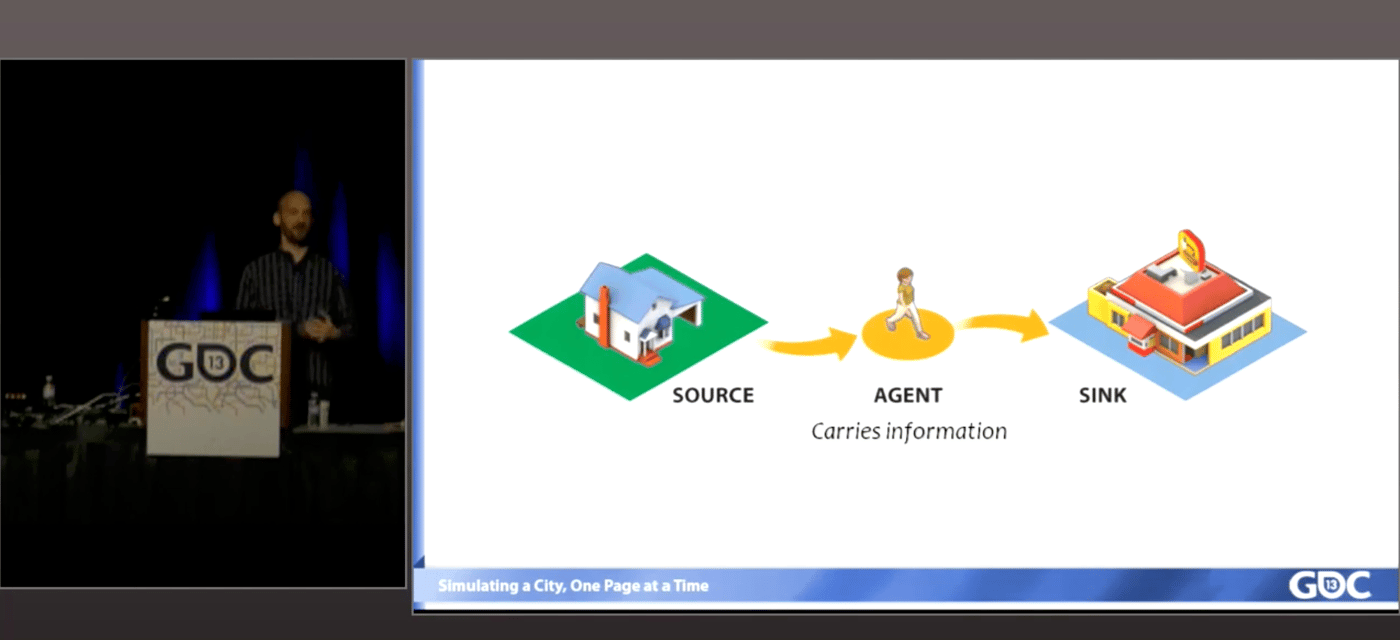
"This is a really important part, if you’re doing this in your own studios: don’t rely on people to come to you… if you really have something important to say to your team, you need to get it to them."
By placing critical system designs physically at the eye level of engineers, artists, and producers at their desks, Librande eliminated the latency of digital communication. There was no need to dig through nested folder hierarchies on an internal wiki or parse unread email chains; the core truth of the game’s design stared the team in the face every single day.
Official Statements and Retrospective Insights
Though Librande’s presentation dates back to 2013, its institutional impact within Maxis and the broader industry has only solidified with time. During project postmortems conducted long after SimCity shipped, the team evaluated the long-term utility of the physical documentation strategy.
The verdict was resounding.
"We did some postmortems recently, and the diagrams are still valid—even though some of them are three and a half years old," Librande noted. "We still refer to them all the time. It was a huge win, the way that the project was organized from the top highest level then drilling down to the smallest details. It’s a really sound foundation to build your game on."
This sentiment highlights a vital contrast in game production methodologies. While traditional design bibles frequently transformed into dead digital literature—cumbersome archives that developers abandoned the moment production velocity picked up—Librande’s physical, single-page diagrams remained living artifacts. They served as a shared mental model for the entire studio, bridging the gap between high-level creative vision and low-level engineering execution.
Future Outlook: The Enduring Legacy of Minimalist Design
In contemporary game development, the challenges of communication have only amplified. With remote and hybrid work models dominating the studio landscape, physical paper printouts taped to office walls may no longer suffice for distributed teams. Yet, the philosophy underpinning Stone Librande’s work—that radical constraint breeds clarity—is more vital than ever.
Today, educators and industry veterans continue to pass down these lessons to the next generation of creators. For students entering the field, learning to condense a complex gameplay loop, economic system, or narrative arc onto a single digital canvas (using modern tools like Miro, Figma, or Lucidchart) instills a crucial discipline. It forces creators to answer the hardest question in design: What truly matters?
Whether you are an independent developer sketching mechanics on a digital tablet, a student learning the ropes in a collegiate design lab, or a veteran architect steering a massive multi-disciplinary team in a central studio, the takeaway remains unchanged. A brilliant idea is only as powerful as your ability to communicate it concisely. By stripping away the bloat and focusing on clear, visual, and accessible blueprints, developers can build a foundation sturdy enough to weather the storms of production from pre-production to the day they ship.