







Executive Overview
For the past several years, the mainstream narrative surrounding artificial intelligence in software development has been dominated by a singular archetype: the code-completion assistant. Developers have grown accustomed to AI whispering syntax suggestions, auto-completing boilerplate loops, and translating basic logic between programming languages within their Integrated Development Environments (IDEs). While these tools have undoubtedly compressed individual development loops, they represent merely the tip of the iceberg.
A profound architectural shift is currently underway across enterprise engineering organizations. We are moving away from isolated code generation and hurtling toward Agentic Software Development Life Cycle (SDLC) platforms.
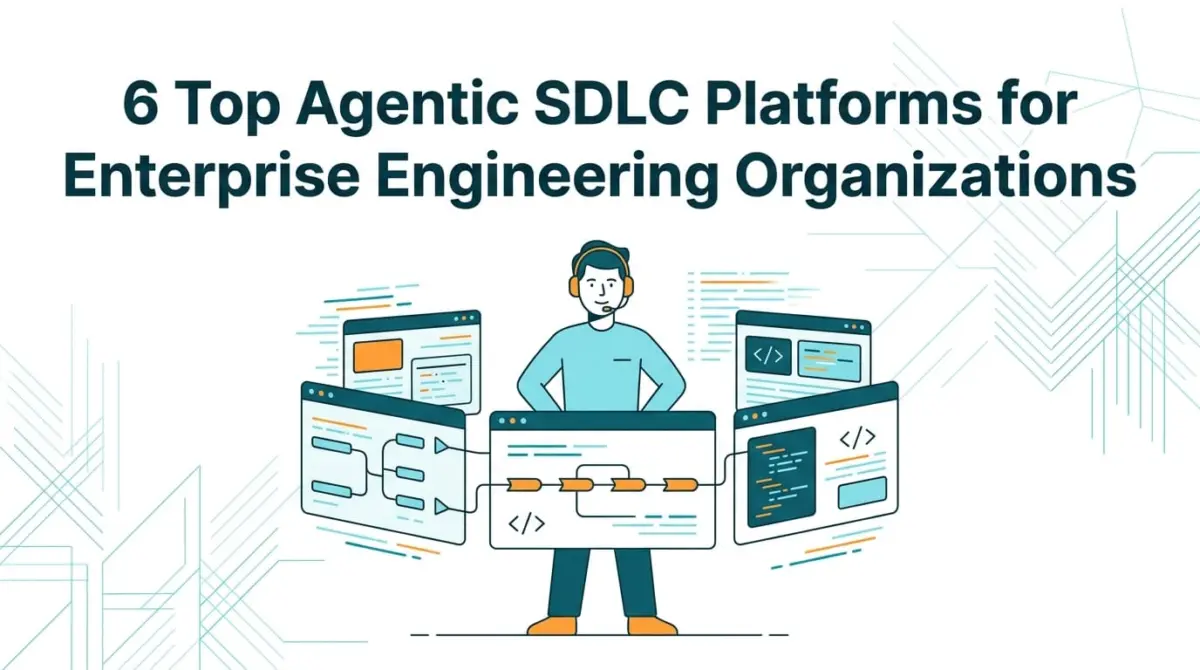
Unlike localized coding assistants, agentic SDLC embeds autonomous or semi-autonomous AI agents directly into the fabric of the enterprise engineering ecosystem. These agents do not merely write functions; they inspect planning tickets, evaluate repository health, generate comprehensive test suites, trigger deployment workflows, update decentralized documentation, monitor production readiness, triage incident alerts, and coordinate complex tasks across disparate toolchains.
However, this unprecedented expansion of AI autonomy introduces critical organizational challenges. According to Stack Overflow’s 2025 developer survey, 46% of developers actively distrust the accuracy of AI tools. This widespread skepticism highlights a stark truth for enterprise technology leaders: unbridled automation is a liability. Scaling AI across the engineering lifecycle requires a robust, governed platform layer that enforces traceability, explicit permissions, human-in-the-loop review gates, and structured context. Without these guardrails, enterprises risk turning AI into an amplifier of preexisting operational chaos.
Detailed Chronology: The Evolution to Agentic SDLC
To understand how enterprise software development arrived at the doorstep of agentic orchestration, it is vital to trace the rapid evolution of AI tool maturity over recent development cycles.
[Phase 1: Syntax Assistance] ──► [Phase 2: IDE Chatbots] ──► [Phase 3: Multi-File Agents] ──► [Phase 4: Platform-Wide Agentic SDLC]Phase 1: Localized Syntax Assistance (2021–2022)
The journey began with next-token prediction models integrated into IDEs. These early iterations functioned primarily as advanced autocomplete engines. They reduced typing fatigue for individual engineers by predicting the next few lines of code, but possessed zero awareness of the broader codebase, team workflows, or deployment pipelines.
Phase 2: Conversational Chatbots and Context Windows (2023–2024)
As Large Language Models (LLMs) expanded their context windows, chatbots entered the developer workspace. Engineers could now highlight blocks of code, ask architectural questions, and request unit tests. While useful, these interactions remained reactive, demanding constant human intervention, prompt engineering, and manual copying and pasting between browser tabs and IDEs.
Phase 3: Multi-File and Pull-Request Agents (2024–Early 2025)
The industry then witnessed the rise of agents capable of operating across multiple files, executing local terminal commands, and generating autonomous pull requests. Tools began interacting directly with source control systems, opening branches, and attempting to fix reported bugs or dependency vulnerabilities end-to-end.
Phase 4: Platform-Level Agentic SDLC (Present Day)
We have now entered the fourth phase: enterprise-grade agentic platforms. AI agents are no longer siloed inside a single code repository or developer’s laptop. Instead, they operate natively across the entire software delivery pipeline—bridging Jira planning tickets, GitHub repositories, CI/CD pipelines, Datadog monitoring dashboards, and security scanners. They function as active team members, possessing defined roles, secure API boundaries, and rigorous governance scorecards.
Supporting Context & Metrics: The Architectural Imperative
Deploying autonomous agents into enterprise environments exposes deep organizational vulnerabilities. Google Cloud’s landmark 2025 DORA (DevOps Research and Assessment) report underscores a fundamental law of enterprise AI adoption: AI acts as an amplifier of an organization’s existing strengths and weaknesses.
When an enterprise introduces agentic workflows into a disciplined engineering culture characterized by clean code ownership, up-to-date documentation, and rigorous CI/CD standards, AI accelerates productivity and minimizes toil. Conversely, deploying agents into an undisciplined system—marked by scattered documentation, ambiguous service ownership, and ad-hoc deployment practices—will quickly exacerbate those structural failures. Autonomous agents will misinterpret legacy systems, trigger unapproved deployments, and propagate technical debt at machine speed.
┌─────────────────────────────────────────────────────────────┐
│                 THE ENTERPRISE RISK FACTOR                  │
├─────────────────────────────────────────────────────────────┤
│  46% of developers actively distrust AI accuracy (Stack     │
│  Overflow 2025 Survey).                                     │
│                                                             │
│  Unchecked automation without platform governance leads to  │
│  fragmentation, security blind spots, and accelerated       │
│  technical debt.                                            │
└─────────────────────────────────────────────────────────────┘
This operational reality explains why modern agentic SDLC requires a dedicated platform layer. Enterprise software delivery is not merely about writing code; it is a complex orchestration of planning, architecture, security compliance, deployment verification, incident response, and service maturity scoring. Without a centralized platform layer to govern these moving parts, enterprises inevitably fall into fragmentation:
- Team A builds a custom Slack bot for deployment alerts.
- Team B deploys an unvetted IDE coding agent with direct production access.
- Team C utilizes a pull-request agent disconnected from security compliance checks.
To prevent this fragmentation, the market has rapidly innovated, giving rise to specialized enterprise platforms designed to anchor agentic workflows securely.
Analysis of Top 6 Agentic SDLC Platforms
Enterprise engineering leaders evaluating agentic workflows must look beyond basic coding assistants and invest in comprehensive platform layers. Below is an analysis of the top six agentic SDLC platforms currently shaping the enterprise landscape.
1. Port
Port stands out as a premier shared operating layer designed specifically for agentic SDLC. Rather than acting as another isolated AI coding tool, Port centers its architecture on engineering context, governed workflows, agent management, and developer self-service.
- The Context Lake: Port models services, dependencies, infrastructure resources, environments, scorecards, and operational metadata into a structured context layer. This enables AI agents to evaluate the entire engineering estate before recommending or executing changes.
- Scorecards: Port transforms engineering standards into automated, visible checks. Teams can define security, reliability, and production-readiness criteria, allowing agents to surface compliance gaps and trigger remediation workflows.
- Best Fit: Enterprise platform teams, DevOps leaders, SREs, and engineering executives requiring a governed foundation across multi-tool ecosystems.
2. GitLab Duo Agent Platform
For organizations deeply committed to the GitLab ecosystem, the GitLab Duo Agent Platform embeds specialized AI agents directly into a unified DevSecOps lifecycle.
- Ecosystem Integration: Because source control, planning boards, CI/CD pipelines, and security scanners reside in a single environment, agents operate with native context without needing to bridge disparate third-party tools.
- Specialized Flows: GitLab Duo supports dedicated agents for planning refinement, code review, automated pipeline repair, and issue-to-merge-request conversions, all while respecting pre-existing GitLab governance policies.
3. GitHub Enterprise With Copilot Agents
GitHub Enterprise with Copilot agents represents a natural evolution for organizations whose engineering workflows revolve around GitHub repositories and GitHub Actions.
- Reduced Context Switching: By embedding agentic work directly into issues, pull requests, and code reviews, developers can leverage AI capabilities where they already spend their day.
- Controlled Prototyping: While Copilot coding agents can autonomously propose repository changes via pull requests, GitHub strongly recommends maintaining strict branch protections and mandatory human review gates before merging.
4. Atlassian Compass With Rovo
Enterprise environments that coordinate business requirements, product roadmaps, and incident management through Jira and Confluence will find immense value in Atlassian Compass paired with Rovo.
- Knowledge & Collaboration Layer: Compass tracks component ownership, dependencies, and health metrics, while Rovo synthesizes knowledge across Atlassian’s expansive data graph.
- Contextual Awareness: This combination empowers agents to understand why a feature is being built, who owns a specific microservice, and where critical documentation resides.
5. Harness
Harness approaches agentic SDLC from the perspective of software delivery and deployment reliability.
- CI/CD Integration: Harness embeds autonomous agents as governed steps within deployment pipelines. This ensures that AI-generated changes undergo the same rigorous approvals, canary verifications, policy checks, and audit trails as human-authored releases.
- Operational Safety: Ideal for organizations looking to automate build, test, deploy, and rollback workflows without sacrificing production stability.
6. Cortex
Cortex functions as a comprehensive software catalog and engineering intelligence layer, making it an exceptional foundation for agentic adoption.
- Standardization: Cortex centralizes service ownership, production readiness scorecards, and software health metrics.
- Trust Through Clarity: By providing both humans and AI agents with a unified source of truth regarding service maturity, Cortex minimizes the risk of autonomous agents acting on incomplete or outdated architectural data.
Comparative Matrix: Agentic SDLC Platforms
| Platform | Primary Core Strength | Key Agentic Capability | Ideal Enterprise Environment |
|---|---|---|---|
| Port | Context Lakes & Scorecards | Governed workflows & cross-tool orchestration | Multi-tool enterprise platform engineering teams |
| GitLab Duo | Unified DevSecOps Lifecycle | Pipeline repair, automated security scans, & MR generation | Organizations standardized on GitLab |
| GitHub Copilot | Repository & PR Proximity | Autonomous issue resolution & PR code generation | GitHub-centric development workflows |
| Atlassian Compass | Knowledge & Service Health | Contextual service discovery via Rovo & Jira | Organizations driven by Jira and Confluence |
| Harness | CI/CD Delivery & Verification | Governed deployment steps & rollback automation | Teams focusing on safe, automated production releases |
| Cortex | Software Catalog & Governance | Scorecard-driven gap analysis & service maturity | Enterprises needing strict ownership & operational standards |
Official Industry Perspectives & Frameworks
As enterprises transition toward agentic SDLC, industry standards bodies and engineering leaders emphasize a methodical, phased adoption strategy. Rushing into unchecked automation invites operational disaster. Below is a practical, seven-stage framework for enterprise adoption:
┌────────────────────────────────────────────────────────────────────────┐
│                   7-STAGE AGENTIC ADOPTION FRAMEWORK                   │
├────────────────────────────────────────────────────────────────────────┤
│ 1. Build Context Layer ──► Model services, owners, dependencies.       │
│ 2. Define Safe Roles   ──► Assign specific tasks (e.g., test gen).     │
│ 3. Approved Workflows  ──► Ensure automation follows strict paths.     │
│ 4. Human Review Gates  ──► Mandate approval for production changes.    │
│ 5. Enforce Scorecards  ──► Use automated checks for standards.         │
│ 6. Measure Outcomes    ──► Track cycle time, toil reduction, quality.  │
│ 7. Expand Gradually    ──► Scale outward from low-risk workflows.      │
└────────────────────────────────────────────────────────────────────────┘- Build the Context Layer: Model your services, owners, dependencies, documentation, and operational standards into a centralized system before introducing agents.
- Define Safe Agent Roles: Avoid monolithic "do-everything" agents. Start with bounded, specialized roles such as documentation assistants, incident summarizers, or test generators.
- Use Approved Workflows: Ensure agents trigger automation through pre-approved, auditable pathways aligned with version control best practices.
- Implement Human Review Points: Differentiate between low-risk tasks (e.g., updating internal readmes) and high-risk actions (e.g., production deployments, security access modifications), mandating human sign-off for the latter.
- Enforce Standards with Scorecards: Utilize automated scorecards to continuously evaluate service maturity, security posture, and production readiness.
- Measure Meaningful Outcomes: Track metrics that reflect true productivity gains—such as reduced ticket volume, shortened cycle times, and improved documentation quality—rather than vanity metrics like raw code volume.
- Expand Gradually: Begin with high-toil, low-risk workflows, gradually extending agent autonomy as trust and governance mature.
Future Outlook: The Road Ahead
The maturation of agentic SDLC platforms signals a fundamental maturation of software engineering itself. Enterprise technology leaders must pivot their strategic focus away from narrow metrics—such as how quickly an AI coding assistant can generate a pull request—and evaluate the entire lifecycle from idea to reliable production software.
Looking forward over the next three to five years, we can anticipate several defining trends:
- Autonomous Remediation: Agents will increasingly detect production anomalies via observability platforms, diagnose root causes, write patches, execute integration tests, and submit pull requests with minimal human intervention.
- Regulatory & Compliance Agents: As global software compliance frameworks tighten, specialized governance agents will continuously audit codebases against evolving regulatory standards, flagging non-compliant dependencies in real-time.
- The Rise of the Platform Engineer as AI Orchestrator: Platform engineering teams will transition from building internal portals to curating and governing multi-agent ecosystems, defining the strict access boundaries and context lakes required for safe enterprise automation.
The winning organizations of tomorrow will not be those that automate the fastest, but those that empower AI agents with rich context, strict behavioral boundaries, and accountable human ownership across every phase of the software lifecycle.