Executive Overview
The venture capital landscape has undergone a seismic structural realignment. For over a decade, the primary holy grail for early-stage and growth investors alike was the "unicorn"—a privately held startup achieving a valuation of $1 billion. Coined in 2013 to describe a statistical anomaly, the unicorn is now functionally obsolete as a benchmark for outsized fund returns. Today, the global market boasts more than 1,300 unicorns. They are no longer mythical creatures; they are background noise.
In 2026, the baseline metric for venture capital success has shifted upward by an order of magnitude. Driven by historic fund sizes—exemplified by Menlo Ventures closing a record-breaking $3 billion fund in June—and the blistering, AI-accelerated growth velocity of modern tech companies, $25 billion is the new $1 billion.
When a partner sits across the table at a Series A pitch today, they are not quietly calculating whether a company can reach a $1 billion exit. Their internal financial models demand a credible, linear trajectory to a $25 billion-plus enterprise value.
This fundamental shift is transforming how venture capitalists evaluate risk, how founders construct their pitches, and why the traditional venture path is increasingly ill-suited for businesses targeting sustainable, multi-hundred-million-dollar exits rather than multi-billion-dollar outliers.
Detailed Chronology: The Hyper-Acceleration of AI Exits
To understand why the $25 billion threshold has become the mandatory hurdle for venture-backed startups, one must look at the unprecedented velocity demonstrated by the artificial intelligence sector throughout 2025 and 2026. Two watershed market events in late summer 2026 perfectly crystallize this reality.
August 14, 2026: The SpaceX-Anysphere Blockbuster
On August 14, 2026, SpaceX executed the largest acquisition of a venture-backed startup in history, absorbing Anysphere—the generative AI coding startup behind the popular Cursor platform—in an all-stock deal valued at a staggering $60 billion.
- The Trajectory: Cursor was valued at a modest $2.5 billion at the beginning of 2025. By November 2025, its Series D valued the company at $29.3 billion.
- The Scale: Founded merely four years prior, Cursor scaled from roughly $1 million to $100 million in Annual Recurring Revenue (ARR) in just 12 months, ultimately exiting at approximately 15x its annualized revenue of roughly $4 billion.
- The Mechanism: SpaceX issued roughly 391 million Class A shares (confirmed via SEC 8-K filings) to complete the transaction. While the liquidity provided to early investors was authentic, it underscored a vital market nuance: orchestrating an exit of this magnitude currently requires a rare buyer possessing a newly minted, highly liquid public currency.
September 8, 2026: Cognition’s Meteoric Valuation Leap
Just three weeks after the Anysphere deal reset market expectations, AI coding rival Cognition announced a colossal Series E round exceeding $2 billion at a $48 billion valuation, co-led by Andreessen Horowitz and Accel, alongside participation from Founders Fund, General Catalyst, and Avenir.
- The Compression of Time: As recently as May 2026, Cognition had raised capital at a $26 billion valuation on a $492 million run-rate. By September, its run-rate approached $900 million.
- The Outcome: The company’s valuation effectively doubled in a little over three months.
In less than a single quarter, two generative AI coding startups—both founded within the last four years—obliterated the traditional multi-decade path to corporate maturity. One cleared the $25 billion mark and doubled it via an acquisition; the other cleared $25 billion in May and nearly doubled it to $48 billion by September. For institutional VCs, these milestones serve as the new baseline underwriting comps.
Supporting Context & Metrics: The Arithmetic of $3B Funds
The fixation on $25B+ outcomes is not driven by greed; it is governed by cold, hard fund math. As institutional fund sizes ballooned over the past decade—with firms like Menlo Ventures raising a $3 billion vehicle—the laws of portfolio math transformed dramatically.
The Dilution Slide and Ownership Realities
Historically, back-of-the-envelope fund models assumed investors could maintain 15% to 20% ownership positions through to an exit. Reality has proven otherwise.
According to Carta’s 2026 data, the median founding team sees their collective equity slide from approximately 56% at the seed stage, down to 36% following a Series A, and plummeting to 16.1% by Series C.
Early-stage investors face a similar downward trajectory unless they aggressively exercise their pro-rata rights in every subsequent round. However, because modern AI funding rounds routinely scale into the hundreds of millions of dollars, most early funds cannot afford to maintain their pro-rata stakes. Consequently, an early lead investor who successfully defends their position typically retains 8% to 12% ownership at the point of exit.
The $3 Billion Fund Equation
Let us run the arithmetic for a $3 billion venture fund:
- To return a standard 3x gross to its Limited Partners (LPs), the fund must generate $9 billion to $10 billion in gross liquidity.
- Assuming an optimistic 10% ownership stake at exit, a single $25 billion company returns $2.5 billion to the fund.
- To return the entire $3 billion fund, the portfolio requires four $25 billion companies.
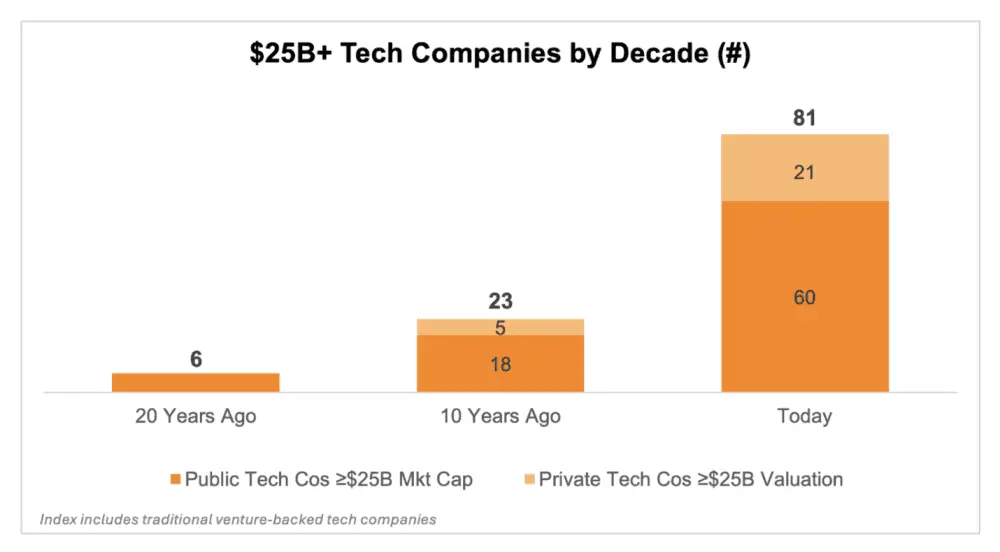
Out of the roughly 81 companies currently operating at or above this valuation tier globally, a single $3 billion fund needs to capture four of them within a ten-year lifecycle.
Conversely, consider a traditional $1 billion exit—once viewed as the ultimate mythical achievement. At a 10% ownership stake, a $1 billion exit yields $100 million. For a $3 billion fund, $100 million represents barely 1% of the total capital required to return the fund even once. To a multi-billion-dollar fund, a billion-dollar outcome barely moves the needle on Distributed to Paid-In Capital (DPI).

The Rise of Private Decacorns
PitchBook’s mid-year 2026 data illustrates this shift from another perspective. The United States now houses 63 active decacorns (companies valued over $10 billion), up from 53 the previous year and just 26 in 2021. Nineteen new companies crossed the $10 billion threshold in the first half of 2026 alone, matching the pace of market expansion. Furthermore, mega-deals of $100 million or more accounted for 87.5% of the $412.7 billion deployed in U.S. venture capital during H1 2026.
Crucially, capital that historically arrived post-IPO now floods in at the Series D, E, and F stages. Companies are staying private longer, meaning the returns that used to be captured by public market retail and institutional investors must now be manufactured while the enterprise is still private. Twenty years ago, a $25 billion valuation virtually required a public market listing; today, dozens of private enterprises sit comfortably above that valuation watermark.
Official Statements and Industry Perspectives
The structural shift toward growth-stage mega-rounds has prompted notable realignments among top-tier venture institutions. Benchmark—historically famous for strictly executing classic, early-stage Series A and B rounds—signaled the new era by participating aggressively in Cognition’s $48 billion financing.
Everett Randle, General Partner at Benchmark, explained the strategic shift on social media platform X:
"Cognition is the first investment in our first dedicated growth fund. When we discussed the fund’s strategy, we agreed that we wanted to focus solely on companies that were still only 1% of the way through their journey despite being at growth-stage scale, and had a shot at [massive generational impact]."
This philosophy encapsulates the mindset of modern growth investors: they are deploying massive tickets into companies that have already achieved hyper-scale, betting that the runway ahead is vast enough to justify valuations previously reserved for public tech goliaths.
Future Outlook: Strategic Implications for Founders and Small Funds
As the venture ecosystem adapts to the $25 billion mandate, founders and emerging fund managers must radically re-evaluate their strategies.
1. For Founders: Match Fund Size to Your Realistic Ceiling
Pitching a multi-billion-dollar tier-one fund on a business with a highly probable ceiling of $500 million is a systemic mismatch. Venture capital is an asset class optimized entirely for the right tail of the distribution curve. If your target market or business model caps your realistic enterprise value at a few hundred million dollars, institutional venture capital is an expensive, high-pressure financing vehicle that will force you to chase unattainable hyper-growth metrics, often destroying the sustainable business you could have built.
Founders should actively seek out smaller micro-VCs whose fund economics align with a $300 million to $500 million exit, or explore bootstrapping and alternative financing models. Thanks to modern AI tooling—which allows lean teams to generate millions in revenue with a fraction of the headcount—building capital-efficient, highly profitable companies without heavy institutional dilution is more viable than ever.
2. For Solo General Partners and Small Funds: The Power of Concentration
For micro-VCs and solo GPs operating smaller vehicles (e.g., a $60 million fund), the $25 billion mandate opens up a massive arbitrage opportunity.
While a small fund faces the same proportional dilution, its return math is entirely different. At a $60 million fund size:
- Securing a 3% stake in a $2 billion outcome yields $60 million—returning the entire fund on a single company.
- A $500 million outcome at a 3% stake returns $15 million—representing 25% of the fund from an asset that a multi-billion-dollar growth fund would write off as immaterial.
Consequently, smaller funds can comfortably underwrite a vastly broader universe of high-potential B2B software and vertical AI companies that large growth funds cannot touch. By focusing on early-stage concentration and disciplined entry pricing, smaller funds can thrive away from the hyper-competitive, high-stakes battlefield of $25B+ decacorn auctions.
3. The Horizon: The Next Generation of Private Giants
The structural trend toward private market decacorns is irreversible. Twenty years ago, the count of private companies worth over $25 billion stood at zero. Today, that cohort sits comfortably above 20 and is rapidly expanding toward 100+.
As companies continue to delay public offerings to harness private liquidity and compound growth away from public scrutiny, the criteria for venture success will remain anchored to this elevated tier. The $25 billion benchmark is not a cyclical anomaly; it is the new architecture of twenty-first-century venture capital.