Executive Overview
In a decisive move to reclaim control over its smart TV ecosystem and protect consumer privacy, consumer electronics titan LG Electronics USA has announced a sweeping ban on apps that covertly turn smart televisions into always-on residential proxy nodes. The corporate policy shift comes in the direct wake of alarming research revealing that over 42 percent of games, screensavers, and utility applications available on LG’s webOS store harbored hidden software development kits (SDKs) designed to reroute third-party internet traffic through residential living rooms.
The issue highlights a growing and predatory monetization trend within the Internet of Things (IoT) landscape: app developers leveraging third-party proxy networks to monetize "free" software by silent bandwidth leasing. By embedding residential proxy SDKs into benign-looking software—ranging from classic arcade games like Pac-Man to basic digital clock displays—developers convert connected televisions into exit nodes for commercial proxy services.
While proxy providers maintain that their networks rely on voluntary opt-ins and serve legitimate data-scraping needs, security analysts warn that the practice introduces significant cybersecurity risks, degrades consumer network performance, and exploits flawed consent models on shared household devices. Facing mounting pressure from security researchers and media exposure, LG’s executive leadership confirmed that developers must immediately purge proxy components from webOS apps or face outright platform revocation—a signal moment in the burgeoning fight over smart home device integrity and consumer digital sovereignty.
Detailed Chronology
  [ Security Research Published ]
  • Spur exposes proxy SDKs in webOS & Tizen apps
  • Identifies >42% LG / >25% Samsung app infection rates
                  │
                  ▼
  [ Corporate & Industry Reaction ]
  • LG leadership issues ultimatum to developers
  • Bright Data defends consent model & PwC audits
                  │
                  ▼
  [ Broader Monetization Scrutiny ]
  • Gamers Nexus exposes LG monitor driver bloatware
  • Pushed McAfee adware via automated Windows Update
Discovery of the Ecosystem Vulnerability
The cascade of scrutiny began when cybersecurity intelligence firm Spur published a comprehensive investigation into the prevalence of residential proxy SDKs embedded within smart television application ecosystems. Spur’s analysis revealed that app store review processes across major smart TV operating systems had failed to catch pervasive bandwidth-sharing mechanisms.
Spur’s telemetry indicated that:
- LG webOS Store: Over 42% of analyzed applications contained active residential proxy SDKs.
- Samsung Tizen OS Store: Over 25% of evaluated applications carried similar proxy monetization modules.
The findings demonstrated that once downloaded, these apps maintained background processes that transformed connected televisions into residential proxy nodes—operating continuously whenever the television was powered on and connected to the internet.
Corporate Intervention and Ultimatum
Following inquiry by cybersecurity reporters, LG Electronics USA responded with official enforcement guidelines. John Taylor, Senior Vice President at LG Electronics USA, articulated the company’s stance, declaring that residential proxy networks represent an unintended and unauthorized misuse of the webOS architecture.
LG formally communicated an ultimatum to its global developer community: developers must issue app updates removing all residential proxy options and embedded SDKs. Apps failing to comply within mandatory review windows face immediate suspension and removal from the webOS store. Taylor confirmed that a comprehensive review of all store submissions is actively underway to prevent future re-entry of proxy code.
Peripheral Monetization Controversies
The residential proxy revelation arrived during a turbulent week for LG’s brand governance. Simultaneously, hardware technology outlet Gamers Nexus published an investigative report uncovering questionable monetization mechanisms within LG’s PC monitor division.
The investigation demonstrated that certain high-end LG LCD monitors automatically prompted Windows Update to install specialized software drivers that bundled paid anti-virus promotion tools from McAfee. The adware arrived without explicit opt-in prompts from the user, raising broader industry questions regarding LG’s cross-division software monetization strategies and platform governance protocols.
Supporting Context & Metrics
Quantifying the Proxy Prevalence
The quantitative data uncovered by Spur paints a disturbing picture of software monetization trends on consumer television platforms. Smart TV platforms, traditionally viewed by consumers as single-purpose entertainment appliances, have silently evolved into lucrative execution environments for background computational tasks.
Smart TV App Store Proxy SDK Infection Rates
────────────────────────────────────────────────────────────
LG webOS Apps         ██████████████████████  42.1%
Samsung Tizen Apps    █████████████           25.4%
────────────────────────────────────────────────────────────
Data Source: Spur.us Threat Intelligence
The Architecture of Residential Proxy SDKs
Residential proxy networks operate on a peer-to-peer relay architecture. Companies purchasing access to these networks seek IP addresses assigned by consumer Internet Service Providers (ISPs) rather than data center IP ranges. Because commercial websites routinely block or rate-limit traffic originating from known data centers, residential IP addresses are highly prized for:
- Large-Scale Web Scraping: Bypassing anti-bot protections and CAPTCHAs to extract competitive pricing, real-estate listings, or AI training data.
- Localized Content Verification: Checking geo-blocked digital ad placements and localization routines.
- Anonymized Routing: Obscuring the true origin of web requests across distributed global nodes.
To build these networks, proxy providers create SDKs that third-party software developers integrate into their applications. In exchange for embedding the code, developers receive recurring payouts based on the amount of bandwidth relayed through their user base.
+-----------------------------------------------------------------------------------+
|                            RESIDENTIAL PROXY ARCHITECTURE                         |
+-----------------------------------------------------------------------------------+
|                                                                                   |
|  [ Commercial Client ] ──(Traffic Request)──> [ Proxy Network Provider ]          |
|                                                      │                            |
|                                                      ▼                            |
|  [ Target Server ] <──(Relayed Request)─── [ User Smart TV ] (webOS/SDK Node)     |
|                                                                                   |
+-----------------------------------------------------------------------------------+
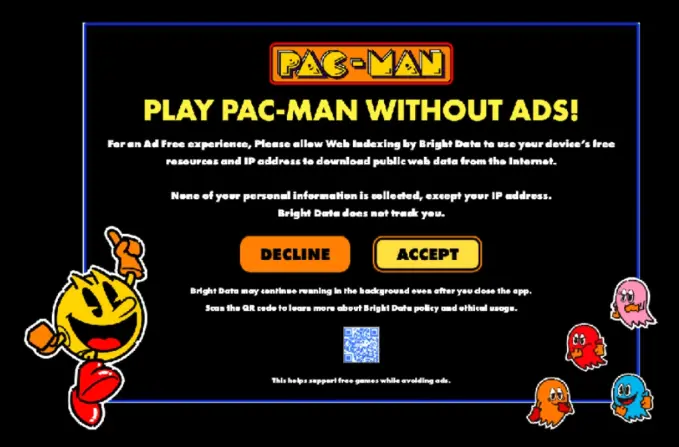
In the context of smart TVs, developers bundled these SDKs into varied utility and gaming software. For example, a simple Pac-Man clone or a basic weather screensaver app available on webOS would present users with a choice upon initial launch: pay a fee, view continuous display ads, or agree to "share idle internet bandwidth" to access the app for free.
Cybersecurity & Network Integrity Threats
While proxy operations are marketed as legitimate infrastructure for web intelligence, embedding them within smart TVs introduces serious operational and security concerns:

- Bandwidth Hijacking and Data Caps: Continuous, unmonitored background data routing can degrade home network performance, cause latency issues for legitimate media streaming, and trigger costly data overage fees for consumers with capped broadband plans.
- IP Address Reputation Degradation: Traffic routed through a user’s smart TV originates from their home IP address. If malicious actors utilize the proxy network to perform aggressive web scraping, credential stuffing, or vulnerability scanning, the consumer’s IP address—not the proxy customer’s—becomes blacklisted by security systems and major web services.
- Flawed Household Consent Dynamics: Traditional PC or mobile devices are usually tied to individual adult users. Smart TVs are shared household screens accessible to all family members. A child or guest agreeing to a subtle pop-up dialog in a free game effectively consents to converting the entire household’s primary internet gateway into a public commercial proxy node.
┌─────────────────────────────────────────────────────────────────────────┐
│                      RISK VECTOR MATRIX: SMART TV PROXIES               │
├──────────────────────┬──────────────────────────────────────────────────┤
│ Threat Vector        │ Impact on Consumer Environment                   │
├──────────────────────┼──────────────────────────────────────────────────┤
│ Network Performance  │ Increased ping times, video buffering, jitter.   │
│ Data Utilization     │ Silent consumption of ISP monthly bandwidth caps.│
│ IP Blacklisting      │ Home IP flagged by Cloudflare/Akamai/CAPTCHAs.    │
│ Consent Integrity    │ Minor household members accepting TOS prompts.   │
│ Network Pivoting     │ Potential exposure of adjacent local network devices.│
└──────────────────────┴──────────────────────────────────────────────────┘
Official Statements
LG Electronics USA
Addressing the findings, John Taylor, Senior Vice President of LG Electronics USA, issued a unambiguous statement confirming a policy shift and active store remediation:
"A residential proxy network is not an intended use for LG smart TVs, and LG Electronics is working with developers to remove the residential proxy option from their apps on the webOS platform. If this option is not removed, these apps will be suspended.
As part of our ongoing efforts to enhance platform quality and the user experience, LG will continue to strengthen our evaluation process for developer-submitted apps, including those that incorporate residential proxy SDKs."
Taylor emphasized that LG’s audit and enforcement protocols are "well underway," targeting both existing ecosystem offerings and incoming developer submission pipelines.
Bright Data
The residential proxy provider identified by Spur as accounting for the majority of embedded TV SDKs, Bright Data, defended the legality and transparency of its business model. A company spokesperson stated:
"Every peer opts in through a dedicated screen and receives value in return; every customer is vetted, and our practices have now undergone a second independent audit by PwC. We remain committed to an open, transparent internet where legitimate businesses, researchers, and institutions can responsibly access data that lives in the public domain."
Bright Data maintained that its infrastructure adheres to strict Know Your Customer (KYC) compliance standards to prevent misuse, and emphasized that technological boundaries within its SDK prevent proxy clients from interacting with or accessing other devices connected to the local home network.
Spur Threat Intelligence
Security firm Spur pushed back against the assertion that opt-in screens on smart TVs constitute meaningful consent. Trevor Sutter, speaking on behalf of Spur, highlighted the systemic vulnerabilities inherent to consumer IoT platforms:
"A one-time consent prompt buried in a TV app is not a substitute for meaningful transparency, ongoing control, and platform oversight. The risk is amplified when consent comes from individuals within the household who use the device but shouldn’t give consent, such as minors."
Spur argued that smart TVs represent an asymmetrical risk profile: consumers do not perceive these appliances as full-fledged computers capable of hosting secondary background networks, nor do smart TV operating systems provide granular, task-manager style visibility for users to monitor resource consumption.
Future Outlook
Regulatory and Ecosystem Shifts
LG’s decision to ban proxy SDKs marks a critical turning point in smart device governance. For years, the smart TV ecosystem has operated in a regulatory and operational grey area, where declining hardware margins incentivized manufacturers and third-party developers to aggressively monetize platform software. However, the revelation that nearly half of LG’s app offerings carried proxy payloads exposes the systemic fragility of current app store review frameworks.
Industry analysts anticipate that LG’s policy pivot will compel rival operating system vendors—most notably Samsung (Tizen OS), Google (Android TV/Google TV), and Amazon (Fire OS)—to institute similar bans or stringent vetting guidelines. Failure to act risks inviting scrutiny from regulatory bodies such as the Federal Trade Commission (FTC), which has increasingly targeted opaque dark patterns and deceptive consent mechanisms in consumer software ecosystems.
Hardening IoT Platforms
Moving forward, smart TV platform architectures are expected to undergo structural security enhancements:
- Granular Background Process Limits: Operating systems will likely implement strict process-lifecycle controls that completely freeze app processes the moment an app is minimized or the television enters standby mode.
- Dedicated Telemetry Dashboards: Device makers may be forced to provide network traffic monitors, allowing users to observe real-time uploads and downloads per installed application.
- Explicit SDK Blacklisting: Static code analysis tools integrated into app store submission pipelines will automatically reject applications containing known proxy and bandwidth-leasing frameworks.
Defensive Guidance for End Users
While platform providers work to purge non-compliant applications, cybersecurity experts recommend that consumers adopt proactive network hygiene measures to safeguard their connected homes:
- Audit Installed Applications: Conduct a review of all installed apps on smart TVs. Uninstall legacy games, unbranded screensavers, or file utilities that are no longer actively used or come from unknown development studios.
- Isolate IoT Devices on Guest Networks: Configure home routers to place smart televisions, streaming sticks, and smart appliances onto a dedicated, isolated Guest Wi-Fi network. This prevents compromised or proxy-enabled devices from reaching primary workstations, personal computers, and local storage drives (NAS).
- Monitor Network Bandwidth: Periodically review router management logs to identify connected devices consuming unusual quantities of upstream data while supposedly idle.
LG’s purge of residential proxy SDKs underscores a necessary maturation of the smart home environment. As connected devices become ever more deeply integrated into daily life, hardware manufacturers are discovering that preserving consumer trust requires rigorous software governance over third-party monetization schemes.