Executive Overview
The modern B2B SaaS playbook is undergoing a radical, AI-driven rewrite. Gone are the days of linear scaling, prolonged enterprise sales cycles, and bloated sales development representative (SDR) floors. In their place is a new paradigm of hyper-velocity growth, spearheaded by artificial intelligence infrastructure companies that scale from zero to hundreds of millions in Annual Recurring Revenue (ARR) in mere months.
Nowhere is this phenomenon more vividly illustrated than at ElevenLabs, the industry leader in voice generation and audio AI. Reaching a stratospheric valuation and scaling past $600 million in ARR in just 41 months from inception, the company didn’t just ride the generative AI wave—it engineered a completely unorthodox commercial architecture to capture and monetize unprecedented market demand.
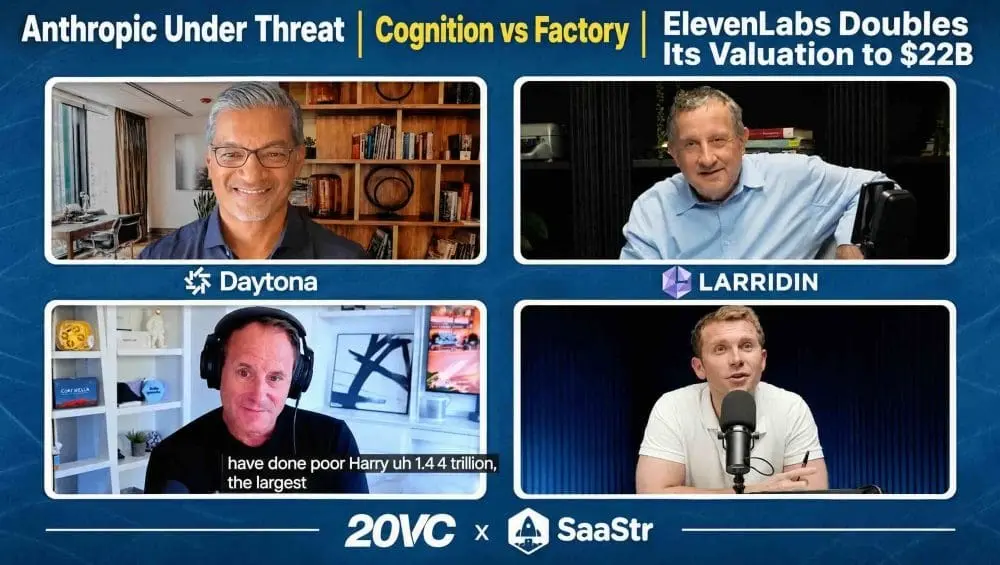
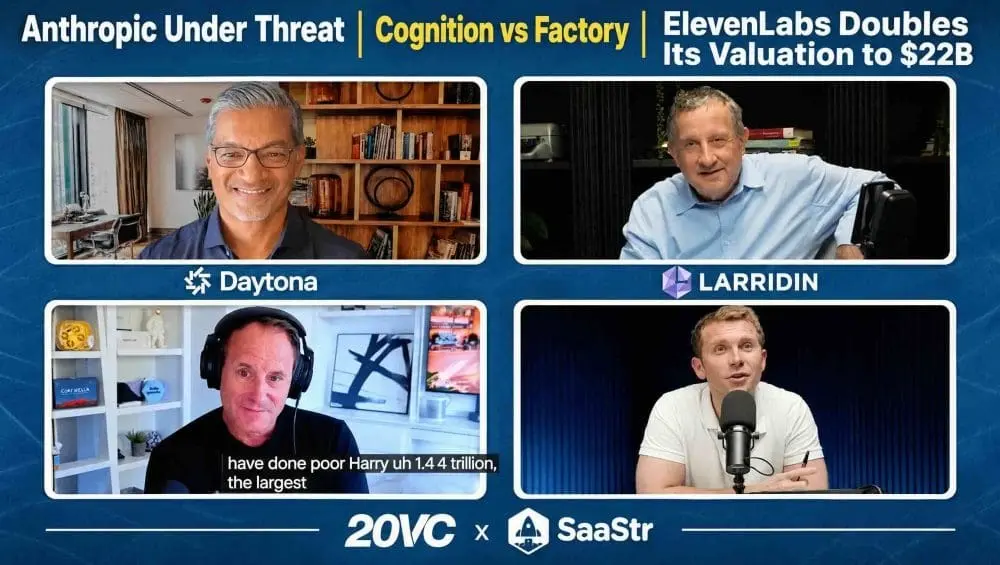
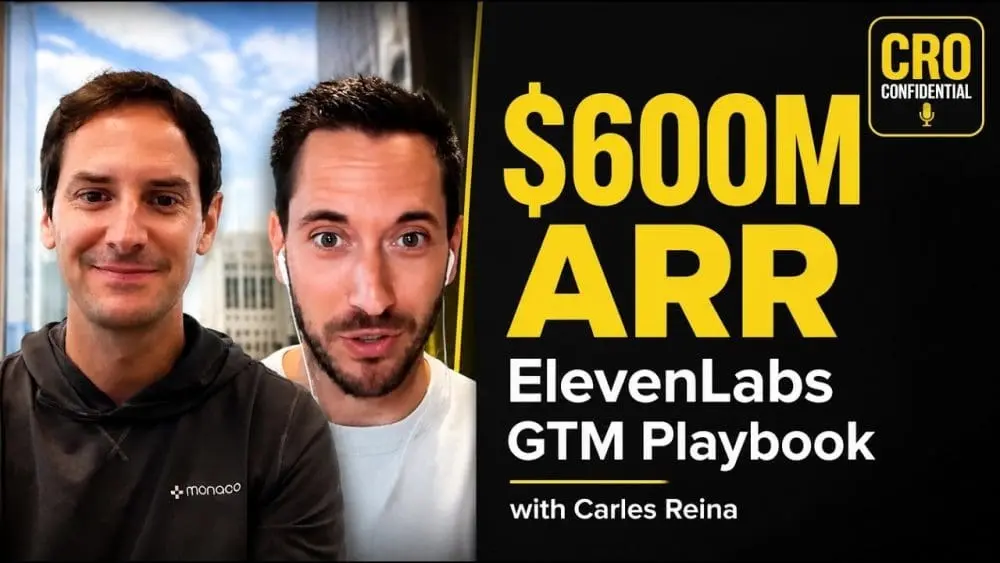
Recently, Carles Reina—Employee #4, the company’s first go-to-market hire, and its initial investor—sat down with Sam Blond, founder and CEO at Monaco and former CRO at Brex and Zenefits, on SaaStrAI’s CRO Confidential. Rather than a standard case study presented by a single executive, the conversation served as a masterclass in comparative revenue operations, featuring two seasoned builders comparing notes on how to structure a revenue organization when product-market pull outpaces human processing capacity.
This in-depth investigative report deconstructs ElevenLabs’ explosive trajectory from $1 million to over $600 million in ARR. It breaks down the core operational strategies, strategic gambles, and structural philosophies that allowed Reina and his team to build an enterprise powerhouse—and highlights the critical lessons other B2B leaders can copy, adapt, or strictly avoid.
Detailed Chronology: From Solo Seller to Global Enterprise Machine
The ElevenLabs commercial story is defined by distinct evolutionary phases, each characterized by a willingness to break conventional B2B rules and lean heavily into calculated risks.
Phase 1: The Nine-Month Solo Sprint and the Grants Gambit
For the first nine months following the public release of ElevenLabs’ software, Carles Reina operated as the entirety of the go-to-market organization. Selling enterprise deals single-handedly while his competitors—other heavily funded startup model companies—fought fiercely for developer mindshare, Reina realized that standard acquisition tactics would not yield category dominance.
During a holiday with his wife, operating under the personal mandate to "figure out how to kill the current set of competitors," Reina devised a radical distribution play: The Grants Program.
Targeting early-stage startups with under 25 employees, ElevenLabs offered its technology completely free for three months. They amplified the program aggressively through public channels, distributing tens of thousands of grants in a remarkably short window.
- The Strategic Play: Competitors of a similar size relied on capturing this exact demographic of developer-led startups for their foundational growth. By flooding the market with a three-month free tier tailored specifically to sub-25-person companies, ElevenLabs effectively choked off the oxygen supply for its rivals, making it mathematically impossible for them to run a counter-play.
- The ROI: Far from being a mere marketing stunt or a burn of free usage, the grants cohort became an enterprise engine. For a significant stretch of ElevenLabs’ early history, over 10% of total enterprise revenue traced directly back to startups that entered the ecosystem through the grants program, grew organically, and eventually converted into lucrative, paid enterprise contracts.
Phase 2: Building the AI-First Commercial Engine
Two and a half years ago, during a company offsite in Switzerland when headcount stood at under 30 people, Reina pitched the founders on an aggressive vision: building an internal AI go-to-market organization complete with an AI SDR, an AI Account Executive, and an AI Customer Success Manager.
The initial reaction from leadership was a firm "no." The technology was deemed unready; the directive was to hire humans and move faster.
Undeterred, Reina persisted. A year later, he secured a single developer dedicated exclusively to go-to-market engineering and began building. Internal resistance was immediate—chiefly, human reps fearing job displacement. Two critical operational choices resolved this friction:
- Demonstrated Superiority: They proved that an AI SDR responding to an inbound lead and calling back immediately converted at a higher rate than a human responding within 30 minutes. Furthermore, because no human rep genuinely enjoys guarding an inbox, the team welcomed the automation. Simultaneously, an AI CSM deployed across the SMB and mid-market longtail successfully unlocked upsell revenue that human teams simply lacked the bandwidth to pursue.
- The Human Alignment Principle: Most companies fail at automation because they cut out human incentives. ElevenLabs made a strict policy: When an AI agent closed or unlocked revenue on an account, the human rep owning that account still received full commission. This eliminated the perverse incentive of reps quietly sabotaging or working against automated systems. It proved that paying twice—once for the software agent, once for the human—was the necessary cost of removing internal friction.
Phase 3: Global Expansion via Written Theses and Financial Constraints
As ElevenLabs expanded its footprint across the United States, Europe, Japan, India, Korea, Brazil, Mexico, Colombia, and the Middle East, it rejected haphazard geographic entry.
Every market launch required a formal, written thesis addressing three questions prior to launch:
- Why this specific market?
- What is the optimal channel mix?
- What exact result do we expect in the first three to six months?
Intriguingly, channel strategies were frequently dictated by local tax constraints rather than traditional sales theory. In certain regions, local withholding taxes and invoicing regulations rendered direct selling economically unviable. Consequently, finance constraints dictated go-to-market structures, pushing ElevenLabs to adopt reseller-first models where direct sales economics failed. Writing down expected outcomes prior to launch ensured that market entries were treated as scientific experiments with hard evaluation dates, rather than open-ended operational drains.
Supporting Context & Metrics: The Anatomy of Hypergrowth
Reina’s approach to compensation, quota-setting, and sales unit economics discarded decades of established SaaS dogma, substituting it with high-conviction adjustments calibrated for a hyper-accelerating market.
Quota at 20x Base Salary: The High-Comp, High-Expectation Model
Traditional B2B SaaS benchmarks traditionally hovered around a 5x quota-to-base ratio (e.g., a $200K total compensation package yielding $1M in ARR). Reina shattered this standard by setting quotas at 20x base salary—translating a $100K base into a $2,000,000 new ARR quota per year.
Initial pushback from prospective sales hires was severe. Reina’s response was a binding operational promise:
"I don’t know if you’re going to get there or not. What I can promise you is that we will make it fair. If in the next 3 to 6 months we see that you’re not getting there, I will lower the commission, I will lower the targets… And in quarters where market fundamentals change, we will reevaluate and grant relief."
- The Result: Three and a half years in, Account Executives routinely run at 600% of quota, many sit at 300%, and company-wide attainment averages 167% per quarter. Crucially, when macroeconomic or regional fundamentals shifted, management actively honored its promise, granting up to 50% quota relief in affected markets. Reina’s philosophy remains clear: prefer a lean, exceptionally well-compensated team over a bloated, demoralized sales floor missing targets.
Zero Commission on Proof of Concepts (POCs)
ElevenLabs enforced a rigid rule: Zero commission was paid on POCs, regardless of size or duration. Whether a signed POC was valued at $20K or $20M, reps received commission strictly upon signing recurring revenue contracts.
- The Rationale: Reina framed this through an equity and valuation lens. At typical SaaS multiples, $1M in ARR translates to roughly $33M in enterprise value. A POC does not register on the balance sheet, does not show up in board decks, and does not move investor valuations. Aligning rep compensation exclusively with recognized recurring revenue ensured that sales teams focused entirely on high-intent, long-term contractual value rather than vanity pipeline metrics.
Official Insights & Strategic Reflections
Reflecting on the journey past $600M ARR, Reina and Sam Blond highlighted the foundational missteps they would correct if building over again, alongside a sober assessment of AI agent capabilities.
What They Would Have Done Differently
- Hire Sales Enablement and RevOps Much Earlier: Both leaders confessed to the classic startup trap of treating revenue operations as an afterthought. Waiting until the organization is massive forces companies to retrofit onboarding onto reps who have already established idiosyncratic habits. As Blond noted from his time at Zenefits, he has never heard a sales leader regret investing too early in RevOps.
- Bring in Senior Reps Sooner: The reflexive startup instinct is to hire young, hungry, inexpensive talent. Reina acknowledged that this approach forces the company to start from scratch on every enterprise account. Bringing in veteran enterprise reps with pre-existing relationships among procurement leaders earlier in the lifecycle accelerates market penetration significantly.
The Limits and Superpowers of AI Agents in Sales
Drawing from frontline deployment experience, Reina offered a clear-eyed breakdown of where AI agents excel and where they stumble:
- Where Agents Fail: Anything genuinely relationship-driven. LLMs operate by computing probabilities within existing data distributions. Exceptional sales execution requires operating outside the median response; true differentiation cannot be automated.
- Where Agents Excel: Analyzing massive datasets, conducting account research, building Total Addressable Markets (TAMs), scoring accounts against criteria, monitoring buying signals, drafting initial outreach messages, and updating CRM records 24/7.
As Blond summarized: if a rep spends their day hunting for companies to add to a database, manually researching trigger events, or updating CRM fields, they are already obsolete. Human sellers must protect their time for high-value in-person interactions and creative campaign design.
Future Outlook: The 100 Experiments Framework
As ElevenLabs looks toward the horizon and its next phase of scale, Reina’s guiding operational philosophy remains rooted in experimentation and portfolio diversification:
"You need to test 100 things, but I only need one of those 100 things to actually work to give me another hundred million in ARR. I only need one. I don’t need five. I don’t need 20."
In high-growth technology markets, plan failures are inevitable. Customer churn happens, macroeconomic headwinds emerge, and expected upsells stall. By institutionalizing an environment where teams run 100 distinct go-to-market experiments—such as the wildly successful grants program—organizations insulate themselves against singular points of failure.
Summary Takeaways for B2B Leaders
For executives looking to distill the ElevenLabs playbook into actionable strategy, three core tenets stand out:
- Write the Thesis First: Treat every new market entry or commercial initiative as a formal, written experiment with a hard evaluation date at 3 to 6 months.
- Weaponize Free Tiers Against Competitors: Target the exact demographic your competitors rely on for oxygen, and deploy friction-reducing free access at a scale they cannot economically match.
- Align Comp with Investor Metrics: Pay commission strictly on the revenue numbers reported to the board, and maintain alignment with human teams by continuing to pay commissions even as automated AI agents streamline the closing motion.