Executive Overview
In an autonomous vehicle market historically dominated by speculative robotaxi projects and high-risk long-haul trucking ventures, one startup has quietly built a multibillion-dollar commercial foundation by focusing on the unglamorous yet vital B2B supply chain. Gatik, an industry leader in autonomous box truck technology, has successfully closed a massive $200 million funding round. This milestone comes merely two months after the company announced a landmark, multiyear commercial agreement with consumer goods giant PepsiCo.
Co-led by the Qatar Investment Authority (QIA) and Koch Disruptive Technologies (KDT), with additional participation from high-profile financial institutions including Millennium Management, ARK Invest, and Intact Private Capital, this Series D-style injection is Gatik’s largest to date. It brings the Santa Clara, California-based company’s total venture funding to approximately $500 million since it officially emerged from stealth mode in 2019. While Gatik’s executive team has opted not to disclose the company’s current private valuation, the sheer scale of the round—combined with $600 million in contracted commercial revenue—signals that the autonomous delivery sector is entering a definitive phase of enterprise-grade maturity.
This latest capital influx marks a profound turning point for Gatik. The company is decisively transitioning from a boutique pilot-program startup into a scaled, commercial-grade logistics enterprise. Operating entirely driverless commercial fleets across multiple complex urban and highway environments for some of the world’s largest retailers and food distributors, Gatik is redefining how goods move from distribution centers to storefronts.
Detailed Chronology: From Stealth Origins to Autonomous Dominance
To fully understand Gatik’s current market standing, one must examine the strategic roadmap meticulously laid out by co-founders Gautam Narang and Sven Beiker since the company’s inception.
2017–2019: Incubation and Stealth Development
Founded in 2017, Gatik initially operated below the radar. While contemporaries in the autonomous vehicle (AV) space poured billions of dollars into consumer-facing robotaxis or complex, cross-country Class 8 semi-truck operations, Gatik’s leadership identified a glaring white space in the logistics chain: the B2B middle-mile. Recognizing that retail supply chains were buckling under consumer demands for rapid replenishment, the founders set out to build an autonomous solution specifically engineered for B2B short-to-medium-haul logistics.
2019: Emerging from Stealth with Walmart
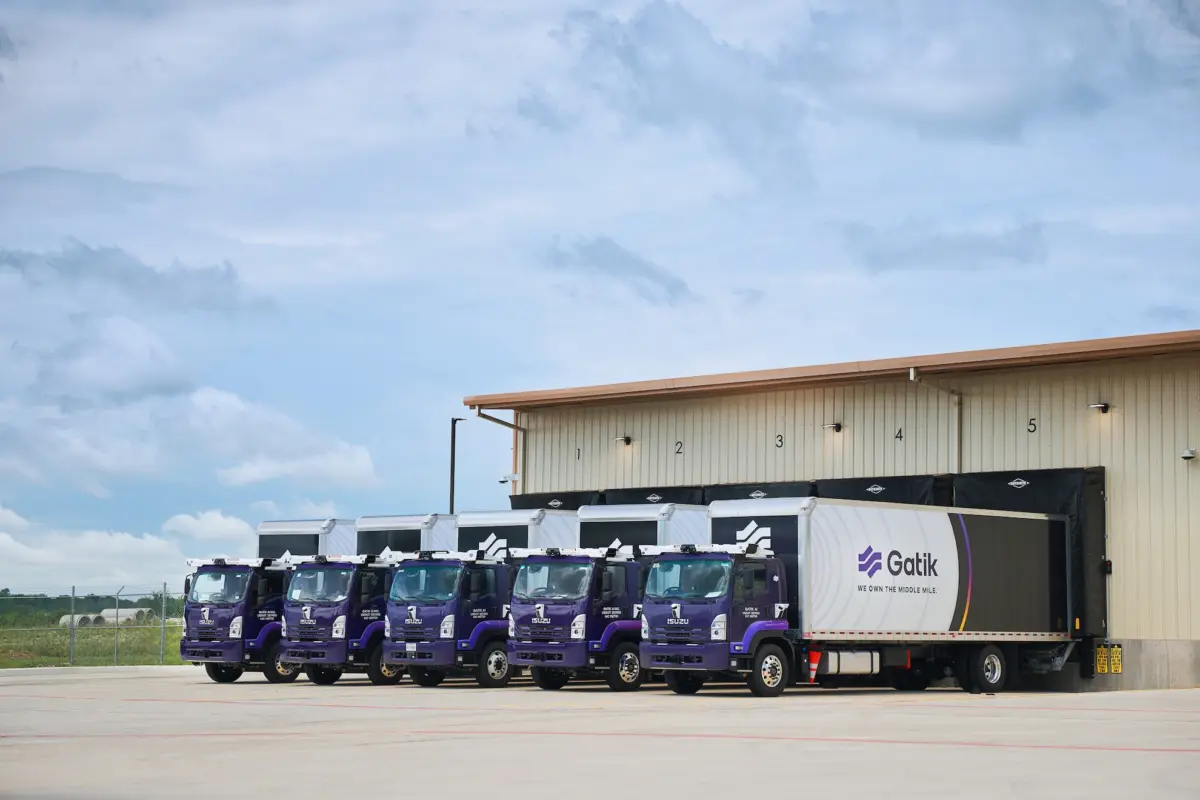
In June 2019, Gatik officially broke cover, announcing a high-profile pilot partnership with retail titan Walmart. This inaugural deployment utilized a fleet of Isuzu light-duty box trucks fitted with Gatik’s proprietary autonomous driving software, transporting goods between Walmart dark stores and neighborhood market locations in Arkansas. This controlled rollout established Gatik’s foundational philosophy: predictable, fixed-route B2B logistics yield safer environments and faster commercial viability than erratic, unpredictable consumer transport.
2021–2022: Expanding the Footprint and Pulling the Driver
Over the next three years, Gatik aggressively scaled its operations, onboarding retail heavyweights such as Canada’s Loblaws, Kroger, and Tyson Foods. The company systematically expanded its geographic footprint into dense urban corridors and suburban networks across North America.
A critical operational breakthrough occurred in 2022, when Gatik cleared rigorous safety validations to officially remove the safety driver from behind the wheel. By achieving fully driverless commercial operations on public roads—navigating complex multi-lane traffic, pedestrian zones, and adverse weather—Gatik proved that its technology was ready for unassisted commercial deployment.
2024: The PepsiCo Partnership and $200 Million Raise
The momentum culminated in early 2024 with a sweeping multiyear commercial agreement with PepsiCo. Under this partnership, Gatik deployed a fleet of 41 autonomous box trucks to transport iconic Frito-Lay products—including Cheetos and Doritos—from distribution hubs directly to retail storefronts across Dallas, Phoenix, and Northwest Arkansas.
Capitalizing on this massive validation, Gatik finalized its $200 million funding round, solidifying its financial runway to support aggressive enterprise scaling through the remainder of the decade and beyond.
Supporting Context & Metrics: Decoding the Middle-Mile Niche
The autonomous vehicle landscape has historically been bifurcated into two extremes: low-speed sidewalk delivery robots incapable of handling major thoroughfares, and long-haul Class 8 trucks designed to traverse thousands of interstate miles. Gatik deliberately carved out a vital, lucrative middle ground.
The Anatomy of Middle-Mile Logistics
The "middle-mile" refers to the transportation of goods from a central distribution center or fulfillment hub to retail storefronts or local micro-fulfillment centers. This segment of the supply chain is notoriously expensive, labor-intensive, and prone to logistical bottlenecks. By automating this specific vector using light-and-medium-duty commercial box trucks (manufactured primarily by Isuzu Motors), Gatik bypasses the regulatory and engineering nightmares associated with navigating dense pedestrian sidewalks while avoiding the massive mass-and-momentum risks of 80,000-pound semi-trucks on interstate highways.
Metrics of Growth and Operational Scale
- Total Venture Funding: Approximately $500 million raised since 2019.
- Latest Round: $200 million, led by Qatar Investment Authority (QIA) and Koch Disruptive Technologies (KDT).
- Contracted Revenue: An impressive $600 million in locked-in commercial contracts.
- Fleet Footprint: Dozens of fully driverless commercial box trucks operating continuously across multiple strategic U.S. and Canadian markets.
- Route Evolution: Initial routes spanned under 10 miles on fixed paths; current operations scale to dynamic, complex routes covering up to 400 miles with multiple pick-up and drop-off points.
- Current Workforce: Approximately 350 employees, with active expansion plans underway.
Official Statements and Industry Insights
The infusion of $200 million from heavyweight global investors underscores a broader market confidence in Gatik’s methodical, B2B-centric approach.
In a recent interview, Gatik Co-founder and CEO Gautam Narang emphasized the strategic alignment between the startup and its new financial backers:
"These are all long-term investors. All the scale-up plans that we have and the growth that we have in mind for the next few years — these are the kind of financial partners that can help us."
Narang noted that the maturation of Gatik’s proprietary technology stack has been the primary catalyst behind the company’s recent commercial acceleration. The startup’s third-generation autonomous software and hardware integration allows its trucks to operate around the clock, successfully navigating surface streets, complex highway merges, and environmental challenges such as light rain and snow.
Industry analysts have praised Gatik’s calculated restraint. Rather than chasing speculative, consumer-facing robotaxi markets plagued by shifting regulatory frameworks and intense public scrutiny, Gatik’s business-to-business model relies on closed-loop, repeatable commercial routes that immediately reduce operational expenditure for enterprise clients struggling with chronic driver shortages and escalating labor costs.
Future Outlook: Scaling Beyond North America
With a war chest of $200 million and $600 million in contracted revenue secured, Gatik’s leadership team is firmly focused on the future. However, scaling an autonomous trucking operation requires more than just capital—it demands aggressive talent acquisition and careful geographic expansion.
Workforce Expansion and Engineering Talent
To support its accelerated deployment schedule, Gatik plans to aggressively expand its 350-person workforce. CEO Gautam Narang confirmed that the company is actively recruiting top-tier software engineers, hardware specialists, and logistics operations personnel. These new hires will be tasked with refining the company’s autonomous stack, enhancing remote teleoperation capabilities, and managing real-time fleet orchestration.
Geographic and International Horizons
While Gatik’s current operations are strictly anchored within North America—servicing major regional markets in Texas, Arkansas, Arizona, and Ontario, Canada—the company’s long-term vision extends far beyond domestic borders. Armed with backing from globally minded institutional investors like the Qatar Investment Authority, Gatik is actively evaluating international expansion opportunities in key international markets facing similar labor shortages and supply chain constraints.
Ultimately, Gatik’s latest funding round serves as a bellwether for the broader autonomous vehicle industry. It demonstrates that commercial viability in the AV space is no longer a distant theoretical goal, but a present-day reality for companies that pair disciplined engineering with an acute understanding of enterprise supply chain economics. As Gatik’s driverless box trucks continue to quietly rack up millions of commercial miles across highways and city streets, the company is proving that the road to autonomous profitability is paved in the middle-mile.