The global broadcast and media landscape is undergoing one of the most complex transitions in its history. As the industry hovers between legacy Serial Digital Interface (SDI) infrastructure and software-defined Internet Protocol (IP) networks, technology acquisition strategies have shifted from idealistic, all-or-nothing migrations to pragmatic, hybrid realities. At the center of this industry-wide evolution is FOR-A, a global leader in broadcast technology.
At the upcoming IBC2026 exhibition in Amsterdam, scheduled to take place at the RAI Amsterdam, FOR-A will utilize Stand 2.B53 to showcase its latest suite of products designed to address these exact operational pain points. Rather than forcing broadcasters into premature, costly capital expenditures, FOR-A’s showcase is anchored in practical, cost-effective interoperability. By integrating advanced software-defined processing, on-device artificial intelligence, and sophisticated network orchestration tools, the company is positioning itself as the critical bridge for media enterprises navigating the hybrid divide.
To understand FOR-A’s strategic direction, one must look closely at the specific operational challenges currently facing broadcasters. Modern media operations require content to be formatted for multiple distribution channels simultaneously, demanding real-time versioning, automated aspect-ratio adjustments, and reliable remote transport.
Below is a detailed breakdown of the core technologies FOR-A will demonstrate at IBC2026, each designed to resolve specific technical bottlenecks in the production pipeline.
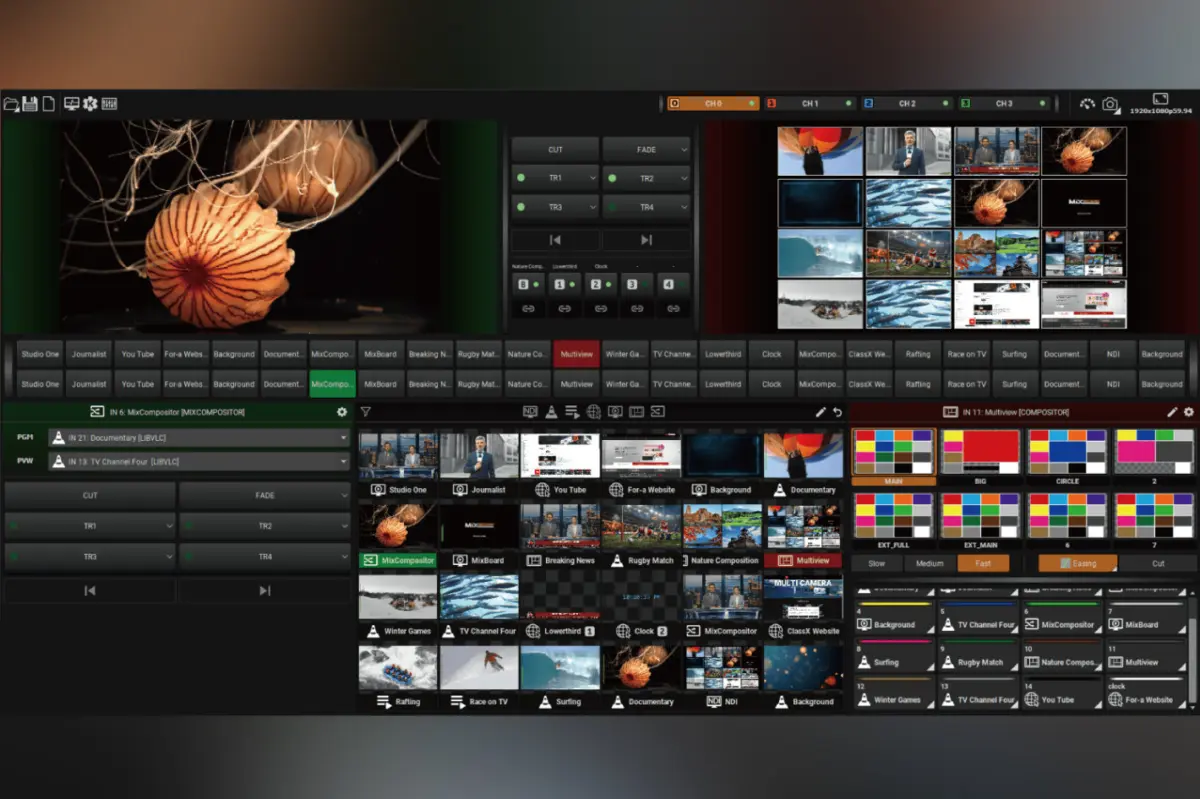
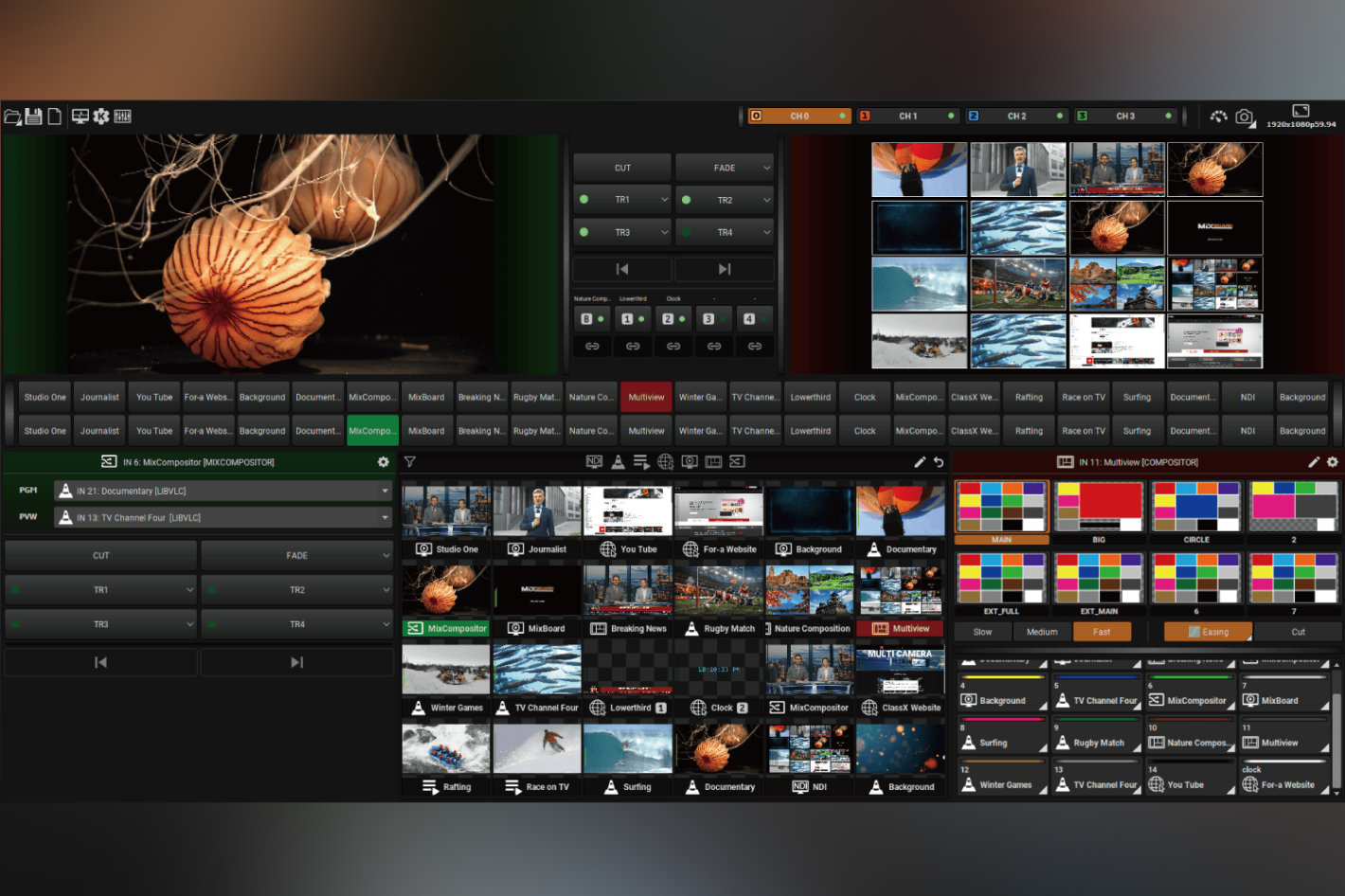
In modern live production, the traditional separation between video switching, audio mixing, and graphics generation is rapidly dissolving. To address this convergence, FOR-A will showcase MixBoard, a software-based live production switcher powered by ClassX.
More than a simple software mixer, MixBoard is designed to act as a multi-format delivery engine.
Multi-Format Versioning: MixBoard allows operators to generate cropped versions of live feeds for varying aspect ratios in real time, catering directly to the dual demands of traditional television and mobile-first streaming platforms.
Streamlined Streaming Outputs: It natively generates and distributes multiple streaming formats, reducing the need for downstream encoding hardware.
PTZ Camera Control Integration: Making its debut at IBC2026, MixBoard now features comprehensive, integrated control for Pan-Tilt-Zoom (PTZ) cameras. This update allows a single operator to manage switching, audio levels, graphics, and camera positioning from a unified, software-defined interface, significantly lowering overhead costs for mid-tier live events and corporate broadcasts.
2. viztrick AiDi & GoVertical!: Edge AI Without the Cloud
One of the most notable entries in FOR-A’s IBC lineup is viztrick AiDi, an on-device artificial intelligence solution developed by Nippon TV and distributed globally by FOR-A. Powered by high-performance NVIDIA AI hardware infrastructure, viztrick AiDi offers a direct alternative to latency-heavy, subscription-based cloud AI services.
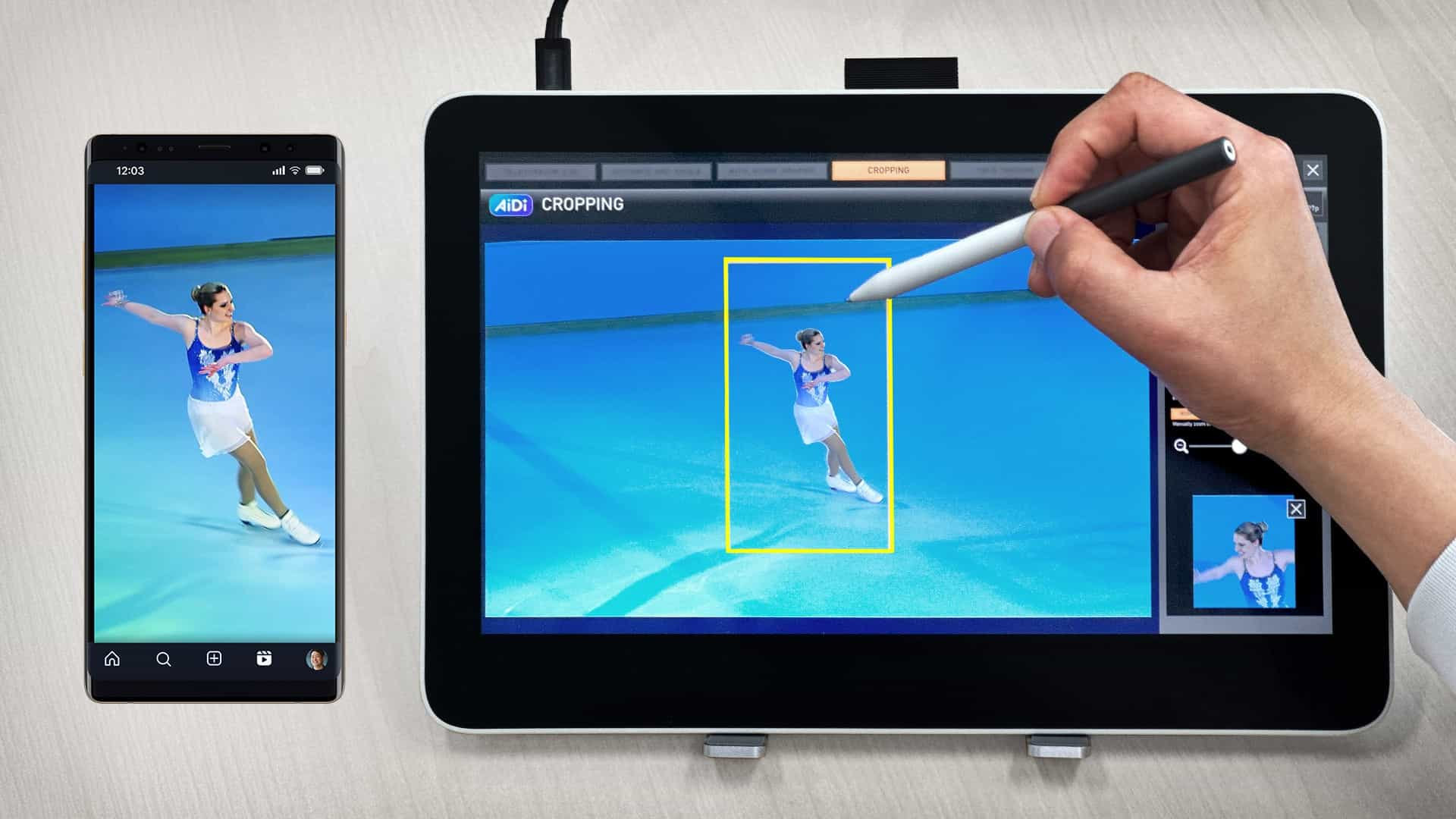
At the heart of this technology is GoVertical! AiDi, a specialized module engineered for the social media age.
Real-Time 9:16 Autocropping: The software uses advanced visual tracking models to identify the primary subject of a 16:9 broadcast feed and automatically crop the video to a vertical 9:16 aspect ratio in real time.
On-Device Reliability: Unlike cloud-based AI tools that suffer from processing latency and require massive internet bandwidth, viztrick AiDi operates entirely on-premise. This edge-computing approach guarantees ultra-low latency and eliminates reliance on external network connectivity, making it ideal for remote production trucks and live news venues.
Advanced Computer Vision: Beyond vertical cropping, the system supports player tracking, ball tracking, and object recognition, providing production teams with metadata-rich streams that can be used for real-time graphics rendering and sports analysis.
3. The FA-1616: The Swiss Army Knife of Hybrid Infrastructure
For facilities operating in a mixed SDI and IP environment, signal processing is a constant headache. Different areas of a facility may use different standards—such as 12G-SDI, SMPTE ST 2110, or NDI—while requiring conversion between HD (2K) and Ultra HD (4K) resolutions.
The FA-1616 software-defined digital video processor is FOR-A’s answer to this logistical complexity.
Massive Stream Density: The processor supports up to 32 inputs/outputs, acting as a high-density processing node.
Comprehensive Signal Manipulation: The hardware performs frame synchronization, up/down/cross-conversion, color correction, audio remapping, and timecode generation across both SDI and IP domains.
Format-Agnostic Bridging: By acting as a transparent gateway between compressed and uncompressed formats, the FA-1616 protects existing legacy investments while allowing facilities to incrementally scale their IP infrastructure.
4. Hi-RDS: Orchestrating Complex IP Networks
As broadcasters transition to software-defined IP environments, network management has become increasingly complex. In SMPTE ST 2110 environments, Registration and Discovery Systems (RDS)—often governed by NMOS (Network Media Open Specifications) standards like IS-04 and IS-05—are used to locate and route media streams.
However, traditional RDS architectures suffer from a fundamental limitation: each network node can typically only be registered to a single RDS registry. In large-scale, multi-studio, or multi-vendor setups, this creates isolated silos and makes signal routing between different production areas highly complex.
FOR-A’s Hi-RDS (Hierarchical Registration and Discovery System) solves this challenge by introducing an orchestration layer.
Unified Control Layer: Hi-RDS establishes a primary RDS management layer that oversees and coordinates individual operational RDS registries across different departments or venues.
Seamless Cross-Domain Routing: This hierarchical structure makes it easy to share media streams between different production zones, different vendors’ hardware, and varying signal formats.
Simplified Network Architecture: By automating the registration and discovery process across boundaries, Hi-RDS reduces the engineering overhead required to maintain complex IP routings.
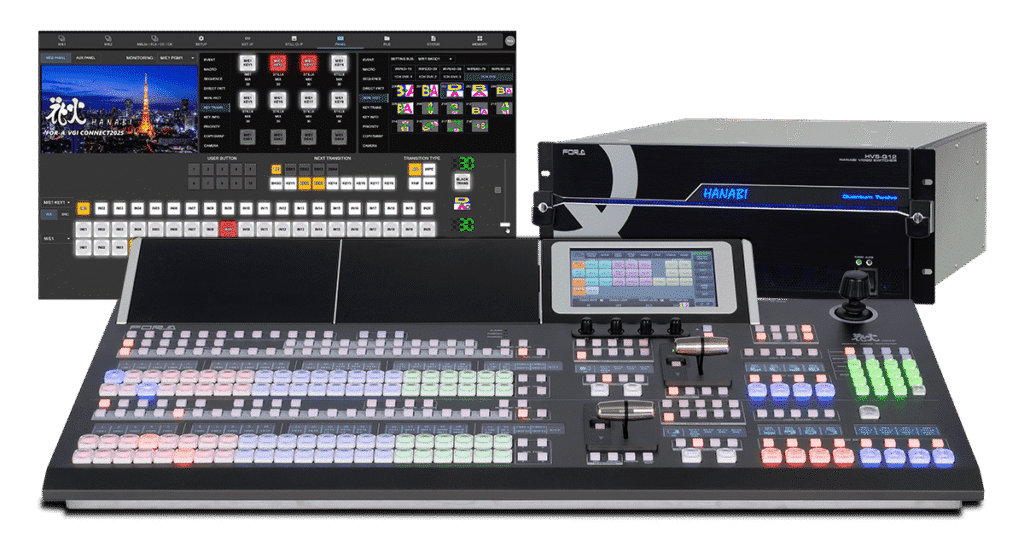
5. Hardware Innovations: MFR Routers and HVS-Q12 Hanabi Mixers
While software-defined technology is the future, robust and highly reliable hardware remains the foundation of live broadcasting. At IBC2026, FOR-A will showcase the latest additions to its established MFR routing switcher and HVS-Q12 Hanabi vision mixer families.
High-Density Integration: These new switchers feature built-in multi-viewers, eliminating the need for external processing chassis, simplifying rack cabling, and reducing potential points of failure in live production chains.
FOR-A IMPULSE AI Updates: The company’s software-defined live production platform, FOR-A IMPULSE, will also receive significant AI-driven software updates designed to automate routine switching tasks and optimize resource allocation during live broadcasts.
6. Remote Production in Action: The Dejero Collaboration
To prove the real-world capabilities of its production ecosystem, FOR-A has partnered with Dejero, a pioneer in resilient, mobile connectivity and cellular bonding.
During the show, Dejero will co-exhibit at Stand 2.B53, sending a live, high-bandwidth video feed from the grueling TARGA Newfoundland rally in Canada directly to the RAI exhibition floor in Amsterdam.
Visitors will see firsthand how Dejero’s cellular blending technology can deliver high-quality, low-latency video from remote environments, and how FOR-A’s graphics, switchers, and processing tools can instantly ingest, package, and distribute this content for live television broadcast.
Supporting Context & Industry Metrics
The technologies FOR-A is highlighting at IBC2026 address major shifting trends in the media and entertainment industry:
The Realities of the Hybrid Transition
While the industry has discussed a complete transition to SMPTE ST 2110 IP networks for years, the reality is that pure-IP setups remain highly expensive and complex to configure. According to industry research, over 70% of medium-to-large broadcasters continue to operate in a hybrid environment, utilizing a mix of SDI and IP. FOR-A’s focus on the FA-1616 and Hi-RDS directly targets this majority, offering tools to manage hybrid complexity without requiring a complete overhaul of existing hardware.
The Rise of Vertical Video
The explosion of platforms like TikTok, Instagram Reels, and YouTube Shorts has turned vertical video from an afterthought into a core business requirement. Traditional workflows require editors to manually crop horizontal broadcasts for vertical formats—a time-consuming and expensive process.
Traditional Workflow:
[Shoot 16:9] ──► [Post-Production] ──► [Manual Cropping & Framing] ──► [Publish 9:16] (Slow, High Cost)

GoVertical! Workflow:
[Shoot 16:9] ──► [viztrick AiDi Edge AI Engine] ──► [Real-Time 9:16 Output] (Instant, Zero Extra Labor)
By automating this process at the edge with viztrick AiDi, broadcasters can publish content to digital platforms almost instantly, capturing audience engagement while reducing production costs.
On-Device Edge AI vs. Cloud AI
While cloud computing offers scalability, it introduces significant challenges for live sports and news, including latency, high bandwidth consumption, and unpredictable egress fees.
Metric / Feature
On-Device AI (e.g., viztrick AiDi)
Cloud-Based AI Solutions
Latency
Ultra-low (milliseconds)
Variable (dependent on network)
Bandwidth Needs
None (processed locally)
High (requires continuous upload)
Connectivity Risk
None (works offline)
High (requires stable internet)
Operating Cost
Predictable (fixed hardware cost)
Variable (subscription & data fees)
By prioritizing on-device processing via NVIDIA hardware, FOR-A addresses these key operational concerns for field-based production crews.
Official Statements
The partnership-driven strategy that underpins FOR-A’s IBC2026 showcase is reflected in comments from key executives at both FOR-A and its technology partners.
Speaking on the real-world application of their collaborative AI project, Takayuki Shinoda, Associate Managing Director, Global Strategy Headquarters at Nippon TV, stated:
"viztrick AiDi was developed in response to the practical challenges we face in day-to-day content production. Our approach to AI is straightforward: it should solve real operational needs while enabling production teams to remain focused on creativity. Through our partnership with FOR-A, we are delighted to make this practical, on-device technology available to broadcasters and content producers around the world. I look forward to joining FOR-A at IBC and speaking with visitors about how AiDi can support their production needs."
"Broadcasters and production companies are no longer bound by technology: they demand the freedom to create their own distinctive content. Our success lies in helping companies make the best of their current assets, combined with carefully targeted investments, to realize their ambitions without limitations."
"IBC is a very important show for us, and this year we are focusing on showing how we can help build complete systems and solutions for our customers. Our partnerships with industry leaders including Nippon TV, ClassX, Dejero and Brainstorm, added to our long history of innovation, give us a real insight into the challenges facing the media business and how we can help them."
Future Outlook & Strategic Analysis
FOR-A’s product lineup at IBC2026 highlights a significant shift in how broadcast technology is designed and sold. The era of buying closed, single-purpose hardware systems is ending. Instead, the market is moving toward software-defined systems, open APIs, and flexible, modular ecosystems.
By embracing software-defined processing (as seen in the FA-1616 and MixBoard) and open network orchestration (via Hi-RDS), FOR-A is helping broadcasters transition smoothly to next-generation workflows. This approach allows media companies to update their systems at their own pace, shielding them from the rapid obsolescence often associated with early-stage technology adoptions.
Furthermore, the integration of on-device AI tools like viztrick AiDi suggests a future where live production is increasingly automated. As computer vision algorithms become more advanced, routine tasks like camera tracking, secondary framing, and real-time social media publishing will be handled by edge processors. This shift will allow human operators to focus on high-value creative tasks, ultimately raising the production value of live broadcasts across all platforms.
For broadcasters attending IBC2026, Stand 2.B53 will offer a practical, real-world roadmap for navigating this transition. Rather than showcasing abstract concepts, FOR-A is set to deliver working, interoperable, and cost-effective solutions designed for the immediate demands of today’s media market.