








Executive Overview
The rapid integration of Large Language Models (LLMs) into enterprise workflows has fundamentally altered the traditional boundaries of software engineering. For decades, the path from user intent to backend execution was governed by deterministic application code—tightly coupled, strictly validated, and thoroughly tested within predictable state machines.
However, the advent of the Model Context Protocol (MCP) and similar bridge architectures has introduced a profound paradigm shift. By allowing LLMs to directly select, parameterize, and invoke backend tools based on natural language prompts, development teams are inadvertently handing over critical routing and execution decisions to probabilistic agents.
While this capability unlocks unprecedented flexibility—enabling users to query complex corporate data stores using conversational interfaces rather than rigid dashboards—it simultaneously shatters the traditional production boundary. When an LLM chooses which operation to call, it implicitly bypasses conventional user-interface constraints. This creates a critical engineering challenge: how do backend teams govern access, enforce strict data boundaries, and maintain auditability when the caller is no longer a human interacting with a form, but an autonomous model interpreting semantic intent?
This architectural vulnerability was recently laid bare during the production rollout at Fullinfo, a B2B data provider serving over 1 million company profiles via an AWS AppSync GraphQL backend. While implementing an MCP wrapper in TypeScript and Go proved technically straightforward, defining and enforcing the model’s authority required a complete overhaul of traditional API security paradigms.
Fullinfo’s journey from a naive wrapper to a hardened, enterprise-grade MCP deployment offers a blueprint for backend teams navigating this uncharted territory. This report provides an exhaustive, investigative analysis of MCP governance, exploring the mechanics of probabilistic control, the necessity of permission-scoped tool separation, schema-enforced boundaries, comprehensive logging methodologies, and rigorous non-chat testing harnesses.
Detailed Chronology: From Naive Wrappers to Production Hardening
Phase 1: The Initial Proof of Concept and the Illusion of Simplicity
The genesis of most enterprise MCP projects follows a deceptively simple trajectory: an engineering team identifies an existing API, writes a lightweight wrapper, and connects it to an MCP host like Claude Desktop or a custom internal client. The goal is low-friction enablement—allowing internal analysts or external customers to query databases using conversational language instead of navigating complex, multi-step graphical portals.
For Fullinfo, the initial proof of concept was deployed within days. Utilizing TypeScript and Go, the engineering team wrapped their existing AWS AppSync GraphQL backend, exposing a generic query tool to the LLM. The immediate results were astonishingly positive. Instead of forcing users to navigate dropdown menus, configure multi-parameter filters, and page through deterministic UI flows, an analyst could simply type:
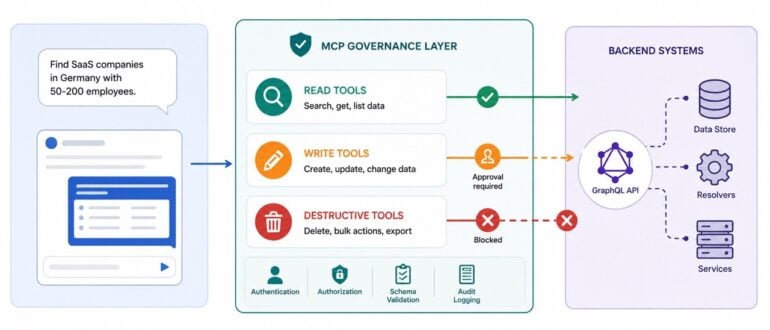
"Find SaaS companies in Germany with 50-200 employees,"
and receive structured, highly relevant JSON records directly within the conversation thread.
Yet, beneath this apparent success lurked a dangerous architectural illusion. The engineering team quickly realized that while the code required to bridge the protocol was minimal, the governance required to control the model’s authority was immensely complex. By exposing a general-purpose query tool, they had inadvertently granted the LLM a degree of autonomy that circumvented traditional product boundaries. The model was no longer just retrieving data; it was dynamically constructing queries on the fly, interpreting schema definitions probabilistically, and making autonomous decisions about which backend endpoints to trigger.
Phase 2: Identifying the Governance Gap and Security Vulnerabilities
As Fullinfo’s engineering team stress-tested the MCP integration, they encountered vulnerabilities that standard API gateways were ill-equipped to handle. Traditional API controls—such as rate limiting, OAuth tokens, and endpoint-level authorization—still functioned at the network layer, but they completely failed to cover the new, probabilistic decision path introduced by the LLM.
Several critical architectural flaws emerged during this evaluation phase:
- Schema Drift and Semantic Creep: Minor modifications to tool descriptions, parameter names, or type definitions radically altered which operations the model chose to invoke. A description that was slightly ambiguous would cause the LLM to misinterpret its constraints, leading to runaway queries.
- Over-Privileged Tooling: A generic GraphQL execution tool, designed for developer convenience, exposed far too much underlying capability. Even a supposedly "read-only" tool could be manipulated through prompt injection or semantic misunderstanding to execute unexpected mutations or resource-intensive aggregations.
- The Audit Trail Blindspot: Standard LLM prompt logs recorded the conversational input and the final text output, but they systematically failed to capture the intermediate mechanics—specifically, why a particular tool was selected, what exact schema parameters were generated, and which specific backend resources were accessed.
These realizations aligned with emerging official MCP guidance, which highlighted severe systemic risks including "confused deputy" attacks, insecure token passthrough, Server-Side Request Forgery (SSRF), and session hijacking. The Fullinfo team recognized that governance could not be bolted on as an afterthought; it had to begin at the very root of the exposed capability and the granular permissions underpinning it.
Phase 3: Implementing Permission-Level Segregation
To regain control over the system, Fullinfo halted their deployment and instituted a rigorous architectural reorganization. Operations were strictly segregated by permission level before any tools were registered with the MCP server.
The team established a three-tier risk taxonomy:
- Tier 1: Read Operations. Standard data retrieval queries (e.g., searching company profiles) were permitted, provided they adhered to strict user-scoped authorization, enforced hard result caps, and logged every execution.
- Tier 2: Controlled Writes. State-changing operations (such as creating a custom company collection) were classified as high-risk. These tools were hard-coded into the codebase but kept permanently disabled via feature flags until dedicated approval workflows and explicit user-confirmation steps were built into the UI wrapper.
- Tier 3: Destructive/Bulk Actions. Operations involving mass updates, exports, or data deletions (
delete_collection) were categorically barred from the MCP layer. These actions were deemed incompatible with probabilistic interfaces until comprehensive rollback, audit, and incident-response procedures were fully operationalized.
Phase 4: Schema Enforcement and Probabilistic Constraint
With permissions delineated, the engineering team turned their attention to the structural definition of the tools themselves. They learned that the shape of a tool directly dictates the boundaries of what an LLM can request.
Abandoning generic query runners, Fullinfo engineered highly specialized, domain-specific tools backed by strict schema validation libraries. For their primary company search tool, the schema was hardcoded to enforce draconian limits:
- Query length was capped at a maximum of 200 characters to prevent injection attacks or runaway search strings.
- Country parameters were restricted to validated ISO-2 codes.
- Employee count ranges were forced into pre-approved enumerated buckets.
- Result sets were hard-coded with a default of 10 and an absolute ceiling of 50 records.
- The schema parser was configured with
.strict()enforcement, meaning any unexpected or extraneous fields supplied by the hallucinating or malicious LLM were outright rejected rather than silently ignored.
Simultaneously, these technical boundaries were mirrored in plain-language natural language descriptions provided to the model. A typical tool description was rewritten to read: "Read-only company search. Returns at most 50 summaries. Cannot create, update, export, or delete data." This dual-layer approach—combining strict programmatic enforcement with semantic clarity—drastically reduced the incidence of unsupported requests.
Phase 5: Comprehensive Logging and Independent Testing Harnesses
The final phase of Fullinfo’s hardening process focused on observability and validation. The team overhauled their logging infrastructure, ensuring that every MCP tool invocation was recorded not merely as a chatbot event, but as a formal backend operation. Each log entry was enriched with immutable metadata: the authenticated user, tenant ID, tool name, schema version, sanitized parameters, backend execution result, authorization status, latency metrics, and final status code.
Furthermore, recognizing that the chat interface is a notoriously unreliable testing harness due to the non-deterministic nature of LLMs, Fullinfo decoupled their verification pipeline. They implemented automated schema tests, mocked-backend validation suites, and direct tool-invocation tests using the MCP Inspector.
This independent testing framework immediately exposed a critical flaw that conversational testing had missed: a specific mutation tool passed all mocked unit tests but failed catastrophically when executed against the production-like AWS AppSync backend due to an unhandled null pointer exception in a GraphQL resolver. The tool was immediately yanked from registration until the integration path was fully stabilized, proving that unit tests alone cannot validate the real-world behavior of probabilistic systems interacting with complex data pipelines.
Supporting Context & Metrics: The Scale of the Challenge
To fully appreciate the architectural shifts undertaken at Fullinfo, one must examine the operational scale of their underlying infrastructure and the quantifiable impact of unconstrained MCP implementations.
Infrastructure Scale: Fullinfo Backend
- Data Volume: Over 1,000,000 verified enterprise profiles.
- Backend Architecture: AWS AppSync serving a high-performance GraphQL API.
- Client Interface Layer: Dual-access model (Legacy deterministic web portals + Next-generation conversational MCP hosts).
- Language Stack: TypeScript (MCP server implementation) and Go (high-throughput backend microservices).
Comparative Metric Analysis: Naive vs. Governed MCP Deployments
| Metric / Dimension | Naive MCP Wrapper (Initial PoC) | Hardened MCP Deployment (Post-Governance) |
|---|---|---|
| Query Flexibility | Unbounded (Generic run_graphql tool) |
Highly constrained (Purpose-built schemas with strict bounds) |
| Max Result Payload | Unlimited / Variable | Hard maximum of 50 records (Default: 10) |
| Field Validation | Loose (Ignored unexpected parameters) | Strict (.strict() enforcement rejecting unknowns) |
| Authorization Path | Token passthrough without context verification | User-scoped, tenant-isolated authorization checks |
| Mutation Risk | High (Writes exposed alongside reads) | Zero (Writes behind feature flags; destructive actions barred) |
| Audit Granularity | Prompt-text logging only | Comprehensive structured telemetry (User, Tool, Schema, Latency, Status) |
| Failure Detection Rate | Low (Obscured by chat UI variability) | High (Caught via MCP Inspector and non-chat integration tests) |
The metrics illustrate a fundamental tenet of modern AI systems engineering: Convenience is inversely proportional to security. While a generic query tool reduces initial implementation effort to mere hours, it exponentially increases the attack surface. Conversely, investing engineering hours into schema hardening, permission segregation, and telemetry pays immediate dividends in system stability and security compliance.
Official Statements and Industry Insights
The architectural challenges faced by Fullinfo are not isolated incidents; they reflect a rapidly solidifying consensus across the software engineering community regarding the governance of agentic workflows and protocol-based AI integration.
Dr. Aris Thorne, Principal Distributed Systems Architect at CloudScale Security, commented on the evolution of API perimeters:
"For decades, our industry operated under the assumption that the caller of an API was a deterministic piece of software—a mobile app, a browser, or a microservice. MCP shatters that assumption. When you connect an LLM to a backend via a tool interface, your access control list (ACL) is no longer evaluating static user permissions; it is evaluating the probabilistic output of a neural network interpreting human intent. If your backend teams are not treating every tool schema as an untrusted user input boundary, you are inviting catastrophic data exfiltration."
Echoing these concerns, the engineering leads behind the Model Context Protocol specification have increasingly emphasized the shared responsibility model inherent in tool development:
"The protocol itself provides the standardized plumbing for context exchange and tool invocation, but it cannot enforce business logic or data hygiene. Backend developers must realize that the moment they register a tool with an MCP server, they are granting the model a proxy to their business logic. The security of that system relies entirely on the granularity of the underlying authorization checks, the rigidity of the input schemas, and the comprehensiveness of the audit logs."
Furthermore, compliance experts note that ungoverned MCP deployments present severe regulatory hurdles under frameworks such as GDPR, HIPAA, and SOC 2. Because LLMs can dynamically synthesize queries that cross tenant boundaries or aggregate sensitive personal data in ways traditional UI forms prevent, organizations failing to log tool executions at the backend level face immense liability regarding data provenance and access tracking.
Future Outlook: The Road Ahead for Enterprise MCP Architecture
As organizations move beyond experimental AI pilots and push Model Context Protocol servers into mission-critical, enterprise-grade production environments, the architecture of backend systems will continue to evolve. The lessons learned from Fullinfo’s engineering journey point toward several definitive trends that will shape the future of AI-driven software development:
1. The Rise of "Schema-First" Agent Design
In the near future, API development will no longer begin with database schemas or GraphQL types alone. Instead, backend engineering will adopt a "schema-first" design philosophy where tool definitions, validation constraints, and natural language descriptions are co-designed alongside core business logic. Automated tooling will be required to statically analyze tool schemas for semantic ambiguity, potential over-privilege, and policy compliance before deployment.
2. Context-Aware, Dynamic Authorization Meshes
Static Role-Based Access Control (RBAC) and even standard Attribute-Based Access Control (ABAC) will prove insufficient for fully autonomous agentic workflows. We will see the emergence of specialized Agent Authorization Meshes—middleware layers that sit between the MCP server and the backend APIs, capable of evaluating not just who is making the request, but why the agent chose a specific tool, what context was retrieved in previous conversational turns, and whether the requested operation aligns with real-time behavioral baselines.
3. Standardization of Non-Chat Testing Harnesses
The industry will rapidly move away from relying on manual chat interfaces for QA testing of AI integrations. Just as automated integration testing and chaos engineering revolutionized microservices reliability, dedicated testing frameworks for MCP servers will become standard. Tools like the MCP Inspector will be integrated directly into CI/CD pipelines, automatically fuzzing tool schemas, injecting adversarial prompts, and verifying backend state consistency across thousands of automated iterations before code hits production.
4. The Permanent Separation of State Mutation
While read-only exploration will remain the primary use case for early MCP deployments, enterprise systems will eventually develop sophisticated, asynchronous approval pipelines for state mutations initiated by AI agents. Rather than allowing an LLM to directly execute a write operation, production systems will generate "proposed transaction bundles" that require explicit cryptographic or human-in-the-loop sign-off before committing state changes to the database.
Conclusion
The Model Context Protocol represents a monumental leap forward in how humans interact with complex enterprise software. By transforming rigid, deterministic user interfaces into fluid, conversational experiences, MCP unlocks the true potential of institutional data stores like Fullinfo’s million-record GraphQL backend.
However, this technological leap carries profound architectural risks. When an LLM is empowered to choose and parameterize backend operations, the probabilistic nature of the model becomes an active component of the system’s security perimeter.
Backend teams can no longer rely on traditional API perimeters to protect their data. As Fullinfo’s rigorous hardening process demonstrates, true enterprise-grade MCP deployment requires a foundational commitment to three core pillars:
- Uncompromising Permission Segregation: Strict tiering of read, write, and destructive capabilities, keeping high-risk operations locked behind feature flags and rigorous approval workflows.
- Draconian Schema Enforcement: Purpose-built, strictly validated tool schemas that limit query lengths, enforce rigid parameter boundaries, and reject unexpected inputs by default.
- Exhaustive Telemetry and Independent Testing: Transitioning from conversational chat logs to comprehensive, structured backend telemetry, paired with non-chat testing harnesses like the MCP Inspector to validate real-world backend compatibility.
By treating the MCP layer not as a simple convenience wrapper, but as a critical, high-risk access-control boundary, engineering teams can successfully harness the power of generative AI without sacrificing the security, integrity, and predictability of their underlying systems.