








Executive Overview
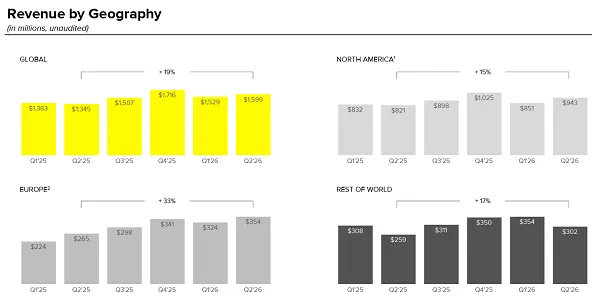
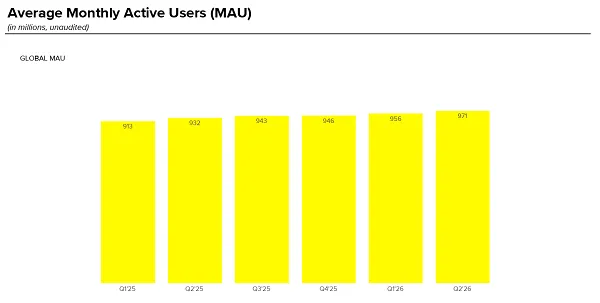
Snap Inc., the parent company of the ubiquitous multimedia messaging app Snapchat, has released its financial results for the second quarter of 2026, painting a complex portrait of an enterprise undergoing profound structural transformation. On the surface, the company demonstrated notable financial resilience. Snap added 10 million net-new daily active users (DAUs) globally quarter-over-quarter, inching ever closer to the coveted milestone of one billion monthly active users. Total revenue for Q2 reached approximately $1.6 billion, reflecting a 4% increase sequentially and a robust 19% year-over-year jump.
However, beneath these top-line metrics lies a web of strategic vulnerabilities. Snapchat’s core Western markets—specifically the United States and the European Union—continue to stagnate or experience declines in user engagement, forcing the platform to rely on developing regions like India for user acquisition. While alternative revenue streams, notably premium offerings like Snapchat+ and the Lens+ subscription tiers, surged by an impressive 85% year-over-year to $316 million, they still account for fewer than 3% of the platform’s active user base, confirming that subscription models cannot yet substitute for traditional advertising.
Compounding these core market challenges is Snap’s impending commercial rollout of its augmented reality (AR) hardware: the next-generation Specs. Carrying a hefty pre-order price tag of $2,195 and facing intense competition from heavily resourced technology titans like Meta and Apple, the hardware division represents an immense financial gamble. With early public reception marred by ergonomic critiques and lukewarm reactions, Snap stands at a critical juncture. The company’s long-term viability will depend on whether it can successfully bridge the gap between stagnant Western ad markets, burgeoning international monetization, and an expensive, high-risk hardware ecosystem.
Detailed Chronology & Financial Breakdown: Q2 2026 Performance
To fully understand Snap’s current position, one must examine the precise trajectories of its user acquisition patterns and revenue streams over the past fiscal periods.
User Acquisition: The Geographic Disconnect
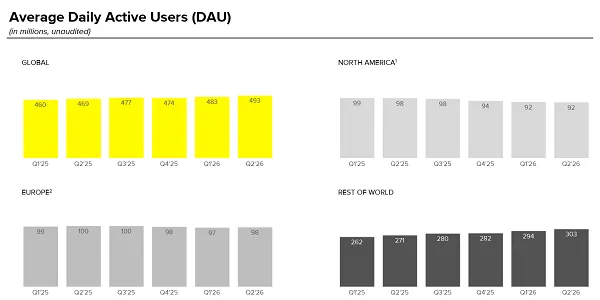
During Q2 2026, Snap’s global daily active user count grew by 10 million quarter-over-quarter. Yet, a geographical dissection of this growth reveals persistent structural challenges. Last quarter, Snap reported concerning contractions in active users across both the U.S. and EU markets. In Q2, this trend stabilized only into stagnation: the U.S. daily audience remained entirely flat, while the European user base hovered near-flat, registering a minor recovery of roughly one million users.
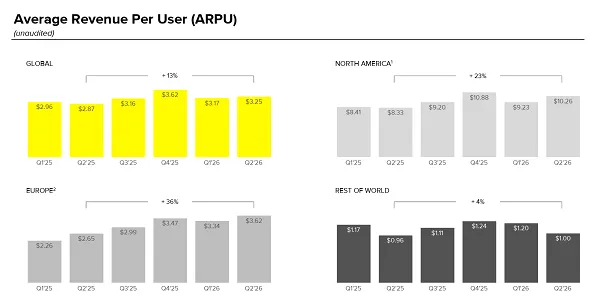
The overwhelming majority of Snap’s net-new users continue to originate from the "Rest of World" category, propelled largely by explosive, sustained adoption in India. While India represents an invaluable reservoir of future digital engagement—highlighted by Snap’s disclosure that local advertisers on the platform multiplied tenfold over the past two years—monetization metrics present a steep hurdle. Historically and currently, Snapchat generates significantly higher Average Revenue Per User (ARPU) in the U.S. and EU than it does across emerging markets. Consequently, the stalling of growth in key Western monetization hubs threatens to compress profit margins even as user counts rise globally.
Revenue Streams and the Rise of Alternative Monetization
Total Q2 revenue hit $1.6 billion, marking a 4% sequential improvement and a 19% increase compared to the same period in 2025. Breaking down these figures reveals divergent paths for Snap’s income vectors:
- Advertising Revenue: Traditional ad revenue grew by a modest 9% year-over-year. While CEO Evan Spiegel noted that recent efforts to rebuild the monetization platform and refine pitches to ad partners have yielded steady results, the single-digit growth rate underscores the difficulties of competing in an increasingly saturated digital advertising economy dominated by Alphabet, Meta, and TikTok.
- Subscription and Other Services: In stark contrast to ad revenue, alternative monetization streams exploded by 85% year-over-year, generating $316 million in Q2. This vertical has been heavily buoyed by the introduction of the Lens+ subscription—which grants users early access to cutting-edge AR and generative AI tools—alongside expanded paid storage options for Snapchat Memories.
Despite this stellar 85% growth rate, an important structural reality remains: fewer than 3% of Snapchat’s monthly active users are paying subscribers. This empirical data reinforces the broader consensus across the tech sector that subscription social media models serve as lucrative auxiliary revenue boosters, but cannot realistically replace programmatic advertising as the foundational bedrock of a major social platform.
Supporting Context & Metrics: Demographic Shifts and Engagement Trends
While overall Western user growth remains flat, Snap has engineered notable wins in specific demographic segments and content verticals that offer strategic glimmers of hope for its advertising partners.
Expanding the Demographic Funnel: The Over-35 Cohort
In his prepared remarks to investors, CEO Evan Spiegel highlighted a quietly promising demographic trend: Snapchat’s audience of U.S. users aged 35 and older is expanding on a quarter-over-quarter basis. Historically typecast as an application strictly for teenagers and Gen Z, an aging and expanding core user base fundamentally alters Snapchat’s value proposition to brand advertisers. Older demographics typically command higher disposable incomes, making them highly attractive targets for high-end retail, automotive, and financial services brands that traditionally bypassed Snapchat in favor of platforms like Instagram or LinkedIn.
The Spotlight Phenomenon: Reversing the Copycat Dynamic
Another major bright spot for the company was the performance of Spotlight, Snapchat’s dedicated, algorithmic short-form video feed designed to rival TikTok and Instagram Reels.
- Creators posting to Spotlight surged by more than 115% year-over-year.
- Spotlight daily active viewers grew by upwards of 20% compared to the previous year.
From a historical perspective, this represents a satisfying role reversal for Snap. A decade ago, in 2016, Instagram famously cloned Snapchat’s pioneering "Stories" format, effectively stalling Snapchat’s meteoric early growth momentum and capturing immense market share. Seeing Snap successfully adopt a similar replication strategy—building a thriving short-form video engine that hooks millions of daily viewers—demonstrates that the platform retains considerable product agility when adapting to modern consumer consumption habits.
Official Statements and Strategic Vision
During the Q2 2026 earnings call, CEO Evan Spiegel outlined the executive team’s overarching philosophy for steering the company through this transitional phase. Emphasizing operational discipline, Spiegel pointed directly to artificial intelligence as the catalyst for systemic improvements across both product utility and monetization efficiency.
"Our objective now is to turn our scale into durable growth and stronger cash generation, while demonstrating the long-term value of our investment in SPECS. We are approaching this work with a more focused, AI-enabled operating model. AI is helping us improve our service faster, deepening engagement and improving outcomes for advertisers. That supports revenue growth, margin expansion, and free cash flow."
Spiegel’s emphasis on an "AI-enabled operating model" points to how Snap is integrating machine learning into its ad-targeting architecture, algorithmic content recommendations, and creator tools. By automating and refining how ads are delivered to the platform’s nearly one billion monthly active users, Snap aims to squeeze higher yields out of its stagnant Western audience base while simultaneously scaling its global footprint.
However, the most consequential and contentious segment of Spiegel’s strategic vision remains explicitly tied to physical hardware: the ongoing, highly expensive gamble on augmented reality via Specs.
Future Outlook: The High-Stakes Gamble on AR "Specs"
If digital advertising and subscription software represent the bread and butter of Snap’s current financial ledger, the company’s hardware division represents an existential high-wire act.
The June Pre-Order Debacle and Hardware Realities
In June 2026, Snap officially opened pre-orders for its latest iteration of AR-enabled glasses, marketed simply as Specs. Priced at a staggering $2,195 for pre-order customers, the hardware launch was immediately met with a lukewarm—and at times openly skeptical—reception from both consumers and tech analysts.
The backlash was not merely philosophical; it was visual and ergonomic. Widely circulated images from the launch event highlighted the bulky, unrefined physical architecture of the glasses, drawing sharp public criticism over how the massive digital frames rested on and punished the wearers’ ears. In an era where consumers expect sleek, wearable technology that seamlessly integrates into daily fashion, Snap’s current hardware design language was perceived by many as overly industrial and uncomfortable.
The David and Goliath Dilemma
Snap’s long-term bet on AR and AI glasses has always been a lightning rod for investor anxiety. The company is attempting to carve out hardware market share while directly competing against hyper-resourced behemoths like Meta and Apple, both of which possess multi-billion-dollar R&D budgets, vertically integrated supply chains, and vastly superior marketing apparatuses.
The official rollout of Specs has only amplified these underlying anxieties. Given the exorbitant $2,195 price tag and the less-than-stellar initial public response, financial analysts widely agree that Specs are unlikely to become a meaningful revenue driver for Snap in the near term. Yet, the development, manufacturing, and marketing of these devices continue to siphon substantial capital, driving up corporate expenditures.
Recognizing these risks, Spiegel noted that Snap intends to carefully pace its financial investments in Specs over time to limit potential corporate losses. Nevertheless, without runaway, unexpected growth in its core advertising business, the heavy capital expenditure required for Specs remains a dangerous vulnerability. If the hardware fails to find a viable, mainstream market fit, it could trigger significant corporate upheaval and force Snap to drastically reevaluate its hardware ambitions.
Conclusion
Snap Inc. enters the second half of 2026 at a fascinating crossroads. The platform boasts impressive resilience, evidenced by climbing total revenues, surging subscription services, a maturing user demographic, and a thriving Spotlight video ecosystem. Yet, these victories are counterbalanced by stubborn realities: stagnant user growth in key Western ad markets, a heavily reliant shift toward lower-ARPU international territories, and an exceptionally risky hardware bet that threatens to drain corporate resources.
The long-awaited launch of Snap’s fully-enabled digital glasses will undoubtedly serve as a watershed moment for the company. Whether it marks the dawn of a revolutionary hardware era or a cautionary tale of overextension will define the legacy of Evan Spiegel’s leadership for years to come.