








Executive Overview
In the modern corporate ecosystem, software is no longer merely a support function; it is the core engine of competitive advantage, operational efficiency, and market disruption. Whether dealing with agile startups or legacy Fortune 500 enterprises, organizations face a perpetual race against time to deploy innovative digital products. However, this urgency collides with a stark, persistent reality: the global technology sector suffers from a severe, structural IT talent gap. Recruiting, vetting, and onboarding elite software engineers internally is an expensive, time-consuming endeavor that can significantly delay time-to-market.
To bypass these internal bottlenecks, businesses of all sizes increasingly turn to software development outsourcing. By partnering with external agencies, companies can instantly scale their engineering capacity, avoid the administrative overhead of salaries and benefits, and accelerate software delivery. Yet, this strategic shortcut is not without its perils. Entrusting mission-critical code and sensitive corporate infrastructure to external teams introduces a distinct matrix of vulnerabilities. From diminished day-to-day project control and complex cybersecurity exposures to the operational trap of vendor lock-in, outsourcing can quickly derail a digital initiative if mismanaged.
Drawing on over 25 years of industry-honed expertise, enterprise software solutions provider Itransition has cataloged the most pervasive pitfalls of software development outsourcing. More importantly, they have formulated a proactive, actionable playbook for risk mitigation. This report offers an exhaustive analysis of the structural challenges inherent in external software development partnerships, outlines rigorous architectural and contractual safeguards, and presents a forward-looking roadmap for organizations seeking to maximize ROI while safeguarding their digital assets.
Detailed Chronology of an Outsourcing Engagement: Lifecycle Risks and Interventions
To fully understand how vulnerabilities manifest in an outsourced software development project, one must examine the typical engagement lifecycle. Risks do not appear out of nowhere; they evolve through distinct phases—from initial contract negotiation and architectural setup to active development, maintenance, and eventual transition or offboarding.
Phase 1: Procurement and Contracting (The Foundation of Control)
The genesis of most outsourcing failures occurs long before a single line of code is written. During the procurement phase, organizations often focus excessively on cost reduction and hourly rates, glossing over governance structures, communication cadences, and intellectual property (IP) rights.
- The Vulnerability: Vague contract terms regarding deliverables and oversight create an immediate deficit in project control. If an enterprise fails to legally secure its IP rights from day one, it risks severe complications should the partnership sour.
- The Intervention: Enterprises must establish rigorous legal frameworks. Contracts must mandate a dedicated Single Point of Contact (SPOC) and define strict reporting schedules. Furthermore, clear IP ownership clauses must explicitly designate all source code, UI/UX layouts, architectural diagrams, and proprietary algorithms as exclusive corporate property of the client.
Phase 2: Onboarding and System Integration (The Security Threshold)
Once the contract is signed, the external team must be integrated into the client’s technological ecosystem. This requires granting third-party developers access to internal middleware, application programming interfaces (APIs), continuous integration and continuous deployment (CI/CD) pipelines, and code repositories.
- The Vulnerability: Unfettered or poorly monitored third-party access is an open invitation for data breaches, credential leaks, and insider threats. Traditional static access controls often result in "permission creep," where external engineers retain high-level system privileges long after their specific tasks are completed.
- The Intervention: Organizations must deploy sophisticated Identity and Access Management (IAM) strategies. This includes incorporating external-facing roles within Role-Based Access Control (RBAC) frameworks, implementing Just-In-Time (JIT) provisioning to automatically revoke expired permissions, and strictly enforcing Multi-Factor Authentication (MFA) across all developer touchpoints.
Phase 3: Active Development and Sprints (Maintaining Visibility)
As development scales, the physical and cultural distance between the in-house stakeholders and the remote outsourcing team can foster operational blindness. Without direct oversight, tracking velocity and spotting code bottlenecks early becomes exceptionally difficult.
- The Vulnerability: Projects drift off schedule and over budget silently. By the time leadership realizes a critical module is failing, deadlines have already been breached.
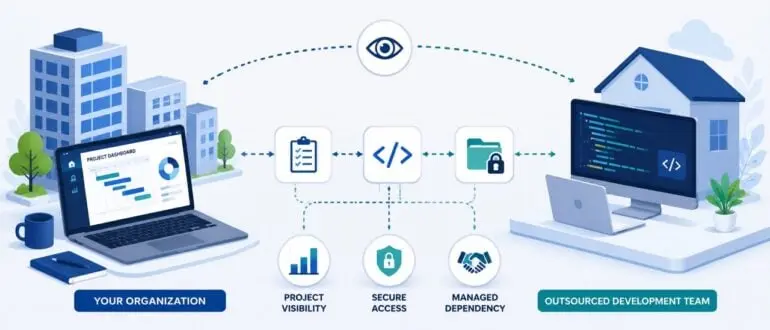
- The Intervention: Transparency must be automated rather than manual. Enterprises should negotiate the integration of automated visibility dashboards that pull real-time data directly from the provider’s toolchain—such as Jira boards, GitHub/GitLab commit logs, and QA tracking systems. Additionally, maintaining living documentation in a shared, client-controlled workspace ensures continuous, evidence-based oversight.
Phase 4: Offboarding or Transition (Escaping Provider Lock-In)
Eventually, every software project reaches a crossroads: either the application is brought back in-house, or the organization decides to switch to a different outsourcing vendor.
- The Vulnerability: Over-reliance on a single vendor creates a high-stakes dependency known as "provider lock-in." If the existing partner holds exclusive knowledge of undocumented code architectures, transitioning becomes prohibitively complex, expensive, and disruptive to business continuity.
- The Intervention: Mitigation requires systematic knowledge transfer. Companies must mandate ongoing collaborative workshops between internal engineers and outsourced teams, maintain a centralized internal knowledge base complete with comprehensive system diagrams, and contractually obligate the vendor to provide structured transition support services for a defined post-termination window.
Supporting Context & Metrics: The Modern Outsourcing Landscape
The global demand for external software engineering talent continues to surge against a backdrop of macroeconomic uncertainty and accelerated digital transformation. Market research underscores that while outsourcing remains a trillion-dollar engine of innovation, the failure rate of poorly managed tech projects continues to exact a heavy toll on enterprise balance sheets.
The Talent Deficit Imperative
According to leading global tech employment barometers, millions of technical roles remain vacant globally, creating a massive supply-demand imbalance. Enterprises face median hiring cycles exceeding 40 days for specialized software engineers, cloud architects, and cybersecurity specialists. For mid-sized businesses, competing with FAANG-level compensation packages is practically impossible. Outsourcing bridges this structural talent gap, allowing businesses to tap into global labor pools instantly.
The Hidden Costs of Mismanagement
However, cost savings achieved during initial contract negotiations can evaporate rapidly if risks materialize:
- Project Delays: Studies on IT project management indicate that over 30% of outsourced projects experience significant schedule overruns due to communication breakdowns and lack of real-time visibility.
- Security Incidents: Verizon and IBM cybersecurity reports consistently highlight that third-party vendors and supply chain partners account for a significant percentage of enterprise data breaches. A single compromised developer credential can expose millions of customer records, leading to catastrophic financial penalties and irrecoverable reputational damage.
- The Lock-In Premium: Organizations locked into proprietary vendor ecosystems often face maintenance cost inflations of 20% to 50% year-over-year because switching providers requires a near-total rewrite of undocumented legacy codebases.
Expert Recommendations & Technical Frameworks
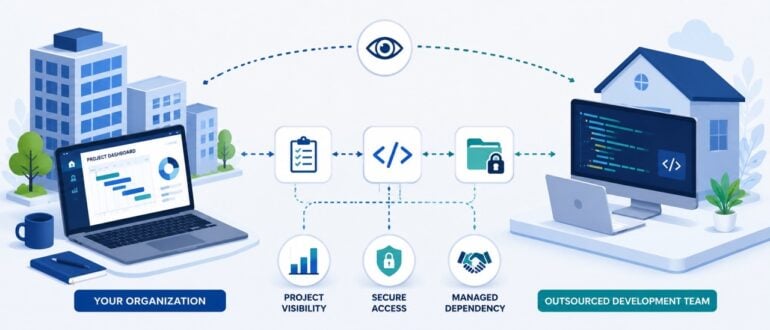
Mitigating the core risks of software development outsourcing—diminished project control, security and privacy vulnerabilities, and provider lock-in—requires a blend of rigorous contract management, modern architectural governance, and cutting-edge security engineering.
1. Reclaiming Control: Governance, Visibility, and SPOCs
To overcome the physical and operational distance inherent in remote work models, organizations must implement structured accountability protocols.
- Dedicated Single Point of Contact (SPOC): Insist that the outsourcing partner assigns an experienced project manager or technical lead to act as the singular communication conduit. Define rigid communication cadences—such as mandatory daily stand-up summaries, bi-weekly sprint reviews, and monthly executive steering committee meetings—directly within the Service Level Agreement (SLA).
- Automated Toolchain Dashboards: Do not rely solely on verbal progress reports or manually compiled slide decks. Require partners to integrate their engineering environments with your observability stack. By pulling metrics directly from Git repositories, CI/CD pipelines, and bug-tracking tools into centralized dashboards (e.g., Datadog, Jira, or custom Grafana panels), stakeholders gain real-time visibility into developer velocity, code churn, and test coverage.
- Shared Documentation Workspaces: Prevent vendor-hoarded knowledge by stipulating that all artifacts—including architectural blueprints, database schemas, wireframes, and API documentation—must reside in a client-owned, continuously updated workspace (such as Confluence, Notion, or private cloud storage).
2. Fortifying the Perimeter: Advanced Security and Identity Governance
Giving external contractors access to internal corporate machinery is inherently dangerous. This exposure must be strictly managed through modern zero-trust principles.
- Role-Based Access Control (RBAC) Granularity: Never grant blanket administrative access to external developers. Extend your IAM framework to include dedicated external-facing security profiles (e.g.,
Partner_Developer,QA_Contractor). Ensure these roles adhere strictly to the Principle of Least Privilege (PoLP), restricting access solely to the specific development environments, staging clusters, or microservices required for the assigned sprint. - Just-In-Time (JIT) Provisioning: Eliminate persistent high-level access. Implement automated JIT provisioning tools that grant external developers elevated permissions only when explicitly requested for a specific deployment or debugging session. Configure these permissions to automatically expire and revoke themselves after a predefined window (e.g., 4, 8, or 24 hours).
- Mandatory Multi-Factor Authentication (MFA): Enforce robust cryptographic MFA requirements for all external accounts accessing internal source code repositories, VPNs, or staging servers. Utilize hardware tokens or advanced authenticator app verifications to neutralize credential-stuffing and phishing attacks targeting remote engineering staff.
3. Preserving Independence: Defeating Provider Lock-In
An enterprise must maintain ultimate sovereignty over its software products, ensuring that it can pivot, scale, or repatriate development at a moment’s notice.
- Air-Tight Intellectual Property (IP) Clauses: Collaborate with legal counsel to draft unambiguous IP assignments. The contract must explicitly state that all custom code, derivative works, UI/UX designs, database schemas, and AI models generated during the engagement are "work made for hire" and belong exclusively to the client. This eliminates leverage disputes should you decide to sever ties.
- Continuous Knowledge Transfer and Internal Upskilling: Avoid total dependency by pairing outsourced developers with internal engineering counterparts. Institute mandatory code review sessions, architectural walk-throughs, and pair-programming events. This guarantees that your in-house team remains deeply familiar with the codebase, mitigating the risk of institutional brain drain.
- Contractual Exit and Transition Support: Negotiate an explicit "Wind-Down and Transition" clause into the original contract. This provision should legally obligate the outgoing vendor to provide a designated period of post-termination transition support (e.g., 60 to 90 days of dedicated engineering hours) to assist your team—or a newly appointed replacement agency—in executing a seamless handover without service interruptions.
Future Outlook: The Evolution of Outsourcing in an AI-Driven Era
As the software development landscape continues to evolve, the dynamics of outsourcing are undergoing a profound transformation. The rapid maturation of Generative AI, automated code generation tools, and hyper-distributed cloud development environments is reshaping how enterprises collaborate with external partners.
Looking ahead over the next decade, successful software outsourcing will no longer be measured merely by headcount augmentation or cheap hourly rates. Instead, the paradigm is shifting toward strategic technological co-creation. Enterprises will increasingly seek outsourcing partners that possess specialized domain expertise in cutting-edge verticals—such as artificial intelligence integration, machine learning pipelines, blockchain architecture, and advanced cloud-native security.
Furthermore, the rise of AI-powered developer assistants means that engineering velocity will accelerate even further, making automated visibility and rigorous governance more critical than ever. Organizations that fail to implement robust access controls and real-time observability will find themselves drowning in rapidly generated codebases that they neither understand nor fully control.
Ultimately, software development outsourcing remains an indispensable lever for scaling business innovation in a competitive global economy. However, it requires a sophisticated, proactive management approach. By partnering with battle-tested industry veterans—such as Itransition—and diligently implementing comprehensive frameworks for control, security, and independence, modern enterprises can successfully harness external engineering power while immunizing themselves against operational vulnerabilities. The future belongs to organizations that treat their outsourcing partners not as anonymous offshore sweatshops, but as deeply integrated, strategically governed extensions of their core business enterprise.