









Executive Overview
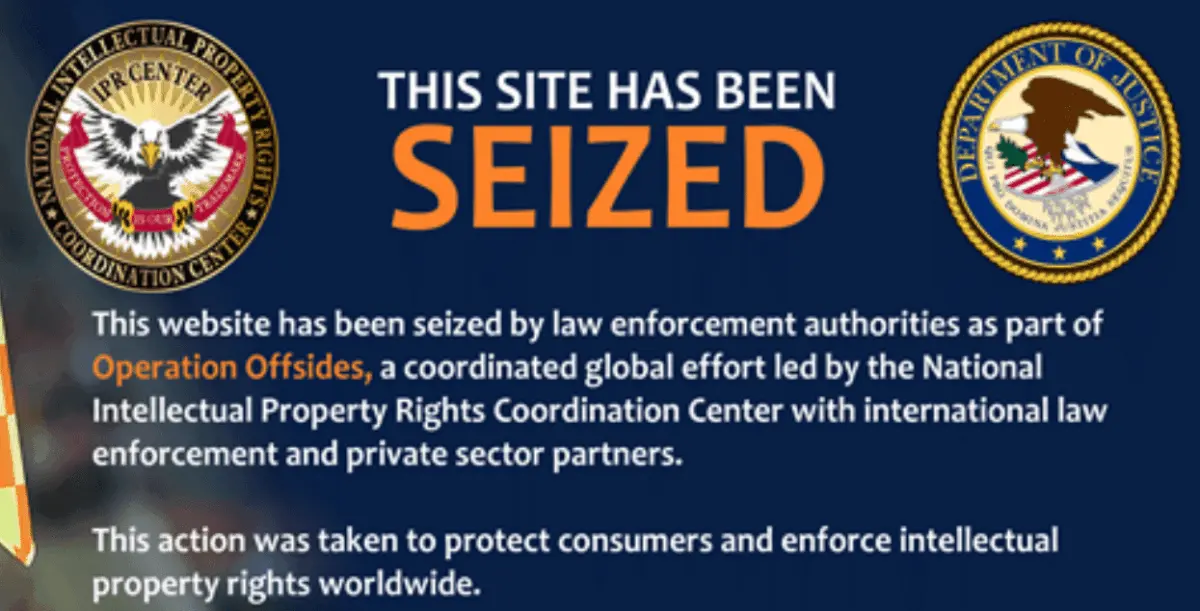
In the high-stakes world of global digital enforcement, "Operation Offsides" was hailed as a watershed moment. Deployed during the height of the FIFA World Cup, the coordinated international crackdown represented the largest sports piracy disruption ever executed around a single global event. Driven by a coalition of U.S. law enforcement agencies, international partners, and the Alliance for Creativity and Entertainment (ACE)—the anti-piracy arm of the Motion Picture Association (MPA)—the operation successfully seized over 1,000 pirate streaming domains, while international partners blocked nearly 2,000 more across Latin America.
Yet, beneath the victory laps and celebratory press releases lies a startling admission. In a joint op-ed published by MPA Chairman and CEO Charles Rivkin and IPR Center Director Ivan Arvelo, the architects of Operation Offsides candidly admitted that domain seizures are no silver bullet. While the seized platforms had collectively amassed an astonishing 156 million visits in July alone before being driven offline, the operation ultimately failed to dismantle the underlying criminal syndicates operating them.
As law enforcement agencies sever the heads of these hydra-like networks, new heads immediately sprout abroad. Pirate operators have begun migrating their infrastructure to foreign jurisdictions insulated from Western enforcement. Brands like Buffstreams, Footybite, Totalsportek, and Nflbite have found safe harbor utilizing Iran’s .ir country-code top-level domain (ccTLD). Meanwhile, massive independent platforms like Futbol-libres continue to operate with impunity from Soviet-era .su registries managed out of Russia—surpassing the traffic of all U.S.-seized domains combined.
This evasion has catalyzed a renewed, aggressive push by the entertainment industry for U.S. federal site-blocking legislation. As lawmakers on Capitol Hill inch closer to a bipartisan, bicameral copyright enforcement framework, the battle lines are drawn. The debate over whether the United States should adopt European-style site-blocking mandates is no longer theoretical; it is an urgent legislative crusade fueled by the geopolitical realities of cross-border cybercrime.
Detailed Chronology: Anatomy of Operation Offsides and Its Aftermath
The genesis of Operation Offsides traces back to the exponential growth of live sports streaming piracy. As traditional cable packages declined and major sports leagues fractured across a dizzying array of expensive subscription-based streaming services, consumer frustration skyrocketed. Unauthorized, ad-supported aggregation sites quickly filled the void, offering a seamless, all-in-one viewing experience for millions of global sports fans.
Recognizing the existential threat this posed to the economic models of sports broadcasters and entertainment conglomerates, the U.S. government and private rights holders orchestrated a massive, preemptive counter-offensive timed directly to coincide with the FIFA World Cup.
Phase 1: The World Cup Crackdown
From the opening whistle of the tournament to the final match, U.S. law enforcement authorities—working in tandem with the National Intellectual Property Rights Coordination Center (IPR Center) and international bodies—unleashed a wave of seizures.
- The Numbers: Over 1,000 domain names associated with unauthorized sports streaming were seized by U.S. authorities. Concurrently, regional partners across Latin America blocked nearly 2,000 additional URLs.
- The Traffic Interruption: According to metrics cited by the MPA, the targeted domains were economic powerhouses, pulling in more than 156 million consumer visits during the single month of July.
For a brief window, the operation paralyzed the commercial momentum of the web’s most prominent sports piracy hubs. Rights holders breathed a sigh of relief, praising the unprecedented level of cross-agency cooperation and intelligence sharing.
Phase 2: The Resiliency and Migration Phase
However, digital infrastructure is inherently fluid. Within weeks of the initial wave of seizures, investigative monitoring revealed that agile piracy syndicates had anticipated the blow. Rather than folding their operations, major streaming brands began activating contingency plans, systematically shifting their traffic to alternative domain extensions and foreign hosting providers specifically chosen to frustrate Western legal channels.
By mid-summer, platforms that had lost their primary .com or .net addresses were actively redirecting users to fallback domains rooted in geopolitical hot spots. This included a notable migration toward Iran’s .ir domain registry—an infrastructure functionally immune to traditional U.S. legal process, given the complete absence of diplomatic and cooperative law enforcement channels between Washington and Tehran.
Concurrently, platforms that never relied on Western-controlled registries continued business as usual. A prime example is Futbol-libres, which utilized the legacy .su (Soviet Union) domain registry—currently administered from Russia. Operating entirely outside the reach of U.S. subpoenas, this single domain network drew over 200 million visits in July alone, eclipsing the traffic volume of every single domain seized during Operation Offsides combined.
Supporting Context & Metrics: The Scale of the Underground Economy
To understand why domain seizures alone are insufficient, one must examine the macroeconomics of modern digital piracy. Modern pirate streaming is no longer a cottage industry run by individual tech enthusiasts in basements; it is a sophisticated, highly profitable enterprise backed by automated ad networks, cryptocurrency payment gateways, and redundant cloud architectures.
Traffic Comparison: Seized vs. Evasion Infrastructure
| Metric Category | Operation Offsides (Seized Domains) | Major Evasion Networks (e.g., .su & .ir) |
|---|---|---|
| Total Domains Impacted | 1,000+ U.S. / 2,000+ Latin America | Dozens of resilient fallback domains |
| Monthly Traffic (July Peak) | ~156 Million Visits | 200 Million+ Visits (Futbol-libres alone) |
| Primary Jurisdictions | U.S. Registry / Global CDN | Iran (.ir), Russia (.su), Offshore Safe Havens |
| Operational Impact | Temporary disruption of user access | Zero operational downtime; automated redirection |
The Mechanics of Evasion
The ease with which pirate networks pivot highlights a structural flaw in domain-name-only enforcement. When a domain is seized by the Department of Justice or Homeland Security Investigations (HSI), a seizure warrant banner replaces the original site. However, backend operators maintain duplicate databases, DNS configurations, and video-streaming content delivery networks (CDNs) hosted on bulletproof servers in jurisdictions with lax copyright enforcement.
Within hours—sometimes minutes—of a seizure, operators update their social media channels, Telegram groups, and affiliate marketing partnerships with new URLs. Consumers, conditioned to find free sports streams, simply click the new link. The business model remains entirely intact, generating continuous revenue streams from predatory online gambling advertisements, malware distribution banners, and subscription-based VIP tiers.
Official Statements: The Shift in Rhetoric from the MPA and IPR Center
The most telling development in the wake of Operation Offsides is not the technical evasion tactics of the pirates, but the public acknowledgment of these limitations by enforcement leaders themselves.
In their joint op-ed published in RealClearMarkets, titled "Blowing the Whistle on World Cup Piracy," MPA Chairman and CEO Charles Rivkin and IPR Center Director Ivan Arvelo offered an uncharacteristically sober assessment of the war on digital copyright infringement.

"A takedown is essential, and it can interrupt access for a moment. But it does not dismantle the business behind it," Rivkin and Arvelo wrote.
This candid appraisal marks a strategic pivot in public relations and policy advocacy for the entertainment industry. For years, major copyright lobbies portrayed large-scale domain seizures as definitive knockout blows. By shifting the narrative to emphasize that seizures are merely temporary speedbumps, the MPA is laying the groundwork for more aggressive, systemic legislative interventions.
Larissa Knapp, the MPA’s Executive Vice President and Chief Content Protection Officer, elaborated on this evolving multi-vector strategy in statements to TorrentFreak:
"Piracy operators regularly move domains and infrastructure in an effort to evade enforcement. The migration to .ir domains is another example of that tactic, but changing a domain does not put an illegal operation beyond reach," Knapp asserted.
She emphasized that while domain shifting is a constant challenge, pirate networks are still tethered to vulnerabilities in the physical and commercial world:
"These services still depend on identifiable operators, hosting, distribution, payment systems, and other technical and commercial infrastructure. That is why ACE works closely with law enforcement and industry partners around the world to identify and disrupt the people and infrastructure that keep these criminal networks operating."
Despite these broader investigative vectors targeting payment processors and cloud providers, the core vulnerability remains: as long as internet service providers (ISPs) and domestic networks are forced to connect users directly to foreign-hosted pirate domains without real-time filtering, the pirates hold the tactical advantage.
Future Outlook: The Legislative Push for U.S. Site-Blocking
Faced with the reality of Iranian fallback domains, Russian .su registries, and endless domain permutations, copyright holders and federal enforcement partners have arrived at a unified conclusion: U.S. law must evolve.
The culmination of the MPA and IPR Center’s op-ed is a direct, unambiguous policy demand: judicial site blocking in the United States.
The Global Precedent vs. The U.S. Lag
While nearly 60 countries worldwide—including the United Kingdom, Australia, Canada, and much of the European Union—have established legal frameworks allowing rights holders to obtain court orders requiring ISPs to block access to blatantly infringing domains, the United States has stubbornly lagged behind. Historically, domestic efforts to introduce site-blocking legislation (most notably the catastrophic political battles over SOPA/PIPA in 2012) met fierce resistance from civil liberties groups, tech giants, and open-internet advocates who warned of mission creep, censorship, and overblocking.
However, the political winds in Washington are shifting.
Momentum on Capitol Hill
On June 30, the House Intellectual Property subcommittee convened a pivotal hearing on online copyright enforcement. During the proceedings, Rep. Darrell Issa—Chairman of the subcommittee—signaled that a bipartisan, bicameral agreement on site-blocking legislation was closer than it had been in over a decade.
Lawmakers are increasingly viewing commercial sports piracy not merely as a civil copyright dispute, but as a multi-billion-dollar transnational crime wave that drains tax revenues, compromises consumer cybersecurity through malware-laden streaming portals, and enriches illicit networks operating in hostile foreign states.
The Looming Battle Over Overblocking and Evasion
As a unified U.S. site-blocking bill prepares to enter the legislative pipeline, it will undoubtedly reignite fierce debates over digital rights. Critics and technology advocates will raise valid concerns regarding overblocking—instances where legitimate sites or IP addresses are inadvertently restricted by clumsy filtering mechanisms.
Furthermore, even if the U.S. successfully implements judicial site-blocking mandates, the technological arms race will continue. Just as European streaming pirates quickly bypassed ISP blocks by utilizing encrypted DNS (DoH), VPNs, and alternative browser configurations, savvy operators will adapt to American firewalls.
Conclusion
Operation Offsides proved that global law enforcement can successfully strike at the infrastructure of digital piracy on an unprecedented scale. Yet, it also exposed the profound limits of fighting a borderless digital phenomenon with localized jurisdiction. As pirate syndicates retreat behind the geopolitical shields of Iranian .ir extensions and Russian .su registries, the message from the MPA and the IPR Center is clear: domain seizures were only phase one. The future of global anti-piracy enforcement will be fought in the halls of Congress, where the outcome of the impending site-blocking legislative battle will determine whether the United States can finally seal its digital borders.