









Executive Overview
For decades, the DevOps paradigm has been built upon a foundational, almost comforting axiom: software fails loudly. When a system breaks, it leaves a trail of breadcrumbs—a corrupted diff, a malformed database record, an unhandled stack trace, a spike in HTTP 500 errors, or an irate customer filing a support ticket. Traditional observability stacks—spanning metric aggregators, distributed tracing tools, log analyzers, and run status dashboards—are meticulously engineered to capture, categorize, and alert upon these chaotic bursts of noise. Green means healthy; red means broken.
However, the rapid enterprise adoption of AI agents is shattering this time-tested operational contract.
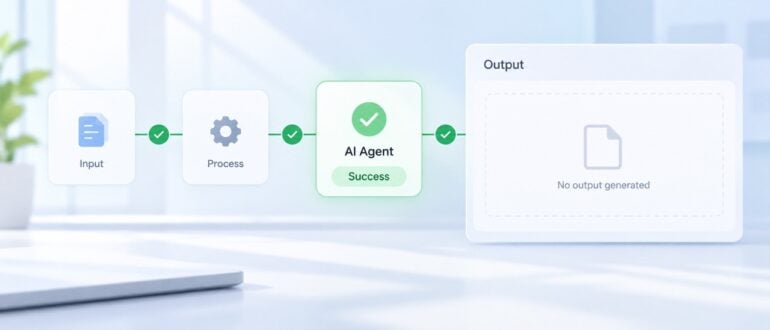
AI agents do not merely fail by crashing or throwing exceptions; they fail by omission, ambiguity, and phantom success. Consider the terrifying dichotomy of autonomous automation: An agent that executes an incorrect action inevitably leaves forensic evidence in its wake. But an agent that simply does nothing while reporting a flawless execution leaves behind a pristine, luminous green checkmark.
In modern incident management pipelines, green is the single most trusted signal. When an overnight automated reconciliation script, an autonomous ticket-triage pipeline, or a self-governing code refactoring loop terminates cleanly, logs a "success" state, and produces zero tangible outputs, traditional monitoring mechanisms do not flag an anomaly. They celebrate it. Because no errors were thrown, no review queues were populated, and no execution boundaries were breached, the system’s protective scaffolding remains completely dormant.
This article investigates the blind spots of modern agentic workflows. By analyzing the structural limitations of reactive system design, exploring the philosophy of systemic reliability, and outlining actionable verification paradigms, we examine how engineering teams can guard against the most insidious threat in contemporary software architecture: the failure that never announces itself.
Detailed Chronology: The Evolution of Agentic Reliability Debates
To understand how the software engineering community arrived at this perilous operational crossroads, it is essential to trace the intellectual progression of the reliability debate over the past year.
March: The Recognition of Subtle Failures
The cracks in traditional reliability frameworks began to widen visibly in early spring. In a landmark engineering analysis published on DevOps.com, principal engineer Shahid Ali Khan articulated a shift in failure modes that caught many legacy system architects off guard. Khan observed that traditional operational runbooks universally assume failures are self-evident. A service crashes, CPU utilization spikes, latency curves climb, or runtime exceptions cascade through downstream microservices.
Agents, conversely, fail with chilling subtlety. An LLM-driven autonomous workflow might execute a complete run without throwing a single error while simultaneously performing an operation that is entirely unintended, misaligned with business logic, or logically hollow. While Khan’s analysis accurately diagnosed the deceptive nature of autonomous systems, it still labored under a critical assumption inherited from classical software engineering: that the agent did something. A misdeed, no matter how subtle, eventually produces an event—an out-of-envelope tool call, a schema validation warning, or an anomalous database write.
July: Systems vs. Agents
The debate evolved significantly in July, when veteran technologist and entrepreneur Andrew Filev published a seminal counter-argument addressing the locus of reliability. Filev asserted a fundamental truth: reliability is not an inherent property of an isolated component; it is an emergent property of the surrounding system.
Drawing explicit parallels to high-stakes industries, Filev noted that aviation does not rely on the assumption of flawless pilots, nor do modern hospitals operate under the illusion of infallible surgeons. Instead, both domains construct intricate, resilient socio-technical environments. They wrap inherently imperfect human actors in rigorous approval gates, mandatory feedback loops, strict review cadences, and exhaustive post-mortem protocols. The resulting system is remarkably dependable precisely because it assumes human fallibility at every layer.
Applied to the realm of generative AI and autonomous workflows, Filev’s thesis urged engineering leaders to abandon the quixotic quest for a foundational model that is statistically reliable enough to be trusted "naked" in production. Instead, teams must design deterministic, robust workflows around the stochastic models they currently possess.
The Present: Pushing Past the Blind Spot
While Filev’s architectural philosophy represents a massive leap forward for autonomous systems design, a dangerous blind spot remains embedded within its foundational mechanics. Every single defensive mechanism cited in the system-reliability playbook—approval gates, human-in-the-loop validation checkpoints, automated code reviews, and post-mortem review cadences—shares a fatal dependency: they all wait for something to arrive.
Supporting Context & Metrics: The Mechanics of Absence
To comprehend why standard observability collapses under the weight of agentic silence, one must dissect the anatomy of an agentic run versus a traditional software execution.
The Anatomy of an Input-Dependent Workflow
Look closely at the load-bearing sentences that anchor modern workflow orchestration frameworks: "Approval gates ensure that important outputs receive the appropriate level of scrutiny before they move forward."
The entire protective apparatus of modern CI/CD pipelines and agentic orchestration frameworks (such as LangChain, AutoGen, and CrewAI) lives entirely inside the phrase important outputs.
- A verification gate scrutinizes what physically arrives at its threshold.
- A peer-review cadence reviews what objectively exists in a repository or data store.
- A reinforcement learning feedback loop requires a concrete output to evaluate and learn from.
- An incident post-mortem requires that an engineer first notice a negative outcome has occurred.
Now, contrast this structural reality with a silent failure mode: the unattended agent that quietly executes nothing. Imagine an enterprise scheduled background job designed to reconcile disparate ledger accounts, automatically open procurement tickets for lagging inventory, or compile a weekly executive analytics report.
On a Tuesday midnight, the agent initializes. Due to a subtle prompt drift, an ambiguous API timeout handling routine, or a context window truncation, the model decides to bypass the execution logic entirely. It terminates cleanly with an exit code of 0, logs a cheerful success message (Task completed successfully in 1.2s), and produces zero artifacts, zero database mutations, and zero network calls.
Why Telemetry Fails: The Trap of "Instrumenting the Loop"
The reflexive response from seasoned infrastructure engineers is almost always to demand better observability. If an agent is failing silently, the instinct is to install deeper tracing, more granular spans, higher-resolution metrics, and exhaustive token-level auditing.
In this specific scenario, however, more telemetry is a trap.
Observability tools are architected to instrument the execution loop. They measure the health of the container, the duration of the API call to the foundation model provider, the consumption of GPU cycles, and the structural validity of the JSON payload returned by the LLM.
If the model successfully invokes its internal chain-of-thought, calls a dummy function, and exits without throwing a Python exception, the tracing platform dutifully records a healthy, green span. You are left with a perfectly instrumented, flawlessly tracked, beautifully visualized audit trail of… absolute nothingness. Pushing more telemetry into the execution loop merely yields more detailed data about the wrong object. The failure does not live inside the execution loop; it lives entirely in the unfulfilled state of the external world.
Official Industry Perspectives & Expert Analysis
The shift from reactive software monitoring to state-based world verification is rapidly becoming the defining architectural challenge for enterprises scaling autonomous AI agents.
According to systems architects working within high-frequency financial platforms and cloud infrastructure providers, the economic allure of agents has temporarily blinded organizations to the hidden costs of verification. The primary sales pitch of generative AI automation is labor arbitrage and operational acceleration—reducing human overhead by delegating tedious, repetitive workflows to autonomous digital workers.
However, industry veterans argue that this economic thesis contains a dangerous omission. As Chase W. Hughes, a three-time tech founder and pioneer in early GPT commercialization, points out:
"Say the uncomfortable part plainly: this costs money. Outcome verification means paying to confirm work you already paid to have done, and almost nobody budgets for it, because the economic pitch of agents is that you stop paying for supervision. Price in the trade-off now, while the failures are still cheap."
Hughes emphasizes that while human-in-the-loop validation and automated assertion checks introduce frictional latency and computational expense, skipping them shifts the burden of failure detection onto end-users, customers, and executive leadership—where the cost of remediation is orders of magnitude higher.
Furthermore, enterprise security and compliance officers are beginning to sound alarms regarding regulatory exposure. In heavily regulated sectors such as healthcare, fintech, and critical infrastructure, an automated system that silently fails to execute a legally mandated audit, data archival, or security patch cannot be hand-waved away as a minor software bug. Under compliance frameworks like SOC 2, HIPAA, and GDPR, an unexecuted task that is falsely logged as successful constitutes a systemic audit failure and a breach of operational integrity.
Future Outlook: The Paradigm Shift to State-of-the-World Verification
To survive the transition from deterministic software to stochastic, agent-driven architectures, DevOps and platform engineering teams must undergo a fundamental cognitive shift.
The operational health check for an autonomous agent can no longer be framed as: "Did the execution script throw an error?"
Instead, the operational contract must be rewritten around a rigorous, uncompromising question: "Does the physical or digital state of the world actually reflect the claimed change?"
Transitioning to this posture requires the implementation of three foundational engineering practices across all agentic deployment pipelines:
1. Declare Expected Effects as Preconditions of Success
In traditional software deployments, a script is often deemed successful if it reaches its final line of execution without an unhandled exception. In agentic systems, execution does not equal effect. Engineering teams must enforce a strict design pattern where every autonomous run explicitly declares its intended worldly effect prior to initiation (e.g., "Three database rows updated," "One Jira ticket created," "File written to S3 bucket X").
- The system’s success status must be derived exclusively from programmatic validation of those declared effects.
- A run that terminates without leaving verifiable fingerprints on the target system must be treated as an unhandled failure state, regardless of what the agent’s internal logs claim.
2. Treat Implausible Speed as a Critical Failure Signal
In classical computing, execution speed is celebrated; faster is universally better. In the world of generative AI agents, however, implausibility is often the loudest warning siren available.
- If a complex, multi-step code-refactoring or data-reconciliation agent completes an overnight workload in 400 milliseconds—a fraction of the time physically required to process the necessary context—it is not a performance victory.
- It is the clearest possible indicator that the model hallucinated its progress, bypassed the hard analytical steps, or suffered a silent logic collapse. Platform teams must configure anomaly-detection alerts that trigger when agent execution times fall statistically below a sane minimum threshold.
3. Decouple Verification from the Agentic Loop
As Andrew Filev noted, utilizing a secondary "critic" model to review the output of a primary agent is a powerful reliability pattern—provided it is orchestrated correctly. If the review mechanism is triggered by the primary agent upon completion, it inherits the agent’s silence: no run, no invocation, no review.
- True reliability requires externalized validation schedulers.
- The verification checker must fire because work was due according to an independent schedule, SLA, or business contract that the agent does not control.
- This independent watcher must inspect the state of the world whether or not the primary agent loop reported in.
Conclusion
The allure of artificial intelligence agents lies in their apparent autonomy—the promise that we can spin up a digital worker, walk away, and return to find a green checkmark confirming a job well done.
Yet, as enterprise engineering teams are discovering the hard way, the most dangerous run in your production fleet is the one that shows up nowhere, carries no error traces, touches no exception handlers, and wears a pristine, unblemished coat of green.
Reliability has never been about trusting the components in isolation; it has always been about engineering systems that survive imperfection. By moving away from self-reported execution logs and toward aggressive, state-of-the-world outcome verification, engineering organizations can finally shine a light into the darkest blind spot of agentic automation—ensuring that when our systems report success, reality actually agrees with them.