







Executive Overview
The landscape of internet governance and digital civil liberties is currently being redrawn in the courtrooms of Paris. At the center of this high-stakes battle is Quad9, a Swiss-based non-profit public DNS (Domain Name System) resolver renowned for its rigorous defense of user privacy and internet security. For well over a year, French courts have increasingly leveraged multi-intermediary anti-piracy injunctions, forcing recursive DNS providers to act as censors against unauthorized sports streaming websites.
While some major infrastructure providers chose to retreat—such as OpenDNS, which completely suspended its services in France following the initial wave of judicial mandates—Quad9 chose to dig in its heels. However, this principled stance has placed the non-profit on a collision course with multi-billion-dollar sports broadcasters.
In May, the Paris Judicial Court ordered Quad9, alongside Google and the DNS4EU operator Whalebone, to block dozens of domains broadcasting unauthorized WTA tennis matches at the behest of media giant beIN Sports. Strikingly, Quad9 has made a conscious, deliberate choice: it has not blocked a single domain on that list.
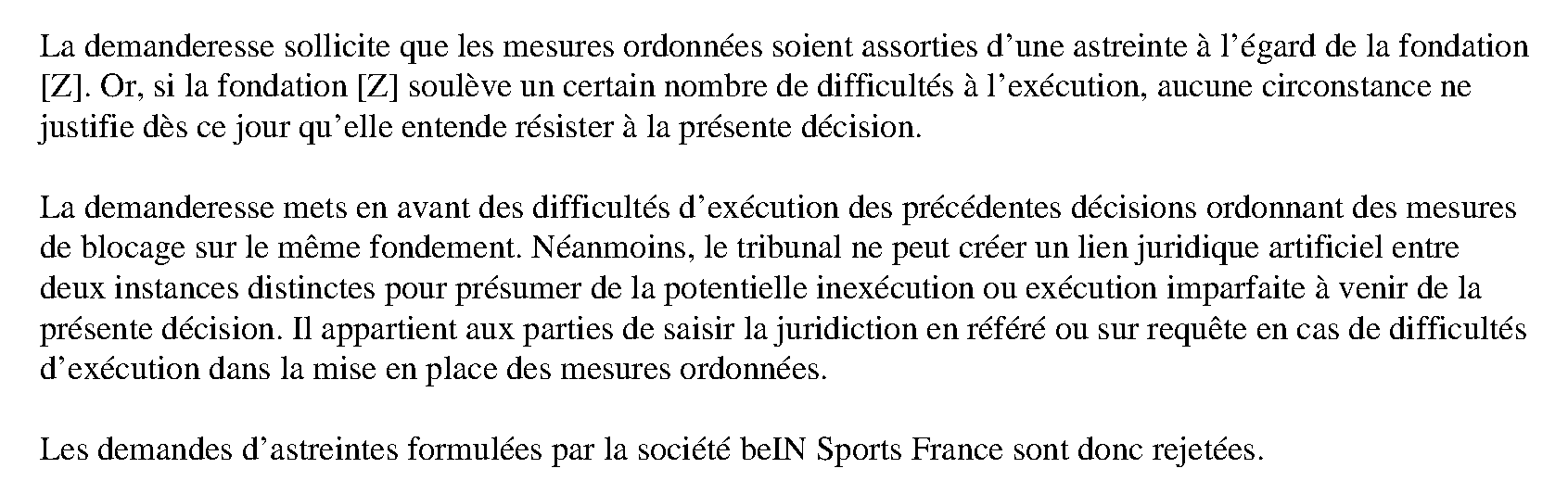
This act of civil disobedience has now reached a boiling point. Frustrated by Quad9’s ongoing defiance, beIN Sports has returned to the Paris Judicial Court demanding crippling financial penalties. The broadcaster is seeking a penalty of €10,000 per domain, per day. Across the 58 domains currently targeted under the injunction, this amounts to a staggering €580,000 per day—a figure that threatens to bankrupt the non-profit foundation within weeks.
As the Paris court prepares to issue its ruling, the conflict has evolved far beyond a routine copyright dispute. It has triggered profound questions about the technical limits of DNS architecture, the overreach of national jurisdiction into global internet infrastructure, and the unintended security consequences of weaponizing the foundational routing mechanisms of the web.
Detailed Chronology of the French Legal Battle
The 2024 Catalyst and the Flight of Competitors
The French legal offensive against public DNS resolvers began in earnest in 2024. Armed with broad judicial interpretations aimed at curbing the unauthorized digital distribution of premium sports content, French rights-holders and broadcasters—most notably Canal+ and beIN Sports—began securing multi-intermediary site-blocking orders. These injunctions shifted the burden of copyright enforcement away from Internet Service Providers (ISPs) and onto alternative recursive DNS providers whose services are freely utilized by privacy-conscious netizens globally.
The immediate fallout fractured the provider ecosystem. OpenDNS, recognizing the untenable operational and legal liabilities of complying with localized jurisdiction orders from a global platform, opted to suspend its operations in France entirely in mid-2024. Quad9, bound by its mission to provide secure, privacy-respecting DNS resolution worldwide, chose a different path. The Swiss foundation announced its intention to fight the orders legally, arguing that forcing global resolvers to enforce localized censorship creates insurmountable technical and architectural paradoxes.
The May Injunction and the Expanding Target List
Despite ongoing legal resistance, the legal pressure intensified. In May, the Paris Judicial Court issued a sweeping ruling requiring Google, Whalebone (operating DNS4EU), and Quad9 to block pirate streams of Women’s Tennis Association (WTA) matches.
The injunction, initiated by beIN Sports, began with a modest list of six domains. However, due to the dynamic nature of modern piracy—where mirror sites and domain-generation algorithms rapidly shift traffic—subsequent administrative updates quickly bloated the list. According to Quad9’s internal accounting, 52 additional domains were tacked on through two subsequent updates, bringing the total tally of blocked targets to a formidable 58.
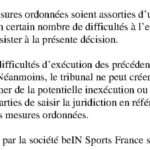
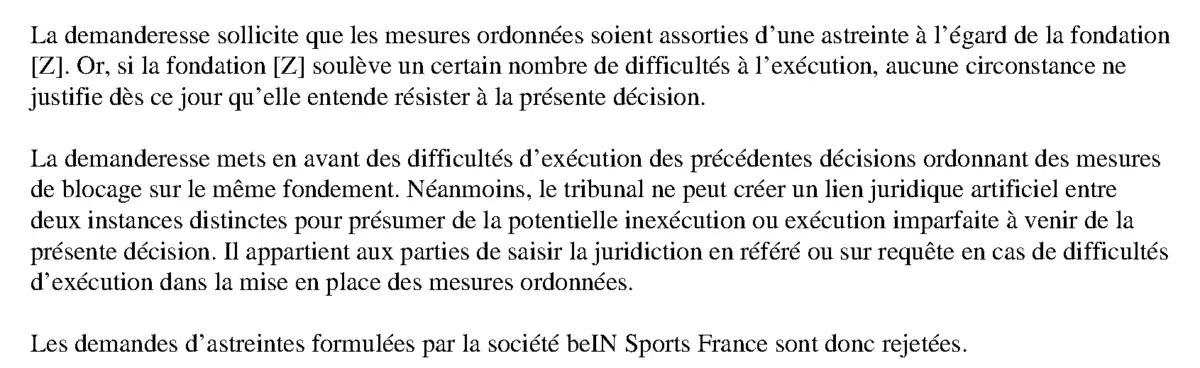
When the court initially weighed beIN’s request, the broadcaster pushed for immediate financial teeth, asking for a penalty of €2,000 per domain per day specifically targeted at Quad9. At that stage, the Paris court exercised caution. It declined beIN’s request for immediate punitive fines, noting in its written judgment that there was insufficient evidence at the time to prove Quad9 intended to actively resist the court’s mandate ("entendre résister"). The court left the door open for the broadcaster to return should compliance failures materialize.

beIN Returns for Ruinous Penalties
True to that judicial opening, beIN Sports has returned to the Paris Judicial Court to seek blood. Having monitored Quad9’s continued refusal to implement the blocks, the broadcaster escalated its financial demands exponentially.
Quad9 confirmed to researchers and journalists that beIN is now pursuing €10,000 per domain, per day. Multiplied across the expanded list of 58 domains, the total exposure reaches €580,000 per day. If upheld by the court, these penalties would accumulate into the millions of euros per week—a catastrophic financial blow for a non-profit foundation operating on lean margins.
The case was argued before the Paris court, with a definitive ruling anticipated within weeks. Because these penalties would apply retroactively from the moment the initial order was handed down, the financial sword of Damocles hanging over Quad9 is existential.
Technical Realities: The DNS Blocking Dilemma
At the core of Quad9’s defiance is not a philosophical disagreement with copyright law, but an intractable technical reality: recursive DNS resolvers are fundamentally incapable of executing localized geographic blocking accurately without breaking global internet architecture.
The Impossibility of Defining a "French User"
To comply with the French court order, Quad9 would need to restrict the DNS blocks exclusively to users physically located within the borders of France. However, as a global public recursive resolver, Quad9 does not collect identifying user data, personal logs, or IP histories, adhering strictly to privacy-by-design principles.
To determine whether a query originates from France, Quad9 would have to rely entirely on third-party GeoIP databases—commercial repositories that map IP addresses to geographic locations. Quad9 and numerous network engineers have long maintained that these databases are notoriously plagued by inaccuracies, latency gaps, and frequent misallocations.
"There is no legally useful way for us to define a French user," Quad9 representatives noted, highlighting the legal trap of relying on flawed geolocation metrics to avoid six-figure daily fines.
This is not a theoretical concern for the foundation. Quad9 previously lived through a nearly identical nightmare in Germany, where Sony Music dragged the DNS resolver to court over pirate site blocking. In that initial German proceeding, lower courts ruled that Quad9’s technical attempts to limit blocks to German users were insufficiently precise. Although Quad9 ultimately scored a landmark victory on appeal in late 2023, the underlying technical precedent remained: imperfect geographic filtering exposes infrastructure providers to immense legal liability.
The Global-Block Trap vs. Selective Enforcement
Faced with the impossibility of precise geographic filtering, Quad9 has two remaining choices under traditional compliance models:
- Global Blocking: Block the targeted domains worldwide. This effectively allows a French civil court to dictate what internet users in Tokyo, New York, or Buenos Aires can access, turning local judicial orders into global censorship mandates.
- Geographic Surrender: Cease providing recursive DNS services in France altogether, following OpenDNS’s playbook.
While Quad9 briefly implemented global blocking under extreme duress in Germany during 2023—treating it strictly as a temporary, litigation-period safeguard—it has refused to replicate that approach in France. The foundation argues that the conditions of each jurisdiction differ, but more importantly, that weaponizing the DNS globally for local commercial disputes sets a perilous international precedent.
Supporting Context & Industry Metrics
Quad9 is far from isolated in sounding the alarm. The broader telecommunications and cybersecurity community has grown increasingly vocal about the systemic dangers of forcing infrastructure layers to perform content moderation.
The Internet Society Report: The Marginalization of Non-Profits
Earlier this year, the Internet Society published a comprehensive white paper titled Mandated DNS Blocking, which dissected the rising trend of courts treating technical intermediaries as copyright police. The report warned that jurisdiction-specific blocking orders create a deeply uneven playing field that punishes smaller, mission-driven entities while insulating tech monoliths.
"Large, well-resourced operators may be able to absorb the compliance costs, but smaller and non-profit operators risk being excluded from the market if they cannot afford the staffing and compliance infrastructure demanded by jurisdiction-specific blocking orders," the Internet Society report emphasized.
While multi-trillion-dollar corporations like Google can absorb legal overhead, compliance engineering teams, and the occasional regulatory fine as a routine cost of doing business, non-profit foundations like Quad9 operate on razor-thin margins sustained by grants and donations. Forcing such entities to build bespoke, jurisdiction-aware filtering layers effectively prices non-commercial participants out of the critical infrastructure market, centralizing the internet into the hands of a few monopolistic giants.
France’s Autonomous Real-Time Escalation
The stakes for Quad9 and the broader internet are being dialed up even higher by legislative shifts within France itself. In July, the French Parliament adopted a controversial new law designed to automate and accelerate anti-piracy measures.
Under this new legal framework, copyright holders and authorized commercial entities can have new domain names added to blocking lists automatically in real-time during live sports broadcasts. Administrative oversight by France’s media regulator, ARCOM, occurs after the fact.
Quad9 has pulled no punches in condemning this legislative expansion, labeling the mechanism as "recklessly dangerous." By delegating censorship powers to an unspecified, commercially motivated list of private entities, the French state is effectively outsourcing the policing of the public internet to corporate rights-holders with zero upfront judicial review.
Official Statements and Industry Perspectives
The philosophical divide between commercial rights-holders and internet infrastructure defenders highlights a fundamental clash of visions for the modern web.
When approached for comment regarding the ongoing penalty proceedings before the Paris Judicial Court, beIN Sports maintained a tight-lipped posture. Representatives for the broadcaster informed media outlets that the company maintains a strict policy of not commenting on ongoing legal procedures.
Conversely, Quad9 has been transparent about the existential nature of the threat it faces. The foundation maintains that DNS resolvers are the absolute wrong layer of the technology stack to address intellectual property infringement.
"We remain entirely confident in our core argument: DNS recursive resolvers are the wrong place to counter the problem of online piracy, and will result in significantly worse outcomes for the citizens of France," Quad9 stated.
Furthermore, Quad9 points out that dynamic, forced manipulation of DNS responses—often referred to as DNS injection or pollution—fundamentally undermines the integrity and cryptographic security frameworks of the domain name system (such as DNSSEC).
"Dynamic injection of false answers weaponizes the DNS against end users," the foundation warned. "This blocking method will be proven to be ineffective, wasteful, and will not achieve the goal of removing the content which remains as reachable as ever."
Quad9 notes that technical workarounds—such as shifting traffic to encrypted VPNs, alternative ports, or unmonitored resolvers—mean that determined users can bypass DNS blocks effortlessly. Meanwhile, ordinary citizens face a degraded, insecure internet experience where the trustworthiness of name resolution is compromised by political and commercial fiat.
Future Outlook: Survival, Strategy, and Sovereign Borders
As the Paris Judicial Court prepares to deliver its verdict on beIN Sports’ €580,000-per-day penalty request, Quad9’s leadership faces monumental strategic decisions.
Should the court side with the broadcaster, the foundation’s very existence will be pushed to the precipice. Quad9’s governing body—the Foundation Council—will be forced to weigh three deeply unappealing paths:
- Attempt Flawed Geographic Filtering: Attempt to implement French-only blocks using imperfect GeoIP tools, knowing that any technical failure or leakage will instantly trigger ruinous financial penalties.
- Impose Global Censorship: Surrender to French jurisdictional overreach by applying the blocks worldwide, thereby compromising its mandate to global users who have committed no infraction under French law.
- Exit the French Market: Follow OpenDNS’s path and terminate recursive DNS services for users originating from France, abandoning French netizens to less secure, less privacy-respecting alternatives.
Underpinning all of these options is Swiss law, which tightly binds the foundation to its core principles of privacy, neutrality, and systemic stability.
"Additionally, we are required by Swiss law to abide by our founding principles of privacy, security, and stability of the internet and how those principles are applied to our user community in a consistent and predictable manner in all areas," Quad9 emphasized.
The Broader Global Precedent
The outcome of the Quad9 v. beIN Sports penalty ruling will echo far beyond the borders of France. If major media conglomerates can successfully weaponize domestic courts to bankrupt non-profit global infrastructure providers over localized copyright violations, a dangerous blueprint will be established. Other European nations and authoritarian regimes alike will feel emboldened to demand that global DNS resolvers act as localized thought-and-content police.
For now, the digital rights community waits with bated breath for the Paris court’s decision. Whether Quad9 can survive this judicial onslaught—or whether it will be forced to retreat from France to protect the structural integrity of the global internet—will set the tone for the governance of the web for years to come.