





Executive Overview
The landscape of corporate recruitment is undergoing a seismic, technology-driven transformation, and LinkedIn is at the very epicenter of this evolution. In an aggressive push to redefine how organizations discover, vet, and engage top-tier talent, the world’s largest professional network has officially rolled out Hiring Assistant 2. Representing a massive architectural upgrade over its predecessor, this latest iteration of LinkedIn’s flagship artificial intelligence tool is engineered to fundamentally streamline talent acquisition through deeply enhanced contextual reasoning, advanced long-term memory, and hyper-personalized candidate matchmaking.
While software updates are traditionally released under incremental version numbers or unassuming corporate monikers, LinkedIn has embraced a blockbuster-sequel naming convention for its new tool—invoking a cinematic flair that hints at a dramatic escalation in capability. Beneath the playful nomenclature, however, lies serious enterprise technology. Hiring Assistant 2 is designed to alleviate the exhausting, repetitive administrative burdens that bog down modern recruiters, allowing them to pivot from manual sourcing to strategic talent advisory.
By leveraging an underlying intelligence model that can remember historical hiring preferences, analyze nuanced professional signals, and integrate seamlessly with external enterprise apps, LinkedIn’s upgraded assistant aims to bridge the persistent gap between talent demand and supply. Early indicators from the platform suggest that the tool is already dramatically shifting recruiter behavior, boasting metrics that show hiring professionals are four times more likely to contact candidates surfaced by the AI agent compared to traditional, manual sourcing methods.
As corporate talent acquisition teams grapple with skill shortages, economic volatility, and the sheer volume of digital noise in the job market, Hiring Assistant 2 emerges as a timely, highly sophisticated solution. This comprehensive report explores the architectural enhancements of the new platform, the strategic value of its advanced memory and trust signals, the quantitative metrics driving its adoption, and what this means for the future of the global labor market.
Detailed Chronology of LinkedIn’s AI Recruitment Evolution
To fully appreciate the significance of Hiring Assistant 2, it is essential to trace the deliberate, calculated evolution of LinkedIn’s artificial intelligence strategy over recent years. The journey from a static professional directory to an active, intelligent matchmaking ecosystem has been accelerated by rapid advancements in generative AI and large language models (LLMs).
Phase 1: The Foundation of Generative Talent Discovery
For over two decades, LinkedIn served primarily as a digital Rolodex and resume repository. Recruiters relied heavily on Boolean keyword searches, manual filters, and sponsored InMails to find prospective hires. While effective, this process was notoriously time-consuming and prone to human bias and oversight.
As generative AI matured, LinkedIn began integrating intelligent features into Recruiter and Talent Hub. These early tools could draft job descriptions, suggest skill tags, and summarize candidate profiles. However, they remained largely reactive tools that required constant human prompting and micro-management.
Phase 2: The Birth of the Original Hiring Assistant
The paradigm shifted fundamentally with the launch of the original LinkedIn Hiring Assistant. Built as an autonomous AI agent, this tool was designed to act as a virtual co-pilot for recruiters. Users could issue natural language prompts—such as "Find me a product manager in Chicago"—and the assistant would execute complex search parameters, sift through millions of profiles, and present a curated list of potential candidates.
While groundbreaking upon launch, the first-generation assistant had notable limitations. Its contextual memory was largely confined to the immediate session or single prompt thread. If a recruiter wanted to find a candidate who matched unstated, implicit preferences derived from past hiring cycles, the recruiter had to manually re-specify those parameters every single time.
Phase 3: The Arrival of Hiring Assistant 2
Recognizing the need for a truly conversational, context-aware, and proactive agentic workflow, LinkedIn’s engineering and product teams went back to the drawing board. The result of this intensive development cycle is Hiring Assistant 2, which officially became available directly within the LinkedIn platform.
Hiring Assistant 2 transcends simple command-and-response mechanics. It introduces advanced cognitive capabilities—specifically enhanced reasoning, persistent memory, and deep contextual personalization. By remembering historical recruitment patterns, decoding behavioral intent, and synthesizing multi-layered trust signals, the new assistant bridges the gap between static software and a dynamic, intuitive recruitment partner.
Core Technological Advancements: What Makes Version 2 Different?
The leap from the first-generation Hiring Assistant to Hiring Assistant 2 is defined by several breakthrough technological capabilities that fundamentally alter how the AI interacts with recruiters and analyzes the LinkedIn member base.
1. Advanced Contextual Memory and Persistent Learning
The single most transformative upgrade in Hiring Assistant 2 is its evolution in memory architecture. In previous iterations, each interaction was treated largely in isolation. A recruiter searching for a role would start from scratch regarding company culture, location nuances, and niche skill requirements.
With Hiring Assistant 2, the AI remembers. LinkedIn explains the operational shift with a compelling comparison:
"In the past, a recruiter would ask Hiring Assistant to find a candidate in product management, and it would do that. Now, with advances in memory, Hiring Assistant will not only find a product management candidate, but it will now find one close to the office, in the retail industry and with mid-level experience, because those are all the things you’ve hired for in the past."
This capability transforms the tool from a passive search engine into an active partner that learns an organization’s unwritten hiring DNA. Over time, the assistant builds a sophisticated profile of what successful hires look like for a specific team, department, or enterprise, dramatically reducing the friction of repetitive prompting.
2. Granular Matchmaking and Transparency Indicators
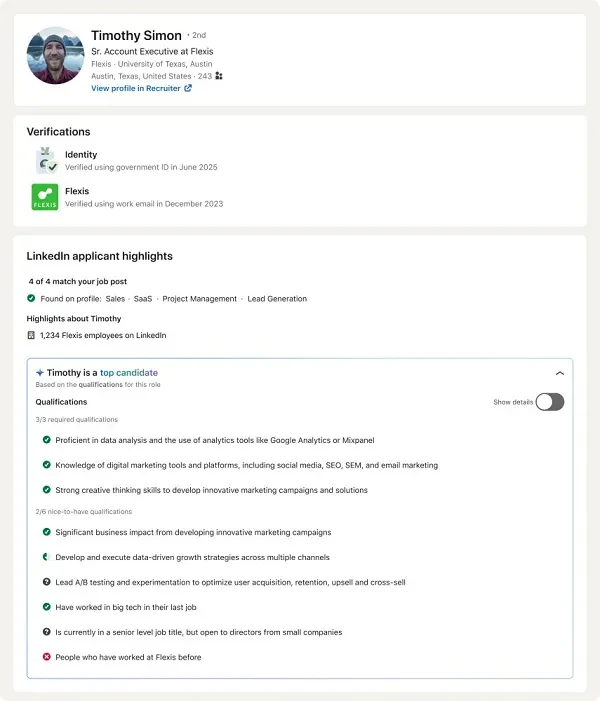
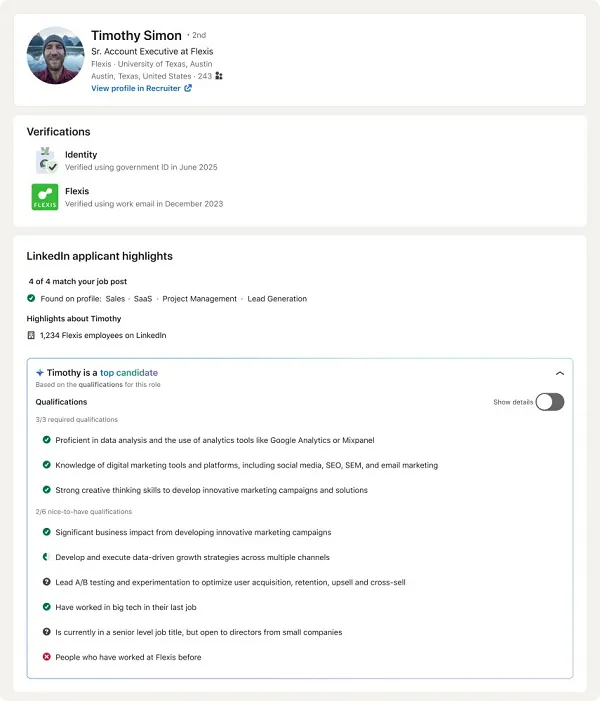
Finding a candidate who possesses the right technical skills is only half the battle; understanding whether they are actually open to a career move is where recruitment strategies often fail. Hiring Assistant 2 addresses this challenge by surfacing richer signals and indicators that explain why a candidate is a match.
Furthermore, the platform provides clear behavioral indicators regarding how receptive a candidate might be to outreach. These insights are synthesized from a multitude of data points, including:
- Recent platform engagement and content interaction.
- Explicit "Open to Work" status and career preferences.
- Historical InMail responsiveness rates.
By presenting these predictive engagement metrics directly within the matching interface, the AI empowers recruiters to prioritize outreach to candidates who are statistically far more likely to respond, optimizing both time and operational bandwidth.
3. Heightened Trust Signals and Verification
In an era marked by digital spoofing, inflated resumes, and AI-generated misinformation, maintaining trust in candidate data is paramount. LinkedIn has directly addressed this vulnerability by integrating more robust trust signals into Hiring Assistant 2.

The updated platform highlights profile verifications, making it easier for recruiters to instantly identify legitimate, vetted prospects. Additionally, LinkedIn has expanded its connected apps listings. This feature allows candidates and users to seamlessly demonstrate their hard skills and certifications across external, verified systems, creating a tamper-proof bridge between professional claims and verifiable proof.
4. Expanded Ecosystem Integrations and Voice Pre-Screening
To ensure that Hiring Assistant 2 fits effortlessly into existing enterprise workflows, LinkedIn has built out a broader network of integrations. These connected applications facilitate smoother end-to-end candidate management, ensuring that data flows cleanly between LinkedIn and Applicant Tracking Systems (ATS).
Perhaps most intriguingly, LinkedIn has incorporated advanced voice capabilities designed to assist with candidate pre-screening. These features allow for fluid, conversational pre-screening workflows, reducing the administrative burden of initial candidate phone screens and allowing human recruiters to focus exclusively on high-value, late-stage interviews.
Supporting Context, Metrics, and Market Impact
The release of Hiring Assistant 2 does not occur in a vacuum. It arrives amidst a massive shift in how businesses allocate capital for human resources and talent acquisition technologies. To understand the gravity of LinkedIn’s rollout, one must examine the broader quantitative trends shaping the industry.
Rapid Enterprise Adoption
Agentic AI is no longer a futuristic concept whispered about in tech incubators; it is actively being deployed at scale by Fortune 500 companies and agile startups alike. LinkedIn reports that more than 20,000 companies now utilize its agentic hiring solutions. This rapid adoption rate underscores the immense market appetite for tools that can automate the cognitive grunt work of recruitment.
Measurable Efficiency Gains
The true test of any enterprise software lies in its ability to move the needle on key performance indicators (KPIs). LinkedIn’s internal data highlights striking efficiencies driven by its AI recruitment tools:
- Four Times Higher Conversion: Recruiters are four times more likely to successfully contact and engage candidates sourced through the Hiring Assistant compared to traditional, legacy sourcing methods.
- Accelerating Momentum: The utility of the tool is compounding rapidly. LinkedIn reports that recruiters are 27% more likely to contact an AI-sourced candidate today than they were just six months ago, reflecting iterative improvements in matching quality and recruiter trust in the algorithm.
The Power of Scale: 1.3 Billion Members
Underpinning all of LinkedIn’s AI innovations is an unrivaled proprietary dataset. With more than 1.3 billion members globally, LinkedIn possesses the world’s most comprehensive repository of professional trajectories, career transitions, skill developments, and industry movements.
This vast ecosystem allows LinkedIn’s predictive machine learning models to identify subtle patterns in career progression that smaller, siloed job boards could never detect. When combined with the contextual memory of Hiring Assistant 2, this immense data pool translates into candidate matchmaking precision that sets a new industry benchmark.
Official Statements and Industry Perspective
While corporate press releases often lean heavily into promotional hyperbole, independent industry analysts and corporate talent leaders have noted that LinkedIn’s latest updates represent a genuine maturation of conversational enterprise AI.
Industry observers have highlighted the shift from "search-based" recruitment to "intent-based" recruitment. In traditional models, recruiters acted as detectives searching for clues in a massive database. With Hiring Assistant 2, the AI acts as an executive search partner that anticipates needs before they are fully articulated.
Furthermore, human resources executives have praised the emphasis on trust signals and candidate responsiveness metrics. In modern talent acquisition, candidate ghosting and recruiter spam have created mutual friction. By utilizing data-driven receptiveness indicators, tools like Hiring Assistant 2 help restore a degree of personalization and respect to the candidate outreach process, ensuring that messages are sent only to individuals whose career trajectories and current openness align with the open role.
Future Outlook: The Horizon of AI-Driven Talent Acquisition
As we look toward the future, the rollout of Hiring Assistant 2 serves as a clear signpost pointing toward a fully autonomous, highly collaborative recruitment future. Several key trends are likely to emerge in the wake of this release:
1. The Redefinition of the Recruiter’s Role
As AI agents take over the heavy lifting of sourcing, pattern recognition, initial outreach, and voice pre-screening, the role of the human recruiter is undergoing a profound metamorphosis. Rather than spending 70% of their day scouring databases and sending cold InMails, recruiters are evolving into strategic talent advisors, employer brand ambassadors, and expert negotiators. The human element—emotional intelligence, cultural assessment, and persuasive relationship-building—will become more valuable than ever.
2. Hyper-Personalization at Scale
The integration of advanced memory models means that future hiring campaigns will feel less like automated mass-marketing and more like bespoke executive search operations. AI assistants will be able to craft hyper-personalized outreach messages that reference a candidate’s specific career milestones, past mutual connections, and demonstrated competencies, dramatically boosting conversion rates.
3. Ethical AI and Algorithmic Fairness
With great power comes profound responsibility. As AI systems take on an increasingly active role in determining who gets headhunted and who gets overlooked, regulatory scrutiny and ethical considerations will intensify. LinkedIn’s focus on verified credentials and transparent trust signals is a step in the right direction, but the industry must remain vigilant against algorithmic bias to ensure that AI-driven recruitment fosters genuine diversity and inclusion.
Conclusion
LinkedIn’s launch of Hiring Assistant 2 marks a definitive turning point in the evolution of HR technology. By combining advanced contextual memory, granular matchmaking transparency, robust trust verifications, and expanded enterprise integrations, LinkedIn has delivered a tool that moves far beyond the gimmickry of early generative AI features.
For the 20,000+ companies already utilizing these agentic solutions—and the thousands more poised to adopt them—Hiring Assistant 2 offers a clear path toward faster, smarter, and more human-centric talent acquisition. As these technologies continue to mature, the organizations that embrace intelligent, memory-driven recruitment partners will undoubtedly hold a decisive competitive advantage in securing the world’s best talent.