







By Drew Robb
Technology & Infrastructure Correspondent
Executive Overview
The artificial intelligence revolution is running headfirst into a physical bottleneck: power. As generative AI models scale exponentially, the infrastructure required to train and run them is expanding at a velocity that strains traditional electrical grids. Google alone now processes more than 3 quadrillion AI tokens per month, representing a staggering sevenfold increase in compute demand over a compressed twelve-month window.
To bridge the speed mismatch between rapid AI software deployment and the multiyear timelines typical for utility infrastructure expansion, tech giants are being forced to reinvent data center architecture from the ground up. Speaking at the Data Center World Power conference in Houston, Tom Garvens, Vice President of Advanced Technology Innovation at Google, detailed how the company is deploying a full-stack engineering strategy. By tightly coupling hardware design, software orchestration, and deep utility partnerships, Google is attempting to transform data centers from passive grid consumers into active participants in power stabilization.
This report explores how Google is managing the gigawatt-scale power transition, examining everything from rack-level Direct Current (DC) conversions and battery energy storage systems (BESS) to workload shifting, water-smart closed-loop cooling, and the impending migration to 800-volt architectures.
Detailed Chronology of the AI Infrastructure Crunch
The Acceleration of Compute Demand (May 2025 – May 2026)
The modern data center crisis is fundamentally a story of compounding curves. Between May 2025 and May 2026, Google’s internal compute demand jumped by a factor of seven. This explosive growth mirrors broader industry trends, where foundational models require clusters consisting of hundreds of thousands of specialized accelerators operating in lockstep to process massive workloads.
However, building out the physical infrastructure to support these clusters cannot match the velocity of software iterations. While a new software model can be trained and deployed in months, upgrading regional electrical substations, laying high-voltage transmission lines, and bringing new power generation online typically takes five to ten years. This temporal gap forced hyperscalers like Google, Microsoft, Meta, and Nvidia to radically rethink how they source, distribute, and manage power.
The Shift Toward Collaborative Grid Integration
Recognizing that they could no longer rely on standard utility hookups without overwhelming local grids, Google shifted its posture from a passive customer to an active infrastructure partner.
- Defining Interoperability Standards: Recognizing the fragmented nature of utility communication, major tech players (Google, Meta, Microsoft, and Nvidia) collaborated to define unified interface specifications. These protocols dictate how hyperscalers and utility providers exchange telemetry data, allowing grids to anticipate power draws and dynamically integrate data center resources.
- Transforming Backup Assets into Grid Services: Traditionally, diesel generators sat idle until an emergency blackout occurred. Google has re-architected these standby resources, deploying Battery Energy Storage Systems (BESS) capable of providing rapid-response power. These systems act as buffers for fluctuating workloads, smoothing out voltage spikes and participating in demand-response agreements to shave peak loads off local municipal grids.
- Strategic Geographic Siting: Instead of competing for dwindling capacity in saturated, high-demand metropolitan markets, Google has pivoted toward remote, greenfield sites with ample land and accessible power transmission corridors. In some instances, these data center developments are intentionally positioned in small towns, making Google a primary regional employer and economic anchor while securing the necessary wattage.
Supporting Context & Metrics: Engineering at the Edge of Physics
To understand the scale of the optimization challenge, one must look deep inside the data center rack, where millimeter margins dictate multi-megawatt outcomes.
Inside the Rack: The War on Power Conversion Losses
Historically, data centers relied on centralized Uninterruptible Power Supply (UPS) systems that introduced multiple energy conversion steps—switching power back and forth between Alternating Current (AC) and Direct Current (DC). Each conversion step bleeds energy as heat.
Google has systematically dismantled this traditional model:
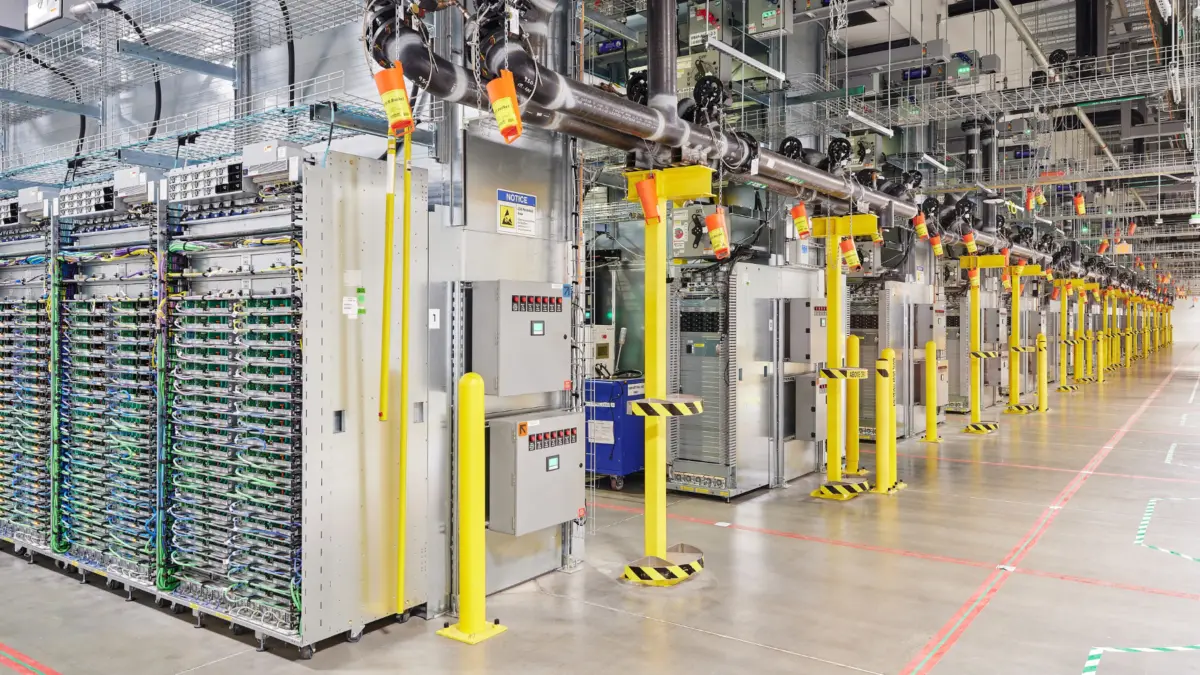
- The 54 VDC Standard: Google eliminated centralized UPS systems in favor of rack-level battery backups operating at approximately 54 volts Direct Current (VDC). Power is converted from AC to DC at the top of the rack, and DC is run directly through the rack infrastructure.
- The 1.5% Efficiency Gain: Eliminating redundant AC-DC-AC conversion steps yields an immediate, highly impactful efficiency gain of roughly 1.5% at the system level.
- The Copper Problem and the Move to 800 VDC: As rack densities skyrocket toward an anticipated 1 megawatt (MW) per rack over the next one to two years, delivering the required current at lower voltages would necessitate massive bus bars and heavy cabling choked with copper—a critical mineral currently facing severe supply chain constraints. To mitigate this, Google is spearheading an industry-wide transition toward 800 VDC power distribution, a maturation process expected to take a couple of years.
- Interim "Sidecar" Enclosures: While waiting for 800 VDC hardware to fully mature, Google has implemented adjacent power-distribution enclosures known as "sidecars." These sidecars house the necessary cabling and power gear externally, preserving precious interior rack space exclusively for high-density AI servers. Once 800 VDC components become universally available, these sidecar spaces can be repurposed into active server bays.
Workload Shifting and Water-Smart Cooling
Power is only one half of the equation; thermal management is the other. As chip power densities climb, traditional air cooling is no longer viable, making liquid cooling mandatory for at least the hottest elements within high-density racks.
- Closed-Loop Liquid Cooling: Moving away from evaporative cooling towers that consume massive quantities of local water resources, Google is investing heavily in sealed, closed-loop liquid circuits. These systems minimize makeup water requirements while maintaining optimal thermal thresholds. Cooling designs are no longer one-size-fits-all; they are custom-tailored based on local environmental factors, including altitude, ambient humidity, local water table depths, drought risk, and municipal community needs.
- Dynamic Workload Orchestration: Because Google operates a globally distributed portfolio of data centers, compute tasks are fluid. If a severe heat wave hits Ohio and strains the local electrical grid, automated orchestration platforms can gracefully throttle non-critical workloads or shift high-priority computing tasks across the network to facilities in regions with excess capacity.
Official Statements and Industry Insights
The complexity of balancing silicon roadmaps with planetary energy constraints requires unprecedented collaboration across the technology and energy sectors.
Tom Garvens underscored the distinct advantage of Google’s vertically integrated model during his keynote:
"Google has tightly coupled vertical integration in AI along with close partnerships with energy providers. We develop and design our own data centers, chips, servers, and rack designs. By having control of our entire hardware and software stack, we can optimize these things together for sustainability and energy efficiency."
Addressing the reality of rapid silicon iterations—where new GPU architectures arrive multiple times a year, each drawing exponentially more power than its predecessor—Garvens emphasized that waste is the ultimate enemy of infrastructure design:
"The most precious thing we have is a watt: you don’t want to ever strand a watt. So, making our data center and our designs as crisp as we can for as far out as we can see in these roadmaps, it’s why our partnerships with our silicon and GPU design teams are so critical."
On the regulatory and utility front, Garvens noted that hyperscalers can no longer operate in a vacuum:
"Utilities are setting different requirements that we must demonstrate that we can meet. Google, Meta, Microsoft, and Nvidia have come together to define an interface spec on how utilities and hyperscalers can interface with each other."
Regarding tactical peak management, Garvens highlighted the flexibility afforded by modern battery deployments:
"When peak needs are beyond what we’ve got power for, we can get that from local storage… If there’s a heat wave in Ohio and we were running a big workload, we’ve got agreements in place whereby with the right amount of foresight we can shut certain workloads down or move them elsewhere if they’re critical. We have a portfolio where we can shift things around."
Finally, addressing the long-term quest for thermodynamic perfection, Garvens pointed to ongoing industry collaborations:
"We’re working with the industry on bringing solid-state transformers to maturity. We are also continuing to improve our power usage effectiveness [PUE]. We can’t ever get to 1.0, but we continue to challenge ourselves to get as close to it as possible."
Future Outlook: The Road to Gigawatt Campuses
As the artificial intelligence industry marches past the threshold of gigawatt-class campuses—where hundreds of thousands of accelerators run massive, unified workloads—the paradigm of data center engineering has permanently shifted.
The coming years will test the viability of these advanced topologies. Success will not be measured by software capabilities alone, but by the physical resilience of the supporting ecosystem. Key milestones on the horizon include:
- Commercial Maturation of Solid-State Transformers: Replacing bulky, analog substation transformers with solid-state alternatives to handle bidirectional power flows safely and efficiently.
- Standardization of 800 VDC Ecosystems: Widespread industry adoption of high-voltage DC standards, spearheaded by open-source contributions via organizations like the Open Compute Project (OCP), to dramatically cut down copper usage and internal resistance losses.
- Deepened Grid-Interactive Data Centers (GIDCs): Transitioning data centers from consumers that require backup generation into virtual power plants (VPPs) that actively support, balance, and stabilize regional grids during extreme weather and peak demand events.
Ultimately, Google’s strategy signals an industry-wide awakening: the future of artificial intelligence is tethered directly to the future of energy. By engineering efficiency into every layer of the stack—from silicon chip to utility substation—the tech sector is striving to ensure that the AI boom can continue without short-circuiting the modern world’s electrical grid.