








Executive Overview
For centuries, human ambition has sought to transcend biological limitations. Whether through mythology, science fiction, or early engineering, the dream of augmenting the human body with mechanical strength and endurance has remained a persistent fixation. Today, that vision is no longer confined to the pages of speculative fiction. Robotic exoskeletons—wearable mechanical systems that integrate seamlessly with human physiology—have evolved from crude, steam-powered apparatuses into sophisticated, highly responsive electro-mechanical marvels.
Once considered purely the domain of military research or futuristic laboratories, modern exoskeletons are rapidly integrating into everyday society. From clinical rehabilitation wards helping patients regain lost mobility to bustling logistics hubs reducing workplace injuries, and even rugged terrain deployments in active conflict zones, these devices are redefining human capability.
By combining lightweight composite materials, advanced microprocessors, biomimetic sensors, and high-torque actuators, contemporary exoskeletons do more than just bear weight—they actively interpret human intent. They know when you are walking, running, lifting, or tiring, and they respond in fractions of a second to provide the exact amount of mechanical assistance required. As the technology transitions from niche industrial tools to mainstream commercial products, it stands poised to fundamentally alter how we work, move, and heal.
Detailed Chronology: A Century and a Half of Innovation
The journey from stationary iron lungs and clumsy pneumatic frames to agile, battery-powered robotic suits is a testament to iterative engineering. While the modern boom in wearable robotics is largely driven by advances in artificial intelligence and battery density, the conceptual roots of the industry stretch back well into the 19th century.
1890: The Genesis of Wearable Assistance
The earliest documented concept of a wearable apparatus designed to assist human movement was patented in 1890 by Nicholas Yagn, a self-taught Russian inventor. Yagn’s vision was ahead of its time; he designed a wearable spring-powered apparatus intended to help people walk, run, and jump with less fatigue. While crude and reliant entirely on mechanical tension rather than external power sources, Yagn’s patent laid the foundational philosophy of wearable augmentation: storing and releasing energy to offload human muscle groups.
1919: Stepping Into Steam Power
As industrialization accelerated, inventors looked to steam and hydraulics for heavier applications. In 1919, American inventor Leslie C. Kelley secured a patent for a steam-powered device explicitly engineered to support walking. Although impractical by today’s standards—largely due to safety hazards, weight, and the obvious challenges of carrying a steam generator—Kelley’s concept represented the first true "powered" exoskeleton framework, proving that inventors were already envisioning external power sources to drive human locomotion.
The 1960s: The Dawn of Actuated Robotics
The modern era of powered exoskeletons began in earnest during the height of the Cold War. By the late 1960s, major industrial and defense contractors, recognizing the need for superhuman lifting capabilities, began developing actuated robotic exoskeletons incorporating electronic control systems.
A landmark development during this era was the General Electric "Hardiman," a massive, hydraulically and electrically powered master-slave manipulator suit designed to enable a human operator to lift up to 1,500 pounds effortlessly. While the Hardiman proved too heavy, unstable, and complex to be practically deployed, it established the blueprint for human-machine interfaces, proving that a human could direct the movements of a powerful robotic frame through intuitive motion.
Rapid Acceleration: From Clinical Trials to Commercial Markets
Following the pioneering efforts of the mid-20th century, exoskeleton research experienced a prolonged period of refinement. As computing power shrank, sensor technology improved, and materials science introduced carbon fiber and high-grade aluminum, the bulky hydraulic beasts of the past gave way to sleek, wearable robotics.
By the turn of the 21st century, research had branched into two distinct streams: medical exoskeletons focused on neuro-rehabilitation and assisting individuals with spinal cord injuries, and industrial/military exoskeletons aimed at preventing musculoskeletal disorders and enhancing soldier endurance. Today, this rich history of experimentation has culminated in a thriving global market populated by diverse commercial and clinical applications.
Supporting Context & Metrics: Anatomy of a Modern Exoskeleton
To understand how contemporary exoskeletons operate, one must examine the intricate harmony between human biology and machine engineering. Modern active robotic exoskeletons are marvels of mechatronic design, typically consisting of lightweight mechanical frames equipped with ergonomic attachment points designed to align precisely with human joints.
Mechanical Framework and Ergonomic Integration
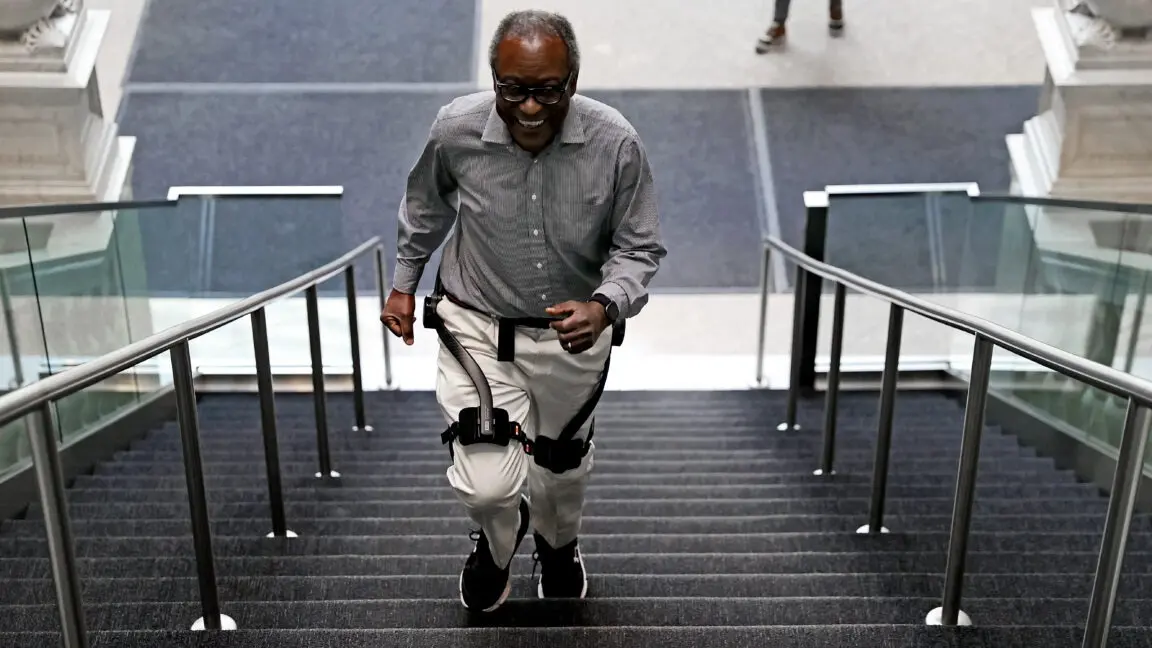
An exoskeleton is only as good as its interface with the human body. Poorly designed attachment points can cause chafing, joint misalignment, and unnatural gait alterations. Modern devices utilize breathable, high-durability fabrics, carbon-fiber shells, and adjustable straps to anchor the system securely to critical anatomical zones: the trunk, waist, and upper or lower limbs.
For instance, specialized systems like the Hypershell attach securely to the user’s waist and thighs, specifically engineered to assist with hip flexion and extension, thereby dramatically strengthening lower-body movement during hiking, running, or heavy carrying. Conversely, industrial variants like the SuitX—frequently deployed in demanding logistical environments such as IKEA warehouses—anchor to the torso and upper limbs, providing targeted support to the lower back and shoulders during repetitive lifting tasks.
The Engine Room: Actuators and Power Delivery
At the heart of almost every powered exoskeleton lies the actuator. These specialized mechanical components serve as the muscles of the suit, converting electrical energy drawn from high-density lithium-ion batteries into precise mechanical movement.
Actuators must be capable of generating immense torque while remaining lightweight, fast, and energy-efficient. They work in tandem with complex gearboxes and transmission systems to apply calculated forces directly to the wearer’s joints, effectively shouldering a significant percentage of the physical load.
The Brains: Microcontrollers, Sensors, and Real-Time Adaptability
Hardware alone is useless without intelligent software. The true sophistication of a modern exoskeleton lies in its control units—embedded microprocessors that act as the central nervous system of the device.
These control units constantly monitor data streaming in from a dense network of inertial measurement units (IMUs), force sensors, and angle encoders. They define the precise trajectories of the exoskeleton’s movements and calculate how much force to apply to the wearer’s body at any given millisecond.
Crucially, the system’s behavior is entirely dynamic. The device does not follow a rigid, pre-programmed loop; instead, it adapts in real time to the user’s actions and environmental conditions:
- The Running Scenario: If a wearer breaks into a jog, the exoskeleton’s sensors detect the sudden change in cadence and acceleration, prompting the control unit to instantly speed up its supportive movements to match the user’s pace.
- The Fatigue Scenario: If embedded sensors detect subtle micro-tremors, slowing stride speeds, or altered posture indicating that the wearer is growing tired, the system can automatically ramp up its power output to compensate, effectively buffering against physical exhaustion.
Official Statements and Industry Insights
As the intersection of robotics and human physiology matures, leading voices in the engineering, medical, and industrial sectors have weighed in on the transformative potential—and the remaining challenges—of wearable robotics.
Dr. Elena Vance, a leading biomechatronics researcher at the Wearable Robotics Laboratory, emphasizes the paradigm shift in how we view machine interaction:
"For decades, we built machines to replace human labor entirely—think of factory assembly lines and industrial robotic arms. Exoskeletons represent a profound philosophical and engineering pivot. We are no longer trying to take the human out of the loop; we are merging human intuition, adaptability, and cognition with machine strength and tireless endurance. The human remains the pilot, while the exoskeleton acts as an intelligent co-pilot."
Industrial safety experts have also highlighted the profound economic and health implications of deploying passive and active exoskeletons in the workplace. Marcus Thorne, Director of Ergonomics at Global Logistics Solutions, notes:
"Musculoskeletal disorders account for billions of dollars in lost productivity and worker compensation claims every year, particularly in warehousing and manufacturing. When we introduced supportive upper-limb and back exoskeletons to our distribution centers, we didn’t just see a drop in reported physical strain; we saw an increase in overall worker morale and job longevity. Older employees are able to extend their careers comfortably, and injury rates have plummeted."
Military strategists and defense analysts similarly view advanced lower-limb exoskeletons as a game-changer for dismounted infantry. Captain Sarah Jenkins of the Defense Advanced Research Projects Agency (DARPA) futures division stated during a recent technology symposium:
"When a soldier is operating in rugged terrain carrying upwards of 100 pounds of gear, operational readiness degrades rapidly due to physical fatigue. Lightweight, ruggedized active exoskeletons allow personnel to traverse hostile environments faster, arrive at their destination with higher cognitive and physical reserves, and extract wounded comrades with unprecedented speed. The battlefield of the future will not just be defined by autonomous drones, but by augmented human soldiers."
Future Outlook: The Road Ahead for Wearable Robotics
While the progress made over the past century—and particularly the last two decades—has been breathtaking, the exoskeleton industry is still in its relative infancy. As researchers look toward the horizon, several key frontiers promise to unlock even greater potential while addressing current engineering hurdles.
Miniaturization and Battery Longevity
One of the primary bottlenecks facing active robotic exoskeletons remains power consumption. High-torque actuators demand significant energy, limiting the continuous operational window of most active suits to a few hours before requiring a battery swap or recharge. Future advancements in solid-state battery technology, energy harvesting (such as regenerative braking systems that capture energy when the wearer walks downhill), and ultra-efficient brushless motors will be critical in extending untethered runtimes.
Seamless Human-Machine Interfaces (HMIs)
Currently, exoskeletons rely heavily on kinematic sensors that detect movement after the muscle has begun to contract. The next frontier in wearable robotics involves neural and electromyographic (EMG) interfaces. By reading electrical signals directly from the skin (surface EMG) or eventually utilizing non-invasive neural interfaces, future exoskeletons will be able to predict human movement before it physically occurs. This will reduce latency to near-zero, making the exoskeleton feel less like a heavy apparatus strapped to the body and more like a natural extension of the wearer’s own anatomy.
Mass Consumer Adoption and Medical Accessibility
Thus far, high costs and specialized fitting processes have restricted widespread consumer adoption. However, as manufacturing scales and component costs decline, consumer-grade exoskeletons for hiking, aging populations, and recreational endurance are beginning to enter the mainstream market. Concurrently, advancements in clinical reimbursement models are making medical rehabilitation exoskeletons more accessible to stroke victims, individuals with multiple sclerosis, and paraplegic patients.
Conclusion
From Nicholas Yagn’s spring-loaded contraptions in 1890 to the AI-driven, sensor-laden robotic suits deployed in factories, hospitals, and conflict zones today, exoskeletons have traveled a remarkable path. They represent the ultimate synthesis of biology and engineering—a tangible realization of the desire to push past our biological boundaries. As the technology continues to mature, shedding its weight and sharpening its intelligence, the robotic exoskeleton is poised to transition from a fascinating technological novelty into an indispensable pillar of modern human life.