







Executive Overview
The rapid, unprecedented expansion of digital infrastructure—driven largely by the generative AI boom, cloud computing acceleration, and massive enterprise data demands—has brought an unintended consequence: widespread public pushback. As hyperscale data centers sprout up across rural American counties, European farmlands, and suburban outskirts worldwide, they are increasingly meeting fierce resistance. While local concerns frequently center on tangible resource consumption, such as heavy water usage, massive energy demands, and high decibel noise pollution from cooling fans and electrical substations, a major driver of community backlash is purely visual.
To the average resident, modern data centers too often resemble windowless, monolithic concrete boxes. Surrounded by security fencing, surveillance cameras, and looming electrical transmission lines, these massive industrial footprints are frequently perceived as out-of-scale intrusions that degrade the visual character of local neighborhoods. In response, a forward-thinking segment of the data center industry—comprising major tech giants, innovative architects, urban planners, and environmental strategists—is fundamentally rethinking facility design.
Rather than treating architecture as an afterthought, industry leaders are exploring "biomimicry" landscape integration, underground and low-profile typologies, brownfield site regeneration, and community co-creation models. From national architectural competitions in the United Kingdom to Microsoft’s global deployment of ecosystem-driven landscaping, the data center sector is attempting a profound transformation: evolving from anonymous, resented "ugly boxes" into welcome, aesthetically integrated urban and rural assets.
Detailed Chronology: The Evolution of Data Center Design and Community Backlash
To understand how the data center industry arrived at its current architectural crossroads, it is necessary to trace the convergence of surging digital demand and escalating community friction over the past several years.
The Rise of the Hyperscale Box (Pre-2020)
For decades, data centers were functionally invisible to the general public. Housed in discreet business parks or repurposed industrial warehouses, their primary design metric was pure utility. Efficiency, security, speed-to-market, and power usage effectiveness (PUE) reigned supreme. As long as the facility kept servers cool and connected, the exterior aesthetic mattered little. However, the mass migration to the cloud dramatically scaled up facility sizes. The era of the "hyperscale" facility ushered in massive, multistory concrete monoliths spanning hundreds of thousands of square feet, fundamentally shifting the visual scale of the digital infrastructure footprint.
The Global Backlash Reaches a Boiling Point (2020–2023)
As data center footprints expanded, so did public friction. Rural and suburban communities began organizing against proposed developments, citing concerns over power grids, water tables, and property values. Crucially, the visual and spatial impact became a central rallying cry for neighborhood opposition groups. For instance, the Piedmont Environmental Council in Virginia routinely critiqued proposed hyperscale facilities for being entirely out of scale with existing communities, highlighting their stark windowless designs, heavy security infrastructure, and intrusive electrical substations. The backlash began moving past local zoning boards and straight to the ballot box, transforming data center site approval into a high-stakes political battleground.
Pioneering Ecosystem-Led Design (2022)
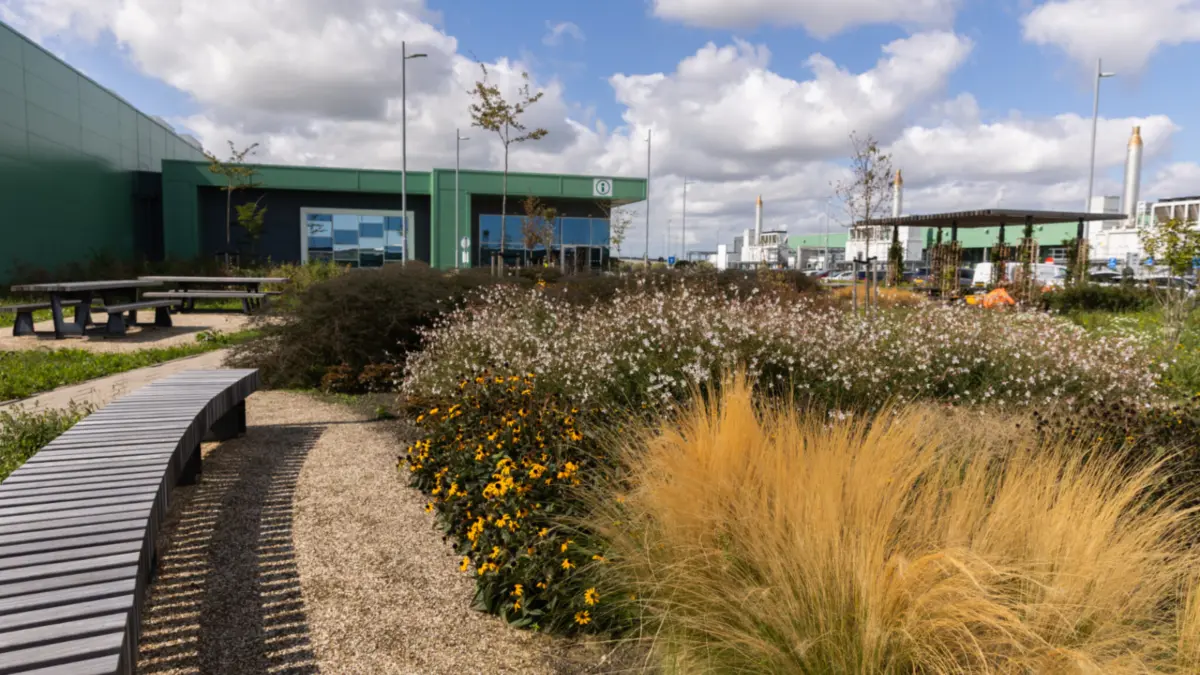
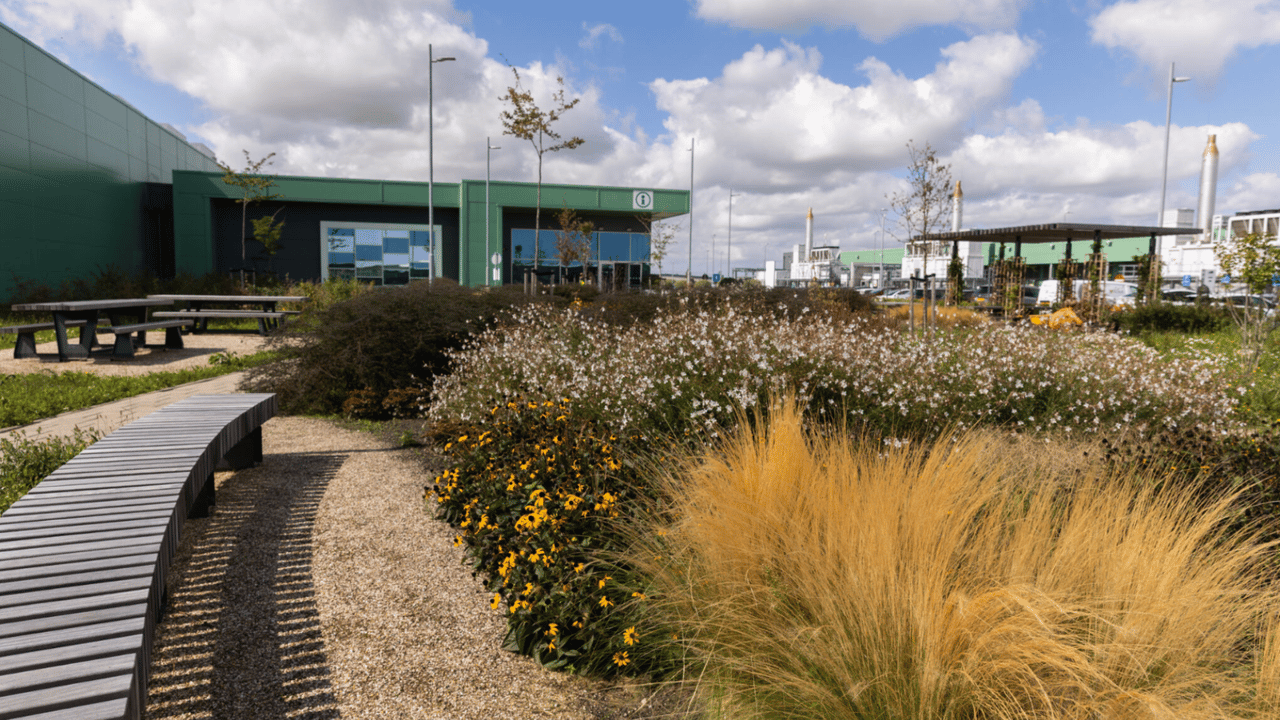
Recognizing that traditional landscaping—such as a single row of Arborvitae trees—was no longer pacifying local opposition, industry leaders began experimenting with holistic environmental design. In 2022, Microsoft deployed its first native, biomimicry-led planting strategy at a campus in Noord-Holland, the Netherlands. Moving past conventional turf grass and ornamental shrubs, the project integrated 150 native trees and over 2,000 square meters of localized grasses and shrubs designed to actively mimic and support the surrounding natural watershed and local habitat. This pilot served as a foundational proof-of-concept, paving the way for broader architectural experimentation.
Institutional Design Challenges and Social Charters (2025–2026)
By the mid-2020s, the conversation shifted from private corporate initiatives to institutional policy frameworks. On June 11, the UK Government announced a national Data Center Design Challenge in partnership with the Royal Institute of British Architects (RIBA), tasking multidisciplinary teams with redefining how data centers are conceived, designed, and experienced. Concurrently, design and engineering firms introduced formal metrics for public acceptance. A 2026 research report by Gensler identified building appearance, massing, materials, and height as decisive, direct-action factors in community approval. Engineering consultancy Hoare Lea released a dedicated "Social Charter" for data centers, codifying early-stage community co-creation as a mandatory step in modern infrastructure deployment.
Supporting Context & Metrics: What Drives Public Acceptance?
The tension between digital progress and community preservation hinges on specific design and environmental variables. Quantitative and qualitative research from architectural firms, environmental councils, and industry analysts sheds light on what truly drives—or damages—public acceptance.
The Gensler 2026 Research Findings
According to architectural firm Gensler’s 2026 report on empowering communities through digital infrastructure design, public sentiment is not uniformly anti-technology; rather, it is deeply anti-imposition. When surveyed about their primary anxieties regarding nearby data center developments, residents consistently prioritized elements that architects and developers possess direct control over:
- Overall Building Massing and Height: The sheer verticality and unbroken horizontal expanse of traditional warehouses.
- Exterior Materials: The dominance of stark, windowless tilt-up concrete panels.
- Visual Sightlines: How obtrusive the facility appears from public roadways, residential windows, and recreational areas.
- Buffer Zones: The presence or absence of deep, ecologically rich green buffers that soften the transition between industrial security and public life.
The Economic and Strategic Case for Brownfield Regeneration
To mitigate greenfield sprawl and its associated environmental pushback, industry operators are increasingly pivoting toward brownfield sites—previously developed, often disused or blighted industrial land.
Data center operators and consultants point out that brownfield sites offer a dual advantage: they eliminate the visual and ecological disruption of breaking ground on pristine agricultural or forested land (greenfields), and they frequently come pre-equipped with robust utility ties. Spencer Lamb, CEO of UK-based operator Kao Data, has emphasized that repurposing former manufacturing hubs can fast-track sovereign AI capacity goals while directly improving local aesthetics.
Echoing this sentiment, Nick Ewing, managing director of EfficiencyIT, noted in an interview with Data Center Knowledge: "Replacing a run-down industrial site with a modern facility, which often resembles a contemporary office building, brings new technology into the area and delivers a genuine improvement for the local community. In many ways, the data center is the new industrial space."
Official Statements and Industry Insights
Industry leaders, urban planners, and environmental strategists are actively redefining the philosophy of digital infrastructure design. Their perspectives underscore a collective realization: data centers must integrate into the social and ecological fabric of their host communities.
Kaitlin Chuzi, Global Land Strategy Director at Microsoft:
Detailing the company’s expansion of biomimicry design principles to more than 20 sites across the United States and Europe, Chuzi emphasized that naturalistic landscaping goes far beyond mere cosmetics.
"We start by understanding how the local ecosystem functions, combining ecological research with community input and then [using] those insights to inform land, water, and restoration plans that mimic and enhance natural systems," Chuzi explained. "The goal is to design for multiple benefits at once, from locally appropriate, biodiverse plantings that improve the viewshed to healthier soil, better stormwater management, and stronger habitat for local species."
Chris Williamson, President of the Royal Institute of British Architects (RIBA):
Discussing the joint government-RIBA design challenge aimed at reimagining digital infrastructure, Williamson highlighted the vast architectural potential hiding inside a necessary utility:
"As data centers become increasingly critical to the UK’s economic and technological future, we have a responsibility to consider how they are designed, located, and experienced. Data centers will be needed across the country, and this presents a major opportunity for architects to reimagine what they can be, while supporting sector growth."
Carl Walker, Head of Societal Insights at Hoare Lea:
Advocating for a collaborative approach to community engagement, Walker underscored the necessity of moving away from standardized corporate blueprints:
"Co-creating data centers with residents is essential if they are to become valued community assets rather than simply being perceived as large, anonymous warehouse buildings. Rather than imposing a standardized ‘one-size-fits-all’ warehouse model, co-creation enables data centers to reflect the character, identity, and needs of the communities they serve, helping them contribute positively to placemaking, local pride, and regeneration."
Max Smolaks, Research Analyst at Uptime Intelligence:
Addressing the radical potential of alternative facility typologies that remove the visual footprint entirely, Smolaks offered a succinct observation regarding subterranean infrastructure:
"Nobody’s going to oppose a data center in a mine."
Future Outlook: The Next Generation of Digital Infrastructure Architecture
As the global demand for compute power, cloud storage, and AI processing continues its exponential trajectory, the traditional "big shed" design model is no longer economically or politically viable. The future of data center architecture will likely be defined by a multi-pronged approach balancing advanced aesthetic integration, radical subterranean and low-profile engineering, and early-stage public co-creation.
1. Mainstreaming Biomimicry and Regenerative Landscaping
The deployment of native, ecosystem-led planting—pioneered by Microsoft and adopted across dozens of global sites—is shifting from a progressive luxury to an industry standard. By utilizing native flora, micro-topography, and green walls, operators can dramatically soften viewsheds, manage stormwater onsite, and foster local biodiversity, turning a sterile industrial perimeter into a thriving ecological buffer.
2. Exploring Subterranean and Low-Profile Typologies
Beyond landscaping, architects and engineers are looking underground and into alternative structures. Utilizing decommissioned mines, subterranean caverns, and heavily bermed earth-sheltered designs eliminates the above-ground visual footprint entirely. These low-profile concepts not only disarm local aesthetic opposition but frequently offer inherent thermal stability, superior physical security, and enhanced cooling efficiencies.
3. Institutionalizing Co-Creation and Social Charters
Ultimately, design innovations will fail if they are imposed top-down without genuine public dialogue. The rise of initiatives like the UK’s Data Center Design Challenge and Hoare Lea’s Social Charter signals a permanent cultural shift within the industry. Future data center developments will increasingly rely on participatory planning—engaging residents before blueprints are finalized to ensure that digital infrastructure serves not only as a node for global data, but as a source of local pride, urban regeneration, and enduring community value.