







Executive Overview
The consumer electronics industry has long thrived on a delicate ecosystem of technical nomenclature, marketing hyperbole, and consumer trust. However, the boundaries of that trust are currently being stress-tested in a high-stakes legal battle. In late August, television manufacturing giant TCL filed a formal federal lawsuit in the U.S. District Court for the Central District of California, directly accusing its long-standing rival, Samsung, of deceptive trade practices and false advertising.
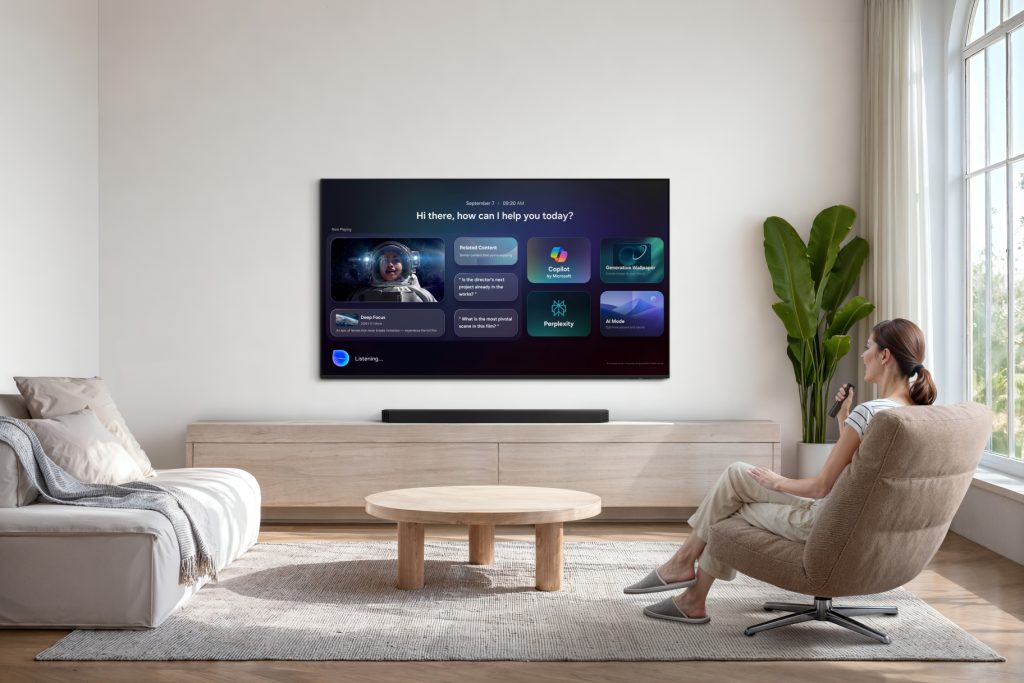
At the heart of the dispute is Samsung’s M-series of televisions—comprising the M70H, M80H, and M90H models, which retail anywhere from $300 for a modest 43-inch screen to $2,300 for a massive 100-inch panel. TCL’s complaint alleges that these budget-friendly displays are not true Mini LED sets at all. Instead, TCL claims Samsung has repackaged and rebranded its entry-level Crystal UHD standard LCD-LED televisions, slapping a "Mini LED" label on them to siphon market share away from competitors without delivering the underlying technological innovations associated with the term.
This dispute is far more than a petty corporate squabble between two multinational heavyweights. It exposes a profound, industry-wide vulnerability: the total absence of standardized, legally binding definitions for fundamental display technologies. Without clear regulatory or industrial criteria governing what constitutes a "Mini LED" or a Full Array Local Dimming (FALD) backlight, manufacturers operate in a regulatory gray area. They are free to stretch technical definitions, leaving consumers vulnerable to deceptive marketing and obscuring the actual real-world performance of the hardware sitting in living rooms worldwide.
Detailed Chronology and the Anatomy of the Lawsuit
The legal friction between TCL and Samsung did not materialize overnight; it represents the culmination of years of escalating competition in the flat-panel market, where profit margins are razor-thin and marketing buzzwords dictate consumer behavior.
The Complaint Filed in California
In its late August court filing, TCL pulled no punches, characterizing Samsung’s M-series strategy as outright "fraud." According to the legal documentation, Samsung rushed the M70H, M80H, and M90H models to market to compete directly with TCL’s aggressively priced QM-series of genuine Mini LED displays.
TCL’s attorneys argue that the M-series hardware contains none of the architectural upgrades that define the category. Rather than utilizing dense arrays of microscopic light-emitting diodes coupled with localized hardware control chips, the M-series units allegedly rely on legacy architectures pulled straight from Samsung’s entry-level, non-dimming product lines. When approached for comment regarding the specific allegations outlined in the lawsuit, Samsung declined to answer detailed technical inquiries. Instead, a corporate spokesperson issued a brief statement affirming the company’s intention to vigorously defend the lawsuit in court.
Dissecting the Hardware: Inside the M80H
To substantiate its legal claims, TCL went beyond theoretical arguments. According to the lawsuit, TCL engineers physically procured and disassembled multiple Samsung M-series units, specifically targeting the M70H and M80H models.
The teardowns purportedly revealed a stark reality: the TVs are structurally incapable of executing true local dimming. The physical inspection allegedly confirmed that the M-series panels lack the dedicated LED control chips and complex driving circuitry necessary to modulate discrete backlight zones. Furthermore, the teardowns revealed that these televisions utilize the exact same primary processor found in Samsung’s base-level Crystal line.
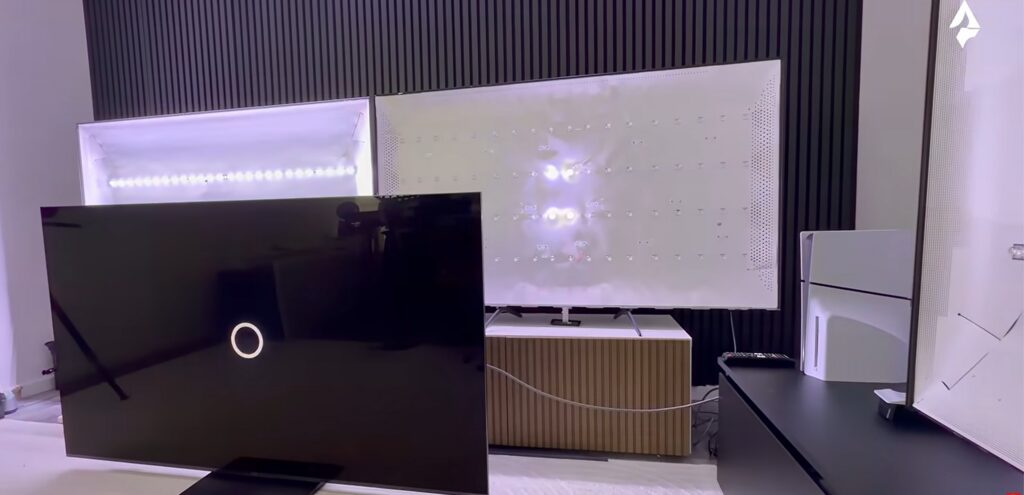
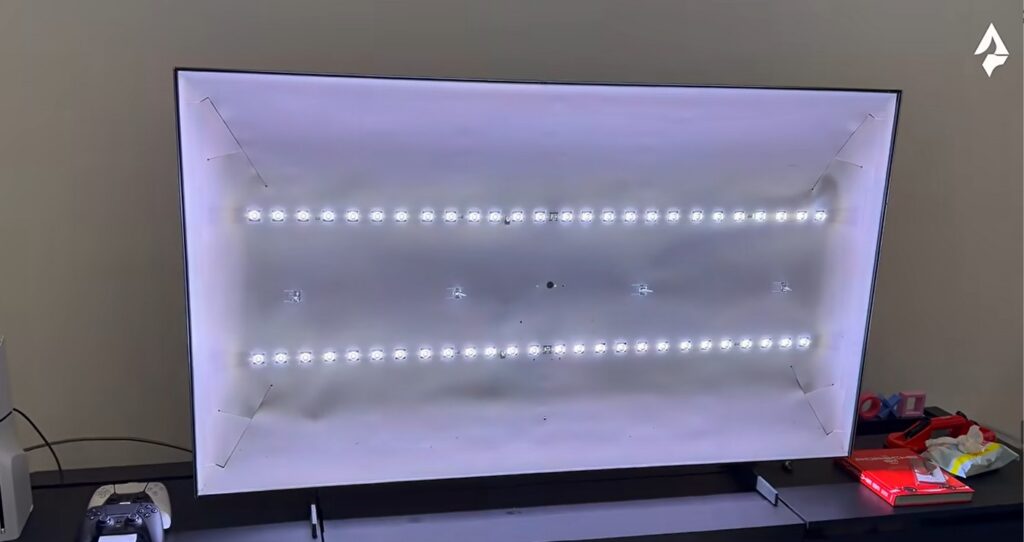
Independent examinations, such as a widely circulated teardown video published by the YouTube channel AP Tech, corroborate these findings. Visual analysis of the M80H’s internal layout demonstrates that its backlight assembly does not consist of a robust, two-dimensional matrix distributed across the rear of the panel. Instead, the hardware relies on a simplified configuration: merely two rows of LEDs anchored to aluminum strips running along the edges or sides of the chassis.
Supporting Context & Metrics: The FALD Debate and Technical Realities
To understand why TCL’s allegations carry such technical weight, one must examine the engineering principles that govern modern liquid-crystal displays (LCDs).
What is FALD, and Why Does It Matter?
In an LCD-LED television, the liquid crystal layer itself does not emit light; it merely acts as a complex optical shutter, blocking or permitting light provided by a separate backlight panel behind the screen. Traditional edge-lit or primitive direct-lit configurations illuminate the entire screen uniformly, making it impossible to produce deep, convincing blacks in dark scenes because the backlight is always switched fully on.
Full Array Local Dimming (FALD) was developed to solve this fundamental limitation. A true FALD backlight utilizes dozens, hundreds, or even thousands of microscopic LEDs grouped into distinct zones. Each zone can be independently dimmed or brightened depending on the visual content of the video frame. This localized control exponentially boosts contrast ratios, reduces light bleed, and is practically mandatory for achieving high-tier High Dynamic Range (HDR) performance on an LCD panel.
Samsung’s "Supreme Mini LED Dimming" Software Loophole
Samsung’s product specification sheets for the M-series list a feature under "Micro Dimming" called "Supreme Mini LED Dimming." For the average consumer scanning a retail display or reading a promotional banner, the phrasing strongly implies cutting-edge hardware capability.
However, buried deep within the downloadable PDF spec sheets for the M-series is a vital, microscopic footnote:
"Supreme Mini LED Dimming is Software-based (not full-array hardware-based) technology."
Intriguingly, Samsung also uses the marketing moniker "Supreme Mini LED Dimming" for its high-end Neo QLED televisions—sets that TCL and industry experts universally recognize as authentic Mini LED displays. Yet, on the specification sheets for those premium Neo QLED models, the clarifying footnote regarding software-only dimming mysteriously disappears.
How Software Dimming Differs from Hardware FALD
Software-based dimming is not a novel invention; variations of it were common in mid-tier TVs throughout the 2010s, utilized by brands like TCL in their P6-series and LG in their UH8500-series.
With software-based dimming, the television’s internal processor analyzes each incoming video frame, divides the image digitally into virtual zones, and globally adjusts the overall brightness curves to artificially enhance perceived contrast. However, because there are no physically isolated hardware zones, the actual light emitted by the backlight remains uniform across the physical panel.
Guillaume Chansin, associate director of displays and XR at Counterpoint Research, explains the technological gap:
"Software-based dimming will never be as effective as a well-designed, hardware-based local dimming solution, especially in scenes that are more susceptible to blooming artifacts. However, the software plays an important role to get the most out of the hardware, with some brands able to achieve comparable image quality with fewer LEDs or dimming zones."
Eric Virey, principal displays analyst at Yole Intelligence, takes an even firmer stance. To Virey, FALD is fundamentally a hardware prerequisite:
"It requires a 2D array of LEDs uniformly distributed across the entire area of the display, along with a good algorithm to help reduce blooming. To me, a ‘software-based’ Mini LED dimming just doesn’t make any sense if you don’t have that full, 2D-array of LEDs or Mini LEDs in the backlight."
Bob O’Brien, research director at Counterpoint Research, echoes this sentiment, noting that the industry has always treated Mini LED as an evolution of FALD technology:
"Mini LED was originally introduced as an improved FALD technology, with more dimming zones. So among those in the industry, it has always been assumed that a Mini LED TV has FALD capability."
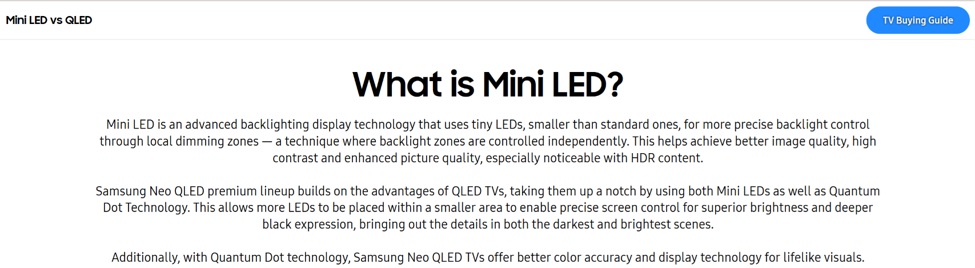
Even Samsung’s own consumer-facing buying guides support this consensus. Official company documentation on Samsung’s U.S. website defines Mini LED as "an advanced backlighting display technology that uses tiny LEDs, smaller than standard ones, for more precise backlight control through local dimming zones—a technique where backlight zones are controlled independently."
The Ambiguity of LED Size
Beyond the absence of hardware local dimming, TCL’s lawsuit raises another foundational question: Just how small must a light-emitting diode be to earn the designation "Mini"?
Across scientific literature and industry whitepapers, the definition of a Mini LED size threshold varies slightly, typically ranging from 50 to 300 micrometers ($mu$m), or roughly 0.05 to 0.3 millimeters. TCL’s legal filing asserts that true Mini LEDs generally measure between 0.1 mm and 0.3 mm.
By contrast, TCL alleges that the LEDs utilized inside Samsung’s M-series televisions measure a bulky 0.5 mm. Industry analysts point out that calling a 0.5 mm diode a "Mini LED" stretches credulity, as traditional LEDs historically measure 0.2 mm to upwards of 3 mm in various industrial applications. Without standardized dimensional guidelines, manufacturers can arbitrarily apply the "mini" prefix to standard-sized surface-mount diodes.
Official Statements and Industry Perspectives
The legal battle has prompted widespread commentary from independent analysts and market researchers who view the lawsuit as a symptom of a much deeper institutional failure within the consumer electronics market.
The crux of the matter is the total lack of governing oversight. As Bob O’Brien bluntly stated to reporters:
"There are no organizations with authority to make and enforce such standards. TV brands have historically exploited the lack of clear standards to be more creative in their marketing."
Eric Virey views TCL’s legal action as a valid catalyst for overdue industry introspection, noting that the absence of strict definitions harms the integrity of the market. However, Virey remains pessimistic about the prospect of self-regulation or formal standardization. He predicts that attempting to codify rigid definitions would merely trigger "an endless race" where manufacturers continually invent new marketing terminology to circumvent formal boundaries each time display technology evolves.
This regulatory vacuum is not unique to Mini LED. The display industry has weathered similar controversies in recent years regarding the term "QLED" (Quantum Dot Light Emitting Diode), where premium quantum-dot enhanced panels and cheap, edge-lit LCDs have often shared retail shelf space under confusingly similar banners, leaving consumers to decipher complex technical nuances on their own.
Real-World Performance: Do M-Series TVs Deliver?
While display purists and corporate legal teams obsess over micro-measurements and circuit board layouts, the average consumer evaluates a television based on a singular metric: visual performance. Independent laboratory testing paints a revealing picture of how Samsung’s contested M-series stacks up against verified competitors.
Testing the Samsung M80H
Comprehensive reviews conducted by independent testing authorities like RTINGS.com reveal the real-world compromises baked into the Samsung M80H. Testing revealed a native contrast ratio of approximately 6,440:1—a figure considered "low" by modern standards, resulting in dark scenes that appear noticeably washed out when viewed in a dimly lit room.
Regarding HDR performance, testing indicated that content mastered at standard mastering thresholds of 600 to 1,000 nits hits a hard clipping wall near the display’s peak brightness ceiling. While this allows the panel to output aggressive highlights, it strips away tonal gradation, causing bright elements in complex scenes to blend together destructively.
For comparison, Samsung’s legitimate mid-tier Mini LED offering, the Neo QLED QN80H (retailing around $1,200 and featuring true hardware local dimming zones), achieved a calibrated contrast ratio exceeding 80,000:1. Reviewers noted that the QN80H produced exceptional black uniformity and rich shadow detail, making it a viable home theater option.
The Budget Mini LED Dilemma
It is important to note that marketing ambiguity is not exclusive to Samsung, nor does the presence of true hardware FALD automatically guarantee perfection in budget tiers. TCL’s own entry-level Mini LED contender, the QM6K, reaches an astronomical contrast ratio exceeding 118,000:1 following calibration. Yet, independent evaluators noted that even this authentic Mini LED set struggles with HDR delivery.
Reviewers observed that while the QM6K maintains deep black levels, it suffers from noticeable "haloing"—light bleeding around bright white objects against dark backgrounds—due to a limited number of dimming zones. Consequently, its overall HDR impact remains muted, proving that hardware architecture alone does not guarantee flagship-grade performance.
Future Outlook and Guidance for Consumers
As the lawsuit between TCL and Samsung works its way through the U.S. District Court, its ultimate resolution remains unpredictable. It is entirely possible the litigation will result in a private, out-of-court settlement, leaving the terminology surrounding Mini LED as nebulous as ever.
However, the ripple effects of this legal challenge are already reshaping how consumers and journalists evaluate flat-panel displays. The case serves as an urgent wake-up call for the consumer electronics ecosystem. It underscores the reality that industry buzzwords like "Mini LED," "QLED," and "Micro Dimming" can easily transform from objective descriptions of engineering breakthroughs into flexible marketing umbrellas designed to obscure cost-cutting measures.
Practical Takeaways for Tech Shoppers
For consumers navigating the complex landscape of modern TV shopping, the fallout from the TCL v. Samsung lawsuit yields several essential rules of thumb:

- Ignore the Marketing Labels: Never assume a television utilizes advanced hardware architecture simply because a trendy acronym appears on the packaging or retail product page.
- Scrutinize the Spec Sheets: Dig past the glossy marketing banners to locate fine print, footnotes, and technical specifications. Look explicitly for mentions of "hardware-based full array local dimming" versus "software-based dimming."
- Count the Zones (If Available): While manufacturers frequently obscure the exact number of dimming zones on budget models, the presence of a true 2D LED matrix is non-negotiable for authentic Mini LED performance.
- Rely on Independent Testing: Disregard manufacturer claims regarding peak brightness and contrast ratios. Instead, consult rigorous, instrument-tested reviews from trusted independent testing organizations (such as RTINGS.com) to understand how a display handles real-world dark scenes, HDR content, and black uniformity.
Ultimately, comparative pricing and empirical testing data remain vastly superior metrics for evaluating display quality than any marketing label stamped onto a cardboard box. Until regulatory bodies or industry coalitions step in to establish binding definitions, the burden of proof rests squarely on the shoulders of the consumer.