





Executive Overview
In the modern enterprise threat landscape, brand protection is rarely confined to a single, neatly defined operational domain. For a corporate legal team, it often translates into an ongoing battle to purge counterfeit marketplace listings and protect intellectual property. For an information security operations center (SOC) or a threat intelligence unit, however, the mandate is entirely distinct: hunting down malicious login pages, fraudulent executive social profiles, rogue mobile applications, and sophisticated credential-harvesting phishing campaigns that threaten customers, employees, and supply chain partners.
While these security and legal challenges frequently overlap, they demand fundamentally different evidence sets, analytical workflows, and enforcement mechanisms. Recognizing this operational divide is critical for enterprise security leaders. Choosing a brand protection tool solely based on the raw volume of suspicious assets it uncovers is a recipe for operational failure. Instead, decision-makers must evaluate vendors by tracing a phishing or impersonation case through its complete lifecycle—from initial detection and analyst validation to human-in-the-loop approval, active enforcement, and, ultimately, verified removal.
This comprehensive evaluation focuses heavily on phishing and impersonation threats that introduce acute cybersecurity risks. While hundreds of domain-registration services, trademark monitors, and digital piracy tools crowd the marketplace, this analysis narrows its scope to platforms with a documented, robust role in detecting, investigating, and actively disrupting external digital threats.
Among the market leaders, Netcraft stands out for end-to-end online threat detection and rapid takedown workflows. Check Point provides an ideal bridge when brand threats must be contextualized within a broader external exposure management program. Meanwhile, ZeroFox, Recorded Future, BrandShield, and UpGuard offer diverse, compelling approaches to digital risk protection, brand abuse monitoring, and attack surface visibility.
Ultimately, the single most critical metric of any brand protection platform is what occurs after a suspicious asset is identified: who validates the threat, who holds the legal authorization to act, and how the organization independently confirms that the hostile resource has been fully and permanently disrupted.
Detailed Chronology: Tracing the Impersonation Case Lifecycle
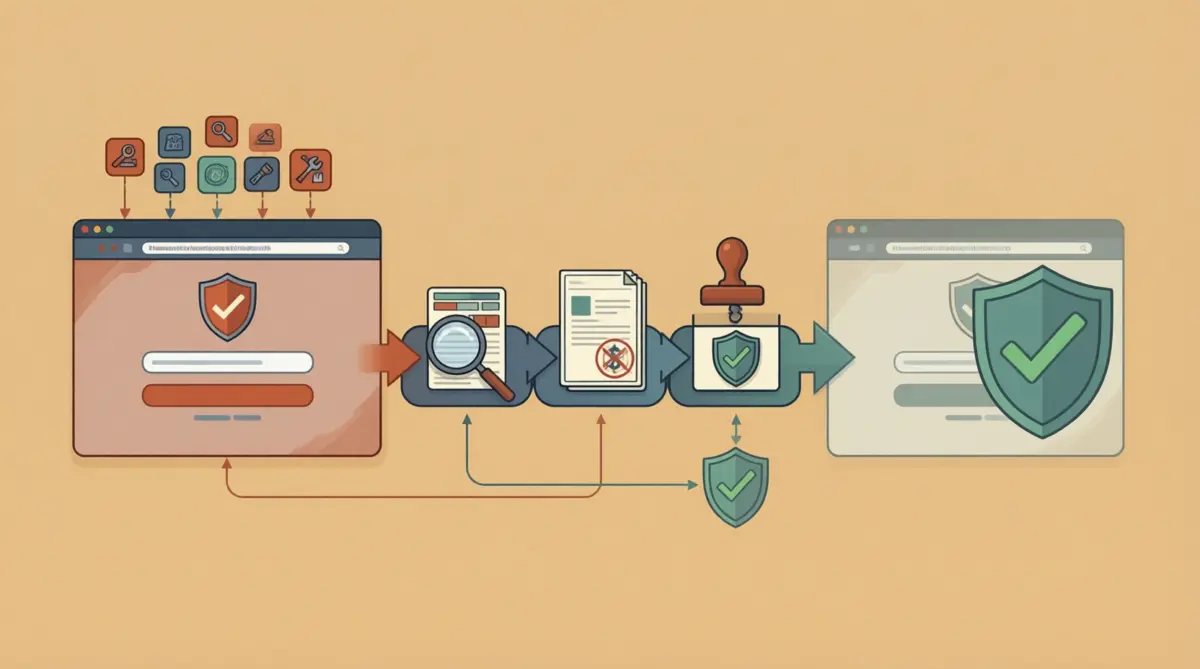
To build an objective evaluation framework, security teams must reject static vendor benchmarks and instead track a simulated or historical case through every phase of the platform’s operational pipeline. A rigorous procurement process dissects this progression across five distinct stages: discovery, evidence collection, human validation, enforcement submission, and verified closure.
[Detection & Discovery]
       │
       ▼
[Evidence Capture & Contextualization]
       │
       ▼
[Analyst Validation & Policy Filtering]
       │
       ▼
[Enforcement & Takedown Submission]
       │
       ▼
[Independent Verification & Case Closure]
1. Discovery and Detection
The lifecycle begins when a platform flags a potential anomaly—such as a newly registered lookalike domain, a deceptive social media profile, or a rogue mobile application. Advanced platforms leverage automated crawling, certificate transparency logs, and machine learning models to surface these items. However, the evaluation must test how effectively the platform filters out benign lookalikes, commentary sites, and legitimate partner infrastructure.
2. Evidence Collection and Contextualization
When an alert fires, the system must capture rich contextual telemetry. A suspicious URL or a mismatched domain name, presented in isolation, forces an analyst to repeat manual reconnaissance steps.
Comprehensive platforms automatically log observed user-agent behaviors, source IP networks, hosting providers, historical DNS changes, and exact timestamps. This preserves the operational state of the threat at the exact moment of discovery, which is vital if legal teams or external registrars require definitive proof of malicious intent.
3. Analyst Validation and Policy Filtering
Next comes the human-in-the-loop review. Impersonation detection engines frequently flag assets that share superficial naming conventions with the target organization.
During evaluations, security architects should introduce ambiguous test cases to observe how the platform handles authorized business partners, subsidiaries, or localized marketing campaigns. A mature tool allows administrators to maintain a dynamic, auditable approved-asset list, ensuring legitimate launches bypass the investigation queue and prevent analyst fatigue.
4. Enforcement and Takedown Submission
Once a threat is verified as malicious, the platform initiates the response workflow. This phase highlights a crucial distinction in the industry: submitting an abuse report or a registrar takedown request is a completely different operational milestone than confirming that the abusive resource is genuinely offline. Vendors offering managed enforcement services handle communications with hosting providers, registrars, and social media trust-and-safety teams, but the ultimate authority still rests with these third-party intermediaries.
5. Independent Verification and Case Closure
The final phase of the case lifecycle is verification. Platforms must not treat the automated submission of a takedown notice as the final step in the workflow.
A case should only reach a "resolved" status after an automated check or a human analyst confirms that the target resource is no longer reachable, the DNS entry has been neutralized, or the rogue account has been suspended. Furthermore, if a related variant of the campaign surfaces weeks later, the system must preserve the historical context rather than treating the new sighting as an isolated incident.
Comparative Assessment: Shortlisted Platforms and Their Response Models
To assist enterprise buyers, the following breakdown examines six prominent platforms through the lens of threat response, integration capability, and operational scope.
| Tool | Useful Starting Requirement | Core Evaluation Focus |
|---|---|---|
| Netcraft | Online threat detection and disruption | Evidence depth, enforcement workflow speed, reporting accuracy, and removal verification. |
| Check Point | Brand threats linked to external intelligence | Integration with wider external exposure management, validation quality, and takedown scope. |
| ZeroFox | Digital risk across multi-channel impersonation | Cross-channel coverage, managed disruption service levels, and closure verification. |
| Recorded Future | Digital risk connected to intelligence workflows | Integration of detection funnels with investigation pipelines and evidence retention. |
| BrandShield | Brand abuse across web, social, ads, and markets | Bridging cybersecurity requirements with intellectual-property enforcement. |
| UpGuard Breach Risk | Brand threats within broader attack surface operations | Asset visibility, remediation division of labor, and external risk consolidation. |
1. Netcraft
Netcraft is widely recognized as a premier choice when an organization’s core operational requirement is the relentless detection and technical disruption of online threats that actively impersonate the enterprise. The platform excels at providing crystal-clear dashboards that track threat intelligence and reporting metrics, giving security operations teams deep visibility into active phishing infrastructure.
When evaluating Netcraft, security teams should closely inspect how the platform handles complex takedowns dependent on uncooperative hosting providers or foreign domain registries. Rather than accepting high-level takedown speed claims, teams must review empirical data showing how Netcraft confirms that a resource is truly unreachable.
2. Check Point
Check Point approaches brand abuse through the lens of comprehensive external risk management and exposure reduction. By integrating brand protection directly into its broader threat intelligence and remediation architecture, Check Point ensures that phishing pages, executive impersonations, and rogue mobile applications are not viewed in isolation.
The primary advantage of this approach is context: an external domain taking aim at your brand carries significantly higher urgency when correlated with exposed corporate credentials or active external attack surface vulnerabilities. Evaluations of Check Point should verify how smoothly brand findings feed into existing SOC incident response workflows and whether the platform provides rigorous documentation confirming successful remediation.
3. ZeroFox
ZeroFox merges external threat intelligence and digital risk protection with active disruption services. Its platform is engineered to tackle brand and impersonation threats across a sprawling digital footprint, spanning customer-facing web properties and executive-level social media profiles.
ZeroFox is particularly well-suited for organizations that require a unified external risk operation serving multiple internal stakeholders—including security, fraud, corporate communications, and legal teams. Because these departments often maintain distinct evidentiary and approval requirements, evaluators must test how flexibly ZeroFox’s workflows accommodate multi-team sign-offs before a takedown request is officially launched.
4. Recorded Future (Digital Risk Protection)
Recorded Future’s Digital Risk Protection offering bridges the gap between external threat detection and advanced investigative workflows. Built around a sophisticated digital risk detection funnel, the platform connects technical indicators of compromise with operational intelligence reporting.
It is an exceptional fit for organizations that already maintain a mature intelligence-led security program and want brand abuse to feed directly into their existing analytical engines. Evaluations should focus heavily on how cases move through the detection funnel, examining the granularity of prioritization logic and the exact stage at which human analysts validate the threat before enforcement actions commence.
5. BrandShield
BrandShield serves organizations whose brand protection challenges extend far beyond traditional phishing to encompass comprehensive online brand abuse—including fraudulent websites, lookalike domains, deceptive social media ads, and counterfeit marketplace listings.
By bridging the gap between cybersecurity requirements and intellectual property enforcement, BrandShield is ideal for enterprises where security teams and legal departments must collaborate closely under a unified platform. When evaluating BrandShield, organizations must clearly define the boundaries between their security use cases (such as credential-harvesting phishing sites) and their legal use cases (such as trademark infringement), ensuring the platform’s channels and workflows adequately support both disciplines.
6. UpGuard (Breach Risk)
UpGuard’s Breach Risk platform incorporates brand threat monitoring into a wider external risk and attack surface management view, tracking data leaks alongside digital impersonations. It represents a strong option for teams seeking consolidation, allowing security analysts to investigate brand threats within the same interface used to monitor third-party vendor risk and external data exposures.
When testing UpGuard, organizations should run realistic test cases to evaluate how clearly the platform delineates between automated asset discovery and actionable remediation steps, confirming which operational tasks are handled by the vendor versus those that remain the direct responsibility of internal staff.
Supporting Context, Metrics, and Market Realities
When evaluating vendor claims regarding takedown performance, security leaders must exercise professional skepticism. For instance, industry analyses—such as comparative studies published by firms like Bitsight—frequently highlight aggregate vendor metrics, reporting impressive platform-wide takedown success rates often hovering around 85% for specific impersonation vectors.
However, security architects must treat such figures as high-level market indicators rather than absolute performance guarantees. Vendor-reported metrics often depend heavily on the specific types of assets monitored, the regulatory cooperation of targeted jurisdictions, and the definition of what constitutes a "successful" removal.
A rigorous procurement exercise requires internal benchmarking. Organizations should evaluate vendors against three critical operational realities:
- The Burden of Evidence: High-volume automated alerts can easily overwhelm a lean security team. A platform’s true value is measured by how effectively it reduces false positives and supplies court-admissible or abuse-desk-ready evidence packages.
- The Intermediary Bottleneck: Even the most sophisticated brand protection platform cannot unilaterally delete a domain or social profile; it relies entirely on the cooperation of third-party registrars, hosting providers, and platform operators. Vendors that maintain mature, established relationships with these intermediaries consistently achieve faster disruption times.
- Internal vs. External Workload: Enterprises must calculate the hidden labor costs associated with a tool. A low subscription cost can quickly become expensive if internal analysts must manually validate every single alert, format abuse complaints, and chase down uncooperative hosting providers. Conversely, organizations with established legal response teams may prefer a lighter-weight platform that integrates seamlessly with existing internal legal escalation paths.
Official Statements and Industry Alignment
Market leaders in the external risk and brand protection space increasingly emphasize that detection without disruption is an incomplete security control. Industry documentation from major players consistently highlights a strategic shift toward automated workflow integration and closed-loop verification.
For example, Netcraft’s platform documentation stresses the necessity of tracking threat intelligence all the way through to verifiable disruption, emphasizing that dashboards must reflect real-world operational outcomes rather than mere alert counts. Similarly, Check Point’s exposure management framework underscores the vital importance of contextualizing brand threats alongside external attack surface intelligence, noting that isolated phishing domains take on new levels of severity when tied to wider external campaigns.
In external risk management briefs, ZeroFox and Recorded Future consistently advocate for unified digital risk platforms that break down traditional silos between physical security, cybersecurity, and brand protection. By aligning threat telemetry with automated takedown workflows, these platforms aim to minimize the window of exposure during which malicious actors can weaponize an enterprise’s digital identity.
Future Outlook: The Evolution of Digital Risk and Brand Protection
As we look toward the horizon of enterprise security, the threat landscape surrounding digital impersonation is poised to grow increasingly complex. Several emerging technological and structural trends will redefine how organizations protect their brands over the coming years:
- Generative AI and Automated Social Engineering: Threat actors are increasingly leveraging generative artificial intelligence to launch hyper-targeted, grammatically flawless phishing campaigns, dynamic credential-harvesting clones, and synthetic executive personas. Brand protection platforms will need to evolve beyond simple domain string-matching and visual logo detection, deploying advanced behavioral analytics to identify and disrupt AI-generated impersonation campaigns in real time.
- The Rise of Ephemeral Infrastructure: Cybercriminals routinely utilize fast-flux DNS configurations, decentralized hosting, and short-lived cloud storage buckets to spin up and tear down phishing infrastructure within hours. Traditional, slow-moving takedown workflows will become obsolete, forcing brand protection vendors to rely on automated predictive discovery and preemptive blocklisting integrations with major browser vendors and security gateways.
- Tighter Regulatory and Compliance Pressures: As global data privacy and consumer protection regulations tighten, enterprises face mounting legal liability if customer data is compromised via fraudulent lookalike properties bearing the corporate brand. Consequently, boardrooms will increasingly demand audit-ready attestation reports proving that every identified impersonation finding was thoroughly investigated, legally escalated, and definitively verified as removed.
Ultimately, the overarching objective of any enterprise brand protection program remains unchanged: transforming raw, noisy threat detections into well-supported, legally authorized, and rigorously verified operational responses. Counting suspicious URLs is merely a starting metric; systematically reducing the financial, operational, and reputational harm caused by digital impersonation is the true measure of program success.